
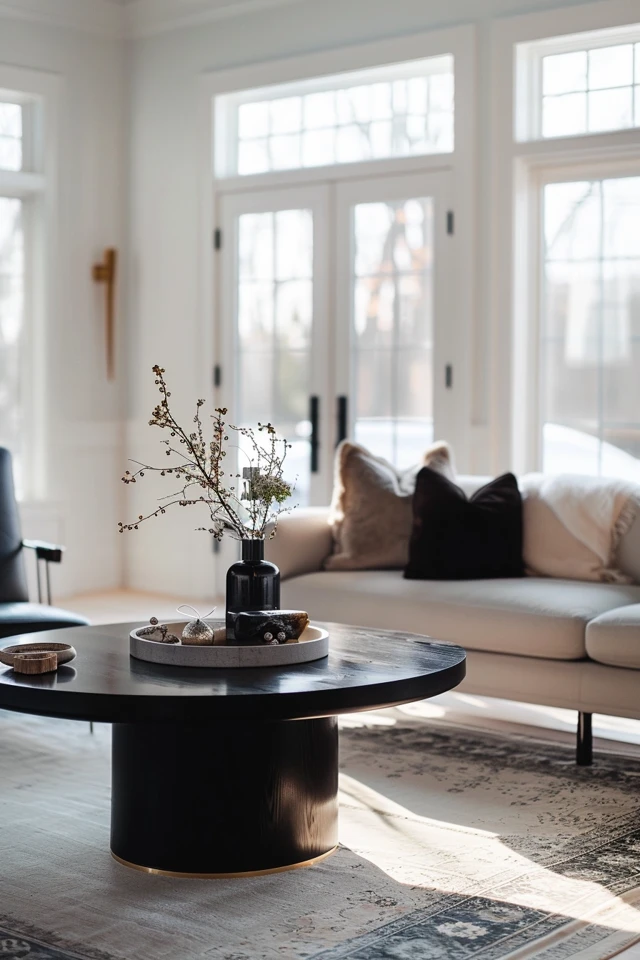
How To Lighten Up A Room With Dark Furniture: Brightening Tips
Dark furniture often feels like a safe, practical choice. A charcoal sectional hides stains, an espresso dining table feels substantial, and a mahogany bookshelf adds instant history to a study. However, without the right supporting elements, these heavy pieces can quickly turn a room into a visual “black hole,” absorbing all the natural light and making the space feel smaller than it actually is.
The goal isn’t to get rid of your dark furniture; it is to manipulate the environment around it to create contrast and balance. You want to make those dark pieces feel intentional and grounded, rather than imposing. It requires a strategic approach to vertical surfaces, lighting temperatures, and textural layering.
If you are looking for visual inspiration, check out our curated Picture Gallery at the end of the blog post.
1. Master the Walls: Paint Colors and Light Reflectance Value (LRV)
The most effective way to counter dark upholstery or wood is through your vertical surfaces. When a client comes to me with a heavy leather sofa or dark walnut cabinetry, the first thing we address is the paint. However, simply painting everything “bright white” can sometimes backfire, making the dark furniture look stark and out of place.
You need to understand Light Reflectance Value (LRV). This is a measurement on a scale of 0 to 100 that tells you how much light a paint color reflects. For rooms with dark furniture, I generally aim for an LRV of 60 to 75. This range provides enough brightness to bounce light around the room but carries enough pigment to hold its own against heavy furniture.
Choosing the Right Undertone
- Creamy Whites and Off-Whites: If your dark furniture has warm undertones (like cherry wood or brown leather), stick to soft whites with yellow or red undertones. A sterile, blue-based white will make brown leather look muddy.
- Cool Grays and Crisp Whites: If your furniture is black, charcoal, or dark navy, you can use cooler whites or very pale grays. This creates a modern, gallery-like contrast that feels intentional.
- The Finish Matters: In darker rooms, I often bump the wall finish up from flat to eggshell or satin. That slight sheen helps reflect artificial light, brightening the corners of the room that lamps don’t reach.
A Note for Renters
If you cannot paint your walls, you have to rely on “removable” brightness. Large-scale wall art with white mats and light frames can mimic the effect of a lighter wall. Peel-and-stick wallpaper in a light, neutral texture like grasscloth can also break up the visual weight of dark shelving units.
2. Strategic Lighting Layers: Beyond the Ceiling Fan
Lighting is where most DIY designs fall short. A single overhead light source casts harsh shadows and creates a “cave effect” when paired with dark furnishings. To lighten a room, you need to wash the walls and ceiling with light, not just the floor.
I recommend a three-layer approach to lighting. This ensures that the dark furniture is illuminated softly, revealing its texture rather than just its silhouette.
The Lighting Triangle
- Ambient Lighting (General): This is your overhead fixture. For rooms with dark furniture, avoid flush mounts that hug the ceiling. Use semi-flush mounts or chandeliers with glass or light fabric shades to diffuse light outward and upward, brightening the ceiling plane.
- Task Lighting (Specific): Floor lamps are your best friend here. Place a floor lamp near the dark sofa or armchair. The key is to choose a lamp with a light-colored shade (white linen or cotton). A black shade directs light only up and down, while a white shade glows, becoming a light source itself.
- Accent Lighting (Mood): This is the secret weapon. Use plug-in sconces or picture lights to illuminate the walls. By directing light at the vertical surfaces, you push the walls out visually, making the room feel larger and airier.
The 3000K Rule
Pay close attention to the color temperature of your bulbs.
- 2700K (Warm White): Cozy, but can cast a yellow tint that makes dark rooms feel stuffy.
- 3000K (Soft White): This is the designer standard. It is crisp and neutral without being blue. It renders colors accurately and makes dark furniture look rich, not dull.
- 5000K (Daylight): Avoid this residential settings. It looks like a hospital and will make dark furniture look harsh.
3. Textile Intervention: Rugs and Window Treatments
If the walls are the backdrop, the floor is the foundation. Placing a dark sofa on a dark hardwood floor or a dark gray carpet creates a “floating” effect where the furniture disappears into the ground. You need to break that visual connection.
The Rug Rules
You need a rug that is significantly lighter than your furniture. It acts as a visual separator.
- Scale is Critical: Do not use a postage-stamp rug. All front legs of your seating furniture should sit on the rug. Ideally, the rug should extend 6 to 10 inches beyond the sides of the sofa. This creates a defined “island” of lightness.
- Material Selection: Natural fibers like jute, sisal, or wool blends in oatmeal, cream, or light gray are excellent choices. They add texture without competing for attention.
- Durability Concerns: Clients often worry about light rugs and pets. If you have a dog or kids, look for a light rug with a subtle, erratic pattern or a “heathered” weave. It hides lint and spots much better than a solid cream rug.
Window Treatments
Your curtains should frame the view, not block the light.
- Hang High and Wide: Install your curtain rod 4 to 6 inches above the window frame (or just below the ceiling molding) and extend it 10 to 12 inches past the window on each side.
- The “Stack back”: When the curtains are open, they should rest against the wall, not cover the glass. This maximizes every square inch of natural light.
- Fabric Choice: Avoid heavy velvet drapes in small, dark rooms. Opt for unlined linen or light-filtering cotton in white or light neutral tones. This maintains privacy while letting sunlight filter through.
4. The Power of Reflection: Mirrors and Metallics
Mirrors are the oldest trick in the designer handbook, but placement is everything. A mirror simply reflects what is opposite it. If you hang a mirror opposite your dark bookcase, you have just doubled the amount of dark furniture in the room.
To lighten a room, you must hang mirrors opposite a light source. This could be a window or a lamp. When positioned correctly, a mirror acts as a secondary window, bouncing sunlight deep into the room.
Metallic Accents
Dark furniture usually has a matte or satin finish (leather, wood, upholstery). To counter this heavy absorption of light, introduce reflective metals.
- Warm Metals: Brass and gold tones warm up the space and look sophisticated against navy or black furniture.
- Cool Metals: Chrome and polished nickel offer high-contrast sparkle and look crisp against dark wood.
Try a glass coffee table with metal legs. The glass top allows you to see the light rug underneath, reducing visual clutter, while the metal legs catch the light.
5. Biophilic Design: Breathing Life into the Space
Dark furniture can sometimes feel sterile or imposing. Introducing organic elements softens the edges and bridges the gap between the dark pieces and the light walls.
Greenery is a Neutral
Plants are essential in rooms with dark furniture. The green vibrance pops against dark leather or wood.
- Variegated Leaves: Choose plants with dual-colored leaves to add brightness. Snake plants (Sansevieria) often have yellow edges, and a Variegated Rubber Plant has splashes of cream and pink.
- Placement: Place a large potted tree next to a dark media console. The organic shape breaks up the boxy, heavy lines of the furniture.
Light Wood Accents
If your main furniture is dark espresso or black, introduce smaller accent pieces in lighter woods like white oak, ash, or birch. A light wood side table or a woven basket creates a “middle tone” that helps the eye transition smoothly from the dark sofa to the white walls, rather than experiencing a jarring contrast.
Designer’s Note: The “Black Leather” Lesson
I once worked with a couple who had inherited a massive, high-quality black leather sectional. They felt the room was depressing and were ready to sell the sofa at a loss. They kept buying dark red throw pillows and dark rugs, thinking they needed to match the “moodiness” of the sofa.
The mistake was leaning into the darkness rather than balancing it. We didn’t change the sofa. Instead, we painted the beige walls a crisp white (Benjamin Moore Chantilly Lace), laid down a large chunky wool rug in a heathered cream, and swapped the dark heavy curtains for sheer linen panels.
Suddenly, that black sofa became the anchor of a chic, modern room rather than a black hole. The contrast is what makes the design work. Don’t be afraid of the light.
Common Mistakes + Fixes
Mistake: Using small, dark throw pillows on a dark sofa.
The Fix: Use pillows in lighter shades that relate to your wall color or rug. Vary the textures—boucle, linen, and chunky knits reflect light differently than flat cotton.
Mistake: Relying on a single ceiling light fixture.
The Fix: Add at least two other light sources at eye level (table lamps or floor lamps). This reduces shadows in the corners.
Mistake: Pushing all dark furniture against the walls.
The Fix: Pull the furniture off the walls by just 3 to 4 inches. It creates a shadow line that suggests airiness and flow, rather than a cramped feeling.
What I’d Do in a Real Project (Mini-Checklist)
If I were walking into your home today to fix a dark room, here is the order of operations I would follow:
- Step 1: Assess the floor. If it is dark, order a light-colored rug immediately. This offers the biggest visual impact for the money.
- Step 2: Audit the light bulbs. Swap everything to 3000K LEDs.
- Step 3: Declutter dark accessories. Remove dark picture frames, dark vases, and dark throws. Replace them with glass, ceramic, or metallic alternatives.
- Step 4: Add a mirror. Find the wall opposite the biggest window and hang a large mirror there.
- Step 5: Style the sofa. Add a light-colored throw blanket draped over the back or arm of the sofa to break up the large block of dark color.
Final Checklist: Brightening Your Space
Use this summary to ensure you have covered all the bases.
- Walls: Painted in a light hue with an LRV of 60+ (or brightened with art).
- Floors: Large, light-colored area rug placed under the front legs of furniture.
- Lighting: Three layers of light (overhead, task, accent) using 3000K bulbs.
- Windows: Curtains hung high and wide to maximize glass exposure.
- Decor: Mirrors placed opposite light sources; metallic accents used for reflection.
- Nature: Plants with variegated leaves added for organic texture.
FAQs
Can I mix different wood tones if my furniture is dark?
Absolutely. In fact, it is encouraged. A room with only one wood tone looks flat and showroom-like. If you have dark walnut tables, mix in lighter oak or wicker accents. The key is to keep the undertones (warm vs. cool) consistent, but vary the darkness.
What if I have dark furniture in a small room?
Scale is your priority here. Keep the furniture profile low. A low-back dark sofa blocks less light than a high-back one. Use “invisible” furniture for accent pieces, such as acrylic or glass coffee tables, to reduce visual clutter.
How do I keep light rugs clean with kids and pets?
Avoid solid colors. Look for rugs with a “heathered” look, subtle geometric patterns, or natural variations (like jute or wool blends). Indoor-outdoor rugs have come a long way in terms of softness and can be scrubbed or even bleached in some cases.
Does the ceiling color matter?
Yes. Always paint the ceiling a flat bright white, even if your walls are a soft cream. This reflects the most amount of light from your lamps back down into the room. A dark ceiling will cap the room and make it feel significantly smaller.
Conclusion
Living with dark furniture does not mean you are destined to live in a cave. These pieces provide a wonderful sense of grounding and durability that lighter furniture often lacks. By strategically adjusting the surrounding elements—the paint, the lighting temperature, and the textiles—you can create a space that feels bright, airy, and sophisticated.
It is all about balance. Let your dark furniture be the bass note in the song, while your walls, rugs, and lighting provide the melody. With a few intentional tweaks, you can transform the mood of your home completely.
Picture Gallery


