
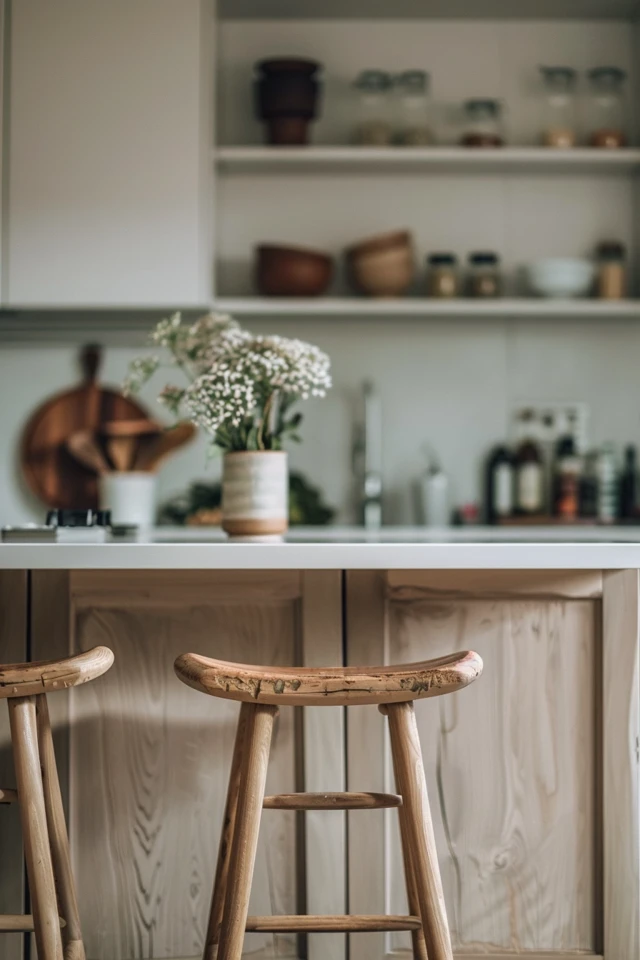
How To Match Old Cabinets With New: Blending Styles
One of the most frequent challenges I encounter in kitchen renovations is the partial update. You might have a sturdy set of vintage oak perimeter cabinets that are functionally sound, but you need an island for better workflow. Or perhaps you are knocking down a wall to expand the kitchen and need to fill the new gap with storage that doesn’t scream “I was bought twenty years later.”
Tearing out perfectly good cabinetry feels wasteful and costs a fortune, but getting new boxes to sit next to the old ones without looking disjointed is a legitimate design hurdle. It requires a specific strategy that balances material assessment with visual trickery. You cannot simply guess the stain color at the hardware store and hope for the best.
The secret lies in deciding whether you are going for a seamless camouflage or an intentional design statement. If you are looking for visual inspiration on how to pull this off, check out the Picture Gallery at the end of the blog post.
Step 1: The Forensic Assessment of Your Current Cabinets
Before you buy a single new box, you need to understand exactly what you currently own. In my design practice, I see homeowners buy “Shaker style” doors thinking they will match, only to realize later that their rail-and-stile widths are completely different.
Start by measuring the “reveal” of your current cabinets. This refers to how much of the face frame is visible when the door is closed. Older cabinets (pre-2000s) often have a partial overlay or a standard overlay, leaving about an inch of the frame visible. Modern cabinets usually feature a full overlay, where the doors cover the entire frame. Mixing these two construction styles is the fastest way to make a kitchen look accidental.
Next, identify the wood species and grain pattern. Oak has a very open, heavy grain texture that you can feel with your fingertip. Maple and birch are tight-grained and smooth. If your old cabinets are oak and you buy smooth maple cabinets to paint, the texture difference will be obvious even under three coats of paint. You must match the texture, even if you plan to change the color.
Step 2: The “Near-Match” vs. The “Intentional Contrast”
There is a concept in robotics called the “Uncanny Valley,” where something looks almost human but not quite, making it unsettling. The same rule applies to cabinetry. If you try to stain new maple cabinets to match aged cherry cabinets, you will likely fail. Wood oxidizes and changes color over time; ambering is a natural process that a fresh can of stain cannot replicate perfectly.
If you cannot get a 100% match, do not attempt a 95% match. It will look like a mistake. Instead, I recommend the “Intentional Contrast” approach. This is often called a tuxedo kitchen or a two-tone design.
If your existing perimeter cabinets are a stained wood, consider installing the new cabinets in a painted finish. For example, honey oak perimeter cabinets pair surprisingly well with a deep navy blue or charcoal island. This tells the eye that the difference is a design choice, not a renovation error.
Designer’s Note: The “Bridge” Method
In a recent project, we had to keep existing white thermofoil cabinets but added a new pantry wall. The whites didn’t match—the old ones had yellowed.
To fix this, we painted the new pantry wall a soft “greige” (gray-beige). We then added a runner rug that contained both the creaminess of the old cabinets and the greige of the new ones. The rug acted as a bridge, tying the two distinct tones together on the floor level.
Step 3: Unifying Through Hardware and Trim
If the cabinet boxes are the canvas, the hardware and molding are the frame that holds the picture together. You can mix cabinet styles, but you should rarely mix hardware styles within the same sightline.
Remove all the old knobs and pulls. Buy enough new hardware for both the old and new cabinets. When the eye scans the room, it picks up on the rhythm of the metal finishes. If every door features the same matte black pull, the brain perceives the cabinetry as a unified set, even if the door styles vary slightly.
Crown molding is another powerful unifying tool. If possible, remove the existing molding from the old cabinets and run a continuous piece of new molding across the tops of both the old and new sections. This physical connection bridges the gap and makes the new installation feel built-in rather than tacked on.
Step 4: Managing Dimensions and Layout
When integrating new units, scale is critical. Old cabinets were often built to different standard heights or depths than modern stock options.
Standard lower cabinets are 34.5 inches tall (without countertops) and 24 inches deep. However, custom vintage cabinets might be 23 inches deep or 33 inches tall. If you place a new standard cabinet next to an old custom one, your countertop will not sit level.
Common Mistakes + Fixes
- Mistake: Assuming the floors are level when joining old and new banks of cabinets.
Fix: Always use shims. Find the highest point in the floor and level the new cabinets to that height. You may need to add shoe molding to the bottom of the old cabinets to hide gaps if the new installation requires raising the height.
- Mistake: Ignoring the “Toe Kick.”
Fix: Older cabinets might have a flush bottom or a shallow toe kick. Modern standards are usually 3.5 to 4 inches high and 3 inches deep. Paint all toe kicks the same dark color (like black or dark gray) to make them recede visually, hiding the structural difference.
Step 5: The Power of Countertops
The countertop is the ultimate equalizer. If you are keeping old cabinets and adding new ones, I strongly advise replacing the countertops across the entire surface if your budget allows.
A single slab of quartz or granite running across both the old and new cabinets physically ties them together. The eye follows the horizontal plane of the counter more than the vertical plane of the doors.
If you cannot replace all countertops, use the “zone” method. Keep the old laminate on the perimeter, but put a butcher block on the new island. Butcher block is cost-effective, adds warmth, and makes the island feel like a piece of furniture rather than a mismatched cabinet.
Step 6: Paint Techniques for Blending
If you decide to paint everything to match, preparation is the difference between a pro finish and a peeling mess. You are likely dealing with two different substrates: the old finish (polyurethane or varnish) and the new raw wood or pre-primed surface.
You cannot use the same primer for both. For the old cabinets, you must degrease them thoroughly with TSP (Trisodium Phosphate) and use a high-bond primer designed for glossy surfaces. For the new raw wood, a standard wood primer is sufficient.
Once primed, however, you can use the same topcoat. I recommend a self-leveling alkyd enamel. It dries harder than standard latex and mimics the smooth finish of a factory spray. Keep the sheen consistent. Satin or semi-gloss is best for kitchens; flat paint is too hard to clean, and high-gloss highlights every dent in the old doors.
What I’d Do in a Real Project (Mini Checklist)
If I walked into your house today to solve this, here is my order of operations:
- Map the gap: Measure the exact gap between the existing cabinet and the wall. If it’s not a standard size (e.g., 17 inches), I would buy a 15-inch cabinet and use a 2-inch “filler strip” to bridge the gap seamlessly.
- Check the hinge direction: Ensure the new doors open in a logical direction for the workflow, regardless of how the old ones opened.
- Lighting check: I would replace the bulbs in the room with 3000K LEDs. Old incandescent bulbs make wood look orange; cool daylight bulbs make it look blue. Neutral light helps you see if your colors actually blend.
- The “distraction” layer: I would install a backsplash that draws the eye upward, away from the transition point between old and new cabinets.
Step 7: Handling Grain and Texture Differences
As mentioned earlier, texture is the silent killer of a cohesive look. If you are painting oak cabinets to match new MDF or maple cabinets, the grain of the oak will show through the paint.
To solve this, you have two choices. The first is to accept it and call it “character.” The second is to use a grain filler on the oak cabinets before priming. This is a paste that fills the pores of the wood. It is labor-intensive—you have to trowel it on and sand it off—but it is the only way to get a glass-smooth finish on oak.
Conversely, if you love the grain of your old cabinets and want the new ones to match, do not buy smooth maple. Buy oak. Even if the new oak is lighter, you can experiment with gel stains to darken it to match the aged patina of the existing cabinetry.
Final Checklist for Blending Cabinets
Before you commit to your renovation, run through this list to ensure you haven’t missed a critical detail.
- Door Style Match: Are the rail and stile widths within 1/4 inch of each other?
- Overlay Check: Are both old and new cabinets Full Overlay or Standard Overlay?
- Hinge Visibility: Do the old cabinets have exposed hinges? If so, try to find decorative exposed hinges for the new ones, or upgrade the old ones to hidden Euro-style hinges (requires drilling).
- Toe Kick Height: Have you measured the toe kick height to ensure the baseboards will align?
- Hardware Count: Do you have enough matching handles for every single door and drawer?
- lighting Consistency: Is the under-cabinet lighting the same temperature on both banks of cabinets?
Frequently Asked Questions
Can I just replace the doors to make them match?
Yes, this is called refacing. If your old cabinet boxes are structurally sound, you can buy brand new doors for the old boxes and the new boxes simultaneously. This guarantees a perfect match but is more expensive than just painting.
How do I match the height if my old cabinets are short?
If your old cabinets are 33 inches tall and new ones are 34.5 inches, build a platform for the old cabinets using 2×4 lumber. Remove the countertop, lift the cabinets, slide the platform underneath, and reinstall. Cover the gap with new toe kick trim or baseboard.
Is it okay to mix wood stains?
Yes, but be careful with undertones. Do not mix a red-based wood (like Cherry or Mahogany) with a yellow-based wood (like Honey Oak). It creates visual friction. You can mix a neutral dark walnut with almost anything, but keep the warm/cool undertones consistent.
Should I buy custom or stock cabinets to match?
If you are filling a specific gap, stock cabinets usually require filler strips. Custom cabinets can be built to the exact inch, maximizing storage. If the budget allows, custom is easier to install because you don’t have to hack the fitting, but stock is significantly cheaper.
Conclusion
Matching old cabinets with new ones is less about finding a molecular duplicate and more about creating a cohesive narrative. By focusing on the unifying elements—hardware, countertops, and molding—you can trick the eye into seeing a single, thoughtful design rather than a piecemeal renovation.
Be honest about the condition of your current cabinets. If they are falling apart, no amount of blending will save them. But if they have good “bones,” a strategic addition of new cabinetry can transform your kitchen’s functionality without the price tag of a full gut renovation. Take your time with the measurements, respect the grain, and when in doubt, use contrast to your advantage.
Picture Gallery


