
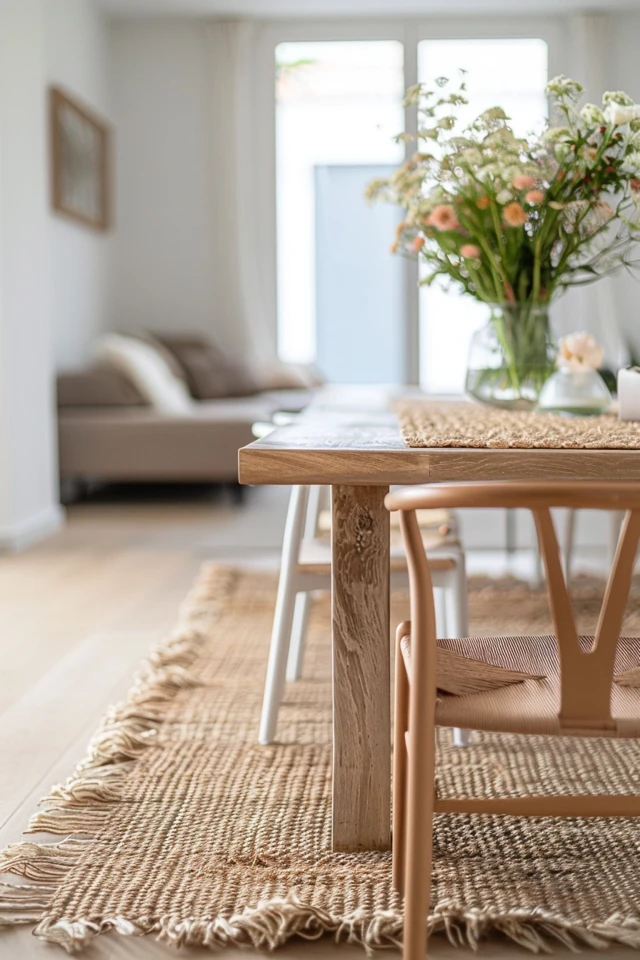
How To Measure Rug Size For Dining Table: Perfect Fit
Dining rooms are often the heart of the home, but they are also the trickiest to furnish correctly due to moving parts. The relationship between your dining chairs, the table, and the rug is a mechanical one, not just an aesthetic one. If the rug is too small, your guests will trip every time they stand up.
Getting the size right requires ignoring standard labels like “8×10” initially and focusing entirely on your specific furniture footprint. You need to account for the table at its largest size, plus the clearance required for human movement. For visual inspiration on how different sizes impact a room, make sure to look at the Picture Gallery is at the end of the blog post.
In this guide, I will walk you through the exact math I use for client projects to ensure the dining space feels grounded and functions seamlessly. We will cover the “chair slide” rule, material selection for high-traffic zones, and how to handle tight spaces.
The Golden Rule: The 24-Inch Pull-Back
The single most important measurement in a dining room has nothing to do with the table itself. It is about the chair. Specifically, it is about how much space a chair occupies when someone is sitting in it or pushing back to stand up.
A dining rug must extend at least 24 inches (2 feet) past the edge of the table on all sides. This 24-inch buffer ensures that the back legs of the chair stay on the rug when a guest pulls the chair out to sit down.
If you have less than 24 inches, the back legs will catch on the edge of the rug. This creates a tripping hazard for your guests and frustrates anyone trying to scoot closer to the table. Over time, this friction will also ruin the binding on the edge of your rug.
The “Luxury” Measurement
While 24 inches is the minimum for functionality, I always aim for 30 inches if the room size allows it. That extra six inches provides visual breathing room. It creates a sense of luxury and ensures that even your tallest guest can slide back comfortably without dropping off the edge.
Designer’s Note: The “Holiday Dinner” Test
In my early years of design, I once specified a rug that had exactly 20 inches of clearance because I wanted to show off the hardwood floors. It looked perfect in photos when the chairs were tucked in.
However, during the client’s first Thanksgiving hosting duty, the rug became a nightmare. Every time a guest stood up for seconds, the chair leg snagged the rug corner, bunching it up.
The Lesson: Function always trumps floor exposure in a dining room. If you cannot get at least 24 inches of clearance on all sides because the room is too narrow, it is actually better to skip the rug entirely. A bare floor is safer and more stylish than a rug that is too small.
Step-by-Step: Measuring Your Space Correctly
Do not rely on the dimensions listed on the manufacturer’s website for your table. You need to measure the physical piece as it sits in your home.
Step 1: Measure the Table
Measure the length and width of your table top. If you have a round table, measure the diameter. Write these numbers down clearly.
Step 2: Account for Leaves and Extensions
This is where most homeowners make a mistake. If you have an extendable table that you use for holidays, you must measure the rug based on the fully extended size.
If you size the rug for the daily configuration, your rug will look like a postage stamp when you add the leaves for a dinner party. Your guests at the ends of the table will be balancing on the transition between rug and floor.
Step 3: Add the Chair Clearance
Add 48 inches to the total length and 48 inches to the total width of your table measurements.
Here is the math:
- 24 inches for the left side + 24 inches for the right side = 48 inches total.
Example:
If your table is 40 inches wide by 80 inches long:
- Width: 40″ + 48″ = 88″ (7.3 feet)
- Length: 80″ + 48″ = 128″ (10.6 feet)
In this specific scenario, an 8×10 rug (96″ x 120″) might actually be slightly too short in length (120″ vs the needed 128″). You would likely need to size up to a 9×12 or look for a custom cut.
Step 4: Check the Room Perimeter
Once you have your ideal rug size, you need to ensure it fits the room. Generally, you want between 12 and 18 inches of bare floor exposed between the rug edge and the wall.
This “negative space” prevents the room from looking like it has wall-to-wall carpeting. It frames the dining zone effectively.
Matching Rug Shapes to Table Shapes
The geometry of your rug should generally compliment the geometry of your table. However, mixing shapes can sometimes work if the scale is correct.
Rectangular Tables
These almost always require a rectangular rug. It mirrors the silhouette of the dining set and provides the most consistent coverage for the chairs.
Ensure the rug runs parallel to the table. Never try to place a round rug under a long rectangular table; the proportions will feel off, and the end chairs will not be protected.
Round Tables
You have two options here: a round rug or a square rug.
Round Rugs:
A round rug under a round table looks harmonious and organic. It is excellent for softening a room with many sharp corners or windows.
- To measure: Take the table diameter and add 48 to 60 inches to get the rug diameter.
Square Rugs:
A square rug under a round table creates a more formal, defined look. It frames the circle effectively. Just ensure the corners of the rug do not impede traffic flow in the rest of the room.
Oval Tables
Oval tables are tricky. They often look best on rectangular rugs.
Finding a perfectly sized oval rug is difficult and restricts your style options. A rectangular rug provides ample coverage for the rounded ends of the table while anchoring the space with clean lines.
Material Selection: The Practicality Check
Sizing is only half the battle. In a dining room, the texture and construction of the rug are just as important as the dimensions.
Pile Height Matters
You want a low-pile or flatweave rug in the dining room. Aim for a pile height of 1/2 inch or less.
High-pile rugs, shags, or Moroccan-style plush rugs are a nightmare for dining spaces. Chair legs get lost in the fluff, making it hard to scoot in. Furthermore, high-pile fibers trap crumbs and are nearly impossible to vacuum effectively.
Material Durability
Wool:
This is the gold standard. Wool is naturally stain-resistant due to the lanolin in the fibers. It is durable, springs back after compression, and cleans relatively easily.
Polypropylene/Synthetic:
These are excellent for homes with young children or messy eaters. They are often scrubbable and can sometimes even be bleached (check the label). They are affordable, meaning you won’t be heartbroken if a glass of red wine spills.
Natural Fibers (Jute/Sisal):
I love the look of natural textures, but proceed with caution. Sisal is very difficult to clean if liquid spills on it. Jute is softer but can shed dust. If you choose natural fibers, look for a tight weave to prevent chair legs from snagging the loops.
Visual Styling and Proportion
The rug acts as an anchor for the visual weight of the dining set. Without it, a table and chairs can look like a “floating island” of furniture in the middle of a room.
Color and Pattern
Dining rooms are high-risk zones for spills. I rarely recommend solid, light-colored rugs for this area unless the client is a “shoes-off, no-kids” household.
Pattern is your friend. A rug with a busy micro-pattern, a vintage-style distress, or a Persian motif will hide crumbs and small stains effectively. It extends the life of the rug significantly.
Defining the Zone
In open-concept floor plans, the rug defines the dining area separate from the living area. The size of the rug dictates the size of the “room.”
If your rug is too small, your dining area will look diminished and temporary. A generously sized rug signals that this is a permanent, dedicated space for gathering.
Common Mistakes + Fixes
Here are the specific errors I see most often when entering a new project, and how to fix them quickly.
Mistake 1: The “Postage Stamp” Look
The Issue: The rug sits entirely inside the perimeter of the chair legs when they are tucked in.
The Fix: Layering. If you have a vintage rug that you love but is too small, buy a large, inexpensive jute or sisal rug to go underneath it. The bottom rug provides the correct 24-inch coverage, while the top rug adds the color and style.
Mistake 2: Ignoring the Sideboard
The Issue: The rug is large enough for the table, but it bumps into the front legs of a buffet or china cabinet.
The Fix: You generally want the rug to stop at least 6 inches before the front feet of any case goods (sideboards, cabinets). If the room is tight, you can have the front legs of the sideboard sit on the rug, but you must shim the back legs to keep the piece level. Never have the rug stop halfway under a piece of furniture; it looks accidental.
Mistake 3: Skipping the Rug Pad
The Issue: The rug ripples and bunches up every time a chair moves.
The Fix: A high-quality felt and rubber rug pad is non-negotiable. It protects the floor, provides sound insulation, and most importantly, keeps the rug stiff and flat so chairs glide over it. Do not buy the waffle-grid non-slip liners; get a solid felt pad.
What I’d Do: A Real Project Checklist
If I were designing your dining room today, this is the exact checklist I would use before purchasing anything.
The “Pro” Checklist
- Tape it out: I use blue painter’s tape to outline the proposed rug size on the floor. I leave it there for 24 hours to see how it feels to walk around it.
- The Chair Test: I place a chair inside the taped line and sit in it. I push back as if I just finished a big meal. If my back legs cross the tape, the size is too small.
- Check Door Clearance: I open every door that swings into the room. I ensure the bottom of the door will clear the height of the rug plus the rug pad.
- Review Traffic Patterns: I walk the path from the kitchen to the table. I ensure the rug edge is not located in a primary walkway where people will constantly trip over the corner.
- The “Scratch” Test: I run my fingernails over the rug sample. If loops pull up easily, I reject it. Dining chairs are abrasive; the weave must be tight.
FAQs
Can I put a rug over carpet in the dining room?
Yes, you can layer a rug over wall-to-wall carpet to define the space. However, the carpet underneath must be low-pile. You must use a specialized “carpet-to-carpet” rug pad to prevent the top rug from creeping and rippling. If your underlying carpet is plush, skip the area rug; it will never sit flat.
What is the best shape for a square dining table?
A square table looks best with a square rug. You can use a round rug for a softer, more eclectic look, but you must ensure the diameter is large enough to cover the corners of the table plus the 24-inch chair pull-back. Rectangular rugs usually look awkward under square tables unless the room itself is distinctly rectangular.
How do I clean a dining room rug?
For wool, blot spills immediately with a clean white cloth and water—never rub. For polypropylene, you can use mild dish soap and water. I always recommend professional cleaning once a year for dining rugs to remove deep-set food particles that vacuuming misses.
Is it okay to not have a rug under the dining table?
Absolutely. In fact, if you have beautiful floors and a small room, going rug-less is a valid design choice. It makes the room feel larger and cleaner. Just be sure to put felt pads on the bottom of your chair legs to prevent scratching the floor.
Conclusion
Measuring a rug for a dining table is less about decor and more about ergonomics. It is the foundation that allows your family and guests to relax comfortably.
Remember the magic number: 24 inches. If you respect the chair pull-back distance, everything else tends to fall into place. Prioritize the correct size over the perfect pattern. A less expensive rug that fits perfectly will always look more high-end than an expensive rug that is too small.
Take the time to tape out the dimensions on your floor. Live with the outline for a day. When you finally roll out that perfectly sized rug, you will feel the difference in how the room functions immediately.
Picture Gallery


