
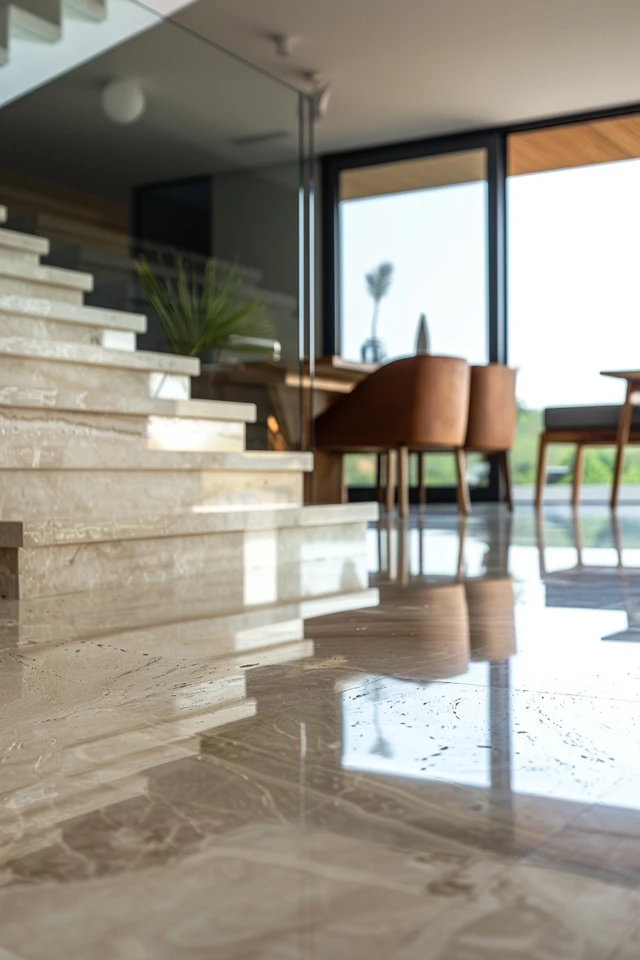
Title: How To Modernize Travertine Floors: Contemporary Update
Introduction
Travertine floors were the absolute gold standard of luxury home design during the early 2000s. If you bought a home built between 1998 and 2008, chances are high that you have acres of beige, tumbled, or honed stone spanning your entryway and kitchen. While this material is incredibly durable and natural, the “Tuscan Villa” aesthetic it was originally paired with often feels heavy and dated today.
The good news is that you do not need to jackhammer up your flooring to achieve a modern look. Travertine is a legitimate natural stone, much like marble or limestone, and it can serve as a stunning, warm foundation for a contemporary organic aesthetic. The secret lies in changing the context around the floor rather than the floor itself.
I have walked into countless client consultations where the first request is to rip out the travertine, only to save them thousands of dollars by restyling the surrounding elements instead. For those seeking visual inspiration, a curated Picture Gallery is waiting at the end of this blog post.
Evaluating Your Finish and Grout Lines
Before we start buying furniture or picking paint, we must assess the current state of the stone. Travertine generally comes in three finishes: polished (shiny), honed (matte and smooth), or tumbled (pitted and rustic). The finish dictates how we approach modernization.
Polished travertine is the hardest to modernize because high-gloss beige reads very dated. If your budget allows, having a professional stone restoration company hone the floors can physically remove the shine. This leaves you with a matte, organic surface that feels much more current and mimics high-end limestone.
If refinishing the stone isn’t in the budget, look immediately at your grout lines. Nothing dates a floor faster than dark, dirty, or widely contrasting grout grids.
Designer’s Note: The Grout Reset
In my experience, 40% of the “ugliness” clients see in their floors is actually just dirty grout. Travertine is porous, and the grout lines are often wide. I highly recommend hiring a professional steam cleaner to lift years of grime. Once clean, use a grout stain/colorant to lighten the grout color to match the stone as closely as possible. Reducing the contrast between the stone and the grout makes the floor look like one seamless surface rather than a checkerboard.
The Color Theory of Modernization: Mastering the Walls
The biggest mistake homeowners make with travertine is painting their walls yellow, cream, or gold. These warm-on-warm palettes create a “flesh tone” box that feels suffocating and old-fashioned. To modernize the stone, you must cool down the surrounding vertical surfaces.
You need to identify the undertone of your specific travertine. Is it pink-beige? Yellow-beige? Grey-beige? Once you know this, you can choose a wall color that neutralizes it.
Pro Rules of Thumb for Paint:
- Crisp Whites: If you want an art-gallery look, go with a clean white like Benjamin Moore’s “Chantilly Lace.” This creates a high contrast that forces the floor to act as a neutral, sandy base.
- Warm Greys (Greige): If stark white feels too clinical, opt for a greige like Sherwin Williams’ “Accessible Beige” or “Agreeable Gray.” These bridge the gap between grey and beige, pulling the grey veins out of the travertine.
- Avoid Yellows: Never use paint with heavy yellow or orange undertones. It will make the pink in the travertine scream.
Rugs as Your Strategic Anchors
If you are a renter or simply cannot stand the look of the stone, area rugs are your best friend. However, the mistake most people make is buying rugs that are too small. To modernize a room with travertine, you need to cover significant surface area to break up the expanse of stone.
Natural fiber rugs, such as jute, sisal, or seagrass, are exceptional for this. The organic texture of sisal complements the natural stone but brings a dry, woody element that feels coastal rather than Tuscan.
Rug Sizing Logic:
- Living Rooms: Ensure the front legs of all furniture pieces are sitting on the rug. If the room is large, all legs should be on the rug.
- Dining Rooms: The rug must extend at least 24 inches past the table on all sides so chairs don’t catch when pulled out.
- Coverage: Aim to leave about 12 to 18 inches of bare floor visible around the perimeter of the room. This looks intentional, whereas leaving 3 feet of floor looks like you bought the wrong size.
Common Mistakes + Fixes:
Mistake: Using small, patterned scatter rugs that look like postage stamps.
Fix: Use one massive, neutral sisal rug as a base. If you want color or pattern, layer a smaller, vintage kilim rug on top of the sisal. This layering technique screams “high-end designer” and distracts the eye from the floor.
Furniture Silhouettes and Material Mix
The furniture you choose will determine whether your home looks like a 2005 model home or a 2024 organic modern sanctuary. The goal is to create contrast. Since travertine is heavy, visual, and “rocky,” your furniture needs to be the opposite.
Avoid heavy, dark wood furniture with scrollwork, ornate carving, or wrought iron details. These elements reinforce the Old World look we are trying to erase. Instead, look for clean lines, light woods, and mixed metals.
What I’d Do in a Real Project:
- Wood Tones: I would introduce White Oak or Walnut. These wood tones are fresher and cleaner than the cherry or mahogany often paired with travertine.
- Upholstery: I would use textured fabrics like bouclé, linen, or performance velvet in white, oatmeal, or charcoal. Avoid patterns on large sofa pieces; keep the visual noise low.
- Metals: Swap out oil-rubbed bronze for matte black or unlacquered brass. Matte black offers a grounding modern punch that tightens up the room.
When selecting a sofa, pay attention to the legs. A sofa with a skirt can feel traditional. A sofa raised on thin, modern legs allows you to see more floor, which surprisingly helps the room feel lighter and airier, preventing the stone from feeling oppressive.
Kitchen Specifics: Cabinetry and Hardware
Travertine is most common in the kitchen, often paired with dark granite and cherry cabinets. If you can’t replace the floor, painting the cabinets is the highest-impact change you can make.
A two-tone kitchen often works beautifully with travertine. Consider painting the lower cabinets a deep, grounding color like charcoal, navy, or forest green. These dark colors read as neutrals and anchor the floor. For the upper cabinets, go with a warm white to draw the eye upward and reflect light.
Hardware Updates:
Change your cabinet pulls immediately. If you have twisted iron or ceramic knobs, swap them for linear pulls in brushed nickel or matte black. This hardware acts like modern jewelry on a vintage dress.
Lighting Temperature:
Do not overlook your light bulbs. Old incandescent bulbs cast a yellow glow that enhances the “dingy” look of beige stone. Swap all recessed can lights and fixture bulbs to 3000K LED. This is a bright, crisp white light that neutralizes yellow tones without feeling like a hospital (which is what 4000K+ feels like).
Subheading 5: Styling for the Organic Modern Aesthetic
The “Organic Modern” design trend is essentially the savior of travertine floors. This style embraces natural materials, imperfections, and warmth, which plays to travertine’s strengths.
Instead of fighting the nature of the stone, lean into it with decor. Use large-scale pottery, dried branches, and woven baskets. These elements make the travertine feel like an intentional earth-tone choice rather than a leftover relic.
Scale and Spacing:
Travertine usually comes in tiles ranging from 12×12 to 18×18 inches. Because the floor has a grid pattern, you want to avoid adding too many other small grids to the room.
- Avoid small mosaic tiles on the backsplash if the floor is busy.
- Avoid plaid patterns on curtains or pillows.
- Go for large-scale art pieces rather than messy gallery walls.
Final Checklist
If you are ready to tackle your remodel or refresh, use this checklist to ensure you are hitting the right notes.
- Deep Clean: Have the stone and grout professionally steam cleaned.
- Grout Color: Stain dark grout lines to a lighter neutral that matches the stone.
- Wall Paint: Paint walls a fresh white or greige (no yellow undertones).
- Rug Sizing: Purchase large, natural fiber rugs that sit 12-18 inches from the walls.
- Metals: Swap shiny gold or heavy iron for matte black or brass.
- Lighting: Change all bulbs to 3000K LED.
- Furniture: Remove heavy, ornate wood pieces; replace with clean-lined oak or walnut.
- Textiles: Use solid linens and textures rather than busy patterns.
FAQs
Can I paint over travertine floors?
Technically, yes, you can use specialized tile paint, but I strongly advise against it. Paint on floor tile will eventually chip, peel, and look cheap, ruining the resale value of the home. It is much better to style around the stone or cover it with large rugs than to paint it.
Does travertine lower home value?
Not necessarily. It is still a natural stone, which holds value better than laminate or vinyl. If the rest of the house is styled in a dated way, the floor feels like a liability. If the house is styled with a modern, organic aesthetic, the floor feels like a high-end European feature.
What is the best color to paint kitchen cabinets with travertine floors?
Warm whites are the safest and most brightening option. Sherwin Williams “Alabaster” or “Swiss Coffee” are excellent choices because they are creamy enough to blend with the stone but bright enough to modernize the space. For a bold look, a deep charcoal grey on the lowers looks stunning against beige stone.
How do I make my honed travertine look less cloudy?
Honed travertine is meant to be matte, but if it looks hazy, it likely has a buildup of soap residue. Stop using wax-based cleaners or oil soaps. Switch to a pH-neutral natural stone cleaner and use a microfiber mop. Occasionally, it may need a professional re-sealing to restore the depth of color.
Conclusion
Modernizing a home with travertine floors does not require a demolition crew. It requires a shift in perspective. By viewing your floors as a natural, sandy foundation rather than a dated burden, you can build a palette that feels sophisticated and calm.
Focus on cooling down the wall colors, cleaning up the grout lines, and bringing in furniture with modern silhouettes. When you stop fighting the stone and start balancing it with crisp whites, natural woods, and matte metals, you transform the “Tuscan” vibe into something timeless and organic. Your floors have stood the test of time; now it is just time to dress them for the current decade.
Picture Gallery


