How To Place A Sectional On A Rug: Coordinated Living Space
Discover expert tips on How To Place A Sectional On A Rug to achieve a Coordinated Living Space that’s both stylish and functional.
Buying a sectional is a commitment to comfort, but it often creates a puzzle regarding floor coverings. Because sectionals are larger and have asymmetrical footprints, they dominate a room’s visual weight. The rug you choose and how you place it will determine if the room feels cozy and expansive or cluttered and disjointed.
As an interior designer, I see more mistakes with rug sizing under sectionals than any other furniture layout. People often buy a standard 5×8 rug, hoping it will work, only to find it looks like a “postage stamp” floating in front of a massive sofa. If you are looking for visual inspiration, I have curated a specific Picture Gallery at the end of this blog post.
In this guide, I will walk you through the professional standards for anchoring your sectional. We will cover the mathematics of sizing, the three primary layout techniques, and how to handle real-life constraints like pets and strange room shapes.
I.
II.Understanding Scale and The “Golden Zone”
Before moving a single piece of furniture, you must understand the relationship between the scale of your sectional and the scale of the room. A sectional is visually heavy. To balance that weight, the rug must be substantial enough to act as a foundation, not just an accent.
The most common error I encounter in client homes is a rug that is too small. If your rug sits entirely inside the “L” or “U” of the sectional without touching the legs, the furniture will look like it is floating away. This disrupts the visual flow and makes the room feel cheaper and temporary.
The Sizing Standards
For most sectionals, an 8×10 rug is the absolute minimum, and truthfully, a 9×12 or 10×14 is often necessary. A good rule of thumb is that the rug should extend at least 6 to 10 inches beyond the ends of the sofa frame.
If you have a particularly large open-concept living space, you might need a custom cut. However, for standard living rooms, sticking to standard large sizes saves money while achieving a high-end look.
Then, look at where your sectional legs fall within that outline. This physical visualization prevents the heartbreak of unrolling a heavy rug only to realize it falls three inches short of the chaise lounge.
III.
IV.Layout 1: The “Front Legs Only” Approach
This is the industry standard for most residential living rooms. It bridges the gap between the furniture and the rest of the room without requiring a massive, wall-to-wall budget.
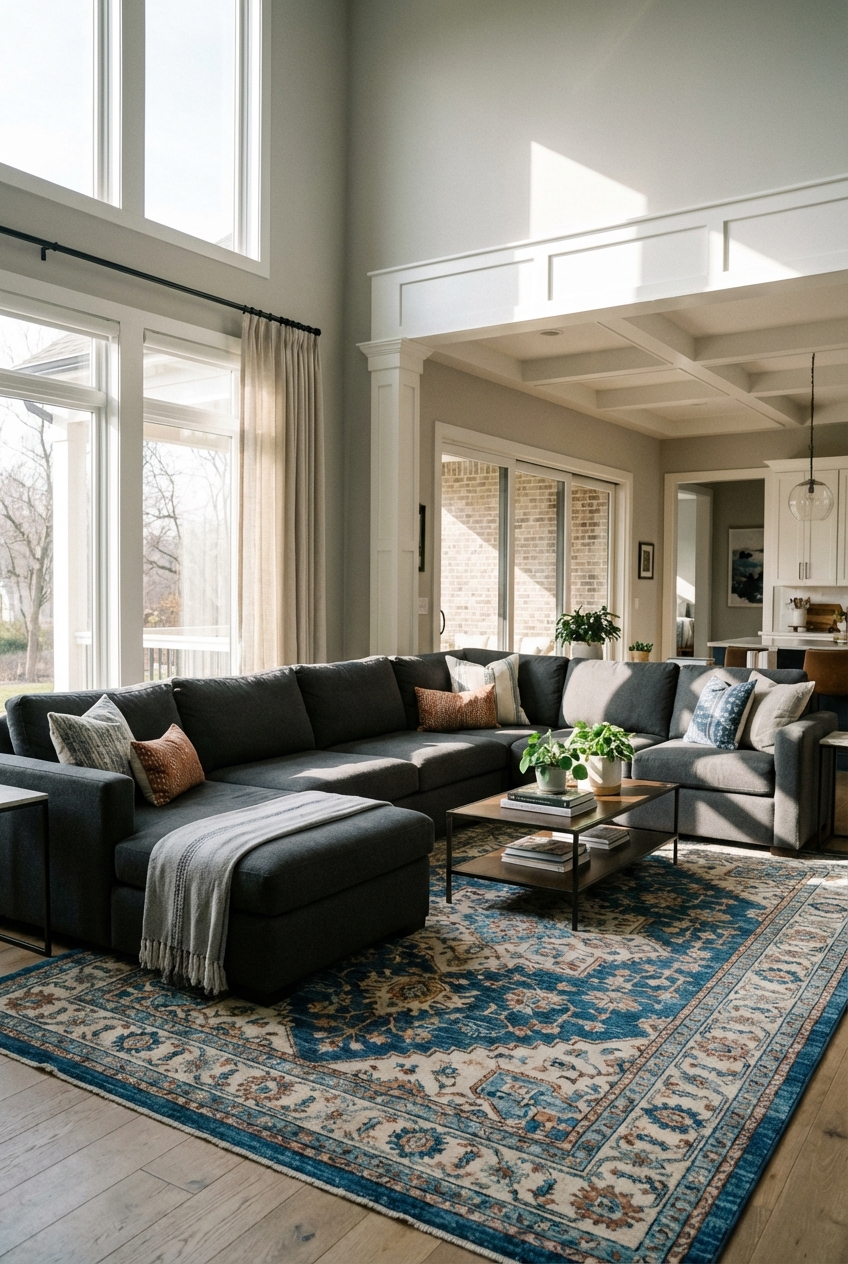
In this layout, the front legs of the entire sectional sit on the rug, while the back legs rest on the bare floor. The rug should slide under the sofa by about one-third of the sofa’s depth.
Why This Works
- It Anchors the Piece: By having the front feet on the texture, the sectional and the rug become one cohesive unit.
- Budget Friendly: It allows you to use a slightly smaller rug (like an 8×10 or 9×12) compared to placing the whole unit on top.
- Safety: The weight of the sofa holds the rug in place, preventing slipping or tripping hazards.
Critical Measurements
Ensure the rug goes under the front legs by at least 8 to 12 inches. If it barely sits under the toes of the legs, it will eventually work its way out as people sit down and stand up.
Also, check the side extensions. The rug should stick out past the side arms of the sectional by at least 6 inches. If the rug ends exactly where the arm ends, it looks cut off and unintentional.
V.
VI.Layout 2: The “All Legs On” Configuration
If you have a large open-concept space, such as a great room that combines living and dining areas, this is the superior choice. Placing the entire sectional—front and back legs—on the rug creates a “room within a room.”
This layout clearly defines the lounge zone distinct from the dining zone or kitchen. It requires a significantly larger rug, often a 10×14 or even a 12×15, depending on the size of your sectional.
Spacing Rules for “All Legs On”
- The Border: You want visible rug extending behind the sofa. Aim for 6 to 12 inches of rug showing behind the back frame.
- The Walkway: Even with a large rug, you generally want to leave 12 to 18 inches of bare floor between the rug edge and the walls. This “breathing room” keeps the space from looking like it has wall-to-wall carpeting.
- Furniture Grouping: If you have accent chairs opposite the sectional, all their legs should also fit on this large rug.
When To Avoid This
Do not force this layout in a small room. If placing all legs on the rug forces the rug to run right up against the baseboards or blocks a heating vent, scale back to the “Front Legs Only” approach.
VII.
VIII.Layout 3: The Asymmetrical Placement
Sectionals often have a chaise lounge on one side, creating an L-shape. This asymmetry can make centering a rug difficult.
A common question I get is: “Does the rug need to be centered on the room, or centered on the sectional?” The answer is almost always the sectional.
Balancing the “L” Shape
When you have a chaise extending out, the rug needs to run underneath that chaise. Ideally, the rug should extend beyond the foot of the chaise.
If the rug stops short and the chaise feet hang off the edge, it creates a visual “cliff” that makes the chaise look too long for the room.
Handling Corner Placement
If your sectional is pushed into a corner against two walls, you have less flexibility. In this scenario, the “Front Legs Only” method is usually your best bet.
However, you must be careful about the “dead corner” behind the sofa. Ensure the rug is pulled out far enough into the room so that your coffee table isn’t cramped against the sofa knees.
IX.
X.Integrating Coffee Tables and Accessories
Once the sectional and rug are mated, you have to layer in the other elements. The coffee table is the centerpiece of this arrangement, and its relationship to the rug is vital for comfort.
Coffee Table Distance
The ideal distance between the edge of the sectional seat and the coffee table is 14 to 18 inches. This is close enough to set down a drink but far enough to walk through without banging your shins.
Ensure all legs of the coffee table are firmly on the rug. If you have a very narrow rug where the coffee table is half-on, half-off, your rug is too narrow.
Floor Lamps and Side Tables
- Side Tables: These usually sit off the rug or straddle the edge in the “Front Legs Only” layout. Just ensure they are stable. If the rug is thick (high pile), a side table half-on/half-off will tilt. Use shims or felt pads to level it.
- Floor Lamps: If you are floating the sectional in the room, getting power to a floor lamp can be tricky. I prefer to place floor lamps near the corners of the rug. Avoid running cords under the rug in high-traffic areas as this causes a fire hazard and premature rug wear.
XI.
XII.Materiality: Choosing the Right Rug Texture
The material of the rug dictates how well it plays with a sectional. Sectionals are heavy; they will crush delicate fibers.
Wool and Wool Blends
Wool is the gold standard for living rooms. It is durable, naturally stain-resistant, and has a “memory” that allows it to bounce back from heavy furniture indentations better than synthetics.
Natural Fibers (Jute and Sisal)
These add wonderful texture and are great for coastal or organic modern aesthetics. However, they are coarse. If your family likes to sit on the floor while watching TV, jute might be too scratchy.
Furthermore, chunky jute rugs can be uneven. Ensure your sectional legs are stable on the weave so the sofa doesn’t wobble.
Performance Synthetics
For homes with pets or young children, polypropylene or P.E.T. rugs are lifesavers. They are often bleach-cleanable and resist fading. Just be aware that once a heavy sectional crushes the pile of a synthetic rug, it rarely bounces back.
XIII.
XIV.What I’d Do: A Real-Project Checklist
If I were designing your living room today, here is the exact sequence of steps I would follow to ensure the sectional and rug look perfect together.
- Measure the Room: I map out the room boundaries, noting heater vents, door swings, and walkways (keep 36 inches clear for main traffic paths).
- Measure the Sectional: I need the total width, the depth of the chaise, and the height of the legs.
- Tape the Layout: I use painter’s tape to outline a standard 9×12 rug. I check if it interferes with door swings or walkways.
- Check the Overlap: I ensure the taped area goes under the front legs of the sectional position by at least 10 inches.
- Verify the Chaise: I check that the taped area extends beyond the end of the chaise lounge.
- Select the Rug Pad: I never skip this. For a sectional, I recommend a 1/4-inch felt and rubber pad. It protects the floor and prevents the “creeping” effect where the rug bunches up against the heavy sofa legs.
XV.
XVI.Common Mistakes + Fixes
Even with the best intentions, things go wrong. Here are three specific issues I fix in consultations regularly.
Mistake 1: The “Floating Island”
The Problem: The rug sits in the middle of the room, and the sectional is 6 inches away from it. No legs are touching the rug.
The Fix: Pull the rug closer to the sofa until the front legs are on it. If this exposes too much bare floor on the other side, the rug is simply too small and needs to be upsized.
Mistake 2: The Color Clash
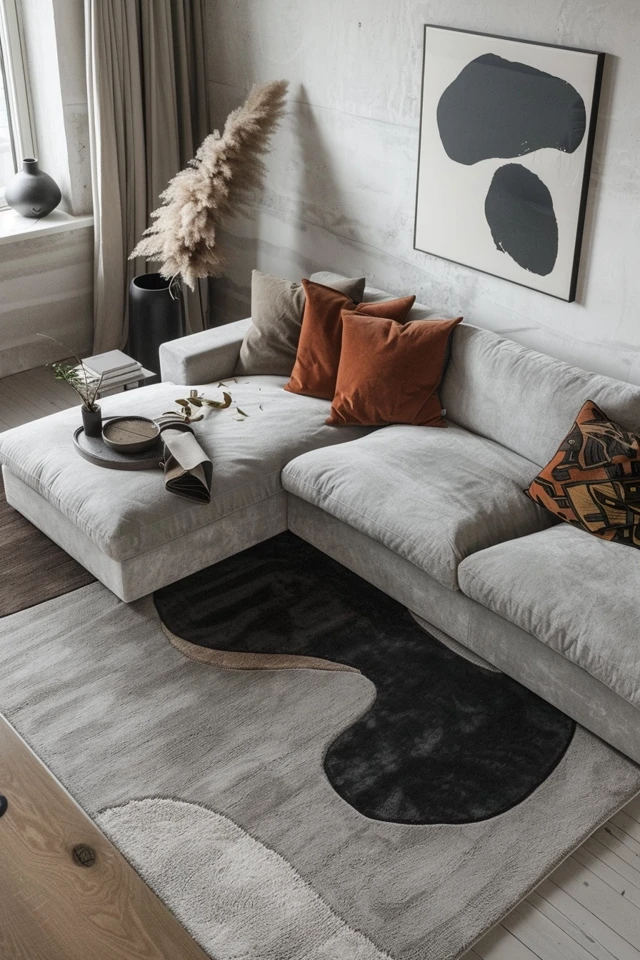
The Problem: The sectional and the rug are the exact same color and value (e.g., a gray sofa on a gray rug). The sofa disappears.
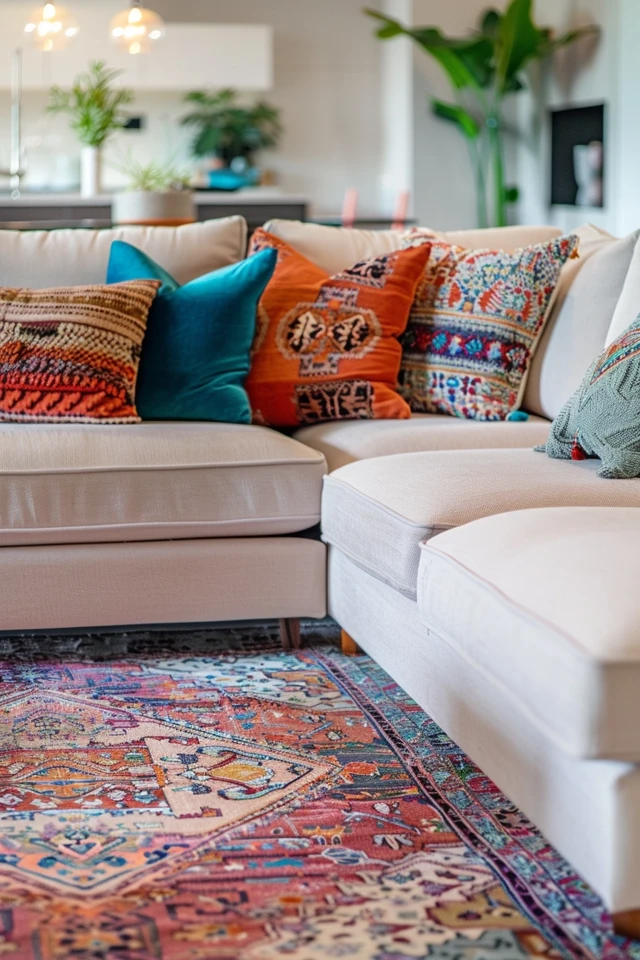
The Fix: You need contrast. If you have a dark charcoal sectional, aim for a lighter ivory or patterned rug. If you have a light beige sectional, ground it with a rust, navy, or olive rug.
Mistake 3: The High-Pile Wobble
The Problem: Putting a side table or a floor lamp half-on a thick shag rug, causing it to lean dangerously.
The Fix: Either move the item fully onto the rug or fully off. If it must bridge the gap, use clear rubber bumpers on the legs that sit on the hard floor to equal the height of the rug pile.
XVII.
XVIII.Frequently Asked Questions
-
Can I layer rugs under a sectional?
- Yes, layering is a great way to add size without buying a massive custom rug. You can use a large, inexpensive natural fiber rug (like jute or sisal) as the base layer to cover the necessary square footage. Then, place a smaller, softer, vintage or patterned rug on top, centered under the coffee table. This adds texture and interest.
-
What if my sectional covers a floor vent?
- Ideally, avoid this. However, if you must place the rug and sectional over a vent, use a plastic air deflector under the sofa to direct air out into the room. Do not cover a heat vent with a rubber-backed rug or a thick rug pad, as the heat can degrade the backing and damage your floors over time.
-
How do I stop the rug from bunching up under the heavy legs?
- This is caused by the drag of the sofa shifting slightly when people sit down. The solution is a high-quality rug pad that grips the floor. Additionally, you can use rubber caster cups under the sectional legs. These cups distribute the weight and grip the rug fibers, locking the two pieces together.
-
Should the rug go all the way to the wall?
- Generally, no. In a living room setting, you want to see the floor around the perimeter. Aim for 12 to 18 inches of bare floor between the edge of the rug and the baseboards. This frames the space. If the rug touches the wall, it looks like you tried to install wall-to-wall carpet and failed.
XIX.
XX.Conclusion
Placing a sectional on a rug is about more than just floor protection; it is about architecture. The rug creates the boundaries of your living space. By following the rules of scale—ensuring the rug is wide enough to extend past the sofa arms and deep enough to anchor the front legs—you elevate the room from a collection of furniture to a designed environment.
Don’t be afraid to go bigger with your rug choice. In design, a rug that is slightly too big feels luxurious, while a rug that is slightly too small feels incomplete. Measure twice, tape it out, and choose a texture that can handle the life you live.
XXI.
XXII.Picture Gallery
Five photographs · drag or swipe