
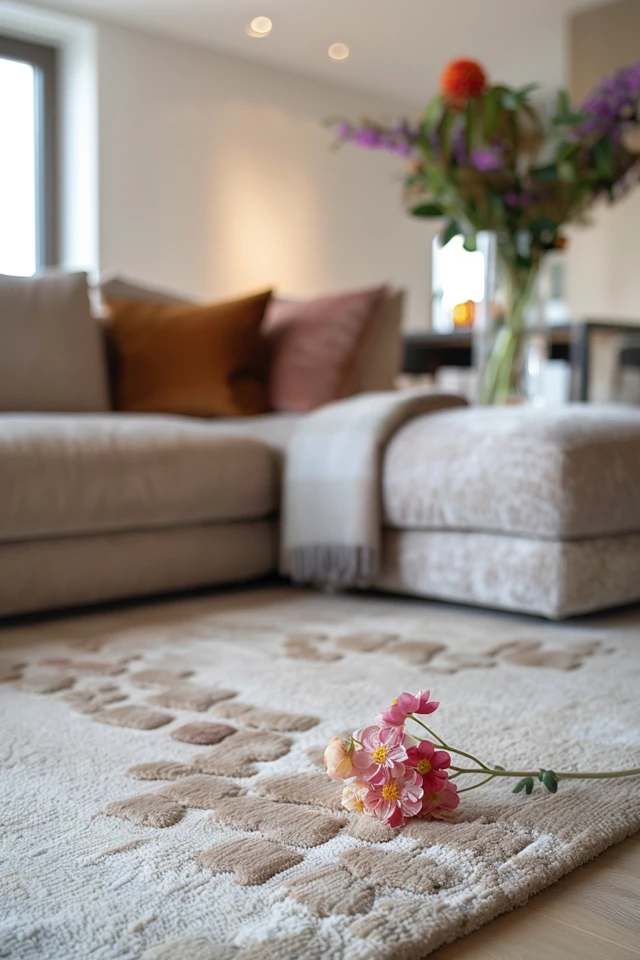
How To Position Rug Under Sectional: Completing The Look
Nothing makes a living room feel disjointed quite like a sectional sofa that feels like it is floating in the middle of nowhere. Because sectionals are visually heavy and large, they require a strong foundation to anchor them to the rest of the room. The right rug placement acts as that anchor, pulling the furniture arrangement together into a cohesive conversation zone.
However, figuring out exactly where to place that rug can be tricky due to the L-shapes, chaises, and sheer size of modern modular sofas. If you want to see visual examples of these layouts in action, be sure to check out the Picture Gallery at the end of the blog post.
In this guide, I will walk you through the specific measurements, layout rules, and designer tricks I use to get this right for my clients. We will cover everything from sizing requirements to handling tricky U-shaped setups.
The Golden Rules of Rug Sizing and Scale
Before you worry about where to tuck the rug, you have to possess the right size. The most common mistake I see in DIY interior design is buying a rug that is too small for the sectional. A “postage stamp” rug that floats in the center of the U-shape or L-shape without touching the furniture legs makes the room look cheap and cluttered.
For a standard sectional, an 8×10 rug is rarely enough. You usually need to look at a 9×12 or even a 10×14 depending on the room size. The general rule of thumb is that the rug should extend at least 6 to 10 inches beyond the ends of the sofa on both sides. This extra width creates a visual border that feels intentional and luxurious.
If you have a particularly small apartment or a “apartment-sized” sectional, you might get away with an 8×10. However, always prioritize going larger rather than smaller. A larger rug expands the visual square footage of the room, while a small rug shrinks it.
Designer’s Note: The Tape Measure Trick
I never order a rug without seeing the footprint first. I tell all my clients to grab a roll of blue painter’s tape. Outline the potential rug size on your floor.
Live with the blue tape outline for a day. Does it block a walkway? Does it run into the hearth of the fireplace? Seeing the physical boundary on the floor prevents costly return shipping fees later.
Placement Strategy 1: The All-On Approach
Placing the entire sectional on the rug is the most luxurious layout. This means every leg of the sectional, including the back legs, sits comfortably within the boundaries of the rug. This works best in open-concept floor plans where the furniture is floating in the center of the room rather than pushed against walls.
By having the rug extend behind the sofa, you define a clear “living zone” distinct from the dining or kitchen areas. It creates a room within a room. For this to work, you generally need 6 to 12 inches of rug extending behind the back legs of the sofa.
This approach requires a significant financial investment because you are looking at very large rug sizes. You also need to ensure you still have enough exposed floor around the perimeter of the room. Ideally, leave 12 to 18 inches of bare floor between the edge of the rug and the walls to keep the space from looking like it has wall-to-wall carpeting.
Common Mistakes + Fixes
Mistake: The rug is big enough for the sofa but hits the wall or covers a floor vent.
Fix: If the room is narrow, verify that the “All-On” approach leaves you a walking path. If you have to walk on the edge of the rug to get through a doorway, the rug is too big or positioned incorrectly.
Placement Strategy 2: The Front Legs Only
This is the industry standard for most living rooms. In this layout, you position the rug so that only the front legs of the sectional sit on the textile. The back legs remain on the bare floor. This anchors the furniture effectively without requiring a custom oversized rug.
How far should the rug go under the sofa? I recommend tucking the rug about 1/3 of the way under the seat depth. This usually equates to the rug edge sitting roughly 8 to 12 inches past the front legs.
This technique is incredibly versatile. It works when a sectional is against a wall and when it is floating. It connects the sectional to the coffee table and any accent chairs opposite the sofa, creating a unified group.
Designer’s Note: Leveling the Sofa
If you have a thick wool rug or a high-pile Moroccan style, placing only the front legs on the rug can cause the sofa to tilt backward slightly. This feels awkward when you sit down.
To fix this, buy dense felt furniture pads. Stack two or three of them on the back legs of the sectional (the ones on the bare floor) to raise them to the same height as the front legs sitting on the rug.
Navigating The Chaise and L-Shapes
The chaise lounge is the part of the sectional that confuses people the most. Do you treat it like a leg or like a sofa? The answer depends on the length of the chaise and the size of your rug.
If you are using the “Front Legs Only” method, the rug should extend under the chaise. Do not stop the rug halfway down the chaise. The rug should run beneath the chaise so that the feet at the end of the chaise are also sitting on the rug.
If the rug is too short to reach the end of the chaise, it creates a visual disconnect. It looks like the chaise is falling off the edge of the design.
The Asymmetry Challenge
L-shaped sectionals are inherently asymmetrical. When positioning the rug, center the rug based on the main seating area, not the entire length of the sectional including the chaise.
However, you must ensure the rug extends far enough to the side to catch the coffee table. The coffee table should be centered on the rug, even if the rug isn’t perfectly centered on the room.
Material Selection and Practical Constraints
Positioning is only half the battle; the material dictates how the rug sits. For high-traffic areas with sectionals, avoid viscose or silk. They are fragile and hate water. Instead, look for wool or high-performance polyester blends.
If you are a renter or have wall-to-wall carpet, you can still use a rug under your sectional. In fact, layering a rug over carpet helps define the space. The placement rules remain the same (front legs on).
The key for layering is texture. If your carpet is low-pile, choose a thicker shag or woven rug on top. If you have plush carpet, choose a flatweave rug. This contrast keeps the rug from bunching up or “creeping” as you walk on it.
What I’d Do in a Real Project: Durability Checklist
- Kids and Pets: I always choose a patterned rug or a heathered wool. Solid colors show every crumb and dog hair.
- Door Clearance: Check the swing of any nearby doors. If the rug is too thick, the door will get stuck.
- Rug Pad: Never skip the rug pad. Under a heavy sectional, a rug without a pad will eventually ripple and stretch. A felt and rubber combo pad preserves the rug’s structure.
Final Checklist: Recap for Success
Before you make your final decision, run through this quick checklist to ensure your layout will work.
- Scale Check: Does the rug extend at least 6 inches past the sides of the sectional?
- Depth Check: If doing “Front Legs Only,” is the rug tucked at least 8–10 inches under the sofa?
- Chaise Check: Does the rug extend under the chaise feet, or at least run parallel to the chaise length?
- Coffee Table Gap: Is there 14 to 18 inches of space between the sofa seat and the coffee table?
- Walkways: Is there at least 24 to 30 inches of walking space around the perimeter of the grouping?
FAQs
Can I use a round rug with a sectional?
Yes, but it is difficult to pull off. A round rug works best with a curved sectional or in a small nook. If you have a standard L-shape, a round rug can make the linear lines of the sofa look harsh. If you do it, place the rug off-center under one leg of the sectional to create an organic, modern vibe.
What if my sectional is against a wall?
The “Front Legs Only” method is your best friend here. It saves space and money. Just ensure the rug doesn’t stop short of the side tables. It looks best if the rug spans the width of the sofa plus the side tables.
My rug is sliding under the sectional. How do I stop it?
Heavy sectionals can push rugs as people sit down and stand up. Use a dual-surface rug pad (felt on one side, rubber on the other). The weight of the sectional on the pad usually holds it in place, but you can also use double-sided carpet tape on the corners for extra security.
Conclusion
Positioning a rug under a sectional is about creating balance. The goal is to make the heavy furniture feel grounded rather than imposing. By following the rule of “front legs on” and ensuring you have adequate width on the sides, you can elevate the look of your entire living room.
Remember that these rules are guidelines, not laws. Every home has quirks—an angled fireplace, a floor vent in a weird spot, or a narrow walkway. Use the painter’s tape trick to test your layout, trust your eye, and prioritize comfort. When the foundation is right, the rest of the styling falls into place naturally.
Picture Gallery


