
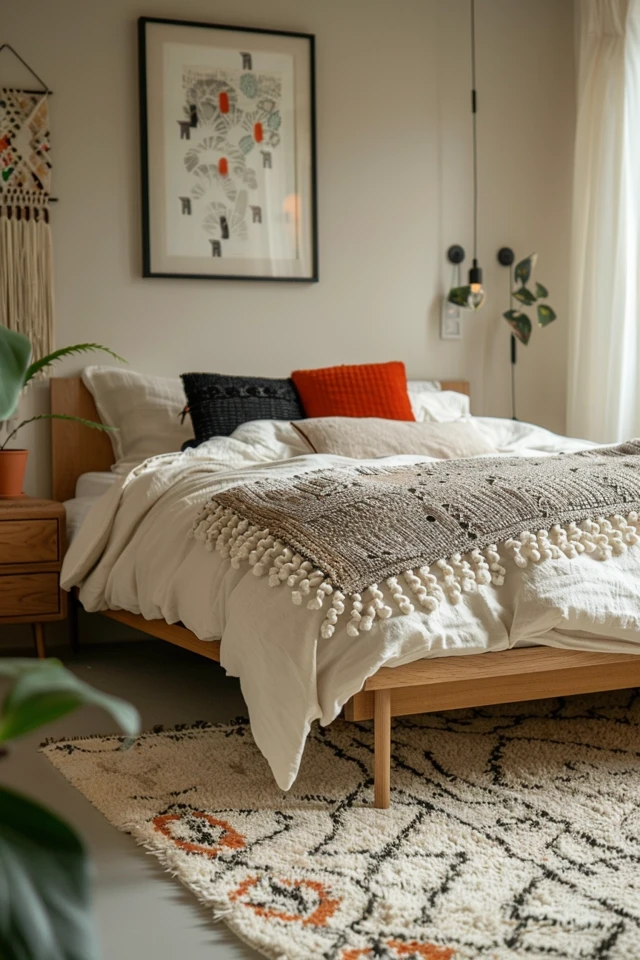
How To Put An Area Rug Under Bed: Bedroom Design Enhancements
The bedroom is arguably the most intimate space in a home, and the way it feels underfoot sets the tone for your entire day. I remember working on a project in a historic brownstone where the original hardwood floors were beautiful but incredibly cold in the winter. The client hesitated to cover the wood, but once we installed a plush, high-pile wool rug properly anchored under the bed, the entire acoustic and thermal quality of the room shifted from echoing and chilly to warm and serene.
An area rug does more than just warm up your toes; it anchors the bed, which is usually the heaviest visual element in the room. Without a rug, a bed can feel like it is floating aimlessly in the space, disconnected from the rest of the furniture. When placed correctly, a rug unifies the nightstands, the bed frame, and the bench at the foot of the bed into one cohesive “zone.”
However, getting the placement right is often trickier than people expect, involving precise measurements and heavy lifting. If you are looking for visual inspiration to guide your layout, please note that a curated Picture Gallery is included at the very end of this blog post. Let’s dive into the mechanics and aesthetics of getting that rug perfectly positioned.
Mastering the Scale: Selecting the Right Size for Your Bed
The most common error I see in DIY bedroom design is purchasing a rug that is too small for the bed frame. This creates what designers call the “postage stamp effect,” where the rug looks like a tiny island struggling to hold the bed.
To achieve a luxurious, hotel-like feel, scale is your most important tool. You need to account not just for the bed itself, but for the breathing room around it. The general rule of thumb is that you want at least 18 to 24 inches of rug extending beyond the sides and the foot of the bed.
For a standard Queen bed (60″ x 80″), an 8′ x 10′ rug is usually the sweet spot. This size allows you to pull the rug down slightly so it starts just in front of the nightstands, giving you plenty of soft texture to step onto when you wake up. If you have a larger master suite, you might bump this up to a 9′ x 12′ to accommodate a bench at the foot of the bed.
For a King bed (76″ x 80″), an 8′ x 10′ rug is technically passable, but it is often a tight squeeze. You might only get 10 or 12 inches on either side, which can look skimpy. In my projects, I almost exclusively specify a 9′ x 12′ rug for King beds. This ensures you maintain that generous 24-inch border on the sides, which is crucial for balancing the massive visual weight of a King mattress.
Designer’s Note: The “Nightstand Gap”
One specific lesson I learned early in my career involves the interaction between the rug and the nightstands. If you have heavy, solid-base nightstands, do not try to perch them half-on, half-off the rug.
It causes the nightstand to tilt, making your water glass unstable and the drawers hard to open. Either the rug should be large enough to go all the way to the wall (under the nightstands completely), or it should stop two to three inches before the nightstand legs begin.
Strategic Placement Layouts: The Three Main Approaches
Once you have the right size, you need to decide exactly where the rug lands. There isn’t just one way to do this, but there are three standard layouts that designers use to solve specific spatial problems.
1. The “Legs Off” Approach (The 2/3 Rule)
This is the most popular and practical layout for modern homes. You place the rug perpendicular to the bed, sliding it underneath so that the bottom two-thirds of the bed are on the rug, while the head of the bed and the nightstands sit on the bare floor.
This works exceptionally well if you have beautiful flooring you still want to show off, or if your budget restricts you to an 8′ x 10′ rug. You should aim to stop the rug about 6 to 12 inches away from the front legs of your nightstand. This ensures that when you swing your feet out of bed, they land on the rug, not the cold gap between the rug and the nightstand.
2. The “All Legs On” Approach (The Platinum Standard)
This layout requires a larger financial investment and a larger room. Here, the rug is large enough (usually 9′ x 12′ or 10′ x 14′) to sit completely under the bed and the nightstands.
This creates a defined island for your sleeping area. It is the best choice for very large master suites where you need to fill negative space. However, be careful with the back edge; ensure the rug doesn’t curl up against the baseboards. I recommend leaving at least 10 inches of floor exposed between the rug edge and the walls to keep the room from feeling like it has wall-to-wall carpeting.
3. The Runner Alternative (For Small Spaces and Budgets)
Sometimes, a room is too narrow for a large area rug, or the bed is pushed into a corner. In these cases, using runners is a smart workaround.
Place a runner on each side of the bed, or just one side if the bed is against a wall. Look for runners that are at least 2’6” wide. This adds the necessary comfort and color without the hassle of lifting a heavy mattress.
Common Mistakes + Fixes
- Mistake: The rug stops short of the foot of the bed.
Fix: This usually happens when you pull the rug too far up toward the headboard. Slide the rug down. You need at least 12 inches of rug visible at the foot of the bed to ground the design.
- Mistake: The rug is crooked.
Fix: Use the floorboards as a grid. Align the edge of the rug perfectly parallel with the planks of your wood floor. Even a half-inch variance is noticeable to the eye.
Material Selection: Balancing Comfort with Durability
The bedroom is a low-traffic zone compared to a living room or hallway, which gives you more freedom to choose delicate or luxurious materials. However, the type of rug you choose dictates how the room feels and how hard you have to work to keep it clean.
Wool: The Best All-Rounder
I recommend wool for 90% of bedroom projects. It is naturally stain-resistant due to the lanolin in the fibers, it creates a thermal barrier, and it has a springy texture that feels great underfoot. While it sheds initially, a quality wool rug will last for decades.
Natural Fibers (Jute and Sisal)
These provide excellent texture and an organic, earthy vibe that works well in coastal or farmhouse designs. However, they can be rough on bare skin. If you love the look of jute, look for a wool-blend jute rug, which softens the fibers significantly.
Synthetics (Polypropylene and Nylon)
If you are renting, on a tight budget, or have pets that are prone to accidents, synthetics are a lifesaver. They are easy to scrub and often bleach-cleanable. Technology has improved to the point where high-quality synthetics can mimic the look of wool quite convincingly.
Silk and Viscose
These materials have a beautiful sheen that looks incredible in photographs. However, I advise clients to proceed with caution. Viscose is extremely absorbent; a spilled glass of water can permanently ruin the texture of the rug. Reserve these for guest rooms or adult-only spaces where no food or drink enters.
Realistic Constraints: High Pile vs. Low Pile
Shag or Moroccan-style rugs are popular for bedrooms because they are incredibly soft. However, high-pile rugs are difficult to vacuum under the bed. Dust bunnies love to cling to long fibers.
If you have allergies, stick to a low-pile or flatweave rug. It is much easier to run a vacuum attachment under the bed frame to keep the air quality in your sleeping zone clean.
Styling and Color Coordination
The rug is a massive surface area, usually the largest block of color in the room after the walls. Therefore, its color and pattern will dictate the room’s energy.
If you have patterned bedding or a busy wallpaper, ground the space with a solid-colored rug or a subtle tonal texture. This prevents the room from feeling chaotic. Conversely, if you have white bedding and neutral walls, the rug is your opportunity to introduce a bold pattern or a rich, saturated color like navy, terracotta, or olive.
Contrast is Key
Consider the floor underneath. If you have dark walnut floors, a dark navy rug might disappear into the void. A lighter beige or grey rug will create necessary separation.
If you have light oak or maple floors, a darker rug provides a grounding effect. You want the bed to feel like it is sitting on a distinct foundation, not floating in a sea of beige.
Layering for Texture
A trend I often utilize in bohemian or eclectic bedrooms is layering. You can start with a large, inexpensive jute rug as the base layer to cover the requisite square footage. Then, place a smaller, softer vintage rug or a sheepskin at an angle or directly alongside the bed.
This adds depth and visual interest. It also allows you to use a smaller, more expensive vintage piece without it looking too small for the room, because the jute rug underneath handles the scale requirements.
Installation Logistics and Maintenance
Installing a rug under a bed is physically demanding. If you have a King-size mattress, do not attempt this alone. You risk injuring your back or scratching your floors.
The Taco Method
To install a rug without disassembling the bed, use the “taco” or fold method.
1. Clear the nightstands and remove the mattress if possible (though you can do it with the mattress on, it’s just heavier).
2. Roll up your old rug (if you have one) and remove it.
3. Roll the new rug up halfway.
4. Lift the foot of the bed and slide the rolled portion underneath until the roll hits the bed legs.
5. Lower the bed.
6. Go to the head of the bed, lift it, and pull the roll through the rest of the way.
Rug Pads are Mandatory
Never skip the rug pad. In a bedroom, the weight of the bed will keep the rug from sliding, but the pad isn’t just for grip. It prevents the rough backing of the rug from scratching your hardwood finish over time.
For bedrooms, I recommend a felt rug pad rather than a waffle-grid rubber pad. Felt adds extra cushion and sound dampening. Look for a pad that is at least 1/4 inch thick for that “walking on clouds” feeling.
Cleaning Under the Bed
You will forget to vacuum under there. It happens to everyone.
Set a reminder to rotate your rug every six months. This serves two purposes. First, it forces you to clean the dust that has accumulated under the bed. Second, it prevents uneven fading from sunlight coming through the windows, and it prevents uneven wear patterns where you step out of bed every morning.
Designer’s Final Checklist: What I Would Do
If I were designing your bedroom today, this is the cheat sheet I would follow to ensure success:
Measure twice: Tape out the rug dimensions on your floor using painter’s tape before buying.
Check door clearance: Ensure the rug isn’t so thick that your bedroom door gets stuck when you open it.
Nightstand logic: Ensure the rug stops 2 inches before the nightstand or goes all the way to the wall. No halfway adjustments.
The 18-inch rule: Verify I have at least 18 inches of soft rug on the sides of the bed for stepping out.
Pad purchase: Buy a felt rug pad immediately when buying the rug.
Color check: Bring a swatch of the rug into the room to see how it looks in morning light vs. evening lamp light.
Frequently Asked Questions
Can I put an area rug over wall-to-wall carpet?
Absolutely. This is a great way to define space in a rental or to add color to a bland beige room. Just make sure to anchor it well. You won’t use a standard rug pad here; you need a “carpet-to-carpet” pad that is specifically sticky on both sides to prevent rippling. Without it, the area rug will creep and bunch up every time you walk on it.
Does the rug have to match the curtains?
No, and it actually shouldn’t match perfectly. That looks a bit dated. Instead, they should “talk” to each other. If your curtains are a cool grey, look for a rug that has cool undertones, perhaps a blue or a slate, rather than a warm beige. They should belong to the same color family or share a similar mood, but they do not need to be identical twins.
What if my bed is in the corner?
Corner beds are tricky. A standard rectangular rug often looks awkward here because much of it ends up buried against the wall. In this scenario, I prefer using a custom-cut rug or simply placing a large runner along the open side of the bed. It saves money and looks intentional rather than like a mistake.
How do I fix dents in the rug from the bed legs?
When you rotate your rug, you will see deep divots. The trick is to place an ice cube in the dent and let it melt. As the water evaporates, the fibers will swell and regain their shape. Fluff it up with a spoon or your fingers afterwards.
Conclusion
Placing a rug under your bed is one of the highest-impact changes you can make to a bedroom. It resolves acoustic issues, adds a layer of thermal comfort, and visually organizes the furniture into a restful sanctuary.
By following the rules of scale—aiming for that 18 to 24-inch border—and choosing materials that suit your lifestyle, you elevate the room from a simple sleeping area to a designed space. Don’t be afraid to go big with the size; a generous rug feels luxurious, while a skimpy one feels temporary. Take your measurements, grab a friend to help with the lifting, and enjoy the softness underfoot.
Picture Gallery


