
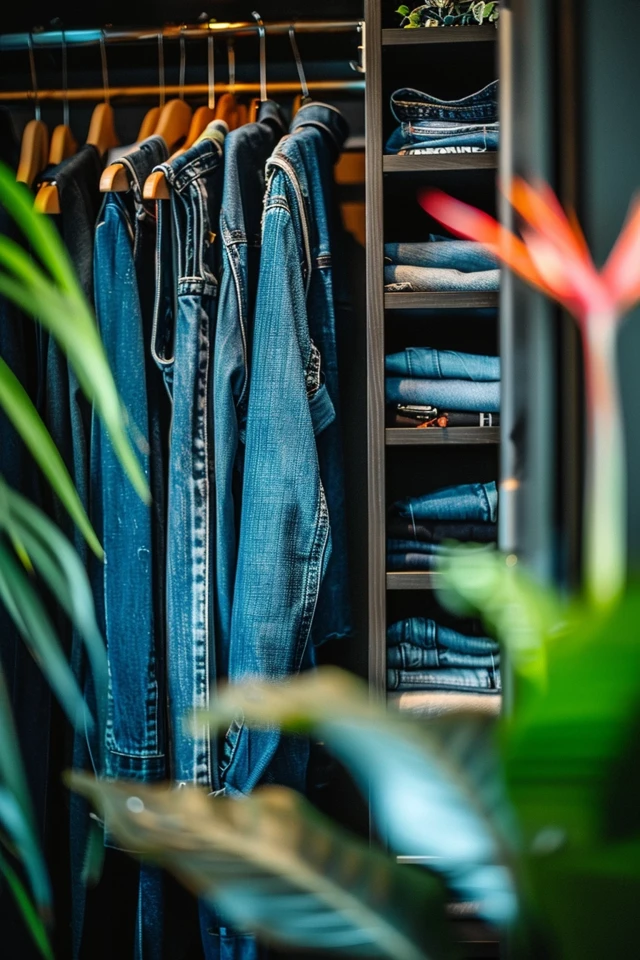
How To Store Jeans In A Small Closet: Organizational Hacks
Denim is one of the most difficult items to store in a compact wardrobe. Unlike silk blouses or cotton t-shirts, jeans are heavy, bulky, and take up a significant amount of “visual weight” in a closet. When I work with clients who have limited square footage, the denim pile is usually the first area we tackle because it offers the biggest return on investment regarding space saving.
If you are struggling with a closet that feels like it is bursting at the seams, the solution is rarely to just shove harder. You need a system that respects the fabric’s weight while utilizing every cubic inch of your vertical storage. If you are looking for visual inspiration, check out the Picture Gallery at the end of the blog post for real-world examples.
In this guide, I will walk you through the exact methods I use to organize small closets for city apartments and guest suites. We will look at hanging techniques, folding logic, and how to select the right hardware so your jeans stay organized for the long haul.
1. The Audit and Measurement Phase
Before buying a single bin or hanger, you must audit what you actually own. In interior design, we call this inventory analysis. You cannot design a functional layout without knowing the volume of items you need to house.
Pull every pair of jeans out of the closet. Sort them into three piles: Keep, Repair, and Donate. Be ruthless here. If a pair hasn’t fit in two years or has a broken zipper you haven’t fixed in six months, it is taking up valuable real estate that could be used for the clothes you actually wear.
Once you have your “Keep” pile, you need to measure your available space. This is where most homeowners go wrong; they guess the dimensions.
Designer’s Rule of Thumb for Measurements:
- Standard Shelf Depth: Most closet shelves are 12 to 16 inches deep. A folded pair of adult jeans is typically 8 to 10 inches wide and 10 to 12 inches long. This means on a 16-inch shelf, you have dead space behind the stack.
- Hanging Clearance: If you plan to hang jeans by the waistband using clip hangers or S-hooks, you need roughly 40 to 48 inches of vertical hanging space.
- Folded Height: A stack of 5 pairs of jeans is generally 8 to 10 inches high. Do not stack higher than this, or the tower will topple.
Use a tape measure to identify the “return” walls in your closet. These are the small sections of wall on the inside of the closet door frame. Even if it is only 4 inches wide, that is enough space for a vertical row of hooks.
2. Vertical Folding vs. The Shelf Stack
The debate between hanging and folding often comes down to the physical constraints of the closet. In a small closet, drawers and shelves are often more efficient than hanging rods because denim is thick. Hanging too many pairs can crowd your shirts and jackets, causing wrinkles.
If you have deep drawers (at least 8 inches deep), the “file folding” method is the gold standard. This involves folding the jeans into a small rectangle that stands upright, rather than lying flat. This allows you to see every wash and style immediately without digging to the bottom of a pile.
How to File Fold Jeans:
- Lay the jeans flat, button side up.
- Fold the left leg over the right leg.
- Fold the crotch inward to create a straight rectangle.
- Fold the ankles up to the waistband (in half).
- Fold that rectangle into thirds.
- Stand it up vertically.
If you lack drawers and must use open shelving, you need to use the “shelf stack” method. However, open stacks of denim can look messy very quickly. The secret to making this look designed rather than cluttered is structural support.
Designer’s Note:
Never place stacks of jeans on a shelf without acrylic shelf dividers. I install these in almost every project. They slide onto the existing shelf and act as bookends for your clothes. They prevent the “lean” that happens when you pull a pair from the middle of the stack.
3. The Hanging Method: S-Hooks and The “S” Rail
If you have more hanging rod space than shelf space, you need to be strategic about how you hang denim. Standard plastic tube hangers are terrible for jeans; the denim slides off, or the hanger bows under the weight.
The most space-efficient hanging method for a casual wardrobe is using S-hooks. You hook the S-hook onto the closet rod and loop the rear belt loop of the jeans onto the hook. The jeans hang straight down by the waistband.
Why S-Hooks Work for Small Spaces:
- Density: You can fit more pairs per linear foot because the waistband is turned sideways. The jeans take up about 1.5 inches of rod width versus the 14-18 inches a standard hanger takes up.
- Visualization: It is easy to see the back pocket design and wash of the denim.
- Ease of Use: It is one motion to hang them up, which increases the likelihood that you will actually put your laundry away.
However, there is a caveat. This method requires significant vertical height. As mentioned earlier, a pair of men’s jeans hanging by the belt loop can drop down 45 inches. If you have a double-hang closet (two rods, one over the other), the jeans might drag on the lower shelf.
Common Mistakes + Fixes:
- Mistake: Using S-hooks on a rod that is too low, causing dragging hems.
- Fix: Use “tier hangers” or “pant trees” that allow you to fold the jeans over a bar. This reduces the vertical drop by half, usually requiring only 20-24 inches of vertical space.
4. Utilizing “Dead” Space and Door Storage
In a small closet, you cannot afford to have dead space. One of the most underutilized areas is the back of the closet door. If you are a renter, you might be hesitant to drill holes, but over-the-door racks are a fantastic solution for denim.
Look for an over-the-door shoe organizer with large, sturdy pockets. While designed for shoes, these pockets are often the perfect size for a rolled pair of skinny jeans or leggings. Rolling jeans (like a sleeping bag) keeps them compact and prevents hard creases.
The Floor Factor:
The floor of a small closet is often a dumping ground for shoes. If you hang your clothes high enough, the floor offers prime real estate for a rolling cart or a heavy-duty bin.
I often recommend a low-profile woven basket or a felt bin for “in-between” jeans—the pairs you have worn once but aren’t dirty enough for the wash. This keeps them off the infamous “chair” in the bedroom and keeps your clean clothes strictly separated from semi-clean ones.
What I’d Do in a Real Project (The Mini Checklist):
- Top Shelf: Store out-of-season denim (white jeans in winter) in labeled fabric bins to keep dust off.
- Eye Level: Store daily wear jeans folded on shelves with dividers.
- Door Back: Install a vertical track system for the overflow pairs.
- Lighting: Install a rechargeable LED motion-sensor light. You cannot organize what you cannot see.
5. Aesthetic Coordination and Material Care
Organization is not just about fit; it is about the visual calm it creates. When you open your closet, it should feel like a boutique, not a bargain bin. This is achieved through color coordination.
Arrange your jeans by wash: Light wash, Medium wash, Dark wash, Black, and Colored/White. Within those categories, I organize by style (skinny, straight, wide-leg). This visual hierarchy reduces the time it takes to get dressed because your brain can instantly locate the shade you need.
Protecting the Investment:
Denim is durable, but it isn’t invincible. Avoid wire shelving if possible, or use shelf liners. The thin metal wires can leave permanent indentations or “grid lines” on denim if the jeans sit at the bottom of a heavy stack for months. A simple plastic or cork shelf liner distributes the weight evenly.
Furthermore, ensure your closet has airflow. Denim is cotton-heavy and can absorb moisture. If you pack jeans too tightly into a bin or onto a shelf, you risk a musty smell or, in humid climates, mildew. Leave enough room to slide a hand between the stacks.
Final Checklist
Ready to reorganize? Here is your step-by-step plan to tackle that denim pile today.
- Purge: Remove any jeans that do not fit or are damaged beyond repair.
- Categorize: Group remaining jeans by wash (light, dark, black) and cut.
- Choose Your Method: Decide between file folding (drawers), stacking (shelves), or hanging (rods) based on your specific furniture.
- Install Hardware: Buy shelf dividers, S-hooks, or shelf liners before you start putting things back.
- Fold or Hang: Process each pair using the consistent method chosen above.
- Label (Optional): If using bins for off-season storage, label them clearly.
- Maintain: adopt the “one in, one out” rule. If you buy a new pair, an old pair must be donated.
FAQs
Is it better to hang or fold jeans?
Generally, folding is better for maintaining the shape of denim, as heavy jeans can stretch out over time if hung by the waistband on clips. However, hanging by the belt loop (S-hook) or folding over a pant bar is perfectly safe. If you have limited rod space, folding is the preferred method.
How do I store jeans without wrinkles?
The “file fold” method or rolling jeans minimizes wrinkles effectively. If hanging, folding them over a thick, velvet-flocked hanger bar prevents the sharp crease line that occurs with thin wire hangers. Avoid overcrowding; pressure causes wrinkles.
Can I store jeans in plastic bins?
Yes, but for long-term storage, breathable fabric bins or canvas bags are better. Denim needs to breathe. If you must use plastic bins for a damp basement or attic, ensure the jeans are completely dry before storing and throw in a silica gel packet or cedar block to absorb moisture and deter pests.
What if my shelves are too high to reach easily?
Reserve high shelves for off-season denim or “archive” pairs you rarely wear. Use a handled bin so you can safely pull the entire container down without needing a step stool for a single pair. Keep your daily rotation between waist and eye level.
Conclusion
Organizing jeans in a small closet is about balancing accessibility with density. By treating your denim with the same care you would treat a delicate dress—giving it designated space, proper support, and logical categorization—you extend the life of the clothing and make your morning routine significantly smoother.
Remember that the best organizational system is one you can maintain. Whether you choose to file fold in drawers or display your collection on S-hooks, consistency is key. Start with a serious edit of your current inventory, measure your specific constraints, and implement a system that works for your lifestyle.
Picture Gallery


