
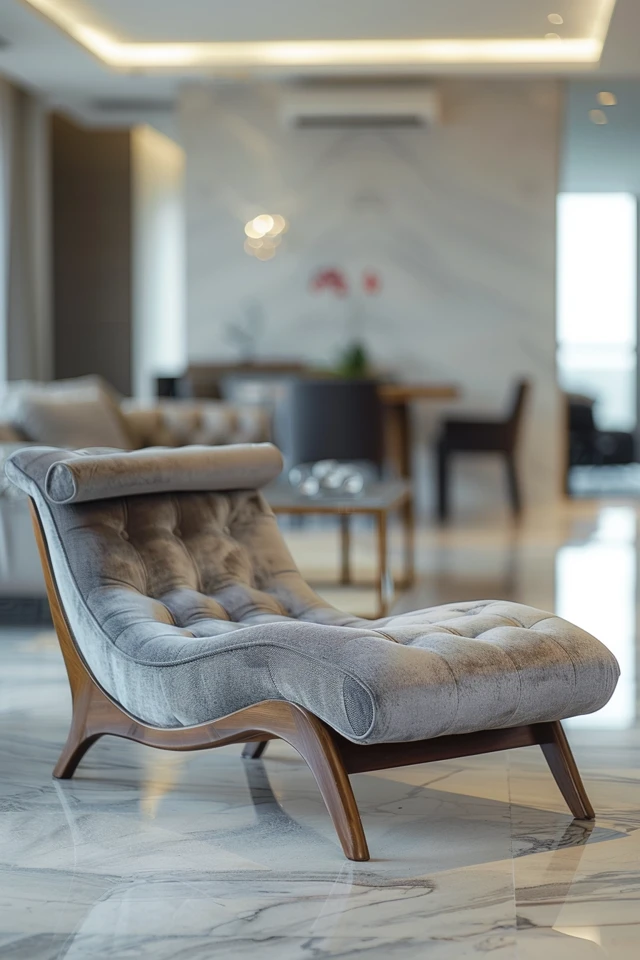
How To Style A Chaise Lounge In Living Room: Elegant Seating
Introduction
There is something inherently luxurious about a chaise lounge. It bridges the gap between a sofa and an armchair, offering a dedicated spot for relaxation that feels slightly more indulgent than standard seating. I remember a specific project where a client felt their living room was too narrow for a sectional but too large for just a sofa; a velvet chaise ended up being the perfect architectural solution to bridge the two zones.
However, styling this piece can be tricky because of its unique asymmetry. It is not quite a bed, and it is not quite a chair, which often leaves homeowners confused about how to orient it or what to put next to it. The goal is to integrate it into the room so it does not look like a floating raft in the middle of the ocean.
If you are looking for visual inspiration to guide your layout, please note that there is a comprehensive Picture Gallery at the end of this blog post. By following a few key design principles regarding scale, lighting, and textiles, you can turn a standalone chaise into the most coveted seat in the house.
1. Determining the Ideal Layout and Orientation
The first step in styling a chaise is acknowledging that its shape dictates its placement. Unlike a symmetrical armchair, a chaise has a “direction.” You need to decide if you want the piece to be part of the main conversation circle or a solitary retreat.
If you are incorporating the chaise into the main seating group, place it perpendicular to your sofa. This creates an “L” shape layout without the visual bulk of a full sectional. In this scenario, ensure the open side of the chaise faces the coffee table or the center of the room to invite people in.
For a solitary reading nook, angling the chaise in a corner is often the best approach. Placing it at a 45-degree angle softens the boxy nature of most living rooms. If you place it near a window, always orient the foot of the chaise toward the view, allowing the natural light to fall over your shoulder rather than in your eyes.
You must also consider traffic flow constraints. As a rule of thumb, you need 30 to 36 inches of clearance around the walking paths of the chaise. Because these pieces are often longer than standard armchairs (usually extending 60 to 70 inches), they can easily block pathways if you are not measuring carefully.
2. Balancing Visual Weight and Scale
A common mistake I see is pairing a heavy, tufted chaise with delicate, spindly side tables, or vice versa. This creates visual dissonance. If your chaise is upholstered in a heavy fabric like velvet or leather and touches the floor (skirted or block legs), it has high visual weight.
To balance a heavy piece, pair it with a substantial side table or a floor lamp with a solid base. If your chaise is leggy and airy, like a mid-century modern design, you can get away with glass tables or thinner metal accents. The goal is to keep the “gravity” of the corner consistent.
Height is another crucial factor. Most chaises have lower back profiles than standard sofas. If you place a low-profile chaise next to a tall bookshelf or a high-back sofa, it can look miniature.
To fix this scale issue, use vertical elements to draw the eye up. Place a tall floor plant, such as a Ficus or a Dracaena, behind the head of the chaise. Alternatively, hang artwork on the wall above the chaise, keeping the center of the art at roughly 57 to 60 inches from the floor to anchor the seating area.
3. The Art of Layering Textiles
A chaise lounge offers a large surface area of upholstery, which can look flat if not broken up with texture. However, you cannot style it exactly like a sofa because you need legroom. If you pile too many pillows on it, there is nowhere to actually sit.
I recommend the “one-plus-one” rule for chaises: one lumbar pillow and one throw blanket. The lumbar pillow supports the lower back, which is essential because chaises often have deep seats. A square 20-inch or 22-inch pillow can also work, but keep it pushed into the corner.
For the throw blanket, use the “waterfall” technique. Fold the blanket lengthwise into a long rectangle and drape it over the foot of the chaise or down the center. This breaks up the long expanse of fabric and adds a splash of contrasting color or texture.
If you have a leather chaise, opt for a chunky knit or wool throw to add warmth and grip. Leather is slippery, and a silk or satin throw will slide right off. Conversely, if you have a heavily textured fabric like boucle, a smooth linen or cotton throw provides a nice visual rest.
4. Lighting the Nook for Function
Lighting is what transforms a piece of furniture into a functional zone. Since chaises are primarily used for lounging or reading, ambient ceiling light is rarely enough. You need task lighting that feels intimate.
Floor lamps are the traditional choice here. Look for a lamp with an adjustable arm or a pharmacy-style lamp. This allows you to direct the beam exactly where you are holding your book or tablet. The bottom of the lamp shade should generally be around eye level when you are seated, which is usually 40 to 48 inches from the floor.
If you are tight on floor space, consider a wall sconce. A swing-arm sconce installed 6 to 12 inches above the top of the chaise’s backrest creates a custom, built-in look. This is a great trick for small apartments where every square inch of floor space counts.
Pay attention to light temperature as well. For a living room relaxation zone, avoid cool, blue-toned daylight bulbs. Stick to bulbs in the 2700K to 3000K range. This provides a warm, inviting glow that mimics the golden hour, making the space feel cozy rather than clinical.
5. Selecting the Right Companion Tables
You need a place to set a drink, a book, or a phone. A chaise without a table is simply inconvenient. The placement of this table is more specific than you might think because of the chaise’s arm configuration.
If your chaise has one arm (asymmetrical), place the side table on the arm side. This makes it easy to reach without twisting your spine. If the chaise is armless, you have more flexibility, but you should generally place the table on the side dominant to the user or away from the traffic path.
The height of the table is critical for ergonomics. The table surface should be within 2 to 3 inches of the arm height of the chaise. If the table is too low, it is a tipping hazard for drinks; if it is too high, it feels awkward to reach.
Regarding shape, round tables are often safer and more visually pleasing next to a chaise. Because you are often walking around the foot or side of the chaise, a round table eliminates sharp corners that can cause shin bruises. A small ceramic drum stool or a pedestal table works beautifully here.
Designer’s Note: The “Left vs. Right” Trap
I have to share a lesson I learned early in my career regarding purchasing chaises. When ordering a chaise, you will often see options for “Left-Arm Facing” (LAF) or “Right-Arm Facing” (RAF).
This does not refer to your left or right arm as you sit on the furniture. It refers to the arm’s position when you are standing in front of the piece, looking at it. I once had a client order a custom RAF chaise thinking it would fit in a specific corner, only to realize the arm was on the wrong side for the wall, leaving the sitter exposed to the hallway.
Always visualize yourself standing in front of the spot where the furniture will go. If you want the arm to be on the side of the wall to the left of you, you need a Left-Arm Facing chaise. Double-check this before you buy, as restocking fees on large furniture are brutal.
Common Mistakes + Fixes
Here are the specific issues I see when walking into a DIY-styled living room, and exactly how to correct them.
Mistake: The “Floating Island” Effect
The chaise is placed too far from other furniture, making it feel isolated from the social zone.
Fix: Use an area rug to bridge the gap. The front legs of the chaise should sit on the same rug as the sofa or main seating group. If it is a separate reading nook, give it its own small rug (like a sheepskin or a 5×7 vintage rug) to define the zone.
Mistake: Blocking the View
Placing a high-backed chaise in front of a window or in the middle of an open-concept divider.
Fix: Use a low-profile, backless, or recamier-style chaise in these areas. This preserves the sightlines and allows light to pass through the room unhindered.
Mistake: Ignoring the “Back” View
Ideally, a chaise is placed against a wall, but sometimes it floats in a room. Many affordable chaises use cheaper fabric or zippers on the back panel.
Fix: If your chaise floats, ensure the back is fully finished. If it’s not, drape a throw blanket strategically over the back or place a console table behind it to hide the unfinished side.
What I’d Do in a Real Project
If I were styling a chaise in your home tomorrow, this is the mental checklist I would run through:
- Check the anchoring: Is it sitting on a rug? If not, I am adding a hide or a small textured rug immediately.
- Sit test the lighting: I will sit down with a magazine. Is there a shadow cast by my head? If so, I move the floor lamp 6 inches forward.
- Texture audit: Do I have contrasting materials? If the chaise is velvet, I add a linen pillow. If the chaise is linen, I add a velvet or leather pillow.
- Drink check: Can I reach my coffee without leaning forward? If not, the side table is moved closer or replaced with a larger diameter table.
- Scale check: Does the corner look empty? I will likely add a large basket with extra blankets or a tall floor plant to fill the negative vertical space.
Final Checklist
Use this summary to ensure you have covered all the bases for an elegant setup.
- Clearance: Maintain 30+ inches of walking path around the foot of the chaise.
- Orientation: Face the view or the conversation area, never a blank wall.
- Lighting: Install a floor lamp or sconce with warm bulbs (2700K-3000K).
- Table Height: Ensure the side table is within 2-3 inches of the arm height.
- Textiles: Add one lumbar pillow and one throw blanket for “lived-in” luxury.
- Rug: Anchor the legs on a rug to connect it to the room.
- Balance: Use tall plants or art to balance the low profile of the seating.
FAQs
Can I put two chaise lounges side by side?
Yes, this is often called a “double chaise” arrangement. It is excellent for media rooms or home theaters. However, you need a significant amount of width. Leave about 6 to 12 inches between them for a small shared table, or push them together to create a daybed effect if the frames allow it.
Does a chaise have to match my sofa?
No, and frankly, it looks better if it doesn’t. Buying a matching “suite” can make a room look like a furniture showroom. Coordinate the chaise by choosing a fabric in a complementary color family or a similar style (e.g., both mid-century modern), but vary the texture.
Is a chaise practical for a small living room?
Surprisingly, yes. A chaise often takes up less visual space than a standard armchair and ottoman combination. Because it is one continuous piece, it looks sleeker and less cluttered. Just ensure you choose an armless or low-arm version to keep the sightlines open.
How do I clean a velvet chaise with pets?
Velvet is actually very durable for pets because it has no loose weave for claws to snag on. Use a velvet brush or a soft-bristle attachment on your vacuum weekly to remove hair. For spills, blot immediately; do not rub. High-performance velvets are worth the investment for pet owners.
Conclusion
Styling a chaise lounge in your living room is about merging the romantic idea of lounging with the practical realities of daily life. It is a piece that invites you to slow down, but it requires deliberate planning to ensure it fits the flow of your home.
By paying attention to the “Left vs. Right” orientation, anchoring the piece with appropriate rugs and lighting, and layering textures that invite touch, you elevate the chaise from a simple piece of furniture to a design statement. It is often the favorite seat in the house for a reason—make sure you style it to reflect that importance.
Picture Gallery


