
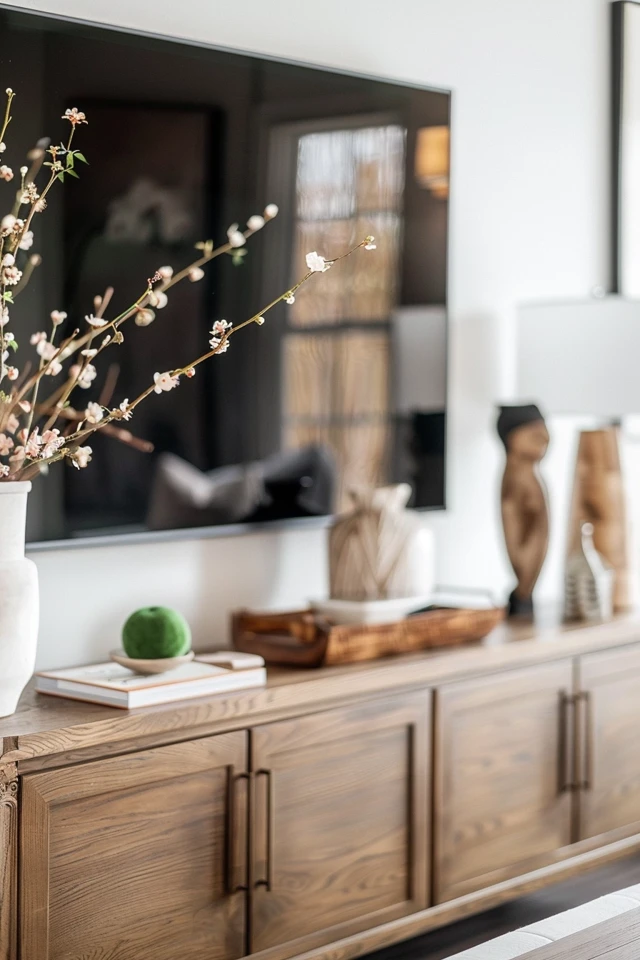
How To Style A TV Console: Decor And Functionality
The television is often the focal point of a living room, yet it is rarely the most beautiful object in the space. We spend hours looking at it, but the black rectangular void can feel visually heavy and disjointed from the rest of the room’s design. The media console is your best opportunity to bridge the gap between necessary technology and warm, inviting style.
I often tell my clients that styling a media console is an exercise in balance. You want to soften the hard, industrial lines of the screen without creating visual clutter that distracts you during movie night. It requires a thoughtful mix of height, texture, and negative space to get it right.
For plenty of visual inspiration to help you visualize these concepts, make sure to check out our Picture Gallery included at the end of this article.
1. Establishing The Foundation: Scale and Proportions
Before you buy a single vase or coffee table book, you must get the furniture mechanics right. The most common error I see in living rooms is a scale mismatch between the television and the console beneath it.
If your console is narrower than your TV, the setup will look top-heavy and precarious. It creates a subconscious feeling of uneasiness, like the TV is about to tip over.
The Golden Rule of Width
- The Measurement: Your media console should be at least 6 to 8 inches wider than your TV on each side. Ideally, the console is 25% to 30% wider than the screen.
- The Visual Effect: This extra width grinds the television, making it feel deliberate rather than imposed. It also provides the necessary real estate for styling objects on the ends.
- Example: If you have a 65-inch TV (which is usually about 57 inches wide physically), your console needs to be at least 70 inches long. A 72-inch or 80-inch console is even better.
Height Matters
The height of your console dictates your viewing comfort. A console that is too high will force you to crane your neck, while one that is too low can feel like dorm room furniture.
For a standard sofa, your eyes should land naturally on the center of the screen when seated. This usually places the center of the TV about 42 to 48 inches from the floor. Consequently, most consoles should sit between 22 and 28 inches high.
Designer’s Note: If you have high ceilings (9 feet or higher), avoid low-profile “floating” consoles mounted 12 inches off the ground. They leave too much negative space above the TV, making the wall feel empty. Opt for a unit with legs or a solid plinth base that stands roughly 26 inches tall.
2. The Layout Strategy: Creating Visual Triangles
Once the furniture is correct, we move to styling. The goal here is to distract the eye from the big black box without blocking the screen.
I rely heavily on the “visual triangle” method. This technique moves the viewer’s eye around the vignette rather than letting it get stuck on the electronics.
Step 1: Anchor the Ends
Treat the surface space on either side of the TV as distinct zones. You want to frame the television, not compete with it.
- The Tall Object: Place your tallest item on one side. This could be a table lamp, a tall vase with dried branches, or a sculptural candlestick. Ideally, this object should overlap slightly with the height of the TV frame but never block the actual screen.
- The Counterbalance: On the opposite side, place an object (or group of objects) that has visual weight but is shorter than your tall object. This creates asymmetry, which feels more organic and modern than perfect symmetry.
Step 2: Layering for Depth
Flat screens are, by definition, flat. To stop the area from looking two-dimensional, you need to create layers.
- Lean Art: If your TV is wall-mounted, you have surface area directly beneath it. Lean a piece of artwork against the wall slightly behind the plane of the TV.
- Overlap: Let the leaves of a plant gently cross in front of a picture frame.
- Grouping: Never place small objects in a straight line like soldiers. Group them in clusters of three, varying the depth so some sit forward and some sit back.
Common Styling Mistakes + Fixes
- Mistake: Using many small “knick-knacks” (tiny candles, figurines, small frames). This reads as clutter from a distance.
- Fix: Apply the “Cantaloupe Rule.” Avoid styling with anything smaller than a cantaloupe unless it is stacked on top of a book. Large, substantial items have more impact and collect less dust.
3. Managing The Tech: Functionality First
Nothing ruins a beautifully styled console faster than a spaghetti tangle of cords. As a designer, cord management is 40% of the job when setting up a media wall.
You have to plan for the “ugly” components: cable boxes, routers, gaming consoles, and power strips.
Hiding the Cords
If you are renting and cannot run wires behind the drywall, you need external solutions that blend in.
- Paintable Channels: Use plastic cord covers that adhere to the wall. Paint them the exact same color as your wall paint. They virtually disappear.
- The Zip Tie Method: Bundle cables tightly behind the unit. If the console has legs, run the bundled cords down the back of a single leg and secure them with black electrical tape or velcro ties so they aren’t visible from the front.
Component Storage
If you have a cable box or media player that requires a remote signal, you might feel forced to leave it on top of the console. This ruins the aesthetic.
The Professional Fix: Buy an “IR Repeater” (Infrared Repeater). This is a tiny, inexpensive sensor you stick to the edge of your TV. It relays the remote signal to your components, which can then be hidden safely inside a cabinet door.
Ventilation is Key
If you are hiding a PlayStation, Xbox, or heavy-duty receiver inside a cabinet, you must ensure airflow.
Electronics generate massive heat. If your console has solid wood back panels, use a hole saw to cut ventilation ports in the back. I often suggest leaving the back panel off entirely if the console is pushed against a wall, as this allows maximum heat dispersion.
4. Materials and Textures: Warming Up the Tech
Televisions are made of glass, plastic, and metal. They are cold, shiny, and hard. To balance this, your decor needs to introduce opposite elements: warmth, softness, and organic imperfections.
The Material Palette
- Wood: A wood console is the easiest way to warm up a media zone. Walnut and white oak are my go-to choices because their grain patterns add movement that counters the static black screen.
- Ceramics: Use matte, earthenware vases. The rough texture absorbs light rather than reflecting it, which prevents distracting glares when the TV is on.
- Woven Elements: Incorporate a rattan tray or a seagrass basket. These natural fibers add immediate coziness.
Styling with Books
Coffee table books are the Swiss Army Knife of console styling. They provide color, interest, and most importantly, elevation.
Use stacks of two or three large hardcover books to lift smaller objects. For example, a small brass bowl looks lost on a large console surface. Place that same bowl on a stack of linen-covered books, and it suddenly feels substantial and curated.
Designer’s Note on Reflections: Be very careful with glass vases, mirrored frames, or glossy lacquered boxes near a TV. They will reflect the moving images from the screen, creating a flickering distraction in your peripheral vision. Always opt for matte, honed, or textured finishes near the television.
5. Lighting The Media Zone
Lighting a TV console is tricky. You want ambiance, but you must avoid glare on the screen.
Bias Lighting
This is the secret weapon of high-end media rooms. Bias lighting involves placing a strip of soft white LED lights on the back of your TV, facing the wall.
This creates a soft halo effect around the screen. It reduces eye strain by lowering the contrast between the bright screen and the dark room. It also looks incredibly sophisticated and architectural.
Table Lamps
I love a lamp on a media console, but placement is critical.
- Placement: The lamp must be far enough to the side that the light bulb does not reflect on the screen.
- Shades: Use an opaque shade (like linen or metal) rather than a clear glass shade. You want the light to cast down and up, not outward into your eyes while you are trying to watch a movie.
- Dimmers: If possible, put this lamp on a smart plug or dimmer switch so you can easily lower the light level when the movie starts without getting off the couch.
6. Styling For Real Life: Constraints and Solutions
Most magazine photos of TV consoles are not realistic for households with children, pets, or high-traffic living rooms. We need to style for durability as much as beauty.
The Child and Pet Factor
If you have toddlers or energetic dogs, a heavy ceramic vase on the edge of a console is a liability.
- Use Weighted Objects: Choose decor with a low center of gravity. A wide, low wooden bowl is much harder to knock over than a tall, slender candlestick.
- Museum Wax: This is a clear, putty-like adhesive used by professionals in earthquake zones. Put a small pea-sized amount under your vases and sculptures. It holds them firmly to the surface but removes cleanly without damaging the finish.
The “Black Hole” Under the Console
If your console is on legs, the floor space underneath often becomes a dust bunny collection zone or a place where dog toys get lost.
The Fix: Place two or three large, matching woven baskets underneath the console. This utilizes the dead space, hides the wall outlets near the floor, and provides functional storage for throw blankets or gaming controllers.
Final Checklist: What I’d Do In A Real Project
If I were styling your home tomorrow, here is the exact mental checklist I would run through to ensure the job is done right:
- Check the Width: Is the console at least 12 inches wider (total) than the TV? If not, I need to source a wider unit or mount the TV to free up surface area.
- Anchor the TV: If the TV is on a stand (not wall-mounted), have I used safety straps to secure it to the console or wall? This is non-negotiable for safety.
- Hide the “Vampire” Lights: Have I used “light dimming stickers” (small black stickers) to cover the bright standby lights on the cable box and soundbar?
- The Glare Test: Turn the TV off and sit on the sofa. Do I see the reflection of the window or the table lamp in the screen? If yes, I need to adjust the angle or move the lamp.
- The Remote Test: Can I change the channel from every seat in the room, or is a vase blocking the sensor?
- Cord Check: If I get on my hands and knees, can I see a power strip? If yes, it needs to be mounted to the back of the furniture or hidden in a cable management box.
FAQs
Should I mount my TV or put it on a stand?
I almost always prefer wall-mounting the TV about 6 to 8 inches above the console. This frees up the entire surface of the console for styling and creates a cleaner, more intentional look. However, if you are renting, a stand is fine—just ensure the console is wide enough to support it visually.
Can I put plants on my media console?
Yes, but be careful with watering. I recommend using a cachepot (a decorative pot without a hole) with a plastic nursery pot inside. Take the plant to the sink to water it and let it drain before putting it back. Water rings can ruin a wood veneer console instantly. Trailing plants like Pothos look excellent draped over the edge of a console.
What do I do if my TV is off-center on the wall?
Do not center the console on the wall; center the console under the TV. If the TV must be off-center due to studs or outlets, create balance by placing a floor lamp or a large potted tree in the empty corner next to the console. This fills the void and makes the asymmetry look intentional.
How big should the rug be in relation to the console?
Ideally, your living room rug should not run all the way under the console against the wall. Leave about 6 to 10 inches of bare floor between the front of the console and the edge of the rug. This defines the “circulation path” and keeps the furniture from feeling crowded.
Conclusion
Styling a TV console is about making peace with technology. We cannot make the television disappear (unless you have a hefty budget for hidden lift mechanisms), but we can integrate it into the room so it feels like a part of the home rather than an intruder.
Focus on the hierarchy of the layout. Get the scale of the furniture right first, hide the chaos of the cords second, and layer in your personality third. When you achieve that balance of function and form, the TV area becomes a space that looks beautiful even when the screen is dark.
Picture Gallery


