
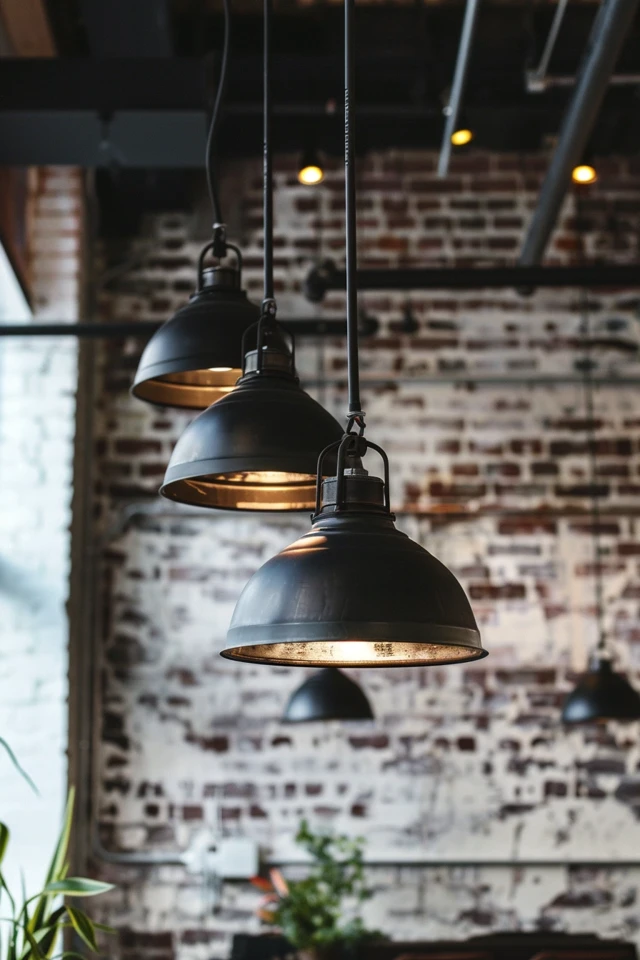
Industrial Pendant Lights: Elegant Illumination
I remember walking into a salvage yard about ten years ago, looking for lighting for a downtown loft renovation. At that time, “industrial” meant rusty cages, heavy iron chains, and fixtures that looked like they weighed a ton. It was a specific look, but it wasn’t exactly elegant.
Fast forward to today, and industrial pendant lights have undergone a massive transformation. They have shed the grit but kept the soul. Now, we see spun brass, matte black finishes, and prismatic glass that fit just as well in a suburban farmhouse or a sleek modern apartment as they do in a converted warehouse.
Finding the right balance between rugged durability and refined style is the key to making this look work. If you are looking for specific examples of how to style these fixtures, be sure to scroll down to the Picture Gallery at the end of this blog post.
Defining the New Industrial Aesthetic
The modern industrial look is less about replicating a factory floor and more about celebrating mechanics and materials. It focuses on the “how” of the object. You see the screws, the joinery, and the bulb itself.
However, “elegant” industrial design cleans up the lines. Instead of raw, rusting steel, we use powder-coated metals or hand-rubbed antique brass. The heavy cages are replaced by sleek wire guards or removed entirely to focus on a high-quality shade.
Designer’s Note: The Material Mix
In a recent project, my client was terrified that industrial lighting would make her kitchen look cold. We compromised on fixtures that featured a matte black exterior shade with a hammered gold interior. When the lights were on, the gold warmed the light, casting a soft, flattering glow rather than a harsh spotlight. The lesson? Pay attention to the inside of the shade as much as the outside.
Material Palette to Look For
- Prismatic Glass: Also known as Holophane glass, this ribbed texture diffuses light beautifully and adds a vintage institutional vibe without being heavy.
- Spun Metal: Look for shades that appear to be one continuous piece of metal. This offers a cleaner, more sophisticated silhouette.
- Mixed Metals: A fixture with a black shade and brass hardware is the ultimate bridge between industrial and transitional styles.
Mastering Kitchen Island Placement
The kitchen island is the most common place clients want to install industrial pendants. It acts as the jewelry of the kitchen. However, this is also where I see the most mistakes regarding scale and spacing.
Because industrial fixtures can be visually heavy (especially metal domes), you have to be careful not to overcrowd the space. You want the eye to travel through the room, not get stuck on a wall of metal hanging from the ceiling.
The Rule of Three vs. Two
There is a long-standing debate about whether to use two large pendants or three smaller ones.
Go for two large pendants if:
- Your island is less than 7 feet long.
- You want a bold, statement look.
- The pendants are solid metal (non-transparent), which takes up more visual space.
Go for three pendants if:
- Your island is longer than 8 feet.
- You are using glass shades (like clear globes or prismatic glass) that feel lighter.
- You prefer a balanced, rhythmic look.
The Essential Measurements
I keep a cheat sheet on my phone for installation days. Here are the numbers I swear by for kitchen islands:
- Height: The bottom of the pendant should sit 30 to 36 inches above the countertop. If your family is very tall, lean toward 36 inches so you aren’t staring directly into the shade while standing.
- Spacing Between Fixtures: Aim for 30 inches between the center of one bulb to the center of the next. You generally want the distance between the bulbs to be the same as the diameter of the fixture, or slightly larger.
- Edge Distance: Leave at least 12 to 18 inches from the edge of the counter to the side of the fixture. If the light hangs over the edge of the island, the scale is wrong.
Selecting the Right Bulb (Crucial for Exposed Fixtures)
With industrial lighting, the bulb is often part of the design. Many industrial pendants have open bottoms or wire cages that leave the bulb completely exposed.
If you choose the wrong bulb, you ruin the fixture. A standard frosted plastic LED bulb from the grocery store will look cheap and out of place inside a beautiful brass cage.
The “Edison” Dilemma
Vintage-style Edison bulbs (the ones with the visible glowing filaments) are the standard for this look. However, old-school incandescent Edison bulbs get incredibly hot and use a lot of energy. They also cast a very orange light (around 2200K) that can make food look unappealing.
Common Mistake: The “Orange Haze”
I once walked into a dining room where the homeowner had installed heavy amber-tinted Edison bulbs. The room looked like a dimly lit dive bar. It was cozy, but you couldn’t read a menu or see the true color of the salad.
The Fix:
Use “filament style” LEDs. Look for clear glass envelopes rather than amber-tinted ones if you want cleaner light. Aim for a color temperature of 2700K (Warm White) or 3000K (Soft White). This gives you the warmth without the muddy orange tint.
Lumens and Brightness
Industrial metal shades direct all the light downward. This is great for task lighting but can leave the ceiling dark, making the room feel smaller.
If your pendants are metal domes, you need to ensure you have other layers of light in the room, such as recessed cans or under-cabinet lighting. Do not rely on industrial pendants as your sole light source in a kitchen.
Dining Room Drama: Scale and Height
Taking industrial pendants into the dining room creates a distinct focal point. Unlike a crystal chandelier which refracts light outward, industrial fixtures usually provide “downlight.”
This creates a moody, intimate atmosphere directly on the table, which is perfect for dinner parties. However, it requires precise placement to avoid shadows on faces.
Sizing the Fixture to the Table
A common rule of thumb I use is the “two-thirds” rule. The chandelier or linear pendant should be roughly one-half to two-thirds the width of your dining table.
If you have a round table that is 48 inches wide, look for a fixture that is between 24 and 32 inches wide.
If you are using a long rectangular table, consider a linear industrial fixture or hang two matching oversized pendants side-by-side.
Hanging Height for Dining
The Standard Rule:
The bottom of the fixture should be 30 to 36 inches above the table surface.
The “High Ceiling” Adjustment:
If you have ceilings higher than 8 feet, raise the fixture 3 inches for every additional foot of ceiling height. This prevents the light from looking like it is strangling the table in a tall room.
Real-World Constraint:
If your dining table is in a multipurpose room where you might push the table aside for parties or yoga, you need to walk under the light. In this case, the bottom of the fixture must be at least 7 feet off the floor. If that places it too high for the table, consider a fixture on a retractable pulley (a classic industrial feature) or choose a different location.
Mixing Metals and Finishes
One of the most frequent questions I get is, “Do my lights have to match my faucet?”
The short answer is no. In fact, matching everything perfectly can make a room look like a builder-grade showroom rather than a curated home.
Industrial style thrives on the mix. It mimics the gathered nature of a workshop. However, there is a method to the madness.
The 70/30 Rule
Pick one dominant metal and one accent metal.
If your kitchen faucet and cabinet hardware are polished nickel (70%), you can bring in matte black industrial pendants (30%) to add contrast.
If your cabinet pulls are unlacquered brass, try pendants in a dark oil-rubbed bronze or gunmetal grey.
What I’d do in a real project:
I love mixing black and brass. I would use matte black industrial dome lights over the island. Then, I would use brass cabinet hardware and a brass faucet. The black lights act as a neutral anchor, while the brass adds the sparkle.
Installation: Cords, Rods, and Chains
The suspension method changes the vibe of the light entirely.
Fabric Cords:
These feel more casual and vintage. They are great for “swagging” a light if your junction box isn’t perfectly centered.
Warning: Fabric cords can gather dust and grease in a kitchen. They are harder to clean than metal rods.
Straightening Tip: New fabric cords often hang crooked. Run a hairdryer over the cord on low heat and gently pull it straight to relax the fibers.
Metal Rods (Stems):
This is the most “elegant” option. It looks structural and permanent.
* Constraint: You are limited to the lengths of the rods provided (usually 6-inch and 12-inch segments). You don’t have infinite adjustability.
Chains:
Chains lean towards the rustic or nautical side of industrial. They are excellent for vaulted ceilings because gravity ensures the light hangs straight down, regardless of the ceiling angle.
Final Checklist: Before You Buy
Before you click “purchase” on those stunning lights, run through this mental checklist. It has saved me from many return-shipping headaches.
- Check the canopy size: Is the plate that attaches to the ceiling wide enough to cover the hole cut for your junction box?
- Verify the max wattage: Can the fixture handle the brightness you need? Many decorative industrial lights max out at 60 watts.
- Measure the weight: Real industrial fixtures made of iron or thick glass can be heavy. If a fixture exceeds 50 lbs, you need a specialized junction box braced to the ceiling joists.
- Slope compatibility: If you have a vaulted ceiling, does the fixture have a swivel or ball joint at the canopy? If not, the rod will stick out at a weird angle.
- Dimmability: Ensure the fixture and the bulbs are dimmable. Industrial lighting is intense; you will want to lower the lights for atmosphere in the evening.
FAQs
Q: Can I use industrial pendants in a low-ceiling room?
A: Yes, but avoid pendants on chains. Look for “semi-flush mount” industrial fixtures. These bolt close to the ceiling but still offer the cage or metal-shade aesthetic without obstructing the walkway.
Q: How do I clean grease off matte black metal shades?
A: Avoid abrasive sponges, which will polish the matte finish and make it shiny. Use a microfiber cloth with warm water and a drop of mild dish soap. Wipe gently and dry immediately to prevent water spots.
Q: My kitchen is white and modern. Will industrial lights look out of place?
A: Not at all. In fact, industrial lights add necessary texture to sleek white kitchens. Look for polished chrome or glossy white enamel industrial shades to bridge the gap between modern and industrial.
Q: Do I need a professional electrician to install them?
A: If you are simply swapping an existing fixture for a new one, a handy homeowner can usually do it. However, if you are adding new locations (like putting two lights where there was only one), you absolutely need an electrician to run new wiring and ensure the boxes are centered.
Conclusion
Industrial pendant lights have graduated from the garage to the gallery. They offer a unique way to ground a room, adding weight and history to spaces that might otherwise feel too precious or new.
By focusing on scale, bulb temperature, and quality materials, you can introduce this rugged aesthetic into your home without sacrificing elegance. Whether you choose a prismatic glass globe or a bold matte black dome, the right light doesn’t just illuminate the room—it defines it.
Picture Gallery


