
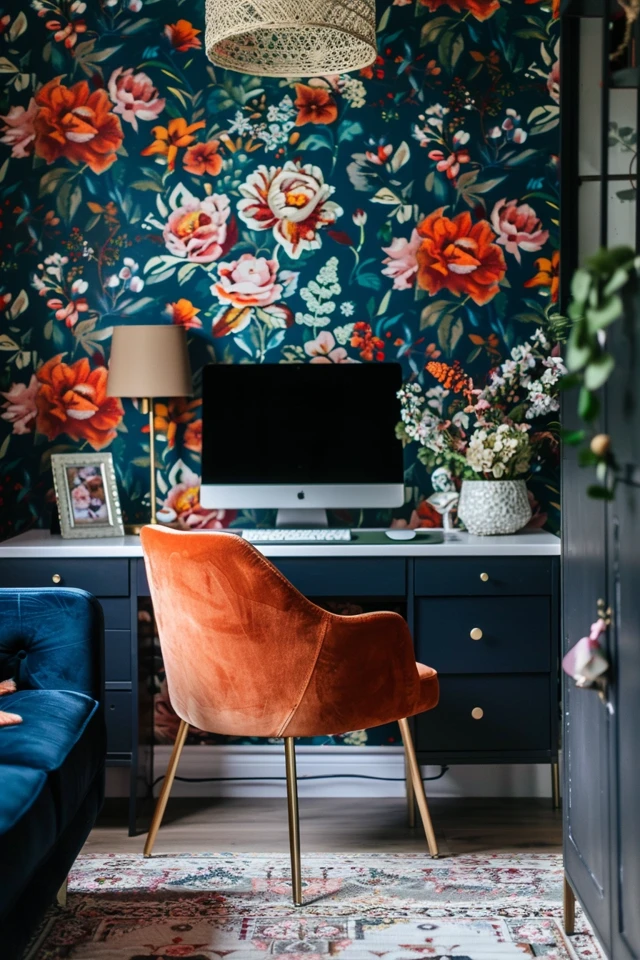
Inspiring Home Office Wallpaper Ideas to Transform
Working from home has shifted from a temporary necessity to a permanent lifestyle for many of us. However, staring at a blank, beige wall for eight hours a day does very little for creativity or motivation. Your workspace needs to be functional, but it also needs to inject energy into your daily routine.
I have seen countless clients struggle with home offices that feel more like storage closets than places of business. Be sure to scroll to the end of this article to explore our curated picture gallery featuring stunning home office wallpaper ideas. Wallpaper is the single most effective tool for changing the psychology of a room without undergoing a major renovation.
In this guide, I will walk you through professional strategies for selecting the right wallcovering. We will move beyond simple aesthetics and discuss how texture, scale, and placement affect your productivity and video call presence.
1. Establishing the Focal Point and Wall Placement
Before falling in love with a pattern, you must decide where the wallpaper will live. In a home office, you generally have two strategic options for placement.
The first option is the “Zoom background” wall. This is the wall directly behind you when you are seated at your desk. Wallpapering this surface creates a professional, styled backdrop for video calls, effectively hiding the rest of the room.
The second option is the “inspiration” wall. This is the wall you face while working. If your desk faces a wall rather than a window, I highly recommend wallpapering this surface to reduce eye strain and provide visual relief during long tasks.
Designer’s Note: The “360” Trap
A common mistake I see is assuming you must wallpaper all four walls. In a small home office (typically 10×10 or smaller), wrapping a bold pattern around the entire room can feel claustrophobic.
If the pattern is large-scale or dark, stick to one accent wall. If you choose a subtle texture or a small-scale neutral print, you are safe to wrap the whole room.
Common Mistakes + Fixes
- Mistake: Wallpapering the wall behind your monitor with a high-contrast geometric pattern.
- Fix: High contrast creates visual noise that competes with your screen. If wallpapering your view, choose low-contrast tonals or organic patterns. save the high-contrast drama for the wall behind your chair.
2. Leveraging Texture with Grasscloth and Faux Finishes
When clients ask for a home office that feels “sophisticated” and “quiet,” I almost always turn to texture rather than print. Grasscloth is a natural material woven from arrowroot, jute, or seagrass.
Grasscloth adds incredible depth and warmth to a room without screaming for attention. It is particularly effective in masculine designs or shared office spaces where you want a gender-neutral backdrop.
Beyond aesthetics, real grasscloth offers a hidden functional benefit: acoustics. The natural fibers help dampen sound, reducing the “echo” effect that often plagues spare bedrooms turned into offices.
If you are on a budget or have a cat that loves to scratch, real grasscloth is risky. In these cases, I specify high-quality vinyl faux grasscloth. Modern printing technology has gotten so good that you often have to touch the wall to know it isn’t real weave.
Designer’s Note: The Seam Debate
Real grasscloth will always have visible seams. The horizontal strands will not line up perfectly from one panel to the next.
This is not a defect; it is the hallmark of a natural product. If you are a perfectionist who needs invisible seams, you must choose a faux vinyl option or a standard printed paper.
What I’d do in a real project:
- For a luxury executive look, I choose a navy or charcoal grasscloth.
- I pair this with walnut wood furniture and brass lighting.
- I ensure the lighting temperature is warm (2700K-3000K) to highlight the weave texture.
3. Biophilic Design: Bringing the Garden Indoors
Biophilic design is the concept of connecting building occupants more closely to nature. In a home office, this is a productivity hack. Studies suggest that viewing nature can lower cortisol levels and improve focus.
You do not need a window with a garden view to achieve this. Botanical wallpapers are my go-to for windowless offices or basement workspaces.
When selecting a botanical print, pay close attention to the style. “Grandmillennial” florals can feel traditional and soft, which is lovely for a creative writing space. However, for a modern, energetic vibe, look for large-scale palm leaves or dark, moody jungle prints.
The Rule of Scale
The size of the pattern should relate to the size of the wall, but not necessarily the size of the room. A tiny powder room or small office can actually handle a massive, over-scaled print.
Large prints in small spaces blur the corners of the room, tricking the eye into thinking the space is larger. Tiny, repetitive patterns in a small room can sometimes feel cluttered.
Common Mistakes + Fixes
- Mistake: Choosing a “ditsy” floral (tiny, tight pattern) for a Zoom background.
- Fix: On camera, small patterns can create a “moiré effect,” where the pattern appears to vibrate or strobe. Stick to medium or large-scale botanicals for video backgrounds.
4. Geometric Patterns for Structure and Order
If you thrive in an organized, structured environment, organic florals might feel too chaotic. Geometric wallpapers provide a sense of order and rhythm that appeals to analytical minds.
Geometrics are fantastic for manipulating the perceived dimensions of your office. Vertical stripes are the oldest trick in the book for raising a low ceiling. This is particularly useful in attic offices with slanted ceilings.
For a modern look, avoid standard pin-stripes. Look for broken grids, hexagonal honeycombs, or Art Deco-inspired arches. These add architectural interest to plain drywall boxes.
Color Considerations for Geometrics
Because geometric patterns are repetitive, high-contrast colors (like black and white) are very stimulating. This is great for high-energy sales roles but might be distracting for deep-focus coding or writing.
For a balanced approach, look for “tone-on-tone” geometrics. This might be a light grey pattern on a white background, or a gloss pattern on a matte background of the same color.
Designer’s Note: Installation Accuracy
Geometric patterns are the hardest to install. If your walls are not perfectly plumb (and they never are), the pattern will start to drift.
If you are DIYing this, purchase 20% overage rather than the standard 15%. You will need the extra paper to match the pattern perfectly at the ceiling line.
5. Murals: The Statement Wall Solution
Sometimes a repeating pattern isn’t enough. Wall murals have made a massive comeback, thanks to digital printing capabilities. Unlike standard wallpaper, a mural is a single image that spans the entire wall.
Murals work best as a standalone art piece. I often use etched landscape murals (grisaille style) to create a sense of depth and horizon. This effectively “knocks down” the wall, making the room feel like it opens up into a landscape.
This is an excellent choice for renters. Many modern murals come in high-quality peel-and-stick fabrics that can be removed without damaging the drywall.
Furniture Placement with Murals
The challenge with murals is furniture obstruction. You do not want to put a tall bookshelf in front of the main focal point of the image.
Before ordering, map out exactly where your monitor, chair, and shelving will sit. Many custom mural companies allow you to mirror or shift the image so the important elements are visible above your desk height.
What I’d do in a real project:
- I measure the wall height and width at three different points to account for bowing.
- I choose a mural where the “horizon line” sits slightly above the height of the computer monitors (usually 45-50 inches off the floor).
- I paint the remaining three walls a color pulled directly from the mural’s background to unify the space.
Final Checklist: The Designer’s Protocol
Ready to commit? Do not click “buy” until you have run through this specific checklist. This is the exact process I use to ensure a project runs smoothly.
1. The Sample Test
Never buy wallpaper online based on the screen image alone. Colors vary wildly on monitors.
- Order a physical sample.
- Tape it to the wall you intend to paper.
- Leave it there for 24 hours. Observe how it looks in morning light, afternoon sun, and under your office lamps at night.
2. The Roll Calculation
Do not rely on the simple “square footage” calculator on the website.
- You must account for the “pattern repeat.” A large pattern repeat (e.g., 24 inches) means you waste more paper matching the design.
- Always buy one extra roll (a “double roll”) than you think you need. Dye lots change. If you run short, the next batch might be a slightly different shade.
3. The Surface Prep
Wallpaper acts like a magnifying glass for wall imperfections.
- Fill all nail holes and sand them flush.
- Wash the walls with TSP (Trisodium Phosphate) or a degreaser to remove dust and oils.
- Crucial Step: Apply a “sizing” or a wallpaper-specific primer. This seals the drywall and allows the wallpaper to slide into position during installation. It also makes removal years later much easier.
4. The Lighting Check
Does your wallpaper have metallic or gloss elements?
- Check for glare. If your desk lamp hits a metallic gold stripe, it might reflect light directly into your eyes.
- Adjust your lighting placement before installation to ensure the glare won’t be an issue.
Frequently Asked Questions
Can I wallpaper a rental office?
Absolutely. Look for “removable wallpaper” or “peel-and-stick” options. These are essentially high-quality stickers. However, be warned: peel-and-stick is actually harder to install than pasted paper because you cannot slide it around on the wall to match the seams. You have to get it right the first time.
How do I clean wallpaper in a home office?
Most modern wallpapers are “washable” or “scrubbable.” For vinyl papers, use a damp sponge with a tiny amount of mild dish soap. For grasscloth or paper-based options, simply vacuum them using the soft brush attachment to remove dust. Never use abrasive scrubbers or bleach products.
Should I wallpaper the ceiling?
The “fifth wall” is a fantastic place for wallpaper in an office, especially if the room is small. It draws the eye up and creates a cozy, jewel-box effect. If you paper the ceiling, keep the walls neutral to avoid sensory overload.
What if my office has textured walls?
Wallpaper needs a smooth surface. If you have heavy “orange peel” or “knockdown” texture, the wallpaper will not adhere correctly, and the bumps will show through. You have two options: skim coat the walls flat with joint compound (messy and skilled work), or use a heavy-grade lining paper first to smooth out the surface before applying the decorative paper.
Conclusion
Transforming your home office with wallpaper is an investment in your career and your mental well-being. By moving away from sterile white walls and introducing texture, color, and pattern, you signal to your brain that this is a space for focus and creation.
Remember to consider the practical constraints of your specific room, such as lighting direction and ceiling height. Don’t be afraid to order multiple samples before making a decision. The right wallpaper does not just decorate the room; it sets the tone for your entire workday.
Picture Gallery


