
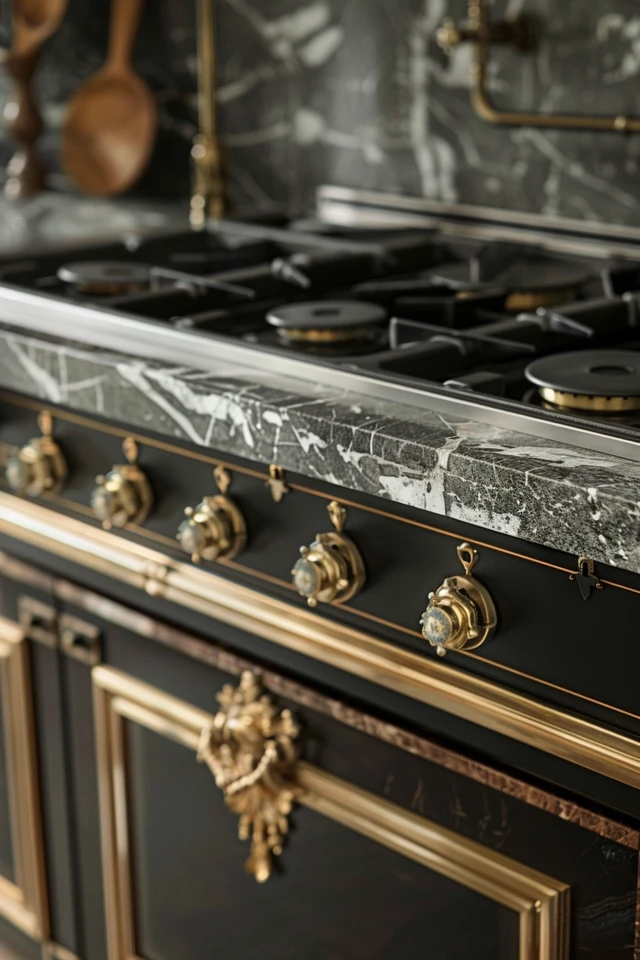
La Cornue Oven Review: My French Kitchen Luxury
When you envision a dream kitchen, the appliances often dictate the layout and the aesthetic. For many of my clients, the crown jewel of that vision is a La Cornue range. It is less of a stove and more of a piece of architectural art, bringing a distinct sense of French heritage into the modern home.
I have specified these ranges for multiple projects and even lived with one myself, so I understand the allure and the practical realities. For more inspiration, check out the Picture Gallery at the end of the blog post.
However, investing in a La Cornue is a significant financial commitment and a design challenge. It requires careful planning regarding layout, ventilation, and fueling. In this review, I will break down exactly what you need to know, from the cooking performance to the critical installation measurements.
The Aesthetic Appeal: More Than Just a Stove
The primary reason homeowners choose La Cornue is undeniably the look. In a world of stainless steel boxes, these ranges offer personality, curvature, and color. The “Albertine” and “CornuFé” lines are the most common entry points for US homeowners.
The finish options are stunning, ranging from Gloss Black to Tapestry (a deep teal) and Pure White. The hardware, usually available in polished brass, stainless steel, or copper, acts as the jewelry of the kitchen.
As a designer, I treat the La Cornue as the focal point of the room. It anchors the cabinetry and dictates the metal finishes for the rest of the space.
Designer’s Note: Metal Mixing Rules
A common mistake is trying to match every metal in the kitchen to the range. If you choose a range with brass trim, do not feel pressured to use brass faucets and brass cabinet pulls everywhere.
I prefer to match the cabinet hardware on the immediate surrounding drawers to the range.
The faucet can remain polished nickel or stainless steel to coordinate with the sink.
Lighting fixtures can pick up the brass accent to create a vertical connection in the room.
Cooking Performance: Does It Function as Well as It Looks?
There is a prevalent fear that these ranges are “all show and no go.” In my experience, that is simply not true, but there is a learning curve. The burners on the gas cooktop are robust, often featuring a high-output central burner that is excellent for boiling water quickly.
The ovens, however, function differently than standard American appliances. Most La Cornue ranges, particularly the 110 model, feature two smaller ovens rather than one massive cavity. One is typically a multi-function convection oven, and the other is a static electric oven.
This setup is actually superior for active cooks. You can roast vegetables at a high heat in one oven while slow-cooking a protein in the other. The convection seal is tight, meaning flavors do not transfer, and moisture is retained exceptionally well.
What I’d do in a real project: The Cookie Sheet Test
Before ordering, I always warn clients about the interior dimensions.
You will need to buy “quarter sheet” pans or specific European-sized cookware.
If you roast massive 25-pound turkeys annually, you must measure the cavity first or opt for the “Albertine” model, which has one large single oven.
CornuFé vs. Château: Understanding the Difference
It is vital to understand that there are two distinct tiers of La Cornue. The series you choose affects your budget, your timeline, and your installation requirements.
The CornuFé series is the “accessible” luxury line. These are manufactured with modern production methods.
They come in standard sizes (90cm and 110cm).
They are usually in stock or have a lead time of 4 to 8 weeks.
The price point typically lands between $10,000 and $15,000.
The Château series is entirely bespoke. Each unit is made to order by hand in France.
The ovens are vaulted, which creates a natural convection effect without fans.
The lead time is significantly longer, often 6 to 9 months or more.
Prices start around $30,000 and can easily exceed $60,000 depending on the size.
Common Mistakes + Fixes
Fix: If you want the custom Château series, it must be the very first thing you order. The lead times are notorious. Do not start demolition until you have a confirmed delivery window, or be prepared to live with a temporary cooktop for months.
Installation and Design Constraints
Designing a kitchen around a freestanding French range requires specific technical attention. These are not slide-in ranges that fit into a standard 30-inch gap.
Clearance and Depth
Standard American base cabinets are 24 inches deep. La Cornue ranges often sit slightly proud of the cabinetry (around 26 to 27 inches deep including the handle). This is intentional; it protects your cabinet finish from heat.
I recommend using a “scribing” filler piece or a decorative pilaster on either side of the range to give it breathing room.
Ventilation is Non-Negotiable
High-BTU gas burners require serious extraction. You cannot use a weak microwave hood vent here.
The hood should be 6 inches wider than the range (3 inches on each side) to capture smoke effectively.
Ideally, mount the hood 30 to 36 inches above the cooking surface.
Gas and Electrical Connections
Most La Cornue ranges are dual-fuel. This means you need a gas line for the cooktop and a 220V/240V electrical outlet for the electric ovens.
Many older homes only have a standard 110V outlet behind the stove.
You will likely need an electrician to run a new dedicated line.
Check the “hookup” location on the spec sheet. French ranges often have specific zones where the gas pipe must emerge from the wall or floor to allow the unit to push back fully.
Durability and Daily Maintenance
Living with a La Cornue is largely a joy, but it does require care. The enamel finish is incredibly durable and resistant to heat, but it is effectively glass fused to metal. It can chip if hit with a heavy cast-iron skillet.
Cleaning the top is the biggest adjustment for new owners. The CornuFé series features a stainless steel accumulation tray under the grates. This tray catches spills and crumbs.
However, stainless steel scratches. Over time, the area around the burners will develop a patina of fine scratches.
I tell clients to embrace this. It shows the kitchen is used. If you want it to look pristine forever, this might not be the right appliance for you.
For the brass or copper accents, you have a choice. You can polish them regularly to keep them shiny, or let them oxidize naturally for an antique look. I personally prefer the natural patina, as it adds character.
Family Friendliness
If you have toddlers, be aware of surface temperatures.
The oven doors are well-insulated, but they still get warm.
The controls are front-mounted knobs. Young children love to turn knobs.
* Consider installing a master gas shut-off valve in a nearby cabinet if you are worried about little hands turning on the gas when you aren’t looking.
Final Checklist: Before You Buy
If you are ready to take the plunge, use this checklist to ensure a smooth process.
- Measure your walkway: Ensure you have at least 42 to 48 inches of clearance in front of the range so you can open the oven doors fully without hitting the island.
- Confirm the fuel type: Check if your home has natural gas or liquid propane (LP). You must order the correct kit.
- Check the electrical: Verify you have a 4-prong, 240V outlet ready, or schedule an electrician.
- Plan the path: These ranges are incredibly heavy (300+ lbs). Measure all doorways and hallways leading to the kitchen to ensure the delivery crew can get it in.
- Verify the hood specs: Ensure your ventilation matches the BTU output of the range.
- Order cookware: Buy flat-bottomed cookware for better contact with the burners and smaller roasting pans for the ovens.
FAQs
Q: Can I fit a Thanksgiving turkey in a La Cornue?
A: Yes, but with caveats. If you have the Albertine (single oven), it fits easily. If you have the 90 or 110 models with split ovens, a 25lb bird might be tight. You may need to cook a smaller bird or separate the turkey pieces.
Q: Is the CornuFé worth the money over a Wolf or Viking?
A: From a purely technical standpoint, a Wolf might offer more precise simmering or larger capacity. You are paying a premium for the design and the French heritage. If aesthetics and joy of use are high priorities, it is absolutely worth it.
Q: How hard is it to get service if it breaks?
A: This depends on your location. In major metro areas (NY, LA, Miami), service is readily available. in rural areas, it can be a challenge. Always call the distributor beforehand to ask about authorized service agents in your zip code.
Q: Does the stainless steel top scratch easily?
A: Yes. Sliding heavy pots across the accumulation tray will cause scratches. This is considered normal wear and tear for this style of range.
Conclusion
A La Cornue range is a statement piece that transforms a kitchen from a utility room into a gathering space. It demands attention and offers a tactile, analog cooking experience that digital touchscreens simply cannot replicate.
While the split oven sizes and maintenance requirements take some getting used to, the payoff is a kitchen that feels timeless and curated. If you plan your installation carefully and embrace the quirks of French design, it will likely become your favorite object in your home.
Picture Gallery


