
La Cornue vs Lacanche: Luxury Range Showdown
When a client tells me they want a French range, the conversation almost immediately narrows down to two heavyweights: La Cornue and Lacanche. These aren’t just appliances; they are the anchors of a kitchen design, setting the tone for the entire renovation.
However, choosing between them is rarely just about aesthetics. I once had a client who ordered a stunning La Cornue Château based solely on a Pinterest photo, only to realize six months later that the oven configuration didn’t fit her favorite roasting pan. If you are just looking for inspiration, you can skip to the Picture Gallery at the end of the blog post.
In this guide, we are stripping away the marketing fluff to look at how these ranges actually perform, how they fit into a layout, and which one deserves the investment.
1. The Heritage and the “Vibe”
Both brands are steeped in French history, but they occupy different psychological spaces in a home. La Cornue is often referred to as the “Bentley” of ranges. It is polished, refined, and feels like a piece of jewelry.
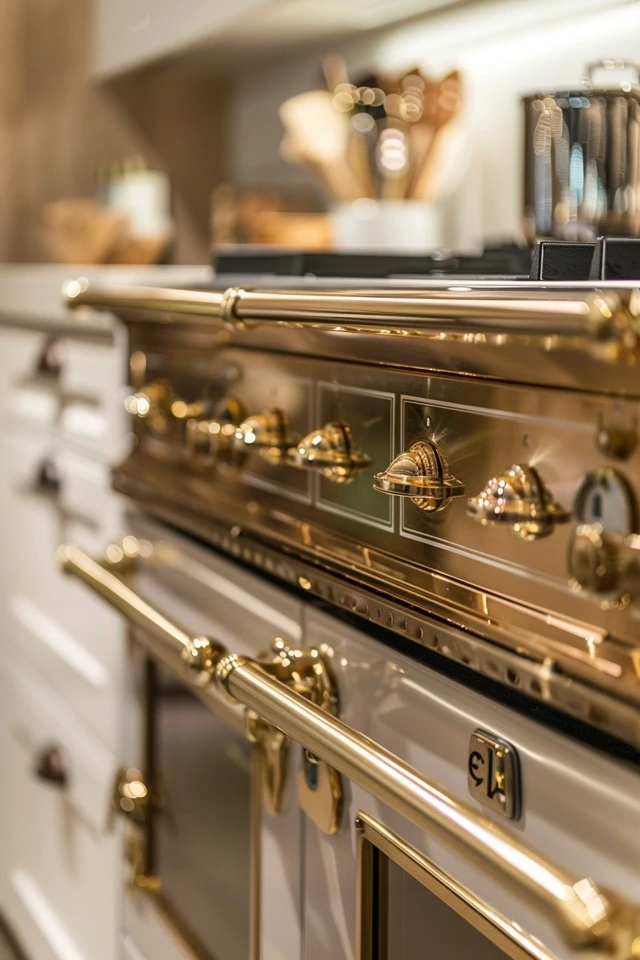
The La Cornue Château line is hand-assembled outside of Paris. It is famous for its architectural presence, heavy brass detailing, and that iconic vaulted oven. If your kitchen design leans toward high-glamour, Beaux-Arts, or ultra-luxury traditional, La Cornue is the natural aesthetic fit.
Lacanche, on the other hand, is the “Land Rover.” It is rugged, utilitarian, and built in Burgundy with a focus on serious gastronomy. It feels less like a showpiece and more like a tool found in a country estate kitchen. It suits designs that are organic, rustic-modern, or transitional.
Designer’s Note: The “CornuFé” Distinction
There is a massive difference between the La Cornue Château series and the CornuFé series. The Château is the custom, handmade legend with the vaulted oven. The CornuFé is a production-line model (manufactured in conjunction with Aga/Rangemaster) designed to offer the “look” at a lower price point.
- Château: Fully custom, infinite colors, vaulted oven, sky-high price.
- CornuFé: Standard sizes (90cm and 110cm), convection ovens, stock colors, mid-range luxury price.
2. Oven Performance and Capacity
This is where the rubber meets the road. European cooking habits differ from American habits, and this is most evident in oven size. If you regularly host Thanksgiving for 20 people, pay close attention here.
La Cornue’s Château line features their patented vaulted oven. The shape prohibits air from trapping in corners, creating a natural convection that locks in moisture. It is arguably the best gas oven in the world for roasting meats. However, the cavity is not massive.
Lacanche takes a modular approach. Most Lacanche ranges (like the popular Cluny model) feature two smaller ovens side-by-side rather than one large cavity. These ovens are undeniably small by US standards. A standard commercial baking sheet often will not fit in a Cluny oven; you must use the specific pans provided by Lacanche or smaller quarter-sheets.
Common Mistakes + Fixes
Mistake: Assuming your current cookware will fit.
Fix: If you bake large batches of cookies or roast 25lb turkeys, do not buy the Lacanche Cluny (1000mm). Upgrade to the Lacanche Sully (1400mm) or the Chagny. The Sully offers larger ovens that accommodate American standard full-size sheets.
What I’d do in a real project
If the client is a serious baker, I usually nudge them toward the Lacanche with an electric convection option. The temperature control is precise. If the client is a “roaster” (meats, vegetables, braises), the La Cornue gas vaulted oven is superior.
3. Cooktop Configuration and The “French Top”
The crown jewel of French cooking is the “plaque coup de feu,” or traditional French Top. This is a cast iron plate that sits over a high-power gas burner. It gets scorching hot in the center and cooler toward the edges.
Lacanche excels at modularity here. You can configure your cooktop with almost anything: gas burners, induction rings, a French top, a plancha (griddle), or even a multi-cooker (steamer/boiler). You are building a custom workstation.
La Cornue’s Château also offers configuration, but the options feel slightly more rigid compared to the “Lego-like” ability of Lacanche. The burners on a La Cornue are incredibly powerful brass beauties, widely considered some of the most durable in the industry.
Real-World Usage Rules
- The Heat Factor: A French top emits a massive amount of ambient heat. In a small kitchen or a warm climate, this will raise the room temperature significantly.
- The Patina: The cast iron plate will stain, spot, and darken. It is not meant to look pristine. If you have a Type-A personality regarding cleanliness, stick to standard sealed burners or induction.
- Ventilation: You cannot skimp on the hood. For a French top, I specify a hood that is 6 inches wider than the range (3 inches overlap on each side) to capture the plume of heat and grease.
4. Dimensions and Kitchen Planning
Integrating these ranges requires precise planning. Unlike standard US ranges that slide into a 30, 36, or 48-inch opening, French ranges use metric measurements.
A “36-inch” equivalent is usually 90cm or 100cm, which does not align perfectly with standard American cabinetry sizes. As a designer, I always require custom filler strips or “scribes” on either side of the range.
Standard Spacing Guidelines
- Aisle Width: Because the oven doors on both brands (especially Lacanche) can be lower or swing open differently, I prefer a minimum 48-inch aisle between the range and the island. 42 inches is the absolute minimum, but 48 allows two people to pass while an oven door is open.
- Depth: These ranges are deep. A Lacanche can sit slightly proud of standard 24-inch base cabinets. We often design the cabinetry run to be 26 or 27 inches deep to accommodate the gas line and make the range look built-in rather than protruding.
- Gas Location: Do not guess the gas location. You must order the range, receive the “spec sheet” for that specific serial number, and give it to your plumber. The gas intake is often in a different spot than a Wolf or Viking.
5. Price and Lead Times
Let’s talk numbers, because the gap can be significant.
La Cornue Château is the most expensive option. You are paying for the brand cachet, the materials, and the hand-assembly. A large Château can easily run upwards of $50,000 to $100,000 depending on the size and finish.
The La Cornue CornuFé is the entry point, usually landing between $10,000 and $15,000. It is accessible and in stock more often, but you lose the custom magic.
Lacanche is the value proposition in the luxury market. A custom Lacanche often costs less than a Château but more than a CornuFé. You can get a stunning, fully custom Lacanche for $15,000 to $25,000.
The Waiting Game
This is the biggest hurdle for renovations.
- Lacanche: Almost always built to order. Lead times fluctuate but generally hover around 5 to 7 months. They come via sea freight.
- La Cornue Château: Strictly built to order. Expect 6 to 9 months or more.
- La Cornue CornuFé: Often stocked in the US (in standard colors like black, white, and navy). You could potentially get one in 2 to 4 weeks.
6. Service and Maintenance
This is the unsexy part of design that keeps me up at night. If you live in a major metro area like NYC, Los Angeles, or Chicago, you will find certified technicians for both brands.
If you live in a rural area or a secondary market, service can be a nightmare. La Cornue, being owned by the Middleby Corporation (a massive appliance conglomerate), generally has a more robust service network in the US.
Lacanche is distributed in the US primarily through Art Culinaire. Their support team is legendary for being helpful over the phone, but they rely on local third-party technicians.
Maintenance Reality Check
- Brass Trim: Unlacquered brass will tarnish. You will need to polish it if you want the shine, or let it age if you want the character.
- Cleaning: Both brands use high-quality enamel. Do not use abrasive sponges (like the green side of a Scotch-Brite). Use soft cloths and warm soapy water. A chipped enamel front is heartbreaking and expensive to replace.
Final Checklist: Which One is For You?
Before you place that deposit, run through this quick decision matrix.
Choose La Cornue Château if:
- Budget is not a primary constraint.
- You want a centerpiece with high-gloss, jewelry-like finishes.
- You roast meats frequently and want the moisture-locking vaulted oven.
- You have a local authorized servicer confirmed.
Choose La Cornue CornuFé if:
Choose Lacanche if:
FAQs
Do these ranges hold their value?
Yes. Unlike a standard Samsung or GE appliance that is worth $0 in ten years, a well-maintained La Cornue or Lacanche is an asset. They are simple machines with very few circuit boards to fail. They can often be resold for a significant portion of their original price, or moved to your next home.
Can I install these in an island?
Technically, yes. However, I advise against it. These ranges are visual anchors that look best against a wall with a prominent hood. Furthermore, the back of the range is often industrial-looking and not meant to be exposed. If you must install in an island, you will need to build a raised pony wall behind it.
Is the oven door hot to the touch?
These are professional-grade appliances. While they are insulated, the doors will get warmer than a standard residential oven. If you have toddlers, you need to be aware of this. However, the knobs generally stay cool to the touch due to the airflow design.
Conclusion
Choosing between La Cornue and Lacanche is not a matter of “better” or “worse.” It is a matter of philosophy. La Cornue offers a heritage of luxury and a specific, grand aesthetic that elevates a kitchen to a showroom level. Lacanche offers a customizable, gastronomical playground for the serious cook who values function as much as form.
In my projects, the decision usually comes down to the lead time and the oven configuration. Measure your roasting pans, check your renovation timeline, and choose the one that makes you excited to cook dinner on a Tuesday night.
Picture Gallery


