
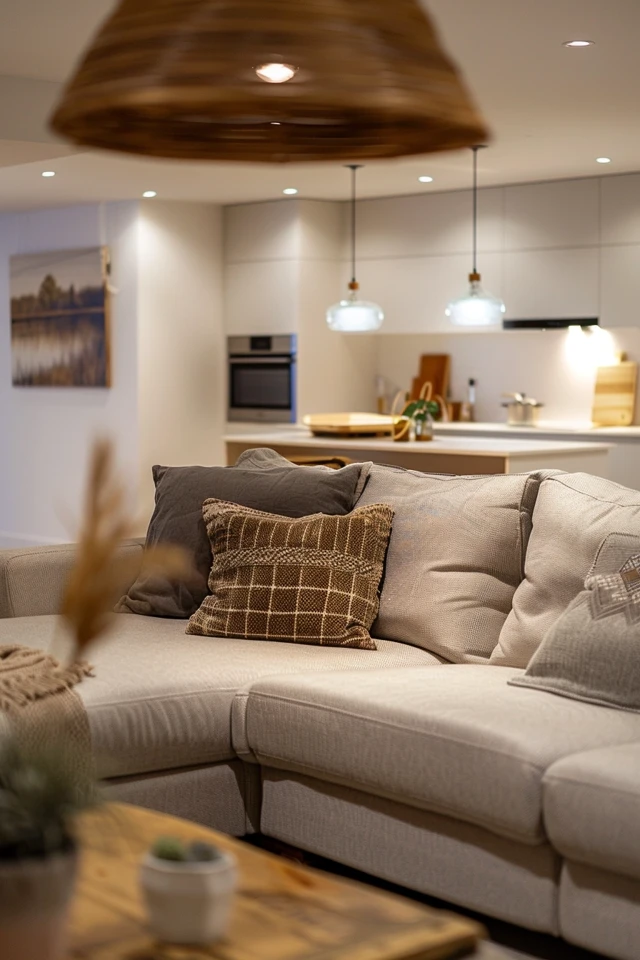
Making A Basement Feel Less Like A Basement: Cozy Transformations
Introduction
We have all walked into a basement that feels like an afterthought. It usually involves a drop ceiling, chilly floors that require slippers, and that distinct, sterile smell of stale air. But the lowest level of your home actually offers the most potential for moody, specialized design because it is separated from the main living areas.
When I approach a basement renovation, I stop treating it as a storage unit that happens to have a sofa in it. Instead, I treat it as a destination—a speakeasy, a dedicated media lounge, or a guest suite that rivals a boutique hotel. The goal is to make people forget they are underground the moment they step off the bottom stair.
To help you visualize these changes, I have gathered some of my favorite finished projects to guide you. For a dose of visual inspiration, scroll all the way down because I curated a Picture Gallery at the end of this post just for you.
1. Lighting Design: Banish the “Cave” Effect
The single biggest giveaway that you are in a basement is poor lighting. Most basements rely on a grid of cheap recessed “can” lights that blast the space with harsh, clinical brightness. To make the space feel cozy, you must layer your lighting just as you would in a living room.
Understanding Color Temperature
You have to get the light bulb temperature right. In a basement with limited natural light, stay strictly between 2700K and 3000K (Kelvin).
Anything higher than 3000K will look blue and resemble a hospital hallway. 2700K provides that warm, inviting glow that mimics incandescent bulbs. Make sure every bulb in the room matches this temperature.
Layering Sources
Never rely solely on overhead lights. I always specify a mix of floor lamps, table lamps, and wall sconces.
If you have low ceilings, wall sconces are your best friend. Install them approximately 60 to 66 inches from the floor to the center of the fixture. This draws the eye up and creates a wash of light against the walls, which pushes the boundaries of the room outward.
Designer’s Note: The Dimmer Rule
In my ten years of designing interiors, I have never installed a basement lighting plan without dimmer switches. Because basements often serve dual purposes—like a playroom by day and a movie room by night—you need control.
If you cannot rewire the walls for sconces, use “plug-in” sconces. You simply mount them to the wall and plug the cord into an outlet. Use a cord cover painted the same color as the wall to make it disappear.
2. Managing Low Ceilings and Ductwork
Basements often come with height restrictions. Standard ceilings are 8 feet, but ductwork often drops that to 7 feet or lower in certain spots. The instinct is often to paint the ceiling white to “make it feel higher,” but that often backfires.
The Case for Color Drenching
When you paint a low ceiling white and the walls a different color, you create a sharp horizontal line that highlights exactly where the room ends.
Instead, I often paint the ceiling, the trim, and the walls the exact same color. This is called “color drenching.” It blurs the edges of the room and makes the ceiling height less perceptible. If you use a moody color like navy or charcoal, the ceiling essentially disappears into the shadow.
Drapery Tricks for Height
If you have small basement hopper windows, do not just cover the glass. Install floor-to-ceiling drapery panels.
Mount the curtain rod as close to the ceiling (or crown molding) as possible, not right above the window frame. Let the fabric hang all the way to the floor, hovering just 1/2 inch off the ground. This vertical line tricks the eye into thinking the window—and the room—is much taller than it is.
Creating a Focal Point
If you cannot fix the ceiling height, distract the eye.
- Use vertical paneling: Beadboard or shiplap running vertically draws the eye up and down.
- Statement art: Hang a large piece of art centered at eye level (roughly 57 to 60 inches from the floor to the center of the piece).
- Tall millwork: Built-in bookshelves that go floor-to-ceiling make the room feel grand regardless of actual height.
3. Flooring: Warmth Underfoot is Non-Negotiable
Basement floors are physically cold because they sit directly on the foundation slab. If your feet are cold, the room will never feel cozy, no matter how nice the furniture is.
Luxury Vinyl Plank (LVP) vs. Wood
I rarely recommend solid hardwood for basements due to moisture fluctuations. Engineered wood is an option, but Luxury Vinyl Plank (LVP) is the current gold standard for durability and water resistance.
Look for a “wear layer” of at least 20 mil for longevity. LVP also allows for a cork or foam underlayment, which provides a thermal break from the cold concrete.
The Importance of Rugs
Even with nice flooring, you need area rugs to anchor the space and add acoustic dampening. Basements can be echo chambers.
Rules for Rug Sizing:
- The “Front Legs” Rule: At a minimum, the front legs of your sofa and accent chairs must sit on the rug.
- Leave a Border: Leave 12 to 18 inches of bare floor visible around the perimeter of the room.
- Go Big: A 5×8 rug is almost always too small for a main seating area. Start looking at 8×10 or 9×12 sizes.
Rug Pad Necessity
Do not skip the rug pad. In a basement, buy a thick felt pad (1/4 inch to 1/2 inch thick). This adds luxury and insulation.
4. Layout and Zoning: Breaking Up the Box
Basements are often long, rectangular boxes with random support columns. The mistake most homeowners make is pushing all the furniture against the walls to “maximize space.” This actually makes the room look like a waiting room.
Float the Furniture
Pull your sofa away from the wall. In a basement, creating an intimate conversation circle is key.
Ideally, you want the front of the sofa to be 14 to 18 inches away from the coffee table. If you have a TV, the viewing distance depends on screen size, but generally, 7 to 9 feet is comfortable for a 65-inch screen.
Dealing with Support Columns
You cannot move structural columns, so you must integrate them.
- The Bar Wrap: Build a bar counter between a wall and a column.
- The Bookshelf Anchor: Use the column as the corner post for a built-in shelving unit.
- The Paint Trick: Paint the column the same color as the walls to help it recede visually. Do not highlight it with stone veneer unless it is part of a very specific lodge aesthetic.
Creating Zones
Since basements are usually open concept, use furniture to define zones.
Use a console table behind a floating sofa to mark the end of the “living room” and the start of the “play area” or “gym.” The console table also gives you a place to add table lamps, bringing light into the center of the room.
5. Materials and Texture: Combatting Sterility
Basement drywall can feel very flat. To get that high-end, cozy feel, you need to add architectural texture. This is what separates a finished basement from a true living space.
Wall Treatments
I love using wainscoting or board-and-batten in basements. It adds depth and shadow.
If you are on a budget, simple picture frame molding (applied directly to the drywall) adds elegance for very little cost. Paint the molding and the wall the same color for a modern, integrated look.
Textiles matter
Since the architecture is often harder and colder (concrete, drywall), your fabrics need to be softer.
- Velvet: A performance velvet sofa is durable but incredibly warm visually.
- Wool: Use wool or wool-blend throws.
- Leather: A worn leather armchair adds character, but balance it with fabric pillows so it doesn’t feel cold to the touch.
Storage that Hides the Ugly
Basements house the mechanical guts of the home—sump pumps, electrical panels, and water shut-offs.
Do not just leave them exposed. Build shallow cabinets or use hinged artwork to conceal electrical panels. For sump pumps, build a bench seat with a removable top. The goal is to hide the utility while maintaining easy access for service.
What I’d Do in a Real Project: Mini Checklist
If I were hired to transform your basement tomorrow, this is the sequence I would follow to ensure success:
- Moisture Audit: Before buying a single pillow, I would tape a 2×2 foot piece of plastic to the concrete floor for 48 hours. If there is condensation underneath when I peel it up, we have a moisture issue to fix first.
- Space Planning: I would tape out the furniture layout on the floor. I would ensure main walkways are 30 to 36 inches wide.
- Electrical Walkthrough: I would mark locations for floor outlets near the sofa (so cords don’t snake across the room) and sconce locations.
- Palette Selection: I would choose a paint color that is saturated. I rarely paint basements pure white; I lean toward “Greige,” Navy, or warm Earth tones.
- Furnishing: I would select a sectional with a deep seat (at least 24 inches deep) for lounging. Basements are for relaxing, not stiff sitting.
Common Mistakes + Fixes
Mistake: Buying furniture that is too large to fit down the stairs.
Fix: Measure your stair width, ceiling clearance, and any tight turns before ordering. Look for modular sectionals that ship in individual boxes or sofas with removable legs and backs.
Mistake: ignoring acoustics.
Fix: If you put a TV in a room with LVP floors and drywall, it will sound tinny. Add heavy curtains, a large plush rug, and even acoustic wall panels (you can buy art-printed ones) to absorb sound.
Mistake: Using “cool white” or “daylight” bulbs (5000K).
Fix: Replace immediately with 2700K or 3000K LEDs. The difference in warmth is instant.
Mistake: Skimping on baseboards.
Fix: Use a minimum 5-inch baseboard. Small 3-inch molding looks cheap and emphasizes the lack of grandeur in a basement.
Final Checklist
Use this quick list to ensure you have covered the basics of a cozy basement transformation:
- Lighting Temperature: All bulbs are 2700K-3000K.
- Light Layers: You have overhead, eye-level (sconces), and lap-level (table) lighting.
- Rug Size: The rug fits under the front legs of all seating.
- Window Treatments: Curtains hang from the ceiling to the floor.
- Flow: You can walk through the room without shimmying around furniture (30″+ clearance).
- Texture: You have mixed materials (wood, metal, velvet, linen).
- Nature: You have added faux or live low-light plants to bring life to the space.
FAQs
Can I use dark colors in a basement with no windows?
Yes, absolutely. Trying to force a dark room to be bright with white paint often makes it look dingy and gray. Embracing the darkness with charcoal, navy, or forest green creates a cozy, enveloping “lounge” feel that is very sophisticated.
How do I make a drop ceiling look better without removing it?
Upgrade the tiles. Swap out generic fissured tiles for decorative PVC tiles that look like tin or coffered wood. Alternatively, use a high-quality matte paint to paint the grid and tiles a uniform dark color, which helps them fade into the background.
What is the best type of sofa for a basement?
A modular sectional is best. It is easier to maneuver down tight stairwells, and you can reconfigure it if your needs change. Look for performance fabrics that resist stains, especially if the basement is a zone for kids or movie snacks.
How do I handle humidity?
Always run a dehumidifier. You can have it drain directly into a floor drain or sump pump so you don’t have to empty the bucket. keeping humidity below 50% protects your furniture and prevents that “musty” basement smell.
Conclusion
Transforming a basement from a cold storage area into a warm extension of your home is about tricking the senses. By controlling the light, softening the acoustics with textiles, and ignoring the instinct to push furniture against the walls, you create a space that feels intentional.
The best basement designs lean into the cozy, enclosed nature of the space rather than fighting against it. Treat it with the same design rigor as your living room—layering lighting, textures, and proper scale—and it might just become the most popular room in the house.
Picture Gallery


