
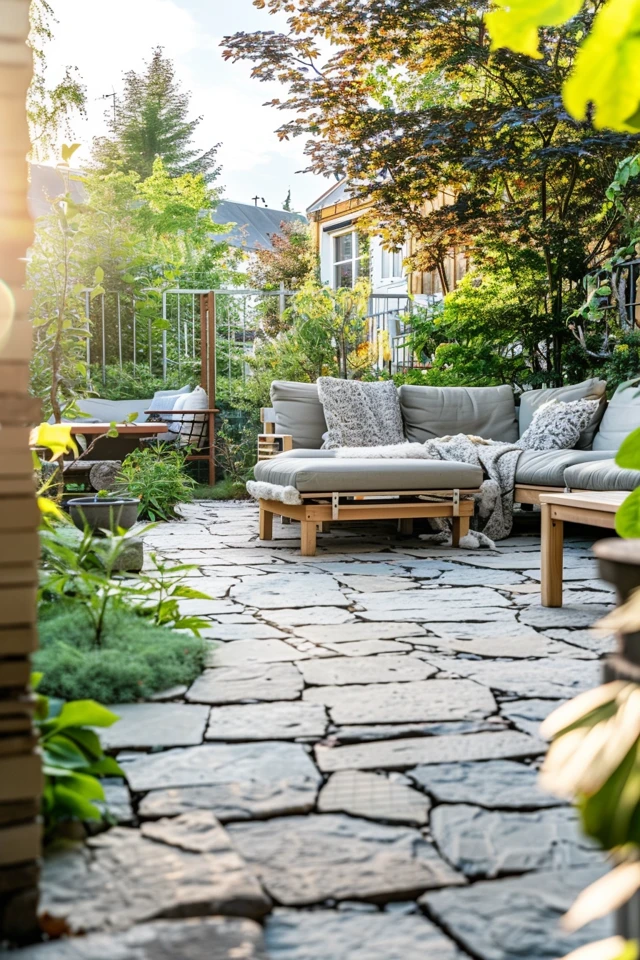
Maximize Space: L Shaped Backyard Ideas & Designs
An L-shaped backyard is often viewed as a layout challenge, but as a designer, I see it as a distinct advantage. That awkward turn or narrow side yard actually provides natural zoning that a standard rectangular lot lacks. It automatically suggests a separation of functions, allowing you to create a “dining wing” and a “lounging wing” without needing to build physical walls.
However, the disconnect between the two legs of the “L” can make the space feel disjointed if you aren’t careful. The key is creating a visual pull that draws people around the corner. You want to avoid the “bowling alley” effect where the narrow part of the yard feels like a leftover utility strip rather than a destination.
In this guide, I will walk you through how to treat the L-shape as an asset. We will cover layout strategies, hardscaping transitions, and how to maximize every square inch of that tricky corner. For a huge dose of visual inspiration, don’t miss our curated Picture Gallery at the end of this post.
1. Mastering the Layout: The Art of Zoning
The biggest mistake homeowners make with L-shaped yards is trying to force everything into one area while leaving the other empty. This creates an imbalance that makes the yard feel smaller than it is. The first step in your design process should be assigning a specific function to each “leg” of the L.
I usually designate the wider section of the yard as the “Active Zone.” This is where you place high-traffic elements like a dining table, an outdoor kitchen, or a play area for kids. Because this area usually connects directly to the main living space of the house, it needs to accommodate movement.
The narrower leg of the L becomes the “Passive Zone.” This is ideal for more intimate seating, a hammock, a fire pit, or a dedicated gardening station. By separating high-energy and low-energy activities, you maximize the utility of the space.
Designer’s Note: The Pivot Point
The “elbow”—where the two legs meet—is the most critical part of your layout. Do not leave this empty. If the corner is dead space, the two areas will never feel connected. I often place a round table or a curved sectional right at the elbow. The curve softens the harsh 90-degree angle and physically turns the body toward the next zone.
Clearance Rules of Thumb
When laying out furniture in these zones, do not overcrowd the pathways. In a narrow L-leg, you need to maintain a clear walkway.
- Main walkways: Keep these 36 to 48 inches wide for two people to walk side-by-side.
- Secondary paths: In the narrow leg, a 24-inch path is acceptable for a “secret garden” feel.
- Dining clearance: Allow 36 inches from the table edge to the nearest wall or fence so guests can slide chairs back comfortably.
2. The Narrow Leg: Solving the “Side Yard” Dilemma
The narrower section of an L-shaped yard is often neglected. It frequently becomes a dumping ground for trash bins or AC units. To maximize space, you have to reclaim this footage. If the width is under 10 feet, do not try to squeeze in a full lounge set. It will look cluttered and block flow.
Instead, lean into the length. This is the perfect spot for a bocce ball court, a lap pool, or a long, linear vegetable garden. Using raised beds along the fence line draws the eye down the length of the space, turning a “corridor” into a featured view.
If you are a renter or on a budget, this is a great place for a bistro setup. A small 24-inch round table and two chairs tucked against a lushly planted fence turn a narrow strip into a morning coffee spot.
Common Mistakes + Fixes
Mistake: Using straight pavers that run parallel to the long walls.
Fix: Use a running bond pattern perpendicular to the length, or a herringbone pattern. This optical illusion pushes the walls out visually, making the narrow leg feel significantly wider.
What I’d Do in a Real Project
If I am designing for a family with a dog, the narrow leg almost always becomes the “dog run.” We use pea gravel or artificial turf here. It keeps the mess contained away from the main dining patio. We separate it with a low gate or a planter box so the “Active Zone” remains pristine for entertaining.
3. Hardscaping: Connecting the Two Worlds
In an L-shaped yard, continuity is your best friend. If you use concrete pavers on one side and wood decking on the other without a thoughtful transition, the yard will look like two separate properties stitched together. You need a unified material palette to stitch the “L” into a cohesive whole.
If you must change materials, do it intentionally at the transition point. For example, a wooden deck might extend from the house (the wide leg), and then step down onto stone pavers for the fire pit area (the narrow leg). This change in elevation and material signals a change in “mood” without feeling accidental.
Smoothing the Angles
L-shaped yards have a lot of hard 90-degree angles. To combat this boxiness, I introduce organic shapes in the hardscaping.
- Curved Patios: Pour concrete or lay pavers with a rounded edge at the interior corner of the L.
- Circular Rugs: If re-doing the patio floor isn’t in the budget, use a large round outdoor rug at the corner. It breaks up the grid.
- Diagonal Decking: Laying deck boards at a 45-degree angle can lead the eye around the corner more effectively than running them straight.
Material Durability Guide
- Porcelain Pavers: Highly durable, fade-resistant, and mimic expensive stone. Great for modern looks.
- Decomposed Granite (DG): An affordable, permeable option for the “Passive Zone.” It creates a satisfying crunch underfoot but can track indoors, so use a doormat.
- Composite Decking: Essential for wet climates. Unlike wood, it won’t rot in the shady corners often found in L-shaped yards.
4. Landscaping and Privacy Screens
Privacy is often a major issue in L-shaped backyards because they tend to border multiple neighbors. You might be exposed on two or even three sides. However, building a solid 6-foot fence all the way around can create a “prison yard” effect, especially in the narrow leg.
Layer your privacy instead. Use a solid fence for the background, but plant tiered greenery in front of it. I recommend the “Thriller, Filler, Spiller” method for planter boxes along the perimeter. Tall grasses or bamboo (in containment barriers) serve as excellent screens that soften the fence line without eating up floor space.
The Focal Point Strategy
You need to give the eye somewhere to rest so it doesn’t focus on the neighbor’s roof. Place a visual anchor at the furthest point of the L.
- A Water Feature: The sound of water draws people toward the back corner.
- A Specimen Tree: A Japanese Maple or a Crepe Myrtle with uplighting creates drama.
- An Art Piece: A sculpture or a painted mural on the back fence creates depth.
Dealing with Shade and Sun
L-shaped yards often have microclimates. One leg might be in full sun while the other is in deep shade due to the house’s shadow.
- Sunny Leg: Plant lavender, rosemary, and succulents. Use fade-resistant fabrics like solution-dyed acrylics.
- Shady Leg: Plant ferns, hostas, and hydrangeas. This is the cooler spot for summer lounging, so place your daybed here.
5. Lighting: Creating Flow at Night
Lighting is the most effective tool for unifying an L-shaped space. If you only light the patio near the house, the other leg of the “L” disappears into a black void at night. This makes your yard feel half its size. You must light the perimeter to define the full boundary of the space.
I use a technique called “moonlighting” where possible. Mount lights high up in trees to cast dappled shadows down. This feels more natural than harsh floodlights.
The Pathway Rule
You must illuminate the path around the bend. Use path lights spaced 6 to 8 feet apart. If you place them too close, it looks like an airport runway. You want pools of light that guide the feet.
Designer’s Trick: The Destination Light
Place a warmer, slightly brighter light at the very end of the narrow leg. This subconsciously tells guests, “There is something worth seeing over here.” It pulls people out of the main gathering area and encourages circulation throughout the entire yard.
Kelvin Temperature Matters
Stick to 2700K (Warm White) for all outdoor lighting. Anything above 3000K looks blue and clinical, resembling a parking lot rather than a home. Consistency is key; do not mix warm string lights with cool landscape lights.
Final Checklist: What I’d Do in a Real Project
If I were consulting on your L-shaped backyard today, this is the exact workflow I would follow to ensure success.
1. The Sightline Check
Stand inside your house at the main window. What do you see? If you see the AC unit or a blank fence, we need to move the focal point. The view from inside should invite you outside.
2. The Zone Map
Draw the “L” on paper. Circle the “Active” area (near the kitchen door) and the “Passive” area (the quiet corner). Ensure they don’t overlap.
3. The Hardscape Transition
Decide how the floor connects. If you have a deck, does it step down to grass? If so, ensure the step spans the width of the opening to feel generous, not rinky-dink.
4. The Vertical Lift
Select three spots for vertical interest to draw the eye up. This could be a pergola, a trellis with jasmine, or a hanging chair. This breaks the monotony of the fence.
5. The Furniture Scale
Measure your “elbow” room. Ensure you buy furniture that fits. A common error is buying a sectional that blocks the path to the second leg of the L.
Frequently Asked Questions
How do I make a small L-shaped yard feel bigger?
Use mirrors. Hanging a weather-rated mirror on a fence in the narrow leg reflects greenery and doubles the visual depth. Also, keep furniture low-profile. bulky, high-backed chairs block sightlines.
What is the best budget material for the second leg of the L?
Pea gravel or crushed stone is the most cost-effective. It requires edging to keep it in place, but it costs a fraction of concrete or pavers. It also drains well, preventing standing water in narrow side yards.
Can I put a pool in an L-shaped yard?
Absolutely. L-shaped yards are actually great for pools. You can place the pool in the long leg and the pool house or lounge area in the short leg. Just ensure you check local setback regulations, as narrow yards often have strict rules about how close water can be to the fence.
How do I handle drainage in the corner?
The inside corner of the “L” (near the house foundation) is prone to water pooling. Ensure your patio slopes away from the house at a pitch of 1/4 inch per foot. You may need to install a French drain if the yard slopes toward that inside corner.
Conclusion
Designing an L-shaped backyard is about embracing the journey around the corner. By distinctly zoning your active and passive areas, maintaining material continuity, and strategically lighting the furthest reaches of the yard, you transform a quirky layout into a multi-functional retreat.
Don’t let the narrow leg become a forgotten alley. Treat it as a destination—a secret garden, a private reading nook, or a dedicated hobby space. When you engage the entire footprint, the yard feels expansive and intentional.
Picture Gallery


