
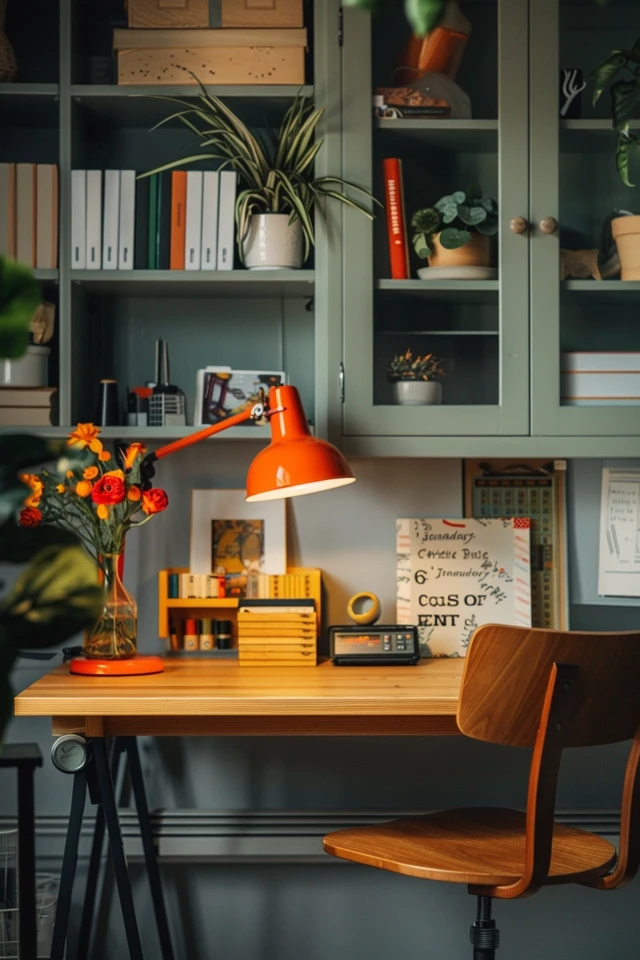
Maximize Space with Small Bedroom Office Combos
Integrating a functional workspace into a place of rest is one of the most common challenges I face in urban interior design. We often assume we need a dedicated room to be productive, but the reality is that a well-designed corner can be just as effective. The secret lies in psychological and physical zoning.
I once worked with a client in a tight 10×12 Brooklyn apartment who was convinced she had to work from her dining table because her bedroom was “too small.” By swapping her bulky nightstand for a sleek writing desk and utilizing vertical wall space, we actually made the room feel larger. For a huge dose of visual inspiration on how layouts like this come together, be sure to check out the Picture Gallery at the end of the blog post.
This guide is about compromise without sacrificing style. We are going to look at specific layouts, furniture scales that actually work, and the lighting tricks that prevent you from feeling like you are sleeping in a cubicle. Let’s turn that cramped corner into a power suite.
1. Layout Logic: The “Inches Matter” Approach
In a small bedroom, floor planning is a game of inches. The first rule of thumb is to identify your “dead zones.” These are typically corners, the space immediately under a window, or the area directly at the foot of the bed.
The most seamless layout is often the “Nightstand Swap.” This involves replacing one bedside table with a small desk. For this to work, you need a desk width of at least 30 to 36 inches. Anything smaller feels like a shelf, not a workspace.
Another high-functioning layout is the “Foot of the Bed” console. If you have at least 36 inches of clearance between the end of your bed and the wall, a narrow console desk can act as a workspace by day and a TV stand or vanity by night. This creates a distinct zone that faces away from the sleeping area.
Designer’s Note: The Flow Rule
In my projects, I never place a desk chair where it blocks the main walkway. You need a minimum of 30 inches of walking path clearance behind a pushed-in chair. If you are sitting in the chair, you ideally want 42 inches from the desk edge to the obstacle behind you to slide back comfortably without hitting the bed frame.
Common Mistakes + Fixes
- Mistake: Placing the desk facing the bed.
- Correction: Whenever possible, orient the desk toward a window or a wall. Staring at your pillows while trying to work kills productivity, and staring at your laptop while trying to fall asleep kills relaxation.
- Mistake: Ignoring door swing.
- Correction: Measure the arc of your bedroom door and closet doors. Ensure your chair doesn’t get hit every time someone enters the room.
2. Furniture Scale and Selection
The biggest error DIYers make is buying “office” furniture for a bedroom. Standard office desks are often deep (30 inches+) and visually heavy. In a bedroom context, visual weight is just as important as physical size.
Look for “writing desks” or “console tables” rather than executive desks. A depth of 18 to 24 inches is sufficient for a laptop and a coffee cup. If you use a large monitor, aim for 24 inches deep so you aren’t sitting too close to the screen.
Leg style matters immensely. Choose legs that are thin and open (like hairpin legs or slender metal frames) rather than solid wood blocks or desks with heavy drawers on both sides. Seeing the floor and the wall through the furniture tricks the eye into thinking the room is larger.
What I’d do in a real project:
If the room is under 100 square feet, I almost always recommend a wall-mounted floating desk. By removing legs entirely, you gain floor space for a wastebasket or storage basket. Install it at standard desk height, which is 29 to 30 inches from the floor.
Chair Selection Checklist
- No Wheels on Carpets: If you have a plush rug, office wheels damage the pile and look utilitarian. Opt for a stationary dining-style chair with a swivel base.
- Low Profile: Avoid high-back executive chairs. They dominate the room vertically. A mid-back or low-back chair preserves the sightlines.
- Fabric First: Choose linen, velvet, or leather rather than black mesh. It needs to look like bedroom furniture, not corporate gear.
3. Zoning Without Walls
When you eat, sleep, and work in the same four walls, mental separation is vital. You need to create a “room within a room.” The easiest way to do this is through rug placement, though this can be tricky in small spaces.
If space allows, a small 3×5 sheepskin or distinct area rug under the desk/chair helps ground the office area. However, be careful not to create a tripping hazard if the rugs overlap. If the desk is on the main bedroom rug, ensure the chair stays on the rug even when pushed back.
Paint zoning is a renter-friendly favorite of mine. You can paint an arch or a rectangle on the wall behind the desk in a color slightly darker than the rest of the room. This visually anchors the desk and claims that territory as “work mode.”
Designer’s Note: The “End of Day” Ritual
One lesson I learned the hard way with clients is the stress of seeing work clutter at night. If you can’t hide the desk, you must hide the mess. I specify storage ottomans or decorative baskets nearby where laptops and papers can be physically stowed away at 6 PM. Out of sight, out of mind.
4. Lighting: The Kelvin Conflict
Bedrooms usually rely on warm, ambient lighting (2700K to 3000K), which is relaxing but terrible for focus. Offices need cooler, brighter light (3500K to 4000K) to reduce eye strain. Balancing these two in one room requires a layered approach.
Do not rely on the single overhead “boob light” found in most rentals. It casts shadows over your shoulder when you sit at a desk. You need dedicated task lighting. An articulating desk lamp is functional, but a sconce is better for saving surface area.
If you are renting, look for plug-in wall sconces with swing arms. Mount them on the wall about 15 to 24 inches above the desk surface. This frees up the desktop for your laptop and notebook.
Common Mistakes + Fixes
- Mistake: Using only a warm bedside lamp for work.
- Correction: This causes eye fatigue. Use a smart bulb in your desk lamp that allows you to shift from “Energize” (cool white) during the day to “Relax” (warm white) in the evening.
- Mistake: Window glare on screens.
- Correction: If your desk faces a window, great. If your back is to the window, you will get glare. Install sheer curtains to diffuse light or solar shades that cut glare without blocking the view.
5. Managing Cables and Clutter
Nothing ruins the serenity of a bedroom faster than a rat’s nest of black cables. In a dedicated office, you might tolerate it, but in a bedroom, it creates visual noise that disrupts rest.
Use adhesive cable clips along the back legs of the desk to guide cords down to the floor. Never let cords dangle freely in the middle of the air. If you have a power strip, mount it to the underside of the desk or the back modesty panel using heavy-duty double-sided mounting tape.
For the “Nightstand Swap” layout, consider how you will charge your phone at night. If your desk is also your nightstand, you likely need a charging station that handles both a laptop and a phone. I recommend a desktop organizer with built-in cable routing to keep the nightstand surface clear for a glass of water.
Storage Solutions for Tight Spaces
- Vertical Shelving: Install floating shelves above the monitor. Use these for books and files, keeping the desk surface strictly for active work.
- The “C-Table”: If you don’t have room for a desk at all, a high-quality C-table can slide over the bed for work and tuck away into a closet when not in use.
- Monitor Risers: Use a wooden monitor riser with a drawer underneath. It lifts the screen to eye level (ergonomics!) and provides a hiding spot for sticky notes and pens.
Final Checklist: The “Bedroom Office” Project
Before you buy a single piece of furniture, run through this checklist. This is the exact mental process I use when consulting on a small space project.
1. Measure Twice
- Confirm the desk width fits the alcove with 1-2 inches of breathing room on sides.
- Verify chair pullback clearance (minimum 30 inches).
- Check outlet locations. Will you need an ugly extension cord?
2. Assess the Light
- Check the window position relative to the screen.
- Plan for a task light that doesn’t rely on the nightstand lamp.
- Purchase cable management sleeves immediately.
3. Choose the Chair
- Does it swivel? (Vital for tight spaces).
- Does the fabric match the bedding or curtains?
- Does the arm height clear the bottom of the desk drawer?
4. Verify Storage
- Where does the laptop go at night?
- Where do papers live?
- Is the trash can hidden?
FAQs
How do I hide my computer monitor when I’m not working?
If a large black rectangle ruins your bedroom aesthetic, you have a few options. You can use a folding screen to physically block the view of the desk. Alternatively, treat your monitor like art: utilize a screensaver that displays black and white photography or art when idle. Some newer monitors have white chassis instead of black, which blend better with neutral bedroom walls.
Is it bad feng shui to have a desk in the bedroom?
Traditionally, yes, because work energy (active) conflicts with sleep energy (passive). However, modern life often requires it. The cure is separation. Make sure you cannot see your work from your pillow. If you can, cover the monitor at night or ensure the chair is pushed all the way in to “close” the energy of the workspace.
What if my room is too small for a chair?
If you literally cannot fit a chair without hitting the bed, consider a fold-down wall desk. These look like a cabinet on the wall and fold down only when needed. You can use a folding chair that hangs on a hook behind the door or slides under the bed when not in use. It’s not ideal for 8-hour days, but it works for casual tasks.
Can I use a vanity as a desk?
Absolutely. This is a classic dual-purpose hack. The key is drawer height. Many vanities have a shallow center drawer that limits legroom. Measure the distance from the floor to the bottom of the drawer; you want at least 24 to 25 inches for your legs to fit comfortably. Add a mirror above the desk, and it transitions perfectly.
Conclusion
Creating a bedroom office combo isn’t just about jamming a table into a corner. It is about respecting the dual nature of your life. You deserve a space where you can be productive, but you also deserve a sanctuary where you can recharge.
By focusing on scale, lighting, and the psychological “closing” of the office at the end of the day, you can maximize your square footage without maximizing your stress levels. It takes a bit of planning and a measuring tape, but the result is a home that works as hard as you do.
Picture Gallery


