
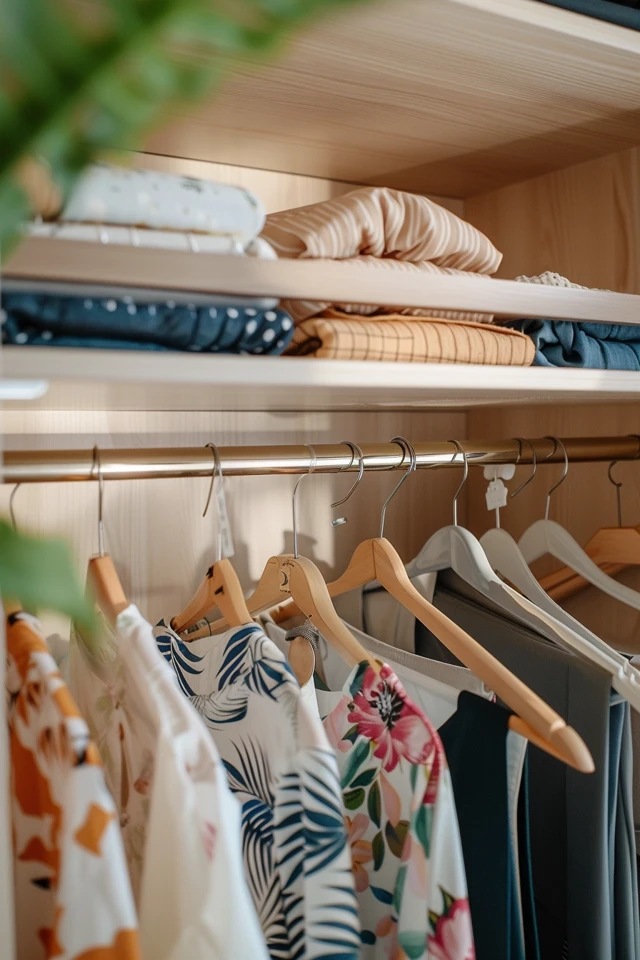
Maximize Space with Smart Angled Closet Ideas
Designers often say that the true test of a home’s layout is how it handles the “leftover” spaces. We all love a perfectly square room with high ceilings, but reality often hands us eaves, nooks, and awkward geometric challenges. Dealing with angled walls or sloped ceilings can feel like a storage nightmare, but these quirks actually offer some of the best opportunities for custom storage.
I have spent years transforming “dead” attic corners and under-stair triangles into highly functional wardrobes. The key is to stop fighting the angle and start working with the geometry. When you embrace the slant, you can often unlock deeper storage potential than a standard reach-in closet would allow.
Whether you are converting a loft, dealing with a historic home’s odd architecture, or trying to maximize a corner unit, there is a solution. To help you visualize these layouts, I have put together a collection of real-world examples, so remember that the Picture Gallery is at the end of the blog post.
1. Mastering the Geometry: Measurements and Planning Rules
Before you buy a single lumber board or closet rod, you must understand the math of your angled space. In a standard rectangular closet, we assume a 24-inch depth for hanging clothes. In an angled closet, that depth varies with every inch of height.
The first rule of thumb I use in any slanted project is the “shoulder slope check.” A standard hanger is 17 to 18 inches wide. To hang clothes freely without them brushing against a slanted drywall ceiling, you need to find the point on the slope where the vertical height accommodates the hanger width plus at least two inches of clearance.
If you try to install a rod too high up into the sharpest part of the angle, your clothes will push against the wall. This causes wrinkles and can eventually damage the paint or wallpaper.
Designer’s Note: The 22-Inch Rule
In my projects, I never plan for a hanging rod unless I have at least 22 inches of clear horizontal depth. If the angle cuts the depth to less than 22 inches, that space automatically becomes shelving or drawer storage. Do not force hanging storage into a shallow angle; you will regret it every time you close the door.
Essential Vertical Measurements:
- Long hanging (dresses/coats): You need 60 to 65 inches of vertical drop.
- Short hanging (shirts/blazers): You need 40 inches of vertical drop.
- Drawers: Standard drawers need about 8 to 10 inches of height per drawer face.
When mapping out your angled closet, use painters tape on the floor and wall. Mark exactly where the height hits 40 inches. Everything below that line is strictly for folded items, shoes, or accessories. Everything above can be considered for hanging rods, provided you have the depth.
2. Conquering the Attic Slope (The Knee Wall Strategy)
The most common angled closet scenario is the attic bedroom or a bonus room over a garage. These rooms usually have a “knee wall”—the short vertical wall beneath the roof slope. Most homeowners ignore this space because it is too low to stand in, but it is prime real estate for storage.
The most effective layout here is a graduated system. Place your deepest storage at the bottom and recess it into the eaves. I often design custom rolling bins or deep drawers that sit on the floor. These can go back as far as 30 inches, utilizing the deep, dark triangle of space where the roof meets the floor floor.
Above the knee wall, you have two main options. If the slope is steep, install open shelving brackets cut at an angle to match the ceiling pitch. This creates a “library” look for shoes or handbags.
Common Mistakes + Fixes
- Mistake: Installing standard doors on a knee wall closet.
Fix: Standard doors swing out and eat up floor space. On short walls, use sliding bypass doors or, even better, handle-free push-to-open cabinet fronts. This blends the storage into the wall, making the room feel larger.
- Mistake: Ignoring the “Triangle of Death.”
Fix: This is the tiny wedge of space at the very top of a joinery unit against a slope. Don’t leave it open to collect dust. Use a filler strip (a scribe piece) painted to match the cabinetry for a built-in, high-end look.
For a recent project in a converted attic, we built “waterfall” shelving. We started with deep drawers at the bottom (24 inches deep), moved to medium-depth shelves in the middle (16 inches), and finished with shallow display shelves at the top (8 inches). This mimicked the angle of the roof and maximized volume without encroaching on the walkable floor area.
3. The L-Shaped and Odd Corner Configuration
Angled closets aren’t always vertical; sometimes they are horizontal issues caused by corner layouts. Corner closets are notorious for being dark and inaccessible. The standard solution is a single rod that wraps around, but this creates a “blind corner” where clothes get lost and tangled.
To fix this, you need to separate the spaces. In professional closet design, we stop the hanging rod about 24 inches from the corner wall. On the adjacent wall, we install shelving that runs all the way into the corner. This allows you to reach into the corner to grab folded sweaters without fighting through a wall of hanging coats.
Another smart approach for angled corners is the “step-in” layout. If you have enough square footage, treat the angled corner as a miniature walk-in. By placing the door on the diagonal (cutting the corner), you create a small pentagonal room.
What I’d Do in a Real Project (The Mini-Checklist):
- Assess the angle: Is it a 45-degree cut or something irregular? Custom shelves are usually required for irregular angles.
- Prioritize access: I never put frequently used items in the sharpest part of the corner. That space is for seasonal rotation (winter coats in July) or luggage.
- Use specialty hardware: I specify “blind corner” pull-out baskets, similar to what you see in kitchen cabinetry. They swing out and bring the contents to you.
If you are renting or on a budget, look for modular wire systems. Many wire shelving brands offer corner joiner pieces that bridge two perpendicular walls. While less aesthetic than wood, they are incredibly functional for odd angles because the open wire lets light pass through, keeping the dark corner visible.
4. Enclosing the Space: Doors, Curtains, and Millwork
Once you have the internal layout solved, you have to decide how to close it off. In an angled closet, off-the-shelf doors rarely work because the top header isn’t level. You are usually left with three choices: custom millwork, curtains, or leaving it open.
Custom millwork is the gold standard. A carpenter can cut a door slab to match the exact pitch of your ceiling. However, this is expensive and requires precise hinges. If the door is cut at an angle, it cannot swing open if the high point of the door hits the lower part of the ceiling slope. You have to hinge the door on the tall side of the jamb.
The Drapery Solution
For a softer, more romantic look—and a much lower price point—I love using heavy drapery. Install a ceiling-mounted track. If the ceiling is sloped, you can use flexible tracks that screw directly into the drywall.
To make this look high-end rather than temporary, ensure the curtains have “fullness.” This means the width of the fabric should be 2 to 2.5 times the width of the opening. Skimpy curtains look messy. Weighted hems are also crucial so the fabric hangs straight despite the odd ceiling angles.
Open Systems: The “Boutique” Look
If you are tidy, leaving the angled closet open can expand the visual size of the room. The trick here is uniformity. You must use matching hangers (wood or velvet). Mismatched plastic hangers will make an open, angled closet look like a garage sale.
Expert Tip regarding Baseboards:
When building a custom unit into an angle, always remove the existing baseboards first. Install the unit flush against the drywall, then reinstall the baseboards around the new cabinet. I see many DIYers push a square cabinet against a baseboard, leaving a 1-inch gap behind the unit where dust collects and things fall.
5. Lighting and Material Choices for Tight Spots
Angled spaces cast weird shadows. If you rely on the main room’s ceiling light, your body will block the light when you stand in front of the closet, making the interior pitch black. Dedicated lighting is not a luxury in an angled closet; it is a necessity.
Lighting Strategies:
- Vertical LED strips: Instead of a light at the top (which is hard to mount on a slope), run an LED channel vertically up the side walls of the closet. This illuminates every shelf evenly from top to bottom.
- Rechargeable motion sensors: If you cannot hire an electrician to run hard wires, use magnetic, rechargeable motion-sensor bar lights. Place them under every other shelf.
- Color Temperature: Stick to 3000K (soft white) or 3500K. Anything cooler (4000K-5000K) will look clinical and blue, making your clothes look unappealing.
Material Selection for Durability
In tight, angled spaces, you are more likely to bump into walls and shelves. I recommend using melamine or pre-finished plywood over standard MDF for the shelving surfaces. Melamine is highly scratch-resistant and slides easily, which is helpful when pulling bins out of deep corner nooks.
If you are painting the closet interior, use a semi-gloss or satin finish. Flat paint scuffs too easily when shoes or hangers drag against it. A slight sheen also helps bounce light around the cramped space, making it feel less claustrophobic.
For the floor of the closet, continue the main room’s flooring if possible. A continuous floor makes the angled nook feel like part of the room rather than a separate, chopped-up box. If the closet floor is unfinished plywood, cover it with a bound remnant of wool carpet or a high-quality vinyl mat cut to fit.
Final Checklist: Designing Your Angled Closet
Before you commit to a design, run through this checklist to ensure you haven’t overlooked the practical constraints of your unique space.
- Check the Clearance: Open the proposed doors (or pull out the drawers). Do they hit the bed, the ceiling fan, or the entryway door?
- Verify Rod Height: Have you measured your longest coat? Ensure it won’t pool on the floor or the shelf below.
- Account for Trim: Did you subtract the width of door casings and baseboards from your available width?
- Load Bearing Check: If you are hanging heavy items (winter coats) on a slanted drywall surface, are you anchored into studs? Drywall anchors alone will eventually rip out of an angled ceiling due to gravity.
- Ventilation: Angled nooks in attics can get hot or damp. Is there airflow? If not, consider louvered doors to prevent mold on leather shoes.
- The “Reach” Test: Can you physically reach the back corner? If not, you need a pull-out mechanism or a step stool.
FAQs
How much does a custom angled closet cost?
Cost varies wildly. A DIY system using plywood and pipes can cost under $500. A semi-custom system (like hacking IKEA units) might run $1,000 to $2,500. Fully bespoke millwork from a carpenter or closet company will typically start at $3,500 and can easily go over $10,000 depending on finishes and size.
Can I use IKEA PAX in an angled room?
Yes, but it requires modification. You can cut the carcass (the frame) of a PAX unit to match a slope, but this compromises the structural integrity. You will need to reinforce the cut angle with L-brackets and secure it firmly to the wall. It is an advanced DIY project, not for beginners.
What is the minimum height for a usable closet space?
For hanging clothes, you really need 40 inches. For shelves and drawers, you can go as low as 18 to 24 inches. Anything lower than 18 inches is generally useless for daily storage and should be closed off with a fascia panel or used for long-term storage of items you only access once a year.
How do I handle a closet under the stairs?
Under-stair closets are the ultimate angled challenge. The best solution is usually pull-out “pantry” style units on heavy-duty distinct casters. Instead of stepping into the dark cupboard, you pull the entire storage unit out into the hallway.
Conclusion
Angled closets are rarely the storage disaster they first appear to be. In fact, they force us to be more thoughtful about what we keep and how we access it. By respecting the geometry—placing rods where the height allows and utilizing low eaves for deep drawers—you can create a system that holds just as much as a standard box closet, but with significantly more character.
Remember that the goal isn’t just to fill the space, but to curate it. Use lighting to banish the shadows, choose durable materials that can handle the friction of tight quarters, and don’t be afraid to mix hanging space with open shelving. When done right, that awkward nook might just become the most efficient part of your home.
Picture Gallery


