
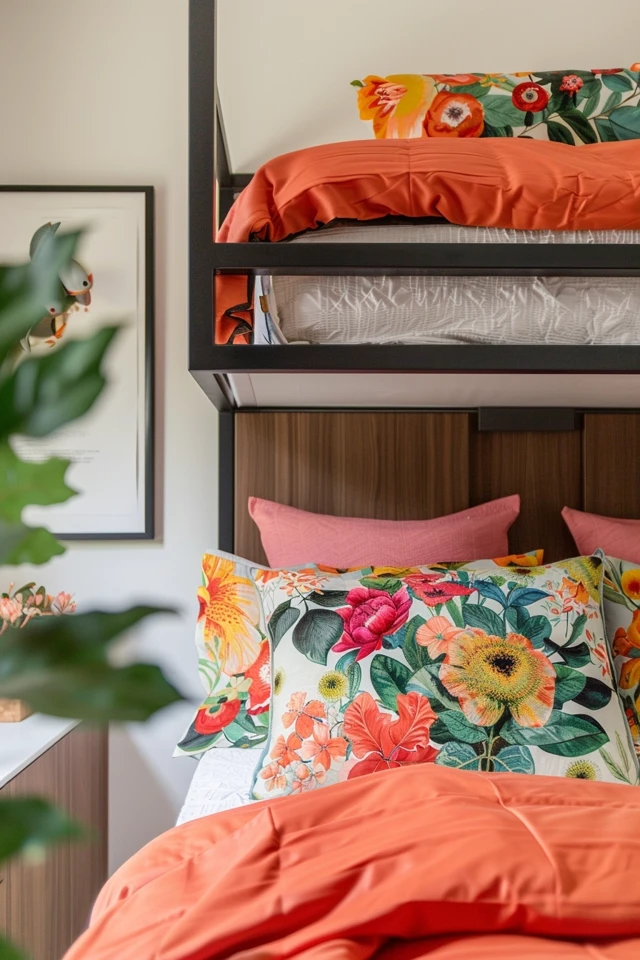
Maximizing Space: 2 Beds in One Small Room Ideas
Fitting two beds into a single small bedroom is one of the most common design puzzles I solve for clients. Whether you are accommodating siblings in a shared room, setting up a versatile guest room, or maximizing a studio apartment, the challenge remains the same. You need to balance comfortable sleeping arrangements with functional floor space, all while avoiding a cramped, dormitory feel.
In my experience, success comes down to prioritizing flow over furniture size. For a full visual walkthrough of these layouts, make sure to check out the Picture Gallery at the end of the blog post. Seeing these concepts in action often clarifies exactly which layout will work best for your specific architectural constraints.
This guide moves beyond basic bunk beds to explore layout strategy, vertical integration, and styling tricks that professional designers use. We will look at specific clearance rules, lighting hacks, and how to create psychological privacy even when physical space is limited. Let’s turn that tight squeeze into a functional, breathable sanctuary.
1. Mastering the Floor Plan: Layout Configurations
Before you buy a single piece of furniture, you must tape out the floor plan. In a small room, inches matter, and the standard layout of placing two twin beds parallel with a nightstand in the middle is not always the best use of space. That traditional setup requires a room width of at least 9 to 10 feet to feel comfortable.
If your room is narrower or square, consider the “L-Shape” configuration. This involves placing the beds in a corner, with the headboards perpendicular to each other or with one bed pushing its side against the wall. This opens up the center of the room for play, a desk, or simply walking space. It drastically reduces the “dead space” that usually accumulates at the foot of the bed.
Another effective option for long, narrow rooms is the “Toe-to-Toe” layout. Here, you place both beds along the same long wall, separated by a piece of furniture like a chest of drawers or a shared bookshelf. This creates a streamlined traffic path on the opposite side of the room.
Designer’s Note: The Clearance Rule
A common failure point in DIY designs is ignoring traffic flow. You need a minimum of 24 inches (preferably 30 inches) of walking space between furniture pieces. If you have drawers opening toward a bed, you need at least 36 inches of clearance to open the drawer and stand in front of it comfortably.
Common Mistakes + Fixes
- Mistake: Blocking the entry flow. Placing a bed so it juts past the doorframe makes the room feel instantly claustrophobic.
- Fix: Ensure the first 3 feet of the room upon entry remain relatively open. Use the wall furthest from the door for the bulk of the bedding.
2. Selecting the Right Bed Frames and Vertical Solutions
In a small room, the bed frame is the dominant architectural feature. Heavy, solid wood sleigh beds or thick upholstered frames add unnecessary visual bulk. Instead, look for frames with legs that elevate the mattress, allowing you to see the floor underneath. This trick of the eye makes the room feel larger because the floor plane appears continuous.
If you opt for bunk beds, customization is key to safety and comfort. Standard bunks are functional, but loft systems are often superior for older children or adults. A loft bed allows you to place a second bed perpendicular underneath (an L-bunk) or use the space below for a desk.
Always measure your ceiling height before committing to a bunk. You need a minimum of 30 to 36 inches of clearance between the top mattress surface and the ceiling. Without this, the sleeper on top will feel suffocated and overheated, as heat rises.
Practical Measurement Guide
- Standard Twin: 38” x 75”. Best for multi-use rooms.
- Twin XL: 38” x 80”. Essential for teenagers or adults to prevent feet hanging off.
- Narrow Twin: 30” x 75”. A specialized size often used in Europe or RVs, but excellent for extremely tight guest rooms.
Designer’s Note: Material Choices
I usually recommend metal or painted wood frames in light colors for small shared rooms. Dark, chunky wood absorbs light and shrinks the space. If you need durability for kids, a powder-coated metal frame is virtually indestructible and easier to wipe down than upholstery.
3. Zoning and Creating Privacy
Sharing a room does not mean sacrificing individuality. One of the biggest complaints I hear from clients with shared rooms is the lack of “me time” or private territory. You have to create visual and physical zones, even if they are small.
The easiest way to do this is with a physical divider that doubles as storage. Placing a tiered bookshelf between parallel beds creates a partial wall. It offers a sense of enclosure when lying down without blocking the light flow to the rest of the room.
Lighting is another critical zoning tool. Relying on a single overhead ceiling fixture guarantees that if one person is awake, both are awake. You must install individual reading lights for each bed. Wall-mounted sconces are ideal because they don’t take up surface space on a nightstand.
Lighting Placement Rules
- Sconce Height: Mount wall lights roughly 60 to 66 inches from the floor, or about 6 to 8 inches above the shoulder of a person sitting up in bed.
- Controls: Ensure the switch is within arm’s reach of the pillow. If hardwiring isn’t an option, use plug-in sconces with cord covers for a polished look.
What I’d Do in a Real Project
If I were designing a shared room for two teenagers, I would install a curtain track on the ceiling between the beds. This allows for total visual privacy when needed but can be swept back to open the room during the day. Use a heavy linen fabric for sound dampening.
4. Integrating Smart Storage
In a double-occupancy small room, the closet is rarely enough. You have to aggressively utilize the “hidden” real estate. The most valuable cubic footage in a small bedroom is the space under the beds.
Avoid bed skirts, which can look messy in small spaces. Instead, choose beds with built-in drawers or use rolling bins that match the room’s color palette. If the beds are for kids, these under-bed drawers are perfect for toys or off-season clothing.
Go vertical with your case goods. Instead of a wide, low dresser, choose a tall, narrow chest of drawers (a “highboy”). This utilizes the vertical wall plane and saves floor space.
Wall-Mounted Solutions
- Floating Nightstands: Even a simple 12-inch wide shelf mounted to the wall serves the purpose of a nightstand without cluttering the floor.
- Over-Bed Storage: Install a shelf or a row of cabinets 24 inches above the headboard. This is a great place for books or decorative items, keeping the lower surfaces clear for daily use essentials like water glasses and phones.
Common Mistakes + Fixes
- Mistake: Using one giant rug that covers the whole floor.
- Fix: While a large rug can work, sometimes in L-shaped layouts, using smaller distinct rugs (like sheepskins) next to each bed helps define the individual zones and leaves some bare floor visible, which creates depth.
5. Visual Styling and Cohesion
When you have two beds in a small space, visual clutter is the enemy. If the bedding, pillows, and rugs are all different patterns, the room will feel chaotic and even smaller than it is. Cohesion calms the eye.
This doesn’t mean everything must match perfectly. In fact, identical “bed-in-a-bag” sets can look a bit sterile. A better approach is to coordinate. Choose a unified color palette—say, navy, cream, and sage green—and allow each person to mix those colors differently.
One bed might have a navy duvet with cream pillows, while the other has a cream duvet with navy pillows. This connects the two sides of the room without enforcing rigid uniformity.
Paint and Color Strategy
- The Envelope Technique: Paint the walls, trim, and even the ceiling the same color. This blurs the boundaries of the room, making corners disappear and the space feel expansive.
- Finish Matters: Use an eggshell finish for walls (wipeable) and satin or semi-gloss for trim. In small rooms, slightly reflective surfaces bounce light around, helping with the sense of space.
Designer’s Note: The Art of Scale
Be careful with wall art. A gallery wall with twenty tiny frames can make a small room feel busy. One large, impactful piece of art above each bed, or a single large piece centered between them, provides a focal point that anchors the room.
Final Checklist: The Project Roadmap
If I were stepping into your home today to execute this transformation, here is the exact checklist I would follow to ensure nothing is missed.
1. Measure Everything Twice
- Measure the room length and width.
- Measure window placement and height from the floor.
- Measure the swing of the door and closet doors.
- Check the location of power outlets.
2. Determine the Layout
- Tape the outline of the beds on the floor using painter’s tape.
- Walk around the tape. Can you open the closet? Can you make the bed easily?
- Adjust until you have at least 24 inches of walkway.
3. Select Furniture with Function
- Buy beds with legs or built-in storage.
- Choose wall-mounted sconces to free up surface area.
- Select a divider if privacy is required (bookshelf or curtain).
4. Establish the Lighting Plan
- Ensure there is ambient light (overhead) and task light (reading).
- Check that light switches are accessible from the beds.
5. Style for Continuity
- Pick a 3-color palette.
- Buy bedding that coordinates but doesn’t necessarily match.
- Hang curtains high (at the ceiling line) to make the room feel taller.
FAQs
What is the minimum room size for two twin beds?
Technically, you can fit two twin beds in a room that is roughly 9×9 feet, but it will be tight. A 10×10 foot room allows for a standard parallel layout with a small nightstand in between. If the room is smaller than 8×9 feet, you should strongly consider bunk beds or a trundle bed system to maintain floor space.
How do I handle window placement with two beds?
It is generally a design taboo to block a window, but in small rooms, you sometimes have no choice. If a headboard must go in front of a window, choose a low-profile headboard that sits below the sill if possible. If it overlaps, pull the bed 4 to 6 inches away from the wall to allow for curtain movement and airflow.
Can I put two queen beds in a small guest room?
This is very difficult in a standard small bedroom (under 12×12 feet). Two queen beds require substantial width. If you absolutely need to sleep four people, consider two full-size beds instead, or a “queen-over-queen” heavy-duty bunk bed system, provided you have the ceiling height.
How do I design for children of different ages?
The “L-shape” layout is often best here. It separates the heads of the beds, reducing late-night chatter. Use the vertical space above the older child’s bed for high shelving that the younger child cannot reach, giving the older sibling a safe place for their treasures.
Conclusion
Fitting two beds into a small room requires a shift in perspective. You have to stop looking at the room as a flat surface and start viewing it as a 3D volume where every inch of vertical space and every clearance zone counts. By choosing the right layout (like the L-shape), selecting visually lightweight furniture, and utilizing wall-mounted lighting and storage, you can create a room that feels intentional rather than stuffed.
Remember that the goal isn’t just to fit the mattresses in; it is to create a space where the occupants can recharge, coexist, and move freely. With a little planning and the right measurements, your small shared room can become the most functional space in the house.
Picture Gallery


