
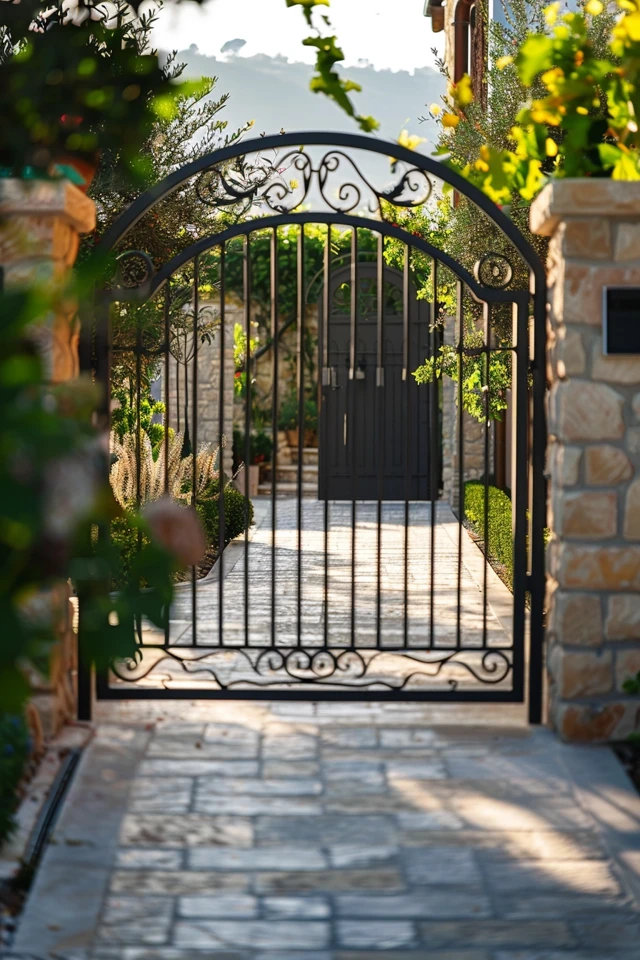
Metal Gate Design Ideas for Your Home’s Entry
Your front gate is essentially the handshake of your home. It creates that critical first impression, signaling the style, security, and maintenance level of everything that lies behind it. As a designer, I view the entry gate as a transitional element that needs to balance curb appeal with heavy-duty functionality.
I recall a specific project in a coastal town where the homeowners had installed a beautiful, intricate wrought iron gate just three years prior. By the time I arrived, the salt air had corroded the hinges and the rust was staining their limestone driveway. For plenty of visual inspiration, make sure you scroll all the way to the Picture Gallery at the end of this post. We replaced it with a powder-coated marine-grade aluminum design that mimicked the look of iron but could actually withstand the environment.
That experience serves as a constant reminder that materials and engineering matter just as much as aesthetics. In this guide, I will walk you through the logic I use when specifying metal gates for clients, from material selection and sizing rules to the finish details that ensure longevity.
1. Choosing the Right Metal for Your Climate and Lifestyle
The most common mistake homeowners make is choosing a metal based solely on how it looks in a catalog. You must consider the weight of the material, the maintenance it requires, and your specific climate conditions.
Wrought Iron
This is the traditional choice for a reason. It is heavy, incredibly durable against impact, and allows for intricate, custom scrollwork that other metals cannot replicate. However, iron is susceptible to rust. If you live in a humid climate or near the ocean, iron requires vigilance and regular sealing.
Aluminum
I specify aluminum for about 70% of my residential projects today. It is lightweight, which puts less stress on your hinges and automation motors, and it does not rust. While it is softer than steel and can dent if hit by a vehicle, modern high-grade aluminum gates are robust enough for standard security needs.
Steel
Steel offers the strength of iron but with a more streamlined, modern finish capability. It is incredibly heavy, often requiring stronger posts and deeper concrete footings than aluminum. Galvanized steel is treated with a zinc coating to prevent rust, which is a non-negotiable requirement if you choose this material.
Corten Steel (Weathering Steel)
For modern or desert-landscape homes, Corten steel is a favorite. It is designed to develop a stable, rust-like appearance over time that acts as a protective layer. It offers a beautiful, organic orange-brown patina that contrasts well with concrete walls and green landscaping.
Designer’s Note: The Weight Factor
When switching from a manual gate to an automated one, weight dictates your budget. A heavy steel gate requires a high-horsepower motor and hydraulic arms, which can double your automation costs compared to a lightweight aluminum gate. Always check the “max weight per leaf” rating on any motor you plan to buy.
2. Matching the Gate Style to Your Architecture
A gate should preview the home’s interior design language. If your home is a mid-century modern ranch, a Victorian-style scroll gate will feel disconnected and jarring.
Modern and Contemporary
For these homes, horizontal lines are king. I often design gates with horizontal metal slats spaced 1 to 2 inches apart. This widens the visual appearance of the driveway. Mixed materials are also popular here; consider a metal frame with inset wood planks (or composite wood for durability) to add warmth to the industrial feel of the metal.
Traditional and Mediterranean
These styles benefit from vertical pickets and arched tops. “Finials”—the decorative tips on top of the vertical bars—add elegance and serve as a subtle security deterrent. For Spanish Colonial homes, I often incorporate “knuckles” or simple scroll details, but I advise keeping it restrained to avoid a dated look.
Transitional and Farmhouse
Here, simplicity is the goal. A simple metal frame with an “X” brace design or wire mesh inserts works beautifully. Matte black is the standard finish, offering high contrast against white siding or brick exteriors.
Common Mistakes + Fixes
Mistake: Ignoring the fence connection.
Fix: Your gate does not need to match your perimeter fence exactly, but it must coordinate. If you have a cedar fence, a metal gate looks great. If you have a vinyl fence, a heavy iron gate often looks too substantial. Try to match the height of the gate to the fence line for visual continuity.
3. Sizing, Scale, and Critical Measurements
Getting the proportions right is where the “pro” look comes from. A gate that is too narrow feels stingy, while one that is too tall can make a home feel like a fortress.
Pedestrian Gates
For a standard walkway entry, the minimum comfortable width is 36 inches. However, if space allows, I always push for 42 to 48 inches. This additional width allows a person carrying groceries or pushing a stroller to enter comfortably without shimmying through.
Driveway Gates
For a single-car driveway, you need a minimum clearance of 10 feet, though 12 feet is safer to avoid scraping mirrors. For double driveways, 14 to 16 feet is standard.
Height Considerations
A standard security gate is usually 6 feet tall. If you go higher than 6 feet, you often trigger local zoning reviews or permit requirements. For purely decorative gates (like a garden entry), 42 to 48 inches high is a welcoming height that defines the boundary without blocking the view.
Clearance Rules of Thumb
- Ground Clearance: Leave 3 to 5 inches of gaps between the bottom of the gate and the driveway. This accounts for small stones, snow accumulation, and slight grade changes.
- Post Size: Never skimp on posts. For a heavy steel gate, a 4×4 inch post is likely insufficient. I recommend 6×6 inch steel posts with a wall thickness of at least 3/16 inch to prevent sagging over time.
- Setback: If your gate opens outward, it must not swing over a public sidewalk. Most municipalities require the gate to be set back at least 15 to 20 feet from the street curb so your car isn’t blocking traffic while you wait for the gate to open.
4. Privacy vs. Visibility: Finding the Balance
One of the first questions I ask clients is, “Do you want to see out, or do you want to stop people from seeing in?” This dictates the infill of the metal frame.
Perforated Metal Sheet
This is a fantastic option for modern homes. It consists of a metal sheet with thousands of tiny punched holes. From a distance, it looks like a solid plane, offering high privacy. Up close, it allows wind to pass through (reducing strain on the motor) and lets light filter in.
Louvers
Angled metal slats, or louvers, allow you to look out while blocking the view of anyone looking up from the street level. This is a common technique in high-density urban neighborhoods.
Backing Plates
If you love the look of a wrought iron scroll gate but need privacy, we can weld a solid metal backing plate or a heavy-duty mesh screen behind the design. This highlights the decorative ironwork while creating a solid barrier.
Designer’s Note: The Wind Load Issue
If you choose a solid metal gate (100% privacy), you are essentially building a sail. In high-wind areas, the wind pressure against a solid gate can burn out electric motors or rip hinges right out of the posts. If you need full privacy, consult an engineer about the post footing depth—you may need to go 48 inches deep into concrete to counteract the wind force.
5. Automation and Access Control Integration
A metal gate is only as good as its usability. Planning for automation before you pour the driveway or install the posts is vital.
Swing vs. Sliding
- Swing Gates: These are generally quieter and more aesthetically pleasing. However, you lose driveway space because of the swing radius. If your driveway slopes upward toward the house, a swing gate is very difficult to install (requires special “uphill hinges” that look clunky).
- Sliding Gates: Best for short driveways or steep slopes. They require “stacking space” along the fence line—meaning you need horizontal room equal to the gate width plus about 3 feet for the tail of the gate to retract.
Smart Access
I rarely install keypads anymore. Modern systems utilize video intercoms connected to your smartphone. When selecting a design, ensure there is a dedicated mounting plate welded onto the pedestrian gate or a gooseneck pedestal for the driveway gate. Drilling into a finished metal gate later to run wires ruins the powder coating and invites rust.
6. Finishes and Maintenance for Longevity
The finish you choose determines how often you will be sanding and repainting. In my projects, I almost exclusively use powder coating rather than wet paint for exterior metalwork.
Powder Coating
This process involves applying a dry powder electrostatically and then curing it under heat. It creates a hard finish that is tougher than conventional paint. It is crucial to sandblast the metal down to white metal before powder coating to ensure perfect adhesion.
Color Strategy
- Matte Black: The classic. It recedes visually and hides dirt well.
- Oil-Rubbed Bronze: A softer alternative to black, ideal for traditional homes with warm brick tones.
- Gunmetal/Charcoal: Excellent for modern concrete homes. It shows less dust than black.
- White: High maintenance. Rust streaks show immediately, and road dust is very visible. Avoid white metal gates unless necessary for a specific coastal cottage aesthetic.
Maintenance Schedule
Even aluminum gates get dirty. Twice a year, wash your metal gate with a mild car wash soap and a soft sponge. Never use abrasive scrubbers. If you have hinges with grease fittings (zerk fittings), pump a little lithium grease into them annually to prevent squeaking and grinding.
What I’d Do: A Real Project Checklist
If I were managing your gate installation today, this is the checklist I would run through before ordering materials:
- Check the Slope: Use a laser level to determine the grade of the driveway. A variation of even 2 inches impacts the gap at the bottom of the gate.
- Utility Sweep: Call 811 to mark underground lines. We need to dig deep for posts, and hitting a gas line is a disaster.
- Conduit Run: Even if you aren’t automating the gate today, run an empty PVC conduit pipe under the driveway from one post to the other. This saves you from having to tear up the concrete later if you add power.
- Geometry Check: Tape out the swing radius on the ground. Park your largest vehicle in the driveway and ensure the gate can close without hitting the bumper.
- Hinge Quality: Specify ball-bearing adjustable hinges. Gates settle over time; adjustable hinges allow you to tweak the alignment with a simple wrench rather than re-welding.
FAQs
How deep should the posts be set for a metal driveway gate?
For a standard 6-foot tall driveway gate, the rule of thumb is to bury at least 30% to 40% of the post length. Typically, this means a hole that is 36 to 48 inches deep and roughly 12 to 18 inches in diameter, filled with high-strength concrete.
Can I automate my existing manual metal gate?
Usually, yes, provided the posts are strong enough. The biggest hurdle is often the lack of a “cross member” (a horizontal bar) at the height where the automatic arm attaches. A welder may need to add a reinforcement bracket to your existing gate to prevent the motor from tearing the metal.
Why is my metal gate rusting at the welds?
Welding burns off the protective galvanization on steel. If the fabricator did not properly clean the slag and apply a cold-galvanizing zinc primer before the final paint job, rust will start at the joints. This is a sign of poor fabrication prep.
Does a metal gate increase property value?
Yes, specifically regarding “perceived value” and curb appeal. A secure, automated entry gate is a high-demand feature for luxury buyers and families concerned with security. It moves a home from an open lot to a secure compound.
Conclusion
Investing in a custom metal gate is one of the few exterior upgrades that offers immediate functional benefits alongside aesthetic ones. It defines your property line, keeps pets and children safe, and elevates the architectural standing of your home.
Whether you choose the clean lines of horizontal aluminum slats or the timeless weight of wrought iron, the success of the project lies in the details—proper sizing, climate-appropriate finishes, and realistic maintenance planning. Don’t rush the design phase; take the time to tape out the layout on your driveway and visualize how you will live with it daily.
Picture Gallery


