
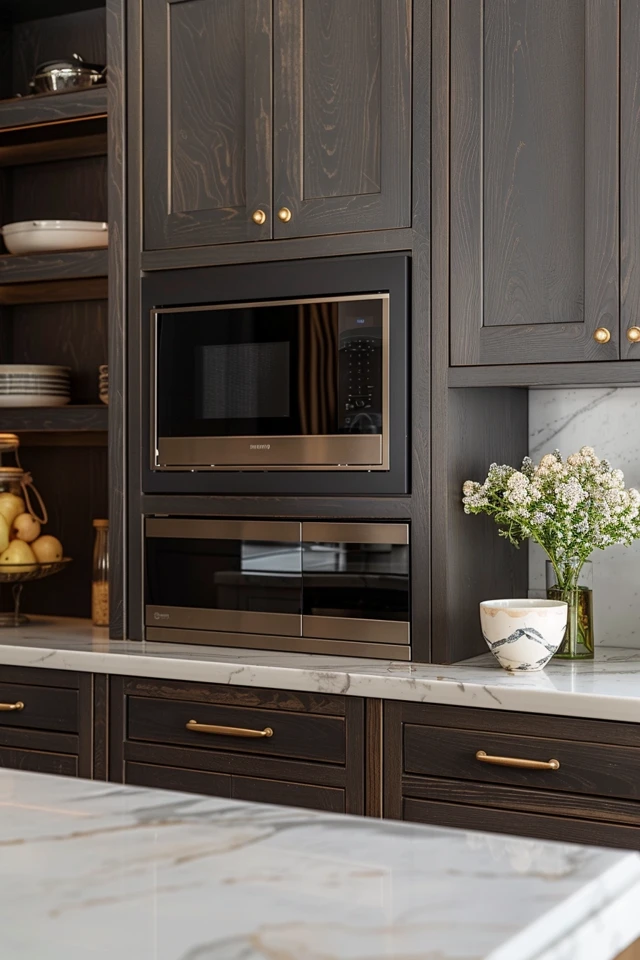
Microwave Storage Ideas to Maximize Kitchen Space
The microwave is often the most used appliance in the modern kitchen, yet it is rarely the most beautiful. We rely on it for reheating coffee, melting butter, and quick meals, but its bulky footprint can dominate valuable counter space and ruin the flow of a thoughtful design. Finding the right spot for it involves balancing accessibility with aesthetics.
As an interior designer, I view the microwave as a puzzle piece that needs a specific home, rather than an afterthought placed wherever a plug exists. To spark your imagination before we dive into the technical details, you can find a curated Picture Gallery at the end of the blog post showing these concepts in action. When you intentionally plan your microwave storage, you reclaim prep space and create a kitchen that feels custom and unencumbered.
Whether you are undergoing a full renovation, looking for a weekend DIY project, or trying to optimize a rental apartment, there is a solution that fits your layout. The goal is to make the appliance accessible for every member of the family without letting it be the focal point of the room.
1. The Built-In Cabinetry Approach
If you are designing a kitchen from scratch or refacing cabinets, a built-in microwave is the gold standard for a seamless look. This usually involves a dedicated cabinet niche specifically sized for the appliance. The result is a flush finish that looks intentional and high-end.
To achieve this, you generally have two routes: purchasing a specific “built-in” microwave or using a standard countertop microwave with a matching trim kit. I almost always recommend the trim kit route to my clients. It allows you to buy a standard, affordable microwave but gives it that custom, integrated appearance by filling the gaps between the appliance and the cabinet frame.
Key Design Rules for Built-Ins:
- Depth Matters: Standard upper cabinets are 12 to 13 inches deep, but most microwaves require 15 to 18 inches of depth. You cannot simply shove a microwave into a standard upper cabinet; it will protrude awkwardly.
- Ventilation is Non-Negotiable: Even built-in units need airflow. Consult the manufacturer’s specs for required clearance, usually 1 to 2 inches on all sides behind the trim kit.
- Height Placement: For safety, the bottom of the microwave should ideally be 3 inches below the primary user’s shoulder height. This prevents lifting hot liquids above eye level.
2. The Under-Counter Drawer Microwave
The drawer microwave has surged in popularity over the last five years, particularly in open-concept kitchens that lack upper cabinetry. These units are installed into base cabinets, usually in a kitchen island or next to the range. They slide open automatically with the touch of a button or a gentle tug.
From an ergonomic standpoint, this is a winner for universal design. It allows you to lift heavy, hot dishes upwards onto the counter rather than reaching up and lowering them down. This is significantly safer for children and aging adults.
However, this choice requires specific planning during the rough-in phase. These units are heavy and require a dedicated 120-volt circuit in the island or base cabinet. They are also significantly more expensive than standard door-swing models, often costing three to four times as much.
What I’d Do in a Real Project:
- Location: I place these on the “prep” side of the island, facing the range, rather than the “social” side where barstools go.
- Clearance: Ensure there is enough clearance for the drawer to fully extend without hitting the oven door or dishwasher if they are open simultaneously.
- Cabinet Width: Most drawer microwaves fit a standard 24-inch or 30-inch cabinet base. Do not guess; select your appliance before ordering cabinetry.
3. The Appliance Garage and Pantry Station
If you prefer your appliances to be completely invisible when not in use, the appliance garage is your best solution. This involves extending the countertop into a cabinet specifically designed to house small appliances like the toaster, coffee maker, and microwave. When the doors are closed, the kitchen looks sleek and minimalist.
Modern appliance garages have moved away from the dated tambour (roll-top) doors of the 90s. We now use lift-up hinges, pocket doors that slide back into the cabinet walls, or bifold doors. This allows full access to the microwave without the doors blocking traffic flow.
Another variation of this is the “Breakfast Station” within a pantry. If you have a walk-in pantry or a large cabinet pantry, relocating the microwave there can be a game-changer. It keeps the main kitchen zone strictly for cooking and prep, while the reheating and snacking zone is tucked away.
Integration Tips:
- Landing Zone: You must have a countertop surface immediately adjacent to or below the microwave. Never place a microwave in a pantry without a shelf to set down the hot plate.
- Electrical Code: If you are hiding a microwave behind doors, many local building codes require a safety switch that cuts power to the outlet when the doors are closed to prevent overheating or fire.
4. Open Shelf Integration
For a lighter, airier kitchen aesthetic, integrating a microwave onto an open shelf is a practical compromise. This works well in industrial, farmhouse, or eclectic styles where exposed storage is part of the charm. It is also a very budget-friendly option compared to custom cabinetry.
The key here is intent. You don’t want the microwave to look like it was just placed on a random shelf. The shelf needs to be deep enough to hold the entire unit safely, and the cord management needs to be invisible. Nothing ruins the look faster than a dangling black power cord snaking down the wall.
When designing open shelving for a microwave, I often specify a “boxed” shelf. This means the shelf above and the shelf below are closer together, creating a dedicated cubby that frames the microwave closely. This mimics the built-in look without the heavy cost of cabinetry.
Styling the Open Shelf:
- Color Coordination: If your shelves are wood and your walls are white, a white microwave often disappears better than a stainless steel one.
- Breathing Room: Leave at least 2 inches of space on either side of the microwave for aesthetics and ventilation.
- Neighboring Items: Flank the microwave with stacks of ceramic bowls or cookbooks to soften the mechanical look of the appliance.
5. Renter-Friendly and Freestanding Solutions
Not everyone can tear out cabinets or rewire an island. If you are renting or working with a strict budget, you need freestanding solutions that look polished. The most effective method is a sturdy kitchen cart or a baker’s rack.
A rolling island cart with a butcher block top provides a perfect spot for a microwave. The shelf below can hold the unit, leaving the top surface free for prep work. This effectively creates a mobile “cooking station” that you can move depending on your needs.
Another option is modifying an existing base cabinet. If you have a standard 24-inch wide cabinet with a door, you can sometimes remove the door, take out the drawer above it, and finish the interior to create an open niche. This requires some DIY skill but is reversible if you save the door and hardware.
A Designer’s Advice for Renters:
- Cord Control: Use adhesive cord clips to run the cable down the back leg of the cart or stand.
- Basket Storage: If the cart has open shelves below the microwave, use matching baskets to hide loose items. This reduces visual clutter and makes the setup look like a deliberate design choice.
- Scale: Measure your microwave before buying a cart. Many carts are quite shallow (14 to 16 inches), and a large microwave may hang off the edge, which is a safety hazard.
Designer’s Note: The “Landing Zone” Rule
I cannot stress this enough: the physical placement of the microwave is secondary to the safety of the “landing zone.” In every kitchen layout I review, I look for where the hot food goes immediately after it leaves the microwave.
I once worked on a project where the client wanted the microwave in a tall pantry cabinet on the far side of the room. I had to veto it because the nearest countertop was five steps away. Imagine carrying a brim-full bowl of boiling tomato soup five steps across a busy kitchen.
The Rule: There must be a heat-resistant surface within 15 to 20 inches of the microwave handle side. If the microwave is above the range, the range is the landing zone. If it is in an island, the island top is the landing zone. Do not violate this rule for the sake of aesthetics.
Common Mistakes + Fixes
Even with good intentions, microwave placement often goes wrong. Here are the most frequent errors I see in residential projects and how to correct them.
Mistake 1: Placing the microwave too high.
Many over-the-range microwaves are installed with the buttons at 60+ inches high. For a shorter person or a child, this is dangerous.
The Fix: If you must use vertical storage, consider a countertop model on a lower shelf or a drawer unit. Max height for the user controls should generally be around eye level.
Mistake 2: Ignoring door swing direction.
Most microwaves have hinges on the left and open from the right. If you place your microwave against a left-side wall, the door will not open past 90 degrees, and you will struggle to get food in and out.
The Fix: Always leave at least 3 inches of filler space between the hinge side of the microwave and a wall. Alternatively, ensure the microwave is on the right end of a cabinet run.
Mistake 3: Forgetting electrical specs.
Plugging a high-wattage microwave into a circuit shared with a toaster oven or coffee maker will trip your breaker constantly.
The Fix: Microwaves should ideally have a dedicated 20-amp circuit. If you are renovating, have your electrician verify the load capacity of the intended outlet.
What I’d Do: The Real Project Checklist
If I were consulting on your kitchen today, this is the checklist I would run through to finalize your microwave storage plan. Walk through these steps before you buy any cabinets or appliances.
1. Measure the Appliance and the Plug Depth
Measure the microwave depth, but add 1.5 inches for the plug protruding from the back. This is the true depth you need inside the cabinet.
2. Check the Trim Kit Compatibility
If you want a built-in look, buy the microwave and the trim kit from the same brand and same series. They are not universal. A Panasonic trim kit will not fit a GE microwave.
3. Verify “Rough-In” Dimensions
If you are ordering custom cabinets, give the cabinet maker the appliance model number immediately. They need the “cutout dimensions,” which are different from the product dimensions.
4. Evaluate Traffic Flow
Stand in your kitchen and mime opening the microwave. Does the open door block the walkway to the refrigerator? If yes, move it. You do not want a traffic jam every time someone heats up leftovers.
FAQs
Can I put a countertop microwave in a cabinet?
Yes, but with caveats. You must ensure there is adequate ventilation space around the sides and top as specified in the manual. You also need to finish the hole in the cabinet back to manage the cord properly.
Are drawer microwaves worth the money?
In my professional opinion, yes. They are the best solution for keeping vertical sightlines clear and are superior for aging-in-place design. The mechanism is reliable, and they hold their resale value well.
Is it safe to put a microwave on top of a fridge?
Generally, I advise against this. It is usually too high for safe use for most people. Furthermore, the vibration from the fridge compressor combined with the microwave weight isn’t ideal. It also looks like an afterthought.
Can I install a microwave inside an island without a drawer unit?
Yes. You can create an open shelf in the island cabinetry and place a standard countertop microwave there. This saves about $800 compared to a drawer unit. Just be sure the shelf has an outlet installed inside the cabinet.
Conclusion
Microwave storage is about more than just hiding an ugly box; it is about creating a kitchen that functions as smoothly as it looks. Whether you opt for a sleek under-counter drawer, a custom built-in with a trim kit, or a cleverly styled cart, the right choice depends on your specific lifestyle and layout constraints.
Remember that the best design decisions prioritize safety and workflow first. Once you establish the correct “landing zone” and ensure proper ventilation, you can focus on the materials and finishes that blend the appliance into your decor. By treating the microwave as a permanent fixture rather than a temporary addition, you elevate the entire feel of your kitchen.
Take your time measuring your space and considering how your family moves through the room. With a little planning, you can turn a bulky necessity into an integrated part of your dream kitchen.
Picture Gallery


