
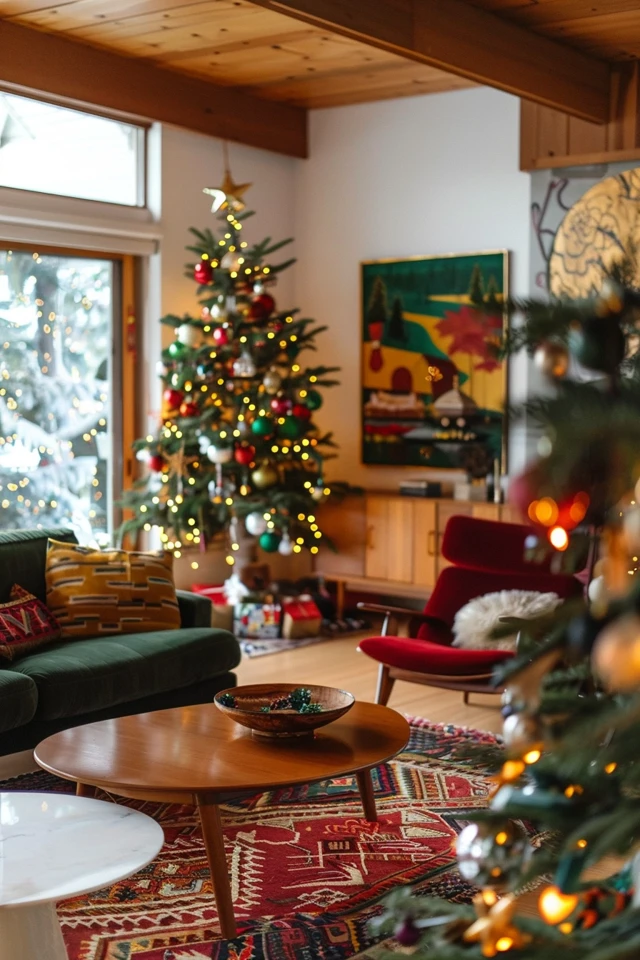
Mid Century Christmas Decorations: My Top Picks
There is a specific kind of magic attached to Mid Century Modern (MCM) holiday decor. It isn’t just about nostalgia; it is about an era that embraced optimism, space-age shapes, and a fearlessness regarding color that we often lack in contemporary design. When I design holiday schemes for clients with mid-century homes—or just mid-century hearts—the goal is always to capture that playful “Atomic Age” spirit without making the living room look like a movie set.
I remember one specific project where the homeowner wanted to transition from traditional farmhouse decor to a sleek, 1960s Palm Springs vibe for her holiday party. We swapped the burlap and pinecones for tinsel and turquoise, and the entire energy of the home shifted. It felt brighter, more festive, and surprisingly sophisticated. For a curated selection of visual inspiration, don’t miss the Picture Gallery at the end of the blog post.
Whether you are a purist looking for authentic vintage Shiny Brites or someone who just wants to incorporate a few retro touches, this guide covers the essentials. I will walk you through the textures, the lighting specifications, and the spatial rules I use to pull this look together.
1. The Aluminum Tree and Alternative Greenery
If you really want to commit to the mid-century look, the tree is your biggest statement piece. The silver aluminum tree is the quintessential icon of 1950s and 1960s Christmas decor. These were originally marketed as “permanent” trees, eliminating the need for watering and needle cleanup.
In a modern context, an aluminum tree acts as a sculptural element. Because it reflects light so intensely, it does not require the same density of ornaments as a traditional fir or spruce. You want to let the branches breathe so the light can travel through the metallic needles.
If silver feels too cold for your palette, look for champagne gold or even pink flocked trees. The key is the silhouette. Mid-century trees often feature sparse, tiered branches rather than a full, conical shape. This allows for better display of long, dangly ornaments.
Designer’s Note: Lighting the Aluminum Tree
There is a critical safety and design rule regarding true aluminum trees: never string electric lights directly on them. In the vintage era, this was a massive fire and shock hazard because the metal needles could cause a short circuit.
Instead, use a rotating color wheel placed on the floor. This projects changing colors—usually red, blue, green, and amber—up onto the reflective branches. It creates that shimmering, shifting effect that is synonymous with the era. If you buy a modern reproduction tree made of mylar or tinsel (plastic), you can use string lights, but I still prefer the floor spotlight method for authenticity.
Common Mistakes & Fixes
- Mistake: Overstuffing the tree. Modern styling usually dictates “the fuller, the better,” but MCM trees were often spindly by design.
- Fix: Embrace the negative space. Leave 4 to 6 inches of horizontal space between major ornaments. This allows the unique shape of the branch tips to stand out.
2. Ornament Curation: The Shiny Brite Aesthetic
When we talk about mid-century ornaments, we are usually talking about “Shiny Brites.” These were mass-produced glass ornaments known for their unique shapes, including indents (reflectors), finials, and stripes. The color palette is distinct: think bright cerulean blue, hot pink, chartreuse, and cherry red, often all on the same tree.
In a professional layout, I group these ornaments by shape rather than color to create rhythm. For example, I might place round indent ornaments deep inside the tree near the trunk to reflect light outward. Then, I hang the longer, teardrop finials on the tips of the branches.
Because many surviving vintage ornaments are fragile glass, I always recommend wiring them securely. Do not rely on the original flimsy metal hooks. Use green floral wire or silver ornament hooks and pinch the end tightly to the branch.
Realistic Constraints: Kids and Pets
If you have cats or toddlers, vintage glass is a liability. It shatters into dangerous dust. Here is how I handle this in family homes:
- Zone Defense: Use shatterproof replicas on the bottom 30 inches of the tree. Several brands now make excellent plastic versions of the classic reflector shape.
- High-Impact Placement: Save your authentic glass vintage pieces for a garland on the mantel or a bowl in the center of the dining table, well out of reach of wagging tails.
Pro-Level Scaling
Pay attention to the scale of your finials (tree toppers). Mid-century toppers are often tall, precarious spires.
- Rule of Thumb: Ensure you have at least 6 inches of clearance between the tip of your tree topper and the ceiling.
- Stabilization: These toppers are often top-heavy. I use a green zip tie or a wooden dowel splint painted green to secure the topper to the central leader branch so it doesn’t lean like the Tower of Pisa.
3. The Mantelscape: Putz Houses and Bottle Brush Trees
The mantel is where you can create a narrative scene. One of my favorite MCM collectibles is the “Putz house.” These are tiny cardboard houses, often covered in mica flakes (glitter) with cellophane windows. They originated in Japan and were popular in the mid-20th century.
When styling a village, elevation is everything. If you line them up in a straight row, the display looks flat and uninteresting. I use acrylic risers or even books hidden under faux snow batting to create varying heights.
Pair these houses with bottle brush trees. The original 1950s trees were usually dyed in organic greens, but later versions embraced the wilder colors of the 60s. I mix cream, gold, and teal trees to bridge the gap between the neutral architecture of a room and the colorful decor.
What I’d Do in a Real Project
Here is my mini-checklist for a balanced MCM mantel:
- The Anchor: A large starburst mirror or clock usually stays on the wall. I frame the decor around it rather than covering it.
- The Garland: Instead of heavy cedar, I use silver or gold tinsel garland. It drapes beautifully and catches the light.
- The Spacing: Group items in odd numbers. A cluster of three bottle brush trees on the left, a cluster of five Putz houses on the right. Asymmetry is very mid-century.
- Safety Check: If the fireplace is functional, keep all cardboard houses and celluloid items at least 12 inches away from the firebox opening. Vintage plastics are highly flammable.
4. Lighting: C7 Bulbs and Ceramic Colors
Lighting temperature makes or breaks this look. Modern cool-white LEDs (3000K-5000K) look too clinical and harsh against vintage decor. You need the warm, cozy glow of incandescents, or LEDs specifically engineered to mimic them (2700K or lower).
For the exterior, the MCM standard is the C7 or C9 bulb. These are the large, ceramic-look painted bulbs. They are opaque, not transparent. This provides a soft, gumdrop-like glow that outlines the architectural lines of a ranch or split-level home beautifully.
If you have a flat roofline—common in mid-century architecture—installing lights can be tricky. Do not staple into the fascia. I use plastic clips that slide onto the gutter or slip under the shingles. This keeps the lines perfectly straight, which is crucial for the geometric precision of modern design.
Designer’s Note: Blow Molds
Plastic illuminated figures, known as “blow molds,” are making a massive comeback. A pair of plastic candles or a jovial Santa on the porch is peak nostalgia. However, they are lightweight.
- Pro Tip: Most blow molds have a small access hole in the back or bottom. Fill a gallon Ziploc bag with sand and stuff it inside the base. This weighs them down without damaging the plastic, preventing them from blowing over in winter winds.
5. Textiles and Tabletop Decor
You don’t need to reupholster your furniture to match Christmas. You just need the right textiles to bridge the gap. In the 1950s and 60s, holiday linens often featured screen-printed atomic motifs, stars, and stylized reindeer.
For the dining table, I love using a felt runner with cut-out starburst patterns. It provides texture and protects the wood table underneath. On top of this, I layer vintage glassware. If you can find “roly poly” glasses with gold rims, they are the perfect vessel for holiday punch.
When choosing throw pillows or blankets, look for texture. Bouclé, velvet, or faux fur in solid colors works best. If your tree is a riot of color, keep your textiles solid to prevent visual fatigue. A solid chartreuse velvet pillow on a gray sofa screams mid-century without being kitschy.
Common Mistakes & Fixes
- Mistake: Using “Department Store Red” everywhere. The standard dark red often clashes with the orange-toned woods (teak, walnut) found in mid-century furniture.
- Fix: Shift your red toward orange-red (vermilion) or swap it entirely for pink or copper. These tones harmonize much better with warm wood grains.
6. Wrapping It Up: The Atomic Gift Wrap
The decor shouldn’t stop at the tree skirt. The gifts beneath the tree are part of the visual display. I advise clients to pick a wrapping paper theme that coordinates with the ornaments.
For an MCM look, avoid glossy, photo-realistic paper. Look for matte papers with geometric prints, simple stripes, or foil finishes. Solid foils in gold, magenta, and turquoise look incredibly luxurious under the lights.
Ribbon choice matters too. Instead of floppy fabric ribbons, use curled ribbon or “star bows.” You can stick multiple star bows on one package for a very retro, abundant look. It is an affordable way to add volume and color to the base of the tree.
Final Checklist: The Mid Century Holiday Audit
Before you declare your decorating complete, run through this list to ensure the vibe is cohesive and practical.
- Scale Check: Is the tree topper clearing the ceiling by at least 6 inches?
- Light Temperature: Are all bulbs (indoor and outdoor) casting a warm glow (2700K or lower)? No blue-white LEDs!
- Safety First: Are authentic aluminum trees lit by projection only (no string lights)?
- Traffic Flow: Is there at least 36 inches of clearance walkway around the tree?
- Color Balance: Have you repeated your accent color (e.g., teal or pink) in at least three places in the room (Tree, Mantel, Coffee Table)?
- Pet/Kid Proofing: Are breakable glass ornaments secured with wire or moved to the top two-thirds of the tree?
- Exterior Lines: Are the roofline lights straight and taut? Sagging wires ruin the clean modernist lines.
FAQs
Where is the best place to find authentic vintage ornaments?
Estate sales and antique malls are gold mines in the off-season (summer). Online auction sites are great, but shipping glass is risky. When buying in person, check the “neck” of the ornament under the cap. If it is black or crumbled, the ornament is likely too fragile to hang.
How do I store a flocked tree?
Flocking (faux snow) can yellow or get crushed. Store the tree upright if possible, in a canvas storage bag rather than a cardboard box. Avoid attics that get extremely hot, as heat can cause the flocking glue to fail.
Can I mix mid-century decor with my existing farmhouse/industrial furniture?
Absolutely. The key is color connection. If your room is neutral (farmhouse), use the metallic elements of mid-century decor (silver, gold, mercury glass) to bridge the gap. Introduce the bold colors through small accents like pillows or a table runner rather than overwhelming the space.
Conclusion
Embracing Mid Century Modern Christmas decor is about more than just buying a silver tree. It is about capturing a spirit of playfulness and breaking the rules of traditional holiday styling. It allows you to mix metals, embrace bold saturation, and highlight the architectural beauty of your home.
Remember, the most successful designs are the ones that prioritize flow and function alongside aesthetics. Secure your valuables, manage your lighting temperature, and leave enough negative space for the decorations to sing. Whether you go full “Mad Men” or just add a few sputnik ornaments to your spruce, this style brings a joy that is timeless.
Picture Gallery


