
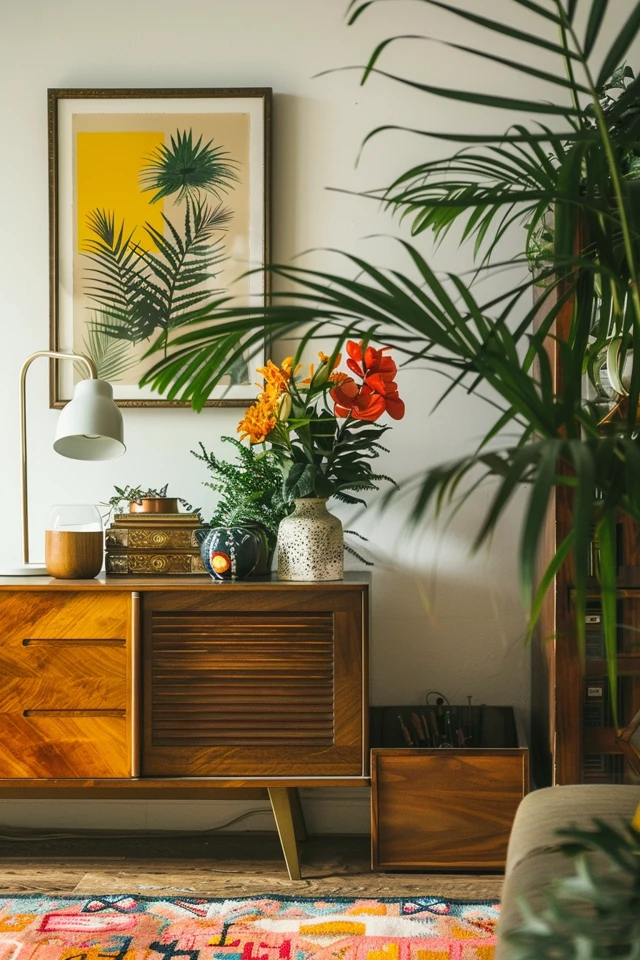
Mid-century Modern Artwork: Adding Flair to Your Home
There is a reason mid-century modern (MCM) design has held onto its popularity for decades. It strikes a perfect balance between organic warmth and clean, functional geometry. When it comes to artwork, this era offers an incredible range of expression, from bold abstract expressionism to subtle, earth-toned minimalist prints.
However, selecting the right piece is only half the battle; knowing how to frame, hang, and light it is what elevates a room from “nice” to professionally designed. I have seen countless beautiful prints lose their impact simply because the scale was off or the hanging height was incorrect. For a dose of visual inspiration, be sure to scroll down to the Picture Gallery at the end of this post.
In this guide, I will walk you through the practical steps of choosing and styling MCM artwork. We will cover the specific measurements you need to know, how to mix vintage vibes with modern living, and the installation rules I use on every client project.
1. Identifying the Mid-century Aesthetic
To choose the right art, you first need to understand the visual language of the era. Mid-century art was a reaction against the strict realism of the past, embracing abstraction, pop art, and new materials. It is not just about “retro” shapes; it is about optimism and experimentation.
Geometric Abstraction
One of the hallmarks of this style is the use of strong geometric shapes. Think overlapping circles, hard-edge triangles, and asymmetrical compositions. These pieces work exceptionally well in rooms that have a lot of rectangular furniture, as the shapes break up the visual rigidity.
Color Palettes that Work
You do not have to stick to bright orange and teal. The sophisticated side of MCM design relies heavily on “muddy” or earthy tones.
- Mustard Yellow and Ochre: Adds warmth without the aggression of primary yellow.
- Olive and Moss Green: Connects the interior to the outdoors, a key tenant of MCM architecture.
- Teak and Walnut Browns: These should be present in the art or the frame to tie into your furniture.
- Burnt Orange and Rust: Provides a classic pop of energy.
Texture and Media
Don’t limit yourself to flat paper prints. The mid-century era saw a rise in textile art and mixed media. A fiber wall hanging or a textured canvas can soften the acoustics of a room with hardwood floors and sleek leather furniture.
Designer’s Note: The “Theme Park” Trap
A common mistake I see is clients buying art that screams “1950s diner.” Avoid kitschy ads or overly literal atomic clocks unless that is specifically what you want. Aim for art that feels like it was painted in the era, not a caricature of the era. Look for abstract expressionism or color field paintings rather than retro signage.
2. The Mathematics of Placement and Scale
As a designer, I live and die by the tape measure. The number one issue in DIY interior design is scale. Art that is too small looks cheap, and art hung too high makes the ceiling feel lower. Here are the specific rules of thumb I use to ensure professional results.
The 57-Inch Rule
Museums and galleries hang artwork so that the center of the piece is 57 inches from the floor. This represents the average human eye level.
- Measure up 57 inches from the floor and mark the wall lightly.
- Measure the total height of your artwork (including the frame) and divide by two.
- Measure the distance from the top of the frame to the hanging wire on the back.
- Do the math: 57″ + (half height) – (wire distance) = where your nail goes.
Relation to Furniture
If you are hanging art above a piece of furniture, like a sofa or a sideboard, the 57-inch rule changes. Instead, you need to relate the art to the furniture item to create a cohesive vignette.
- The 2/3rds Rule: The artwork should span roughly two-thirds of the width of the furniture below it. If your sofa is 84 inches wide, your art (or group of art) should be about 56 inches wide.
- Vertical Spacing: The bottom of the frame should sit 6 to 8 inches above the back of the sofa or the top of the console table. Anything higher than 10 inches disconnects the art from the furniture, leaving it “floating” in space.
Common Mistakes + Fixes
Mistake: Using a single small 8×10 frame behind a large sofa.
Fix: If you love a small piece, do not hang it alone. Turn it into a gallery wall, or frame it with an oversized mat (3 to 4 inches thick) and a chunky frame to increase its total physical footprint.
3. Framing and Finishes: The MCM Way
The frame is just as important as the art itself. In mid-century design, the frame serves as the bridge between the artwork and the architectural elements of the room. The goal is a clean, tailored look that respects the materials.
Wood Tones and Profiles
The most authentic look for this style is a simple, flat profile wood frame. Avoid ornate gold scrolling or heavy farmhouse rustic woods.
- Walnut: The gold standard for MCM. It pairs beautifully with vintage credenzas.
- White Oak or Ash: Good for “Scandi-Modern” interpretations, which are lighter and airier.
- Black Metal: Thin, matte black metal frames work well for black-and-white photography or architectural blueprints.
Matting Matters
A mat (the white border around the print) provides breathing room. For a high-end look, I almost always use a custom mat size. If you buy a standard frame, the mat is often too narrow.
- Standard Mat: usually 1.5 to 2 inches.
- Designer Mat: 3 to 5 inches. This extra white space draws the eye in and makes the artwork feel more expensive.
Canvas and Floating Frames
If you purchase a canvas print (common for abstract expressionist styles), use a “float frame.” This leaves a small gap between the canvas edge and the wood frame, creating a shadow line that adds depth. It looks much more finished than a bare canvas edge.
4. Room-by-Room Styling Strategies
Every room serves a different function, and the artwork should reflect that energy. Here is how I approach specific zones in a home using MCM principles.
The Living Room: The Focal Point
This is usually where your largest piece will go. Since mid-century furniture is often low-profile (low backs on sofas and chairs), you have a lot of vertical wall space to fill.
- The Strategy: Use one massive “statement” piece to anchor the room. An abstract piece with horizontal movement can make the room feel wider.
- Lighting: Consider installing a picture light above the frame. A sleek, brass picture light adds that library-chic vibe common in 1960s executive offices.
The Dining Room: Conversation Starters
Dining rooms are great for series or grids. Since you are often seated, the art placement might need to be slightly lower than the standard 57 inches if the room is intimate.
- The Strategy: A grid of 3 or 4 geometric prints works well here. It mimics the structure of the dining table and chairs.
- Glass Glare: If you have a chandelier, be wary of glass glare. Use non-reflective (museum) glass or stick to matte canvas prints in this room.
The Bedroom: Calm and Organic
Mid-century design can be high energy, but the bedroom needs to be restful. Avoid aggressive shapes or jarring colors like bright red.
- The Strategy: Look for “color field” art—large swathes of soft, blending colors. Organic curves are better than sharp triangles here.
- Placement: Above the bed is the classic spot. Ensure the frame is secure. I prefer acrylic (plexiglass) over real glass above a bed for safety, especially in earthquake-prone areas.
Designer’s Note: Real-World Lesson
I once designed a bedroom with a heavy, glass-framed print over the headboard. The client was terrified it would fall. We swapped it for a large textile tapestry on a walnut dowel. It absorbed sound, added texture, and removed the safety anxiety completely.
5. Curating and Mixing Eras
You do not need to live in a time capsule to enjoy MCM art. In fact, the most stylish homes mix eras. The clean lines of mid-century art play very well with contemporary, industrial, and even traditional styles.
The 80/20 Rule
If your home is mostly modern or traditional, use MCM art as the “spice.” If your furniture is strictly mid-century, try adding a piece of contemporary photography to keep the room from looking like a movie set.
- Mixing with Traditional: An abstract geometric print looks stunning above an antique fireplace mantel. The contrast creates tension and interest.
- Mixing with Industrial: The warmth of MCM wood frames softens the harshness of concrete floors and exposed ductwork.
Gallery Walls: Controlled Chaos
A mid-century gallery wall is usually more structured than a bohemian one.
- The Grid: Identical frames, identical mats, arranged in a perfect square or rectangle. This is very “corporate 1960s” and looks very high-end.
- The Organic Balance: Mixing sizes but keeping a consistent color palette. Keep the spacing between frames consistent (2 to 3 inches) to maintain order.
What I’d Do in a Real Project: A Mini Checklist
When I start styling a wall, I follow this exact sequence:
- Photograph the wall: I take a straight-on photo of the empty space.
- Tape it out: I use painter’s tape to outline potential frame sizes directly on the wall. This is the only way to truly feel the scale.
- Check the palette: I bring a paint chip or fabric swatch from the sofa to the frame shop or art store. Never trust your memory on colors.
- Select the frame: I match the frame wood to the secondary wood in the room (e.g., the legs of the armchair), not necessarily the main floor color.
Final Checklist
Before you hammer that nail, run through this final check to ensure success.
- Scale Check: Is the art at least 2/3 the width of the furniture below it?
- Height Check: Is the center of the art roughly 57 inches from the floor (or 6-8 inches above furniture)?
- Color Balance: Does the artwork contain at least one color found elsewhere in the room (rug, pillows, curtains)?
- Safety: If the piece is heavy, did you use a wall anchor or find a stud? A 20lb hook is rarely enough for a large framed piece with glass.
- Level: Have you used a spirit level? Even a fraction of an inch off can be noticeable with the geometric lines of MCM art.
- Lighting: Is the art in direct sunlight? If so, ensure the glass has UV protection to prevent fading.
FAQs
Q: Can I put MCM art in a room that isn’t mid-century style?
Absolutely. Because mid-century art focuses on form and color, it is highly versatile. A geometric black and white print works in a farmhouse, and a colorful abstract works in a maximalist space. The key is the frame; pick a frame that bridges the gap between the art and your current decor.
Q: How do I handle art in a rental where I can’t put holes in the wall?
For lighter pieces, adhesive command strips are fantastic, but you must use the heavy-duty velcro style and use enough of them. For large statement pieces, consider the “lean.” Leaning a large framed piece on a sideboard or even the floor is a very casual, designer-approved look that requires zero holes.
Q: Should all the frames in a room match?
No, that can look a bit too “catalog.” However, they should speak the same language. If you have a walnut frame, a black metal frame, and an oak frame, it might look messy. Try to stick to two finishes per room (e.g., all wood frames are walnut, but you mix in a few black metal ones).
Q: How do I protect my art from fading?
Mid-century prints often feature vibrant reds and oranges, which are the first colors to fade. Never hang valuable art in direct, harsh sunlight. If you must, invest in “Conservation Clear” glass or acrylic, which blocks 99% of UV rays. It is more expensive but worth it for longevity.
Q: What if I have high ceilings?
If you have 10-foot ceilings or higher, the 57-inch rule still applies to the center of the art. Do not hang art higher just because the ceiling is high; it disconnects from the human scale. Instead, buy taller artwork to fill the vertical gap, or stack two pieces vertically.
Conclusion
Adding mid-century modern artwork to your home is one of the most effective ways to inject personality and warmth into a space. Whether you are drawn to the chaotic energy of abstract expressionism or the quiet order of geometric minimalism, this era offers something for everyone.
Remember that the difference between a college dorm look and a sophisticated home lies in the execution. Pay attention to your frame quality, respect the negative space on your walls, and measure twice before you hang. By following the guidelines on scale and placement, you can curate a collection that feels timeless, intentional, and uniquely yours.
Picture Gallery


