
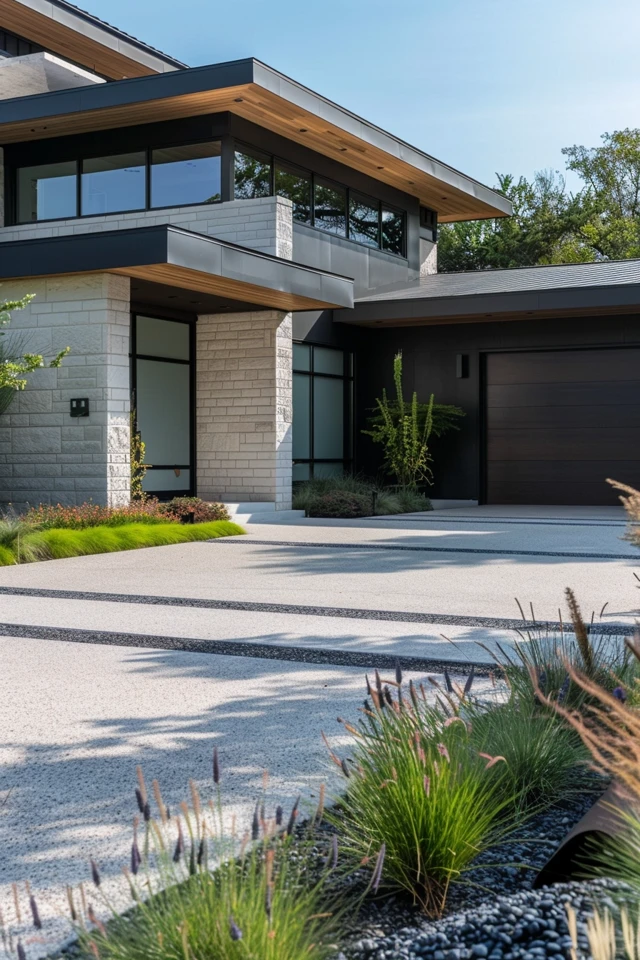
Title: Modern Concrete Driveway Ideas for Stylish Curb Appeal
Introduction
When we think about home renovations, the driveway is often the last item on the list. We spend months obsessing over kitchen backsplashes or the perfect shade of white for the living room, yet we ignore the massive slab of gray sitting right in front of the house. As a designer, I see this as a missed opportunity because your driveway often covers 30 to 50 percent of your property’s front visual field. It sets the tone for the entire architectural narrative before anyone even steps through the front door.
I recently worked on a mid-century modern renovation where the clients were ready to paint the brick exterior to “modernize” the look. I advised them to hold off on the paint and instead invest that budget into ripping out the cracked, oil-stained asphalt driveway. We replaced it with large geometric concrete pads separated by black Mexican beach pebbles. The transformation was so drastic that the neighbors asked if they had remodeled the entire house. The driveway didn’t just serve a function; it anchored the home’s aesthetic.
Modern design isn’t just about minimalism; it is about intentionality and materials that age gracefully. Whether you are dealing with a steep slope, a tight budget, or a need for better drainage, concrete offers versatility that few other materials can match. If you are looking for visual inspiration, you can jump right to the Picture Gallery at the end of this blog post.
1. The Geometry of Modern Design: Layout and Scale
The hallmark of a modern concrete driveway is the departure from a single, monolithic pour. Large, unbroken slabs of concrete can look commercial and uninviting. Instead, we use geometry to create visual interest and break up the heavy mass of the material.
The most popular approach in high-end modern design is the “floating paver” look. This involves pouring large rectangular concrete pads that are separated by negative space. This layout does two things: it reduces the visual weight of the hardscape and creates a rhythm that leads the eye toward the house.
Designer’s Note: Getting the Scale Right
A common mistake homeowners make is sizing these pads too small, which makes the driveway look busy and cheap.
For a standard vehicle, you need stability. I recommend pads that are at least 4 to 6 feet wide and 6 to 10 feet long. If the pads are too small, they will rock or settle unevenly under the weight of a heavy SUV. The thickness is also non-negotiable; while a patio can be 3.5 inches thick, a driveway must be at least 5 to 6 inches thick with rebar reinforcement to prevent cracking.
Designing the Gaps
The space between these slabs is just as important as the concrete itself. For a sleek, clean look, I usually specify a 4-inch gap. This is wide enough to define the shape but narrow enough to walk over comfortably without tripping.
If you plan to fill these gaps with gravel, use a crushed aggregate rather than round stones. Crushed stone locks together, whereas round stones act like marbles and will end up scattered all over your street.
2. Finishes and Textures: Moving Beyond Basic Gray
Standard broom-finished gray concrete is functional, but it rarely screams “style.” To elevate the curb appeal, we need to manipulate the surface texture.
One of my go-to finishes for modern homes is the “sand finish” (sometimes called a top-cast finish). This process involves washing away the very top layer of cement paste to reveal the sand particles underneath. The result is a texture that looks like limestone or natural stone. It provides excellent slip resistance without the rough, jagged feel of an exposed aggregate finish.
Acid Staining and Integral Color
If the standard gray feels too cold for your home’s palette, consider integral coloring. This is where the pigment is mixed into the concrete truck before pouring, ensuring the color runs all the way through the slab.
I generally advise against surface painting, as it will inevitably chip under tire friction. Integral colors in charcoal, slate, or warm taupe can ground the house and make the landscaping pop.
Common Mistakes + Fixes: Color Matching
Mistake: Trying to match the driveway color exactly to the house siding or brick.
Fix: Aim for contrast. If your house is a light cream stucco, go for a darker slate driveway. If your house is dark gray or charcoal, a lighter, natural concrete color will provide necessary brightness.
3. The “Green” Driveway: Permeability and Softscaping
Modern design is increasingly intersecting with eco-friendly living. A “ribbon driveway” is a classic design element that has returned in full force.
This layout consists of two parallel strips of concrete for the car tires, with a strip of grass or ground cover in the center. This design significantly reduces the amount of concrete used and allows rainwater to soak into the ground rather than running off into the sewer system.
Choosing the Right Ground Cover
The challenge with ribbon driveways or grass-jointed pavers is maintenance. Real grass requires mowing, watering, and edging, which can be a nightmare in narrow strips.
What I’d do in a real project:
- Artificial Turf: For the lowest maintenance and a perpetually green look, high-quality artificial turf is the best option. It handles the weight of a car without turning into mud.
- Dymondia or Creeping Thyme: If you prefer real plants, these ground covers are tough, drought-tolerant, and stay flat to the ground. They can handle occasional tire traffic.
- Gravel Grid Systems: If you prefer stone between the ribbons, install a plastic cellular grid system underneath. This holds the gravel in place so your tires don’t create ruts.
Handling Drainage
If you live in an area with heavy rainfall, breaking up the concrete with green spaces is a functional necessity. It prevents water from pooling near your garage foundation. Ensure the sub-base beneath the soil strips is permeable (crushed rock) to encourage deep drainage.
4. Lighting for Impact and Safety
You cannot design a driveway for daytime only. Lighting is the jewelry of the exterior; it ensures safety and highlights the architectural lines of the driveway at night.
For modern driveways, we want to avoid the “runway effect” where lights are placed symmetrically every two feet on both sides. This looks like an airport landing strip. Instead, use asymmetrical placement to create pockets of light and shadow.
Embedded Lighting
One of the sleekest looks involves embedding LED puck lights directly into the concrete. These are flush with the surface, so you can drive right over them. I often place these at the corners of the driveway apron to mark the entry.
Strip Lighting
For a truly futuristic or ultra-modern look, linear LED channels can be installed in the expansion joints between slabs. This creates glowing lines on the ground. However, this requires careful coordination with the electrical contractor before the concrete is poured.
Designer’s Rules of Thumb for Lighting
- Color Temperature: Always use 2700K to 3000K (warm white). Anything higher (4000K+) looks like a blue-tinted security light and ruins the ambiance.
- Spacing: For path lights along the edge, space them 8 to 10 feet apart. You want pools of light to overlap slightly, not a continuous beam.
- Glare Control: Choose fixtures with a “cutoff” or shroud. You should see the light on the ground, not the light bulb itself.
5. Maintenance and Long-Term Durability
Concrete is durable, but it is not invincible. The biggest enemy of a modern, clean-lined driveway is cracking. While some cracking is inevitable due to ground movement, strategic design can control where those cracks happen.
This is where “control joints” come in. These are the deep lines cut into the concrete. In a modern design, we can use these joints as a design feature. Instead of arbitrary lines, we layout the joints in a grid pattern (e.g., 4×4 squares) to mimic the look of large tiles.
Sealing is Mandatory
To keep a modern driveway looking crisp, you must seal it. Unsealed concrete is porous and acts like a sponge for oil drips, berry stains from trees, and tire marks.
I recommend a penetrating sealer rather than a film-forming sealer. A penetrating sealer soaks into the pores and protects from within without changing the surface texture or making it shiny. Film-forming sealers can peel over time and look patchy.
Dealing with Climate Constraints
If you live in a freeze-thaw climate (like the Midwest or Northeast), you have to be careful with large slabs. The ground heaves when it freezes.
Pro Tip for Cold Climates: Use more rebar reinforcement (every 12 inches on center) and a high-strength concrete mix (4000 psi minimum). Avoid using salt to melt ice, as it eats away the top layer of concrete. Use sand for traction instead.
Final Checklist: The “Real Project” Mini-Guide
Before you call a contractor, run through this checklist to ensure your vision translates to reality. This is the exact mental list I use when doing a site visit.
- Check Local Codes: Does your HOA or city have impermeable surface limits? You may be required to use grass or gravel for a percentage of the driveway.
- Measure Your Cars: Open the doors of your car in the driveway. Do you step onto concrete or into mud? Ensure the hardscape is wide enough (minimum 10-12 feet for a single car width) to allow for comfortable exiting.
- Conduit Placement: Lay empty PVC pipes under the driveway forms before pouring. This gives you a way to run irrigation or lighting wires later without cutting the concrete.
- Texture Sample: Ask the contractor to pour a small 2×2 foot sample of the finish. “Sand finish” means different things to different people. Approve the sample physically.
- Edge Restraints: If you are using gravel gaps, ensure there is a solid border to keep the gravel from migrating into the lawn.
FAQs
Is a modern concrete driveway more expensive than asphalt?
Yes, generally concrete is 40% to 60% more expensive than asphalt upfront. However, it lasts significantly longer (30+ years vs. 15-20 years) and requires less maintenance, making it a better long-term investment for property value.
Are large concrete pavers slippery when wet?
They can be if you choose a smooth, troweled finish. This is why I always recommend a broom finish, sand finish, or acid-etched finish. These textures provide “tooth” for tires and shoes during rain or snow.
Can I DIY a modern paver driveway?
You can DIY the formwork, but I strongly advise against DIYing the pour. Concrete sets fast, and large slabs require professional finishing tools to get perfectly flat. If you mess up the leveling, you will have puddles forever. Hire a pro for the pour and finish.
How do I clean oil stains off a modern driveway?
If the concrete is sealed, simple dish soap and water usually work. For unsealed concrete, use a poultice or a specialized microbial cleaner that “eats” the oil. Avoid harsh acids as they will ruin the surface finish.
Conclusion
Your driveway is more than just a place to park your car; it is the handshake of your home. By moving away from standard slabs and embracing modern geometry, mixed materials, and thoughtful lighting, you can drastically increase your home’s curb appeal.
Remember that the best design balances aesthetics with the realities of your climate and lifestyle. Whether you choose a sleek ribbon driveway or a grid of aggregate pads, the key is intentionality. Treat the driveway with the same design care as your living room floor, and the results will pay off every time you pull up to the house.
Picture Gallery


