
Pantry Wallpaper Ideas to Refresh Your Space
The pantry is often the hardworking workhorse of the home. It is usually hidden behind a closed door, piled high with cereal boxes, canned goods, and small appliances. Because it is a utilitarian space, it is frequently the last place homeowners think to decorate.
However, treating your pantry like a “jewel box” is one of the best kept secrets in interior design. Because the space is small, you can take design risks that might feel overwhelming in a large living room. A bold, whimsical, or moody wallpaper can turn a mundane chore like grabbing a can of soup into a moment of joy.
If you are looking for visual inspiration to spark your creativity, check out the Picture Gallery at the end of the blog post. But first, let’s dive into the practical logistics, material choices, and design rules you need to know before buying your first roll.
1. Selecting the Right Material for High-Traffic Zones
When choosing wallpaper for a pantry, functionality must come before aesthetics. Pantries are high-traffic zones prone to flour dust, sticky spills, and scuffs from moving heavy appliances. A delicate paper wallpaper is generally a mistake in this environment.
You need a material that can withstand abrasion and moisture. I almost exclusively recommend vinyl or non-woven wallpapers for pantries. These materials are wipeable and much more forgiving than traditional pulp papers.
Vinyl vs. Non-Woven
Solid Vinyl: This is the most durable option. It is essentially a sheet of plastic printed with a design. It is waterproof and scrubbable, making it ideal if your pantry stores messy items like oils or baking supplies.
Non-Woven: This is a blend of natural and synthetic fibers. It is breathable, which prevents mold growth—a key factor if your pantry lacks ventilation. While washable, it is not as scrubbable as solid vinyl.
Designer’s Note: Avoid Grasscloth
I love the texture of grasscloth in a dining room or study, but I never use it in a pantry. Real grasscloth is absorbent and impossible to clean. It will hold onto food odors (like onions or spices) and trap dust in its fibers. If you want that look, opt for a “faux grasscloth” made of vinyl.
2. Managing Scale and Pattern in Small Spaces
One of the most common questions I get is about the scale of the pattern. Should you use a small print or a large mural in a tiny room? The answer depends largely on your shelving situation.
If you have open shelving that will be fully stocked, a large-scale pattern will be visually chopped up. You will only see slivers of the design between the pasta boxes and bins. In this case, a tighter, smaller repeat pattern works best because the brain can easily fill in the gaps.
The “Visual Noise” Rule
If your pantry organization is chaotic (mismatched packaging, branded boxes), a busy wallpaper will make the space feel claustrophobic.
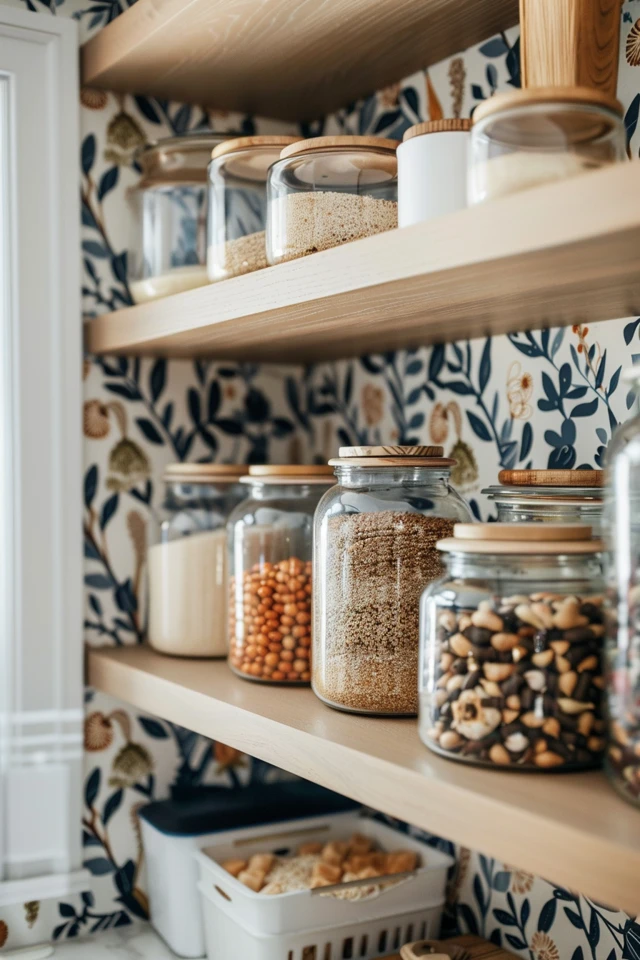
The Fix: Pair busy wallpaper with uniform storage. Decant your dry goods into clear glass or plastic matching containers. This creates a quiet foreground that allows the busy background to shine without overwhelming the eye.
Common Mistakes + Fixes
Mistake: Choosing a dark wallpaper for a pantry with no natural light.
The Fix: If you love a moody navy or forest green print, you must upgrade your lighting first. Dark walls absorb light, making it hard to read labels. Install under-shelf LED strips or a high-lumen flush mount before hanging the paper.
3. Where to Apply It: Strategic Placement
You do not always have to wallpaper all four walls. In fact, in a “reach-in” pantry (closet style), you usually only wallpaper the back wall. This creates a focal point that draws the eye inward.
For “walk-in” pantries, you have more options. You can wrap the entire room, or you can employ a designer trick known as “the fifth wall.”
The Ceiling Statement
Wallpapering the pantry ceiling is a fantastic move for small spaces. It keeps the walls neutral and bright, which helps the room feel larger, but provides a surprise element when you look up.
This is particularly effective if you have floor-to-ceiling shelving that leaves little wall space exposed. A patterned ceiling reflects personality without competing with your groceries.
What I’d Do in a Real Project
- Reach-in Pantry: Wallpaper the back wall only. Use a bright, reflective pattern to maximize light.
- Walk-in Pantry: Wallpaper all walls if using open floating shelves. If using heavy cabinetry, wallpaper the ceiling or just the backsplash area between the counter and upper shelves.
- Butler’s Pantry: Treat this like a wet bar. Go dark, moody, and wrap the entire room, including the ceiling, for a dramatic effect.
4. The Logistics of Installation Around Shelving
The biggest hurdle in refreshing a pantry is the shelving. Navigating around fixed shelves is a nightmare and rarely looks professional. You will end up with peeling edges where the paper meets the bracket.
The Golden Rule of Prep
You must remove the shelving before wallpapering. I know this adds hours of labor to the project, but it is non-negotiable for a professional finish.
If your shelves are permanently built-in (like MDF painted directly to the wall), you have two choices:
1. Wallpaper only the back panels of the shelf units (the “cabinet backing” look).
2. Use paint instead.
Measuring for Success
Pantries often have odd angles or bulkheads. When calculating how much wallpaper you need, do not just calculate square footage. You must account for the “pattern repeat.”
If a wallpaper has a 24-inch drop match, you waste nearly 2 feet of paper per strip to line up the design. Always buy at least 15-20% more than your raw measurements suggest.
Renters and Temporary Updates
If you are renting or afraid of commitment, Peel-and-Stick wallpaper is the industry standard solution. However, be warned: peel-and-stick does not slide. Traditional paste allows you to slide the paper into place to match the seam. Peel-and-stick grabs instantly.
Tip for Renters: Do not try to wallpaper behind deep shelves with peel-and-stick; you will get frustrated. Instead, buy thin MDF boards, wrap them in wallpaper, and push them to the back of the shelves. It creates the look of wallpapered walls with zero installation risk.
5. Lighting and Color Temperature
Lighting makes or breaks a wallpaper project. This is especially true in windowless pantries. The color of your light bulb (Kelvin rating) will completely change how your wallpaper looks.
Most pantries come with standard builder-grade lighting, which is often yellow (2700K) or harsh blue (5000K).
Selecting the Right Bulb
I recommend a 3000K or 3500K LED bulb for pantries. This provides a crisp, white light that renders colors accurately.
If you choose a wallpaper with a white background, a 2700K bulb will make it look dingy and yellow. If you choose a blue wallpaper, a 2700K bulb can make it look muddy or green. Always test a swatch of the wallpaper in the pantry with the door closed and the light on before committing.
The Gloss Factor
Pay attention to the finish of the paper. Metallic accents in wallpaper can be wonderful in a pantry because they bounce light around the small room. A matte finish is more sophisticated but will absorb light.
Final Checklist: Before You Buy
Ready to transform your pantry? Run through this checklist to ensure you haven’t missed a critical step.
- Texture Test: Rub a sample of the wallpaper with a damp cloth. Does the ink smudge? If yes, it is not suitable for a pantry.
- Shelf Depth: Measure the depth of your shelves. If they are 12 inches deep or more, the back wall will be in shadow. Choose a lighter wallpaper color.
- Batch Numbers: Ensure every roll you buy has the same “Run” or “Batch” number. Colors can shift slightly between print runs.
- Hardware Check: Are you replacing shelf brackets? If the new brackets are smaller, you need to patch and sand the old holes perfectly smooth, or they will show through the paper.
- Ventilation: Does your pantry get humid? If so, ensure you are using a mold-resistant adhesive.
FAQs
Q: Can I wallpaper over wire shelving?
A: You physically can, but you shouldn’t. Wire shelving is difficult to work around. It is best to take the wire shelves down, wallpaper the full wall, and then reinstall the shelving. This creates a clean, continuous look.
Q: How do I clean wallpaper in a pantry?
A: For vinyl wallpaper, use warm water and a tiny drop of dish soap on a soft sponge. Wring the sponge out until it is just damp—never soak the wall. Wipe gently from the bottom up to prevent dirty water streaks.
Q: Does wallpaper expiry matter?
A: Believe it or not, yes. Wallpaper rolls shouldn’t sit in your garage for two years before use. Humidity can affect the backing and the adhesive (if pre-pasted). Buy the paper when you are ready to start the project.
Q: How much does it cost to wallpaper a standard pantry?
A: For a DIY project, a standard reach-in pantry (approx. 5×2 feet) usually requires 2 to 3 double rolls. Depending on the brand, this can range from $100 to $400 for materials. Professional installation for a small space often has a minimum daily rate, usually starting around $350–$500.
Conclusion
Refreshing your pantry with wallpaper is a low-risk, high-reward project. It transforms a space associated with chores into a pocket of personality. By choosing the right durable material, managing the scale of your pattern, and addressing the unique lighting challenges of a small room, you can create a professional-level result.
Remember that the pantry is for you. Unlike the living room, guests rarely see it. This gives you the freedom to choose that wild lemon print or the dark moody floral you were too scared to use in the hallway. Clear off the shelves, prep your walls, and enjoy the view every time you reach for the snacks.
Picture Gallery


