
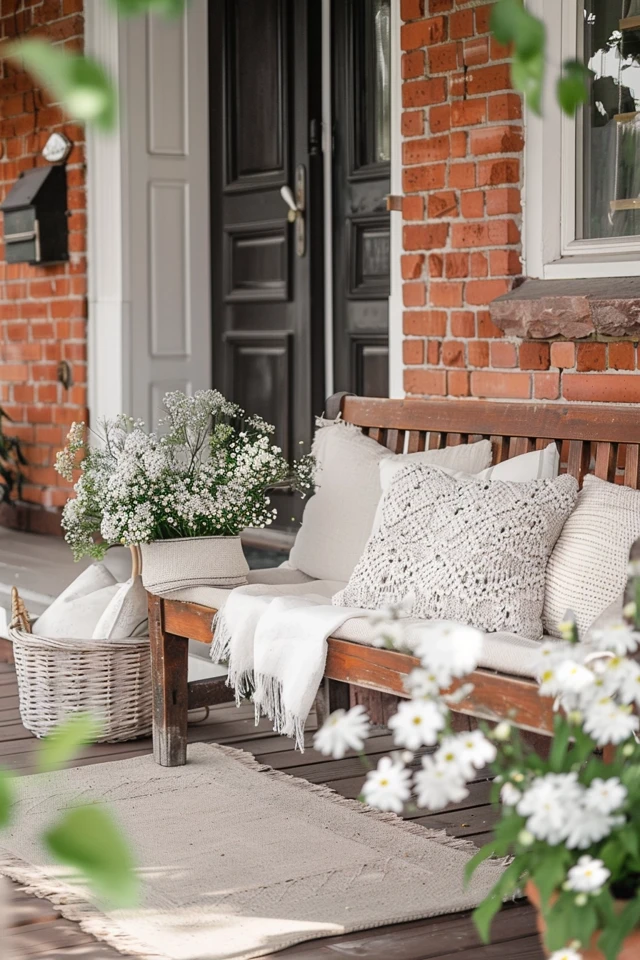
Red Brick House Front Porch Ideas for Cozy Charm
Red brick homes possess a timeless quality that new construction often struggles to replicate. The inherent warmth and texture of the masonry provide a solid foundation for design, but they can also feel visually heavy if not balanced correctly. When I work with clients who own red brick colonials or ranches, the goal is almost always to soften that exterior and create an inviting transition from the street to the front door.
I remember a project in Georgia where the homeowner felt their red brick facade looked too imposing and dark. By introducing creamy whites, oversized natural textures, and strategic lighting, we transformed a fortress-like entrance into a welcoming haven. If you want to jump straight to the visuals, you can find our curated Picture Gallery at the end of this blog post.
Creating a cozy porch on a red brick house requires understanding how to work with the undertones of the brick rather than fighting against them. Whether you have a sprawling wraparound porch or a modest stoop, the principles of scale, contrast, and functionality remain the same. This guide will walk you through the exact steps I use to design these spaces professionally.
1. Mastering the Color Palette: Working with Undertones
The most critical decision you will make for your porch is the accent color palette. Red brick is never just red; it contains flecks of charcoal, rust, purple, brown, and even orange. If you ignore these underlying hues, your furniture and decor will feel disjointed.
High Contrast for Modern Appeal
If you want a crisp, updated look, high contrast is your best friend. Black is a classic choice that grounds the space and adds sophistication. Painting the front door a deep, true black (like Tricorn Black) or a very dark charcoal instantly modernizes red brick. Pair this with bright white trim to create a sharp, clean architectural line.
Cool Tones for Balance
To neutralize the intense warmth of the brick, look to the opposite side of the color wheel. Deep navy blues, slate grays, and forest greens work beautifully because they cool down the visual temperature of the house. A slate blue front door on a red brick house is one of my all-time favorite combinations because it feels historic yet fresh.
Designer’s Note: The “Matchy-Matchy” Trap
One lesson I learned early in my career is to never try to match a red paint to the brick. It is nearly impossible to get the undertones right, and even if you do, the result looks muddy and flat. If you love warm colors, opt for a natural wood stain instead of red paint. The wood grain offers enough texture to break up the visual solidity of the brick.
Common Mistakes + Fixes
- Mistake: Using bright, primary yellow or bright red accents.
- Fix: These colors tend to look jarring against traditional brick. Instead, opt for mustard yellow or deep burgundy if you want warm accents.
- Mistake: Ignoring the grout color.
- Fix: Look closely at the mortar between your bricks. Is it gray, beige, or white? Choose your trim and cushion colors to harmonize with the mortar for a cohesive look.
2. Furniture Selection and Layout Logic
Once your palette is set, you need to address the layout. A porch is an outdoor room, and it should follow the same traffic flow rules as your living room. The biggest error I see is furniture that is too small for the scale of the house.
Scale and Proportions
Red brick is a “heavy” material visually. If you place spindly, thin metal chairs on the porch, they will disappear. You need furniture with visual weight. Chunky teak armchairs, wide wicker sofas, or Adirondack chairs with substantial arms can hold their own against the masonry.
Material Matters
For cozy charm, I lean heavily toward natural textures. Wicker and rattan (specifically all-weather synthetic resin for durability) add a softness that breaks up the hard lines of the brick. If you prefer wood, teak or cedar are excellent choices because they weather to a silver-gray that complements red brick beautifully.
Defining the Zones
Even on a small porch, you need distinct zones. If you have a depth of at least 6 feet, you can fit a conversation area.
- The Swing Zone: If you have the structural support, a porch swing is the ultimate “cozy” factor. Ensure you have at least 24 inches of clearance behind the swing and 18 inches on either side.
- The Conversation Spot: Place two chairs angled toward each other with a small side table in between. The table should be roughly the same height as the chair arms, usually 18 to 22 inches high.
What I’d Do in a Real Project (Layout Checklist):
- Clearance: I always ensure a minimum 36-inch clear path from the steps to the front door. Never block the entry flow.
- Knee Space: Allow 12 to 18 inches between the edge of the seat and a coffee table.
- Rug Sizing: Just like indoors, the rug should be large enough that at least the front legs of the furniture sit on it. A 5×8 rug is usually the minimum for a seating group.
3. Lighting and Hardware: The Jewelry of the Exterior
Lighting and hardware are where you can significantly influence the style of your red brick home. Whether you are going for farmhouse, traditional, or industrial, these metal finishes act as the jewelry that ties the look together.
Sizing Exterior Lights
Most builders install lights that are far too small. A good rule of thumb is that your entry light fixture should be approximately one-third the height of the door if you have one light, or one-quarter the height if you have two flanking lights. If your door is 80 inches tall, your single lantern should be around 26 inches high. Do not be afraid to go big; red brick can handle oversized fixtures.
Finish Coordination
You do not need to match your finishes perfectly, but they should “speak” to each other.
- Matte Black: This is the safest and most striking choice for red brick. It pops against the background and matches almost any door color.
- Oil-Rubbed Bronze: This offers a softer, more traditional look. It blends slightly with the brick, creating a subtle elegance.
- Polished Brass/Gold: This is coming back in a big way. Unlacquered brass looks stunning against navy or black doors and adds a historic charm to the red brick.
Layering Light Sources
To achieve “cozy charm,” you cannot rely solely on a harsh overhead floodlight.
- Sconces: These provide eye-level ambient light. Use warm white bulbs (2700K to 3000K). Anything cooler will make the red brick look sickly at night.
- String Lights: For covered porches, bistro lights strung across the ceiling add instant whimsy and warmth.
- Portable Lanterns: I love placing oversized battery-operated lanterns on the steps or near the door. They add a welcoming glow at ground level, which softens the transition from the walkway.
4. Softening the Hardscape with Textiles
This is the step that transitions a porch from “a place to sit” to “a place to linger.” Because brick is hard, rough, and cold, you must overcompensate with soft goods. This is especially true for renters who cannot paint doors or change fixtures; textiles are your best tool.
The Foundation: Outdoor Rugs
An outdoor rug is essential for defining the space and covering cold concrete or wood decking. Against red brick, I prefer neutral rugs with texture. A jute-look polypropylene rug is durable, scrubbable, and adds a sandy, natural tone that looks great with red. If you want pattern, a black and white geometric stripe or a navy border works well.
Pillows and Throws
Don’t skimp on pillow inserts. Flimsy pillows look cheap and uncomfortable. Use polyester-fill outdoor inserts that are one size larger than the cover for a plump look.
- Fabric Choices: Sunbrella or other solution-dyed acrylics are non-negotiable for longevity. They resist fading and mildew.
- Pattern Mixing: Since brick is a “pattern” in itself (a grid), be careful with small-scale prints. Go for large-scale stripes, solids with texture (like nubbly weaves), or simple botanicals.
Drapery for Drama
If you have a covered porch with columns, installing outdoor curtains can soften the vertical lines. Stick to white or off-white sheer outdoor fabrics. They filter the light beautifully and create a resort-like atmosphere. Mount the rod high—as close to the ceiling as possible—to make the porch feel taller.
Common Mistakes + Fixes
- Mistake: Leaving cushions out all year.
- Fix: Even “all-weather” fabric gets dirty. Buy furniture covers or invest in a deck box to store cushions during heavy pollen seasons or winter.
- Mistake: Using indoor textiles.
- Fix: Cotton throws will mildew in days. Look for recycled PET throws (made from plastic bottles) that feel like wool but wash off with a hose.
5. Landscaping and Planters: The Finishing Touch
Landscaping is the bridge between your home and the earth. With a red brick house, your plant choices and container styles play a huge role in the overall aesthetic. The goal is to break up the mass of red with vibrant greens and strategic blooms.
The “Thriller, Filler, Spiller” Technique
This is a classic container gardening rule that works every time.
- Thriller: A tall, architectural plant in the center (e.g., Ferns, Dracaena, or Boxwoods).
- Filler: mounded plants that fill the middle space (e.g., Impatiens, Begonias, or Coleus).
- Spiller: Trailing plants that hang over the edge (e.g., Creeping Jenny, Ivy, or Sweet Potato Vine).
Color Coordination with Brick
You want your plants to pop, not blend in.
- White Blooms: White Hydrangeas, Gardenias, or white Petunias look crisp and elegant against red brick. This is a very stately, traditional look.
- Chartreuse Green: Plants with lime green foliage (like Sweet Potato Vine) offer an electric contrast to the rusty red of the brick.
- Purple/Blue: Lavender or Salvia provides a cooling effect that calms the red tones.
Planter Materials
Avoid terracotta pots; they are too close in color to the brick and will vanish.
- Concrete/Stone: Provides a great textural contrast and looks high-end.
- Glossy Glazed Pots: A high-gloss black or navy pot reflects light and adds a modern edge to the matte brick.
- Wood Boxes: Choose a dark walnut stain or a painted finish to stand out.
Designer’s Note: Sizing Your Planters
Tiny pots look cluttered. I usually recommend planters that are at least 24 inches tall for a front entrance. If you have a grand entrance, go for 30 inches or higher. The scale of the pot needs to match the visual weight of the brick columns or doorframe.
Final Checklist: The “Weekend Makeover” Plan
If I were managing your porch renovation, this is the checklist I would use to ensure we hit every detail without overspending or missing a step.
Phase 1: Prep & Clean
1. Power wash the porch floor and the brick facade (use low pressure for brick to avoid damaging mortar).
2. Clean light fixtures and replace bulbs with 2700K warm LEDs.
3. Measure your available floor space for rugs and furniture.
Phase 2: The Anchors
4. Purchase or paint the front door (Black, Navy, or Slate Blue).
5. Place the outdoor rug (Leave 12-18 inches of flooring visible around the edges).
6. Position the main seating furniture (Ensure 36-inch clearance for walkways).
Phase 3: The Layers
7. Add 20-inch or 22-inch pillows to the seating.
8. Place a side table within arm’s reach of every seat.
9. Install new house numbers (match the finish to your light fixtures).
Phase 4: Life & Styling
10. Pot up two large flanking planters for the door using the Thriller/Filler/Spiller method.
11. Add a doormat layered over the rug (coir mats work best for scraping shoes).
12. Hang a seasonal wreath that contrasts with the door color.
FAQs
What is the best railing color for a red brick house?
Black is universally the best choice for railings on a red brick home. It recedes visually, allowing the architecture to stand out, and mimics the look of historic wrought iron. White railings can work on traditional colonial styles, but they require more maintenance and can sometimes look plastic if vinyl is used.
How do I modernize a dated red brick porch without painting the brick?
Focus on the “jewelry.” Swap out polished brass 1990s fixtures for sleek matte black lanterns. Change the house numbers to a modern sans-serif font. Paint the front door a bold, dark color. Finally, update the landscaping from overgrown hedges to structured boxwoods or ornamental grasses.
Can I use gray furniture with red brick?
Yes, but the shade matters. Avoid “cool” grays with blue undertones, as they can clash. Look for “warm” grays or “greige” (gray-beige). Charcoal gray is also excellent because it reads as a neutral dark tone similar to black but slightly softer.
How do I choose a rug size for a small stoop?
For a small landing or stoop, skip the area rug and focus on a high-quality doormat. Look for a “double-wide” doormat (usually around 24×48 inches). This looks substantial and grand, whereas a standard small mat can look like a postage stamp on a concrete slab.
Conclusion
Designing a front porch for a red brick house is all about embracing the character of the home while softening its edges. You don’t need to cover the brick or paint over it to achieve a modern, cozy aesthetic. By using the right scale of furniture, contrasting colors like black or navy, and layers of soft textiles, you can balance the visual weight of the masonry.
Remember that the most inviting porches are the ones that are used. Focus on comfort first—deep seats, places to set a drink, and warm lighting—and the style will naturally follow. Whether you are renting or owning, these updates can happen over a single weekend, instantly boosting your curb appeal and giving you a new favorite spot to enjoy your morning coffee.
Picture Gallery


