
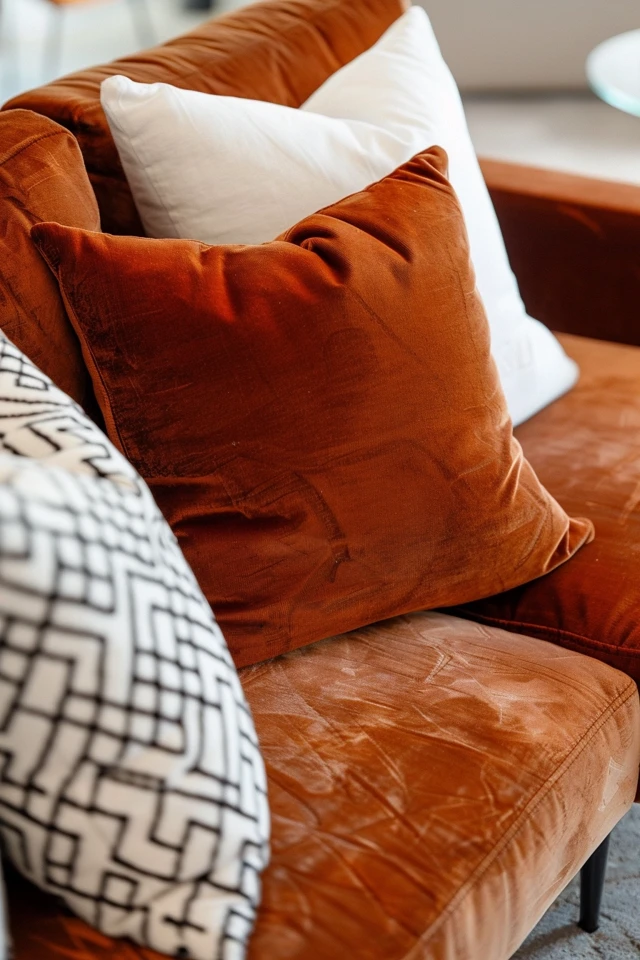
Title: Rust Velvet Sofa: My Chic Living Room Update
Introduction
For years, I played it safe with neutral furniture. Like many of my clients, I relied on grays, oatmeals, and creams because they felt low-risk and easy to style. But recently, I felt my living room needed a distinctive anchor, something that brought immediate warmth and personality without requiring a total renovation.
I decided to take the plunge with a rust velvet sofa, and it completely transformed the energy of the space. It sits perfectly between a neutral and a statement piece, acting as a grounding earth tone that still turns heads. Check out the Picture Gallery at the end of this blog post to see the full transformation and how it all came together.
If you are considering this bold move, you probably have questions about durability, color matching, and scale. As an interior designer, I want to walk you through the exact process I used to select, place, and style this piece. I will share the technical rules I follow and the realistic constraints I had to work within.
Why Rust Velvet? Material Selection and Durability
Choosing a sofa is about more than just aesthetics; it is an engineering decision regarding fabric performance. Velvet often gets a bad reputation as being fussy or delicate, but that depends entirely on the fiber content. For my living room, and for most high-traffic family homes, I always recommend “performance velvet.”
Performance velvet is typically made from polyester or a polyester blend, rather than cotton or silk. This synthetic structure is incredibly durable. In the industry, we measure durability in “double rubs.” For a residential sofa that will see daily use, you want a fabric rated for at least 30,000 double rubs. My sofa is rated for 50,000, meaning it can withstand serious wear and tear from kids and pets.
Another reason I chose rust is its ability to camouflage. Unlike a stark white or light beige sofa, rust hides the occasional crumb or speck of dust. It is forgiving. The velvet texture also tends to release pet hair easily with a simple lint roller, unlike woven linens where hairs get trapped in the weave.
Designer’s Note: The “Crush” Factor
One thing that often surprises clients is that velvet has a “nap” or direction. When you sit on it, the fibers shift, creating lighter and darker patches. This is called “crushing” or “bruising.” It is a characteristic of the fabric, not a defect. If you require a surface that looks perfectly uniform 24/7, velvet might drive you crazy. However, I find this movement adds depth and richness to the room that flat cotton just cannot achieve.
Mastering the Color Palette: What Goes with Rust?
The biggest hesitation I hear regarding rust furniture is the fear that it will clash with existing decor. People often worry it will look too “70s retro” or limit their future color choices. In reality, rust acts as a deep neutral. It is essentially an orange-brown earth tone, meaning it pairs naturally with almost everything found in nature.
When styling my room, I looked at three distinct color strategies. The first is “Warm on Warm.” This involves pairing the rust sofa with creams, terracottas, warm woods (like walnut or white oak), and brass accents. This creates a cozy, monochromatic, desert-chic vibe.
The second strategy, and the one I often use for modern spaces, is “High Contrast.” Rust looks incredible against deep navy blues, forest greens, or charcoal grays. These cool tones balance the heat of the rust. If you have blue walls or a dark gray rug, a rust sofa will pop beautifully without feeling chaotic.
Common Mistakes + Fixes
- Mistake: Using primary red or bright yellow accents nearby.
- Fix: Avoid “McDonald’s” color combinations. Rust is a complex, muddied color. It needs other complex colors. Instead of bright yellow, use mustard or ochre. Instead of bright red, use burgundy or clay.
- Mistake: Matching the wood tones too closely to the fabric.
- Fix: If your sofa legs are walnut and your coffee table is the exact same shade of brown, the room falls flat. Aim for contrast. If the sofa is dark rust, try a lighter oak table, a glass table, or even a stone surface like travertine.
Layout and Scale: Getting the Measurements Right
A bold sofa demands correct placement. Because the color carries visual weight, the physical scale of the furniture must be balanced with the room’s dimensions. In my living room, I had to ensure the sofa didn’t swallow the space.
Here are the spacing rules I adhere to in every project. First, the coffee table clearance. You need exactly 15 to 18 inches between the edge of the sofa seat and the coffee table. Anything less than 15 inches feels cramped for your legs. Anything more than 18 inches makes it awkward to reach your drink.
Next is the rug size. A common error is buying a rug that is too small for a colored sofa, which makes the sofa look like an island floating in the room. The rule of thumb is that at least the front two legs of the sofa must sit on the rug. Ideally, the rug should extend 6 to 10 inches past the ends of the sofa on both sides.
For example, if your rust sofa is 84 inches wide (a standard 7-foot sofa), you cannot use a 5×7 rug. It will look disjointed. You need an 8×10 rug minimum to ground the piece. The color of the rug is equally important here. Since the sofa is the hero, I chose a rug with a neutral base but with small hints of rust and olive in the pattern to tie the room together.
What I’d do in a real project: The Walkway Check
I always tape out the floor before ordering. You need a minimum of 30 to 36 inches of walkway space behind or around the sofa if it floats in the room. Since rust is a dark color, it stops the eye. If you crowd the walkways, the room will feel significantly smaller than if you had used a light gray sofa. Give a dark sofa room to breathe.
Lighting and Textures: The Secret Ingredients
Velvet absorbs light, whereas leather or linen might reflect it. This means a rust velvet sofa can look completely different depending on the time of day and your light bulbs. In my update, I had to adjust my lighting plan to accommodate the new fabric.
During the day, natural light makes the rust look vibrant and golden. At night, without proper lighting, it can turn into a muddy brown blob. The solution is layered lighting. I made sure to have floor lamps nearby with warm bulbs. I recommend 2700K or 3000K LED bulbs. Do not use 4000K or 5000K “Daylight” bulbs with rust velvet; the cool blue light will clash with the warm fabric and make the sofa look sickly.
Texture variation is the key to making the room feel “chic” rather than “heavy.” Because the sofa is a large block of soft, matte pile, the surrounding elements need to provide contrast. I avoided adding more velvet pillows. Instead, I introduced boucle (nubby texture), leather (smooth and cool), and linen (crisp and matte).
I also brought in hard materials. I used a marble side table and a brass floor lamp. The shine of the metal and the coldness of the stone cut through the warmth of the velvet. This balance of “hard/cold” and “soft/warm” is what creates that high-end designer look.
Real-Life Maintenance: Kids, Pets, and Stains
Let’s talk about the reality of living with this sofa. I have lived with it for several months now, and I have learned a few maintenance tricks. The biggest fear people have is stains. Most performance velvets are hydrophobic, meaning liquids bead up on the surface for a few moments before soaking in.
When a spill happens, the rule is to blot, never rub. Rubbing velvet pushes the liquid into the base weave and damages the pile. I keep a clean, white cotton cloth handy for this. For dried stains, a drop of clear dish soap in water usually does the trick. Always check the cleaning code on your specific sofa. “W” means water-based cleaners are okay, “S” means solvents only (no water), and “WS” means either is fine. My sofa is “W,” which is the most family-friendly option.
Dust is another factor. Rust shows light-colored dust more than a beige sofa would. I vacuum the sofa once a week using the upholstery attachment. This lifts the dust and also perks up the fibers, keeping the velvet from looking matted. If you have a white dog or cat, you have to be realistic: you will see the fur. However, velvet is excellent for cats with claws because there are no loops in the fabric to snag.
Designer’s Note: The Steaming Trick
Over time, your favorite spot on the sofa will look compressed. The velvet might look lighter there because the fibers are flattened. This is normal. To fix it, I use a handheld garment steamer. I hover it about 2 inches above the fabric (never touching it) to release the steam, then gently brush the fibers up with a soft bristle brush. It looks brand new in minutes.
Final Checklist: Is a Rust Velvet Sofa Right for You?
If you are on the fence, run through this mental checklist. This is the same criteria I use when helping clients make a final decision.
- Light Evaluation: Does your room get decent natural light? Dark velvet can make a dark room feel like a cave.
- Palette Check: Are you willing to embrace warm tones? If you insist on everything being cool gray and chrome, rust will fight you.
- Maintenance Reality: Are you willing to vacuum it weekly? It attracts dust more than linen.
- Lifestyle Match: Do you have cats? Velvet is great. Do you have a dog that sheds white fur? It might be high maintenance.
- Size Constraints: Do you have the physical space to let the color breathe? (Remember the 30-inch walkway rule).
FAQs
Is rust velvet just a trend that will fade?
Rust is an earth tone, similar to olive green or navy blue. While velvet had a massive resurgence recently, the color itself is timeless. It was popular in the 70s, the 90s, and today. It is not a “fad” color like millennial pink or neon green. If you stick to classic shapes (like a tuxedo or mid-century silhouette), it will age well.
Can I mix a rust sofa with a grey wall?
Yes, but the tone of the grey matters. Avoid “cool” blue-grays. Look for “warm” grays or “greige” (gray-beige). The warmth in the paint will connect with the warmth in the sofa. If you must use a cool gray, add plenty of wood accents to bridge the gap.
Does velvet get hot in the summer?
This is a common myth. Synthetic performance velvet is breathable enough for indoor climate control. It doesn’t stick to your skin like leather does. It feels cozy in winter but remains neutral in temperature during the summer.
How do I style throw pillows on a rust sofa?
Use the rule of three. One square pillow in a neutral complex pattern (like a beige/black geometric), one smaller square in a solid deep color (like navy or forest green), and one lumbar pillow in a different texture (like boucle or leather). Avoid matching the pillows to the sofa color exactly.
Conclusion
Updating my living room with a rust velvet sofa was one of the best design risks I have taken in my own home. It shifted the room from safe and forgettable to warm and curated. While it requires a bit more thought regarding lighting and rug choices, the payoff is a space that feels incredibly inviting.
The key is to treat the rust color as a neutral foundation rather than a loud accent. By layering in textures, respecting the scale of the room, and choosing the right lighting temperature, you can create a chic space that stands up to daily life. Whether you are a renter looking for a statement piece that moves with you, or a homeowner settling in for the long haul, this choice offers the perfect blend of style and substance.
Picture Gallery


