Sago Palm Landscaping Ideas for Exotic Gardens
Create a lush retreat with my top sago palm landscaping ideas to elevate your garden into an exotic, tropical paradise at home.
There is something undeniably prehistoric and sophisticated about the Sago Palm. I often tell my clients that if they want to add instant architectural structure to a garden without building a wall or installing a sculpture, this is the plant to choose. Its stiff, glossy fronds and rugged trunk create a focal point that demands attention, making it a staple for anyone aiming for a tropical or exotic aesthetic.
However, incorporating these cycads (they aren’t actually true palms) requires more than just digging a hole and dropping them in. Because they are slow-growing and can become quite wide, you have to plan your landscape around them rather than squeezing them in as an afterthought. I have seen many homeowners make the mistake of planting them too close to walkways, only to regret it when the sharp leaves start snagging clothing years later.
If you are looking for specific visual examples to spark your creativity, please scroll down to view the Picture Gallery at the end of the blog post.
I.Understanding Scale and Placement
The most critical aspect of designing with Sago Palms is respecting their mature size and growth rate. These plants grow incredibly slowly, often only producing one new set of leaves per year. This means that if you buy a small 1-gallon plant, it will take decades to become a substantial specimen.
For high-impact areas like the front entryway or a pool deck, I always recommend budgeting for a larger, mature specimen. You want a trunk that is at least 12 to 18 inches high if you want immediate visual weight. Because they grow so slowly, “buying time” is often worth the extra cost in the landscape budget.
When determining placement, you must account for the horizontal spread. A healthy Sago can eventually span 6 to 8 feet across. In my designs, I draw a 4-foot radius circle around the center of the planting hole on the site plan. This “no-plant zone” ensures the fronds have room to arch gracefully without crowding neighboring plants or structures.
If you are planting near a sidewalk, driveway, or patio edge, place the center of the trunk at least 5 feet away from the pavement. This prevents the “pincushion effect” where guests have to dodge sharp leaves to get to your front door. If you have a tight space, consider a different tropical plant like a Pygmy Date Palm or a Bird of Paradise.
II.Creating Symmetry and Focal Points
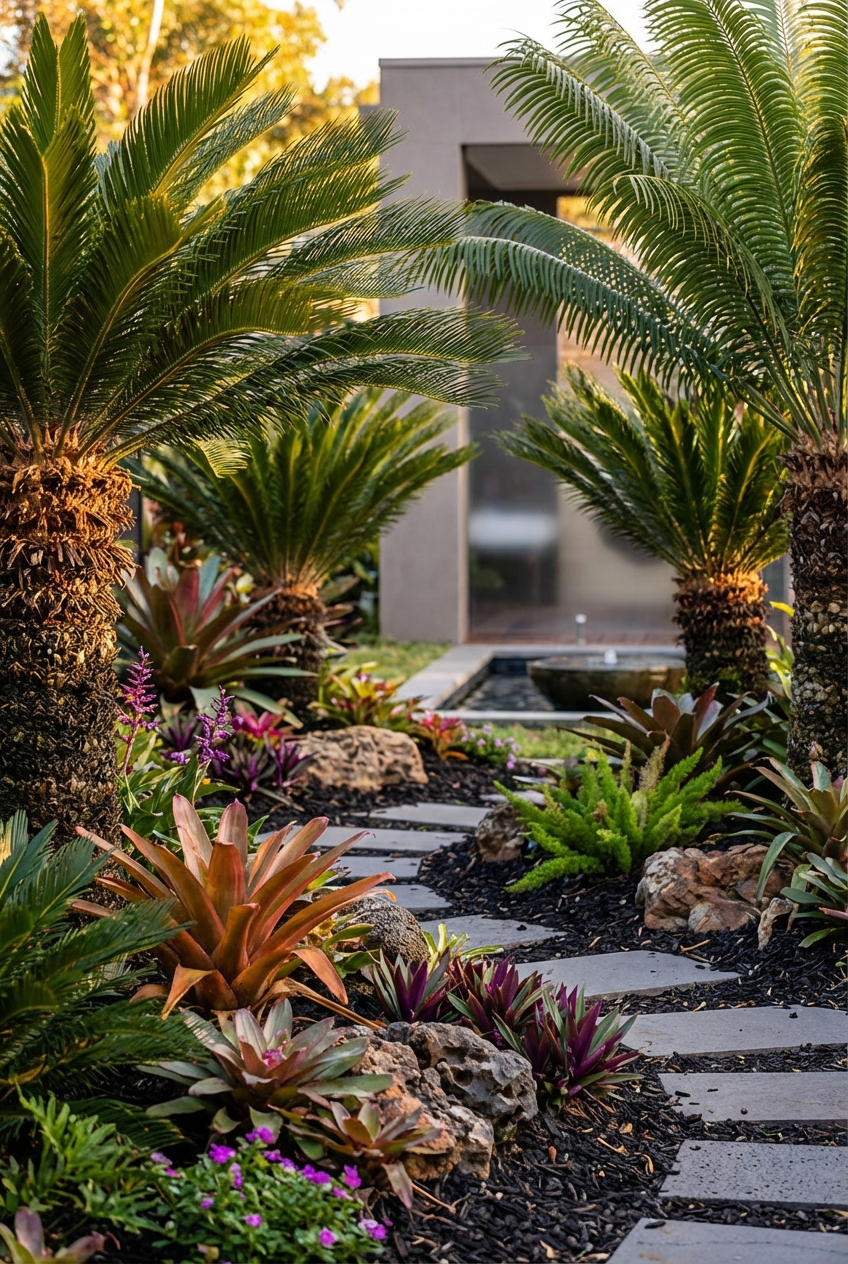
Sago Palms are naturally symmetrical, which makes them perfect for formal tropical designs. A classic application is flanking a driveway or a grand entrance. Placing one Sago on either side of a path creates a sense of arrival and grandeur often seen in high-end resort landscaping.
When using them as a focal point in a garden bed, I like to use the “island” approach. Elevate the soil slightly to create a berm or mound. This does two things: it improves drainage (which Sagos love) and it physically lifts the plant to give it more prominence.
For a more natural, jungle-like exotic vibe, avoid straight lines. instead, plant them in odd-numbered groups. A cluster of three Sagos of varying heights creates a wonderful tiered effect. Place the tallest one in the back and the two smaller ones slightly forward and to the sides. This mimics how they might grow in nature and adds depth to a flat yard.
Common Mistakes + Fixes
- MistakePlanting Sagos in a deep depression or low spot in the yard.FixSago Palms hate wet feet. If water pools around the trunk, rot creates a mushy base, and the plant will die. Always plant them slightly above the soil grade or amend heavy clay soil with plenty of sand and organic matter to ensure rapid drainage.
III.Companion Planting for Texture Contrast
A Sago Palm is visually “heavy.” The leaves are dark, stiff, and spiky. To create a balanced exotic garden, you need to surround it with plants that offer softness and contrasting colors. If you surround a Sago with other spiky plants like Yucca or Agave, the garden can look hostile and uninviting.
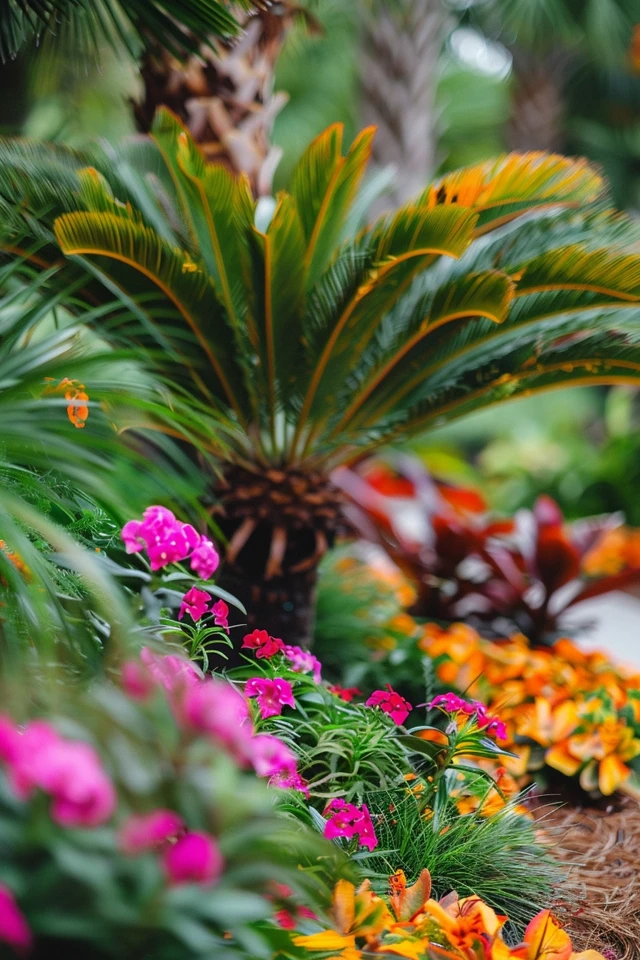
I love pairing Sagos with ferns. The soft, lacy texture of a Foxtail Fern or a Boston Fern provides a beautiful counterpoint to the rigid Sago fronds. The bright lime green of the ferns also pops against the deep emerald green of the Sago.
Another excellent strategy is using low-growing ground cover to hide the bare soil around the trunk. Mondo Grass or Liriope are durable choices that can handle the shade cast by the Sago’s canopy. For a splash of color, Crotons are a fantastic choice in frost-free zones. The red, orange, and yellow foliage of the Croton warms up the cool green tones of the palm.
What I’d Do in a Real Project
If I were designing a corner bed with a Sago Palm as the anchor, here is the layering formula I would use:
- The Anchor: One mature Sago Palm (minimum 15-gallon pot size) placed 4 feet from the fence.
- The Mid-Layer: Three Cordyline ‘Red Sister’ plants behind and to the side for height and pink/red color.
- The Softener: Five Foxtail Ferns planted in a semi-circle around the front base of the Sago.
- The Ground Cover: Blue Fescue or dark mulch to finish the edge.
IV.Using Sago Palms in Containers
If you are a renter or live in a zone where temperatures drop below 15°F, keeping Sagos in containers is a brilliant move. It allows you to bring the exotic look indoors during winter or move the plant around your patio to change the layout.
When choosing a pot, scale is everything. A Sago looks best in a container that is wider than it is deep. Low bowl planters or urns work exceptionally well because they complement the arching habit of the leaves. Ensure the pot has a large drainage hole; I cannot stress this enough.
For the material, I prefer glazed ceramic or concrete for outdoor use. Terra cotta is good for plant health because it breathes, but it can crack in freezing weather. If the Sago is staying indoors, a heavy basket weave planter can soften the prehistoric look and make it feel more like furniture.
Pot Sizing Logic
Don’t over-pot a Sago Palm. Unlike some fast-growing annuals, they do not need massive amounts of extra soil volume. Choose a pot that provides 2 to 3 inches of clearance around the root ball.
If the pot is too big, the excess soil holds too much water, which leads to root rot. Keeping the roots somewhat snug promotes healthier growth and reduces the risk of overwatering.
V.Hardscaping and Lighting for Drama
To truly achieve an “exotic” garden feel, you have to look beyond the plants. The materials you put on the ground matter. Sago Palms look incredible when surrounded by river rocks or black Mexican beach pebbles. The smooth stone contrasts with the rough, shaggy trunk.
Avoid using standard wood chips right up against the trunk. Organic mulch holds moisture against the bark, which can invite pests and fungus. I usually leave a 3-inch ring of clear soil or gravel right at the base of the trunk to let it breathe.
Lighting is the secret weapon of landscape designers. At night, a Sago Palm can look like a living sculpture if lit correctly. Never shine a light directly down on it; it flattens the shape. Instead, use uplighting.
Place a well light or a small spotlight at the base of the trunk, aimed straight up into the canopy. This illuminates the texture of the trunk and creates dramatic shadows through the feathery leaves. If you have a cluster of Sagos, light the primary one and let the ambient glow catch the others for a moody, mysterious vibe.
VI.Designer’s Warning: The Safety Factor
I would be remiss if I did not include a serious warning regarding Sago Palms. Every part of this plant is highly toxic to dogs and cats. The seeds (which look like bright orange nuts) contain the highest concentration of the toxin cycasin. Ingesting even one or two seeds can be fatal to a pet.
When I consult with clients who have puppies or dogs that are known chewers, I usually advise against planting Sagos. It is simply not worth the risk. If you have a mature, well-trained dog and really want a Sago, you must be diligent about removing the seed heads the moment they appear in the center of the plant.
For families with small children, the danger is less about poison (unless they eat plants) and more about the sharp leaves. The tips can puncture skin easily. Avoid placing these plants near play areas or trampolines where kids might fall into them.
VII.Final Checklist: Installing Your Sago Landscape
Before you head to the nursery, run through this checklist to ensure your site is ready. This is the exact mental process I use when standing in a client’s yard.
VIII.Frequently Asked Questions
- Why are the leaves on my Sago Palm turning yellow?
- This is the most common question I get. It is usually one of two things: a nutrient deficiency or overwatering. Sagos are heavy feeders of Magnesium and Manganese. If the older, lower leaves are turning yellow and frizzy, it’s likely a deficiency. Apply a palm-specific fertilizer with micronutrients. If the new growth is yellowing, you might be overwatering or have poor drainage.
- Should I cut off the bottom leaves?
- Yes, but only if they are brown or dead. I recommend the “10 to 2” rule. Imagine the palm is a clock face. You want to keep all green leaves between the 10 and 2 positions. Only trim the fronds that droop below the horizontal line (9 and 3). This keeps the plant looking tidy and focuses energy on new growth. Avoid the “pineapple cut” where you strip almost everything off; it stresses the plant.
- How fast do they really grow?
- Painfully slow. In ideal conditions, you might get one “flush” of leaves per year. A trunk might grow only an inch in height annually. This is why mature specimens are so expensive—you are paying for the 15 or 20 years it took to grow that tall.
- Can Sago Palms survive a freeze?
- They are hardy to about 15°F to 20°F (USDA Zone 8). If a hard freeze is predicted, cover the plant with a frost cloth or burlap. If the leaves turn brown after a freeze, don’t cut them off immediately. They provide insulation for the growth point (the center). Wait until spring to see if new green leaves emerge before trimming the dead ones.
IX.Conclusion
Sago Palms are the heavy lifters of the exotic garden. They provide structure, history, and a bold texture that few other plants can match. By respecting their need for space, ensuring excellent drainage, and pairing them with softer foliage, you can create a landscape that feels like a private resort.
Remember that good design is about patience. With Sagos, you are planting for the long haul. Give them the room they need today, and they will reward you with a stunning architectural presence for decades to come.
X.Picture Gallery
Five photographs · drag or swipe