
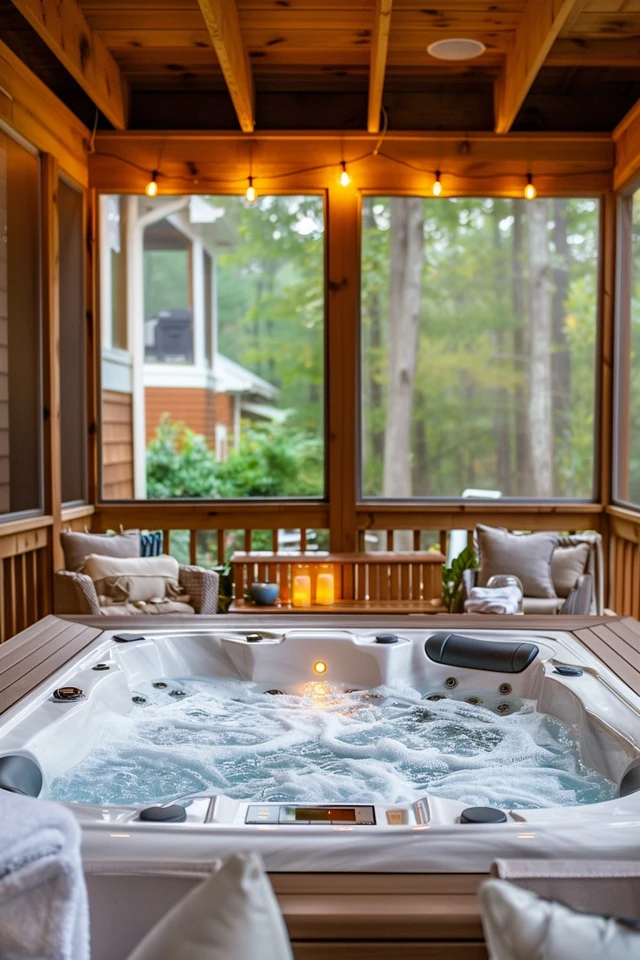
Hot Tub – Screened-In Porch with Hot Tub Ideas & Designs
There are few home upgrades that transform a lifestyle quite like a screened-in porch equipped with a hot tub. It creates a bridge between the comfort of your interior living room and the raw beauty of your landscape. You get the fresh air and the sounds of nature, but you are protected from the mosquitoes and the harsh glare of the sun.
However, integrating a massive vessel of hot water into a semi-enclosed space requires more than just dropping a spa onto a deck. It requires navigating humidity, structural weight loads, and precise space planning to ensure the area feels like a luxury retreat rather than a damp utility room.
If you want to skip straight to the visuals, check out our Picture Gallery at the end of this post. Otherwise, let’s dive into the technical details and design strategies that will make your project successful.
Critical Structural and Ventilation Requirements
Before we pick out tile samples or throw pillows, we have to talk about physics. A hot tub is incredibly heavy. An average four-person tub holds about 300 to 400 gallons of water. Since water weighs roughly 8.3 pounds per gallon, plus the dry weight of the tub and the weight of the occupants, you are looking at a load of 4,000 to 5,000 pounds.
Most standard deck framing is built to support 50 to 100 pounds per square foot (PSF). A hot tub requires support for at least 100 to 125 PSF. If your screened porch is elevated, you must work with a structural engineer to reinforce the joists and footings directly beneath the spa.
Ventilation is the second non-negotiable factor. Hot water generates steam, and in a screened porch, that humidity can get trapped if you use heavy vinyl windows or tight screening. This leads to mold on the ceiling and rot in the framing.
Designer’s Note: A Real-World Lesson
I once consulted on a project where the homeowner installed a beautiful cedar ceiling in their hot tub porch but failed to install a ceiling fan or proper venting. Within six months, the beautiful cedar was buckling and stained black from trapped moisture. We had to tear it all out. To prevent this, always install a wet-rated ceiling fan to keep air moving. If you have glass enclosures, install a humidistat-controlled exhaust fan.
Moisture Management Strategies
- Ceiling Materials: Use PVC beadboard or marine-grade plywood rather than standard drywall. If you use wood, seal it on all six sides before installation.
- Cross Ventilation: Ensure you have screens on at least two sides of the room to encourage a natural breeze.
- Vapor Barriers: If the porch is attached to the house, ensure the shared wall is properly flashed and waterproofed to prevent steam from migrating into your home’s insulation.
Layout Planning and Clearances
The layout is where your project succeeds or fails aesthetically. A common mistake is pushing the hot tub into a corner without thinking about maintenance access. Every hot tub has a service panel containing the pumps and heater. If you block this panel with a wall or permanent railing, a technician cannot fix your tub without draining and moving it.
You need to identify exactly where the access panel is on your specific model before framing walls. I always recommend leaving a clearance of at least 18 to 24 inches on the service side. If space is tight, consider a removable wall section or a custom bench that lifts away.
Defining the Wet and Dry Zones
To make the room usable for more than just soaking, you need to establish zones.
The Wet Zone:
This is the immediate 3-foot perimeter around the tub. No upholstered furniture belongs here. This area is for entering and exiting.
The Dry Zone:
This is where you place your seating group or dining table. Keep this area at least 4 to 6 feet away from the water’s edge if possible. This prevents splashing on your furniture and keeps electrical lamps safely away from water sources.
Common Mistakes + Fixes
- Mistake: Placing the tub directly in front of the only door to the yard.
- Fix: Offset the tub to one side. Keep a clear traffic path (minimum 36 inches wide) from the house door to the exterior screen door.
- Mistake: Buying a tub that is too tall for the room.
- Fix: Check the vertical clearance. If you have a low ceiling, a tall tub can make the room feel claustrophobic. Consider sinking the tub halfway into the floor (a “recessed” installation) to lower the visual profile.
Flooring Selections for Safety and Durability
Flooring in a hot tub porch takes a beating. It faces chemically treated water, constant moisture, and temperature fluctuations. Wood decking is the standard choice, but it requires annual maintenance.
If you are building a ground-level screened porch, a stamped concrete pad is often the best choice. It is cool underfoot, creates a solid foundation for the tub, and cannot rot. For elevated porches, composite decking is the superior choice over pressure-treated lumber. It won’t splinter, which is crucial for bare feet.
Tile and Stone Considerations
If you want a more finished “interior” look, porcelain tile is an excellent option, but you must look at the slip resistance rating.
In the industry, we look for the DCOF (Dynamic Coefficient of Friction). For a wet area like a hot tub surround, you want a rating of at least 0.42, but ideally higher (0.60+). Do not use polished stone or glossy ceramic tile; they become ice rinks when wet.
Rug Sizing and Placement
You can use rugs, but they must be outdoor-rated. Polypropylene is the material of choice because it doesn’t absorb water and resists mold.
What I’d Do in a Real Project:
- Texture: I avoid thick pile rugs near the tub. They hold water too long. Flatweave is best.
- Placement: I place a small, high-traction runner right at the steps of the tub for safety.
- Living Area: In the dry zone, I use a large area rug to anchor the furniture. Ensure the rug stops at least 2 feet before it reaches the hot tub so it doesn’t get soaked by splashing.
Privacy and Lighting Design
Privacy is tricky in a screened porch. During the day, screens act like a veil, making it hard for neighbors to see in. However, at night, the dynamic flips. If you have lights on inside the porch, you are in a fishbowl, and everyone outside can see you perfectly.
To solve this, I recommend installing outdoor roller shades or curtains on the inside of the screens. Outdoor drapery made from solution-dyed acrylic (like Sunbrella) adds softness to the room and provides total privacy when drawn.
Lighting Layers
Lighting sets the mood. You never want bright overhead floodlights in a hot tub room. It kills the relaxing vibe and creates glare on the water.
Ambient Lighting:
Use dimmable wall sconces. Mount them roughly 60 to 66 inches from the floor. This provides a warm glow without shining in your eyes while you soak.
Accent Lighting:
String lights or “bistro lights” draped across the ceiling are a classic for a reason. They provide a soft, starry effect. Ensure they are UL-rated for wet locations.
Safety Lighting:
Install low-voltage step lights or LED tape lights under the rim of the hot tub or on the stairs. This ensures you can see where you are stepping without turning on the big lights.
Styling and Decor: Bringing the Indoors Out
The goal is to stop thinking of this as a “deck” and start treating it like a “living room.” The difference is in the materials. Everything must be moisture-resistant.
Furniture Selection
Avoid wicker that isn’t resin-based. Natural wicker will rot in the humidity. Look for powder-coated aluminum or teak frames. Teak naturally resists rot, but it will turn gray over time unless oiled.
For cushions, you need “reticulated foam” or quick-dry foam. Standard interior foam acts like a sponge and will mildew. The fabric covers should be removable and washable.
Accessory Checklist
- Towel Storage: You need hooks or a rack within arm’s reach of the tub. Walking across a cold room to get a towel ruins the experience.
- Side Tables: Every seat needs a place to set a drink. Ceramic garden stools are perfect because they are heavy, water-proof, and colorful.
- Greenery: Plants thrive in the humidity of a hot tub room. Ferns, palms, and pothos do incredibly well. Use heavy pots so they don’t get knocked over.
Maintenance and Winter Use
Using a screened porch hot tub in the winter is magical, but it requires preparation. If you live in a freezing climate, the plumbing in the “dry zone” of your porch is at risk if you have a sink or wet bar.
The hot tub itself is insulated, but the ambient temperature in the room will drop. You might want to consider adding infrared heaters mounted to the ceiling. Unlike space heaters that blow hot air, infrared heaters warm the objects (and people) below them. This makes the transition from the hot water to the cold air much more bearable.
You also need to manage condensation aggressively in winter. When it is 20 degrees outside and 100 degrees in the tub, the steam is intense. Keep that ceiling fan running on low to prevent ice from forming on the screens or windows.
Final Checklist
Ready to start planning? Use this checklist to ensure you haven’t missed a step.
- Verify Structure: Have an engineer confirm the floor can hold 125 PSF.
- Electrical Check: Ensure you have a dedicated 220v circuit (or 110v for plug-and-play) and a GFCI disconnect within sight of the tub but at least 5 feet away.
- Measure Access: Confirm the tub can physically fit through your gates and doors to get into the porch.
- Plan Service Panel: Locate the panel side and ensure 24 inches of clearance.
- Choose Flooring: Select slip-resistant materials (DCOF > 0.42).
- Ventilation: Plan for a wet-rated ceiling fan or exhaust system.
- Water Source: Plan how you will fill the tub. Is there a hose bib nearby?
- Drainage: Plan where the water goes when you drain the tub. You cannot drain it directly onto wood decking.
FAQs
Can I put a hot tub on an existing screened porch?
Only if the structure is reinforced. Standard porches are not built for the weight. You almost always need to add additional concrete footings and double up the joists beneath the tub area.
How do I stop the windows from fogging up?
Ventilation is the only cure. You need to exchange the air. Running a ceiling fan helps, but opening a transom window or door to allow fresh air in is usually necessary to clear the fog.
What is the best size hot tub for a small porch?
For small spaces, look for a 2-3 person corner hot tub (triangular shape). These save floor space and often fit better into the flow of a rectangular porch.
Do I need a permit for this?
Yes. In almost all US municipalities, you need a building permit for the structural work and an electrical permit for the hot tub connection.
Conclusion
Creating a screened-in porch with a hot tub is a significant investment, but the payoff is a year-round sanctuary that significantly increases the enjoyment of your home. By focusing on the boring practicalities first—structural support, ventilation, and safety clearances—you create a foundation that allows the design to shine.
Don’t rush the layout phase. Tape the outline of the tub onto the floor. Walk around it. Sit in your proposed chair locations. When you take the time to get the flow right, the result is a space that feels effortless, luxurious, and uniquely yours.
Picture Gallery


