
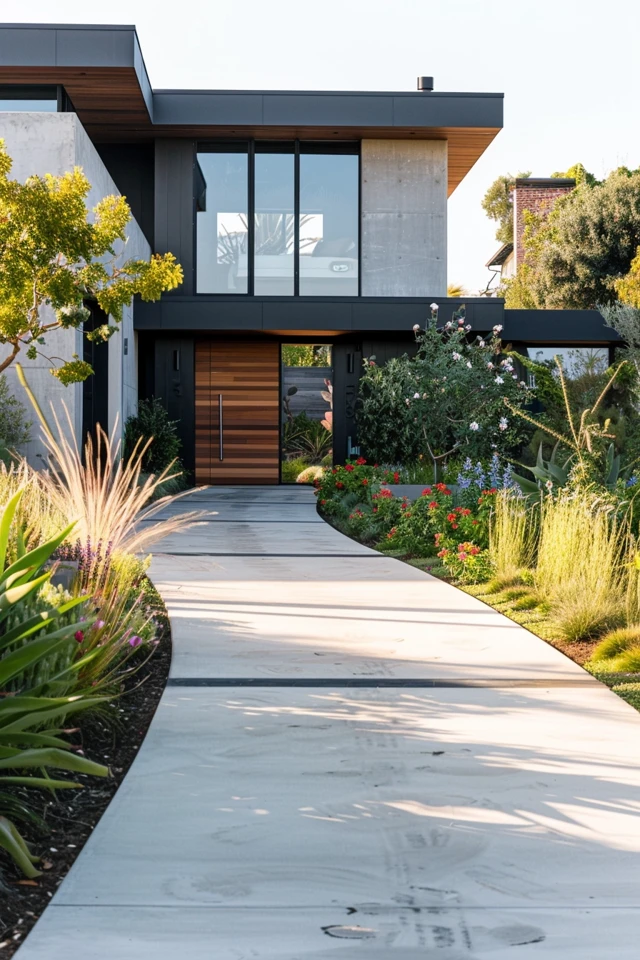
Simple Concrete Driveway Ideas for Home Appeal
Your driveway is essentially the red carpet to your home. While often treated as a purely utilitarian necessity, the right concrete design can completely transform your property’s curb appeal and set the tone for the rest of your exterior design.
It does not have to be complicated or overly ornate to make a statement. For a huge dose of inspiration, make sure to check out the full Picture Gallery at the end of the blog post.
At-a-Glance: Key Takeaways
- Simplicity sells: Clean lines and thoughtful finishes often look more expensive than complex, busy patterns.
- Finish matters more than shape: A simple rectangular driveway looks high-end with a salt finish or exposed aggregate rather than a plain broom sweep.
- Scale is critical: A driveway that is too narrow feels cheap and functions poorly; getting the width right is the first step in design.
- Lighting creates luxury: Integrated lighting or well-placed landscape lights can soften the harshness of a large concrete slab.
- Joints are design elements: Control joints are necessary to prevent cracking, so plan them to align with your home’s architecture rather than cutting them randomly.
What This Style Means (and Who It’s For)
When we talk about “simple concrete ideas,” we are not talking about the cracked, gray slabs you see in old commercial parking lots. In the design world, “simple” refers to intentional minimalism. It is about using concrete as a monolithic, sculptural element that complements the architecture of the house rather than competing with it.
This style relies on texture and geometry. Instead of using stamped patterns that try to fake the look of stone or brick, we embrace the honesty of the material. We highlight the concrete itself through better finishing techniques, strategic cuts, and contrasting borders.
This approach is perfect for homeowners who want a low-maintenance exterior that feels modern and clean. It is also ideal for those working with a mid-range budget. You are putting your money into quality materials and site preparation rather than labor-intensive stamping processes. If you have a modern, transitional, or farmhouse-style home, a refined concrete driveway is often the best aesthetic choice.
The Signature Look: Ingredients That Make It Work
To elevate a standard pour into something designer-grade, you need to understand the ingredients. A plain gray slab looks unfinished. A “designed” slab uses specific textures and edging to create visual interest.
The Finish
The texture of the surface is the most important aesthetic decision you will make.
- Sand Finish: This is my personal favorite for modern homes. It looks like uniform, compacted sand. It provides a non-slip surface but looks much more refined than a standard broom finish.
- Exposed Aggregate: By washing away the top layer of cream, you reveal the stones (aggregate) underneath. This hides oil stains and dirt exceptionally well and adds an organic, earthy texture.
- Salt Finish: Rock salt is pressed into the wet concrete and then washed away, leaving small divots. It creates a vintage, weathered look that works beautifully on Mediterranean or Spanish-style homes.
The Control Joints
Concrete will crack; it is a guarantee. Control joints induce cracking in straight lines where you want them. In a high-end driveway, we cut these in a grid pattern (often 4×4 feet or 5×5 feet) to make the driveway look like large tailored pavers.
The Edging
A simple concrete pour looks significantly better with a border. This can be a “picture frame” border of smooth concrete around a textured center, or a soldier course of brick or cobblestone to soften the transition between the hard driveway and the soft lawn.
Layout & Proportions (Designer Rules of Thumb)
As a designer, I see driveways poured too narrow constantly. It creates a “tight” feeling that subconsciously lowers the perceived value of the home. You need to account for car doors opening and comfortable walking paths.
Width Requirements
- Single Car Driveway: The absolute minimum is 10 feet wide, but I strongly recommend 12 feet. If you have retaining walls on either side, push this to 14 feet so you can open car doors without hitting concrete.
- Double Car Driveway: The standard is 20 feet, but 24 feet allows two large SUVs to park side-by-side with room to walk between them.
- The “Landing Strip”: If your driveway is long, ensure it flares out where it meets the street to accommodate the turning radius. A 15-foot radius is usually sufficient for standard residential vehicles.
Slope and Drainage
You never want water pooling on your concrete. The standard rule of thumb is a slope of 1/8 to 1/4 inch per foot. If your driveway is perfectly flat, you must install a trench drain near the garage door to prevent flooding.
Thickness Standards
For a standard passenger vehicle, a 4-inch slab is standard. However, if you own a heavy truck, RV, or have a delivery van frequently parking there, I specify a 5-to-6-inch thickness. It costs slightly more in material but prevents structural cracking down the road.
Step-by-Step: How to Recreate This Look
Creating a high-appeal concrete driveway is 80% preparation and 20% pouring. Do not rush the prep work.
1. Site Excavation and Compaction
Remove all vegetation and soft topsoil. You must get down to the subgrade. If the soil is soft or clay-heavy, you may need to dig deeper and replace it with gravel. The soil must be mechanically compacted; you cannot just stomp on it.
2. The Gravel Base
Never pour concrete directly onto dirt. You need 4 to 6 inches of crushed stone or recycled concrete as a base. This allows for drainage and provides a stable platform. This base must also be compacted.
3. Forming and Reinforcement
Set your wood forms to define the shape. Curves should be smooth, not jagged. Inside the forms, install a grid of rebar (steel bars). While wire mesh is cheaper, rebar provides superior structural integrity. I recommend
3 rebar spaced 12 to 18 inches apart.
4. The Pour and Screed
The concrete truck arrives, and the mix is poured. It is then “screeded” (leveled off) to be flat with the forms.
5. Finishing and Texturing
This is where the magic happens. Once the concrete begins to set but is still pliable, the finishers apply the texture (broom, salt, or sponge). If you are doing a “picture frame” border, they will trowel the edges smooth while texturing the center.
6. Cutting Control Joints
Within 24 hours of pouring, the control joints should be saw-cut. Plan this grid beforehand to align with the center of your garage doors or the front entry walk.
7. Sealing
Wait at least 28 days for the concrete to fully cure before applying a penetrating sealer. This protects the finish from salt, oil, and UV damage.
Budget Breakdown: Low / Mid / Splurge
Concrete pricing varies wildly by region and ready-mix availability, but the hierarchy remains consistent.
Low Budget ($6 – $10 per sq. ft.)
- Finish: Standard light broom finish.
- Shape: Straight edges, no curves.
- Details: Standard tooled joints (no saw cutting).
- Note: You can elevate this look by simply keeping the concrete extremely clean and edging the adjacent grass perfectly.
Mid Range ($10 – $18 per sq. ft.)
- Finish: Exposed aggregate, salt finish, or “sand” finish.
- Shape: subtle curves or flares at the entry.
- Details: Saw-cut geometric joints; potentially a colored admixture to tint the concrete a darker gray or warm beige to match the house.
Splurge ($18 – $30+ per sq. ft.)
- Finish: Ribbon driveway (concrete strips with grass/gravel in between) or heavy sandblast finish.
- Details: Integrated paver borders, heating coils underneath to melt snow, and integrated LED lighting channels.
- Complexity: Significant grading work, retaining walls integrated into the driveway design.
Common Mistakes (and How to Fix Them)
Mistake: Skimping on the sub-base.
Many contractors try to save money by pouring over dirt or using a thin layer of gravel.
The Fix: Demand a minimum of 4 inches of compacted aggregate base. If you live in a freeze-thaw climate, 6 inches is safer. The concrete is only as strong as what is underneath it.
Mistake: Random joint placement.
Contractors often cut joints wherever it is easiest for them, resulting in lines that visually clash with your home.
The Fix: Draw a plan. If your garage is 20 feet wide, you likely want a center line at 10 feet. Ensure the horizontal cuts are evenly spaced.
Designer’s Note: The “White Concrete” Trap.
“I often see clients upset because their new driveway is stark, blinding white while their house is earth-toned. Fresh concrete cures very bright. To avoid this glare, I recommend adding a very small amount of black or charcoal pigment to the mix—just enough to turn the brightness down to a soft gray, not enough to look ‘colored.’ It makes the driveway look established instantly.”
Mistake: Ignoring drainage.
Puddles in the middle of a driveway accelerate deterioration.
The Fix: Always verify the slope. If the driveway must be flat due to terrain, install a channel drain (a long metal grate) across the width of the driveway to catch runoff.
Style Variations
While the driveway serves a single function, the aesthetic should shift based on your home’s architecture.
The Modern Minimalist
For contemporary homes, less is more. Use a “sand finish” for a uniform, matte texture. Avoid curves; stick to strict geometric rectangles. Use saw-cut joints in a large grid pattern (e.g., 5-foot squares). Consider a “floating” look by separating the driveway from the walkway with a 4-inch gap filled with black Mexican beach pebbles.
The Transitional / Traditional
Here, you want to soften the hardscape. An exposed aggregate finish works wonders because the stones add warmth and color variance. Use a smooth concrete border (about 12 inches wide) to frame the aggregate. This looks tailored and classic.
The Farmhouse / Rustic
Avoid the pristine look. A salt finish mimics the texture of weathered stone. You might also consider a “ribbon driveway,” which consists of two parallel strips of concrete for the tires, with grass or gravel down the center. This reduces the amount of hardscape and looks historically accurate for rural properties.
Finish & Styling Checklist
Once the concrete is poured, styling is about integration with the landscape.
Designer’s “What I’d Do” Checklist:
- Soften the Edges: Never let grass grow directly against the concrete without a plan. I advise a 12-to-24-inch garden bed buffer between the driveway and the lawn, filled with low ground cover (like Liriope or Mondograss). This prevents trimmer damage to the concrete edge.
- Lighting: Place path lights every 6 to 8 feet along the edge. Do not over-light it like an airport runway; utilize warm white (2700K or 3000K) bulbs.
- House Numbers: If your driveway is long, install a concrete bollard or a large landscape rock with house numbers near the street entry.
- Sealant: Use a matte or satin sealer. High-gloss sealers look like plastic and can be slippery when wet.
FAQs
Will my concrete driveway crack?
Yes. There are two types of concrete: concrete that has cracked, and concrete that will crack. The goal of control joints and proper reinforcement is to ensure it cracks in a straight line where you can’t see it, rather than spider-webbing across the surface.
Can I pour new concrete over old concrete?
Generally, no. This is called “capping.” Unless the new layer is at least 2 to 3 inches thick and bonded correctly, it will flake off and crack very quickly. It is almost always better to demo the old slab and start fresh.
How long do I have to wait to drive on it?
You can walk on it after 24 hours. You should wait 7 days for light passenger vehicles. If you have a heavy truck, wait the full 28 days for the concrete to reach its maximum cure strength.
Is wire mesh enough, or do I need rebar?
For a driveway, rebar is superior. Wire mesh often gets stepped on during the pour and ends up at the bottom of the slab where it does no good. Rebar is rigid and stays in the middle of the slab where it provides actual tensile strength.
Conclusion
A simple concrete driveway does not have to be a boring necessity. By focusing on the fundamentals—correct proportions, high-quality finishes, and intentional joint patterns—you can create an entrance that elevates the perceived value of your entire home.
Whether you choose a textured salt finish for a rustic feel or a sleek sand finish for a modern look, the key is execution. Invest in the prep work, insist on proper drainage, and treat the concrete as a design element rather than just a place to park your car. The result will be a durable, beautiful surface that welcomes you home for decades.
Picture Gallery


