
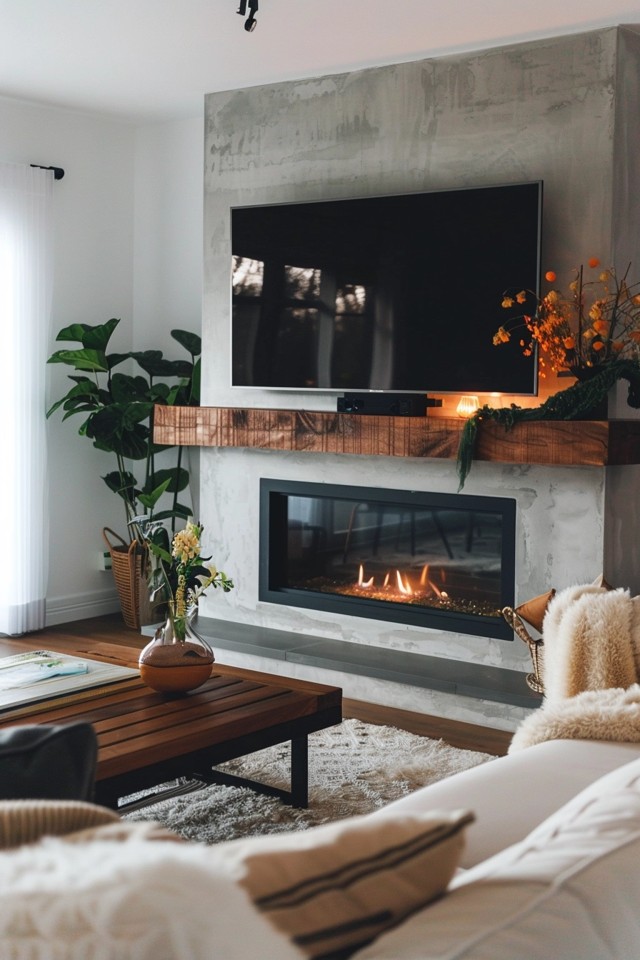
Sleek Linear Fireplace Ideas with TV Above
Designing a living room where the television and the fireplace coexist peacefully is one of the most common challenges I face in residential projects. For years, design purists argued that televisions should never go above a fireplace due to poor viewing angles and heat risks. However, the rise of the linear fireplace has completely changed the geometry of our feature walls.
Because linear fireplaces are wider and significantly lower to the ground than traditional square fireboxes, they allow the TV to drop down to a more comfortable viewing height. This combination creates a sleek, horizontal aesthetic that feels modern and intentional rather than forced. It streamlines the room’s focal point so you aren’t choosing between watching the fire or watching the game.
In this guide, I will walk you through the technical clearances, material selections, and layout tricks required to execute this look safely and beautifully. For a quick dose of inspiration, scroll to the bottom because the full Picture Gallery is at the end of the blog post.
1. Establishing the Correct Proportions and Scale
The most immediate visual failure in a fireplace-TV combination is improper scaling. If your television is wider than your fireplace, the entire wall will feel top-heavy and unstable. The visual weight needs to be anchored at the bottom.
As a general rule of thumb, your linear fireplace should be at least 6 to 12 inches wider than the television above it. For example, if you are installing a standard 65-inch TV (which is roughly 57 inches wide), you should aim for a linear fireplace that is at least 60 inches wide, though a 72-inch unit looks significantly better.
If you cannot change the size of the fireplace because you are working with an existing unit, you can cheat the visuals. I often extend the fireplace surround material—like stone or tile—horizontally beyond the firebox to create the illusion of a wider base. Flanking the fireplace with low, linear cabinets also helps ground the design.
Designer’s Note: The Pyramid Principle
I always teach my junior designers the “pyramid principle” for vertical layouts. The widest element should be at the bottom (the hearth or fireplace), the medium element in the middle (the TV), and the narrowest or lightest elements at the top (sconces or artwork). If you flip this and put a massive 85-inch screen over a tiny 40-inch fireplace, the room will feel subconsciously anxious and unbalanced.
2. Managing Heat and Technical Clearances
Before we get to the pretty finishes, we must address the physics of heat. Electronics act like magnets for heat damage, and voiding your TV warranty is a very real possibility if you ignore clearances.
Gas linear fireplaces generate significant heat, often projecting it directly upwards. If you are using a gas unit, I highly recommend looking for models with “cool wall” technology or heat-shifting ducts. These systems push the hot air out through vents near the ceiling, leaving the wall directly above the fireplace cool enough for a TV and sensitive artwork.
If you are choosing an electric linear fireplace, you have much more freedom. Most electric units are zero-clearance, meaning you can frame right up to the edge and the glass remains cool to the touch. This is often the best solution for renters or condos where venting gas isn’t an option.
Common Mistakes + Fixes
- Mistake: Mounting the TV flush against a wall that gets hot.
- Fix: Use a recess or a niche. Frame the wall so the TV sits inside a cavity. This shields the sides and bottom of the TV from rising heat and looks incredibly high-end.
- Mistake: Assuming a mantel is just decorative.
- Fix: If you don’t have heat-shifting tech, you must use a mantel. It acts as a heat deflector. A non-combustible mantel (like concrete or metal) projects heat away from the screen.
3. Optimal Viewing Height and Neck Strain
The biggest complaint about TVs over fireplaces is neck strain. In a perfect ergonomic world, the center of your television screen should be at eye level when you are seated. For most standard sofas, that eye level is roughly 42 to 45 inches off the floor.
Traditional fireplaces push TVs up to 60 or 70 inches, which is the front row of the movie theater experience nobody wants. With a linear fireplace, you can install the unit much lower. I typically place the bottom of the linear fireplace just 12 to 18 inches off the finished floor.
This low placement allows the mantel or TV to start much lower. If you keep the gap between the top of the fireplace and the bottom of the TV tight (around 8 to 10 inches, heat permitting), you can often get the center of the TV down to a reasonable 50 to 55 inches. While this is slightly above perfect eye level, it is generally acceptable for casual viewing, especially if you have a deep sofa that allows you to recline.
What I’d Do in a Real Project
- Step 1: Mark the proposed TV height on the wall with blue painter’s tape.
- Step 2: Sit on the actual furniture (or a box of similar height).
- Step 3: If you have to tilt your chin up more than 15 degrees, the TV is too high.
- Step 4: If it’s too high, I would recommend a specialized “mantel mount” bracket that allows you to pull the TV down over the fireplace when watching, and push it back up when entertaining.
4. Material Selection for a Seamless Look
To achieve that “sleek” aesthetic, you need to simplify your material palette. Traditional fireplaces often rely on chunky stacked stone or heavy brick, but modern linear designs favor smooth, continuous surfaces.
Large-format porcelain tile is one of my go-to materials. You can find slabs that mimic Calacatta marble or limestone, but they are thinner and lighter than real stone. The goal is to minimize grout lines. If you can use a single slab or extra-large tiles (24×48 inches), the wall will feel expansive and architectural.
Another trend taking over high-end design is Venetian plaster or Roman clay. This applies a texture directly to the drywall that mimics the look of concrete or stone but adds warmth and movement. It is seamless, elegant, and much cheaper than cladding a wall in slab stone.
Coordinating Finishes
When selecting your surround, consider the TV when it is off. A giant black rectangle on a stark white wall can look like a black hole. I often recommend dark charcoal, slate, or black shiplap walls for the fireplace surround. This helps the TV camouflage into the background, making the fire the star of the show rather than the appliance.
5. Managing Glare and Lighting
Lighting is the silent killer of a good media wall. Because linear fireplaces often feature glass fronts, and TVs are obviously reflective, you are dealing with two highly reflective surfaces stacked on top of each other.
Avoid placing recessed can lights directly above the TV wall. This creates “scalloping” shadows on the screen and harsh glare on the fireplace glass. Instead, use wall washers set back 24 to 30 inches from the wall, or rely on floor lamps and table lamps for ambient lighting.
If your room has windows directly opposite the fireplace wall, you will need serious window treatments. Solar shades can cut the glare without losing the view, but for movie nights, blackout curtains are a necessity.
A Note on The Frame TV
I almost exclusively specify Samsung Frame TVs (or similar art-mode televisions) for these installations. The matte screen finish drastically reduces glare compared to standard glossy screens. Furthermore, being able to display art when the TV is idle transforms the wall from a “tech center” into a gallery wall.
6. Storage and Component Hiding
A sleek wall is ruined instantly by a hanging HDMI cable. In new construction, this is easy: we run conduit pipes behind the drywall from the TV location to a media closet or a side cabinet.
If you are renovating, you need a plan for the cable box, gaming consoles, and router. Linear fireplaces often look best when paired with asymmetrical low-slung cabinets. A floating bench or cabinet to the left or right of the fireplace provides a perfect place to hide components.
You can use an IR (infrared) repeater system to control devices hidden inside solid wood cabinets. Alternatively, many modern cabinets use slatted wood or perforated metal doors which allow remote signals to pass through without revealing the clutter inside.
Rug Sizing and Layout
Don’t forget the floor. A linear fireplace puts out heat at a lower level. Ensure your area rug is pulled back at least 18 to 24 inches from the face of the fireplace. Not only is this a safety precaution, but it also keeps the hearth area looking uncluttered. I usually recommend a low-pile rug in these spaces to maintain that clean, modern geometry.
Final Checklist
Before you call the contractor or start demo, run through this final checklist to ensure you haven’t missed a critical detail.
- Check Manufacturer Clearances: Have you read the PDF manual for your specific fireplace model? It will dictate exactly how close the mantel and TV can be.
- Verify Wall Depth: Linear fireplaces are deep. Do you have the framing depth to recess it, or will you need to build the wall out?
- Plan Power Outlets: You need power for the fireplace (often hardwired) and a recessed outlet box behind the TV. Don’t forget a conduit for HDMI cables.
- Measure the Furniture: Ensure your coffee table is roughly 14-18 inches from the sofa, but at least 30 inches from the fireplace to allow traffic flow.
- Test Paint Colors: Paint a large swatch on the wall and watch how the firelight changes the color at night. Gray paints can turn surprisingly blue or purple under artificial light.
- Soundbar Placement: If you aren’t doing in-ceiling speakers, where does the soundbar go? Mounting it to the mantel or using a bracket attached to the TV is usually the cleanest look.
FAQs
Can I mount a TV above a wood-burning linear fireplace?
Technically yes, but it is very risky and I rarely recommend it. Wood fires produce inconsistent heat and smoke that is harder to control than gas or electric. If you must do it, you need a substantial non-combustible mantel and the TV needs to be mounted significantly higher, which usually ruins the viewing angle.
How much does a linear fireplace installation cost?
Costs vary wildly. A simple electric linear unit might cost $500 to $1,500, with another $1,000 for framing and drywall. A high-end gas linear fireplace can cost $4,000 to $8,000 for the unit alone, plus venting, gas plumbing, and stone finishing. A fully finished stone wall with a gas unit often runs between $10,000 and $20,000.
What if my room is narrow?
If your room is narrow, avoid a raised hearth. A hearth that sits on the floor takes up valuable floor space. Instead, install the fireplace slightly higher in the wall (floating) so the floor space underneath remains open visually, making the room feel wider.
Do I need a hearth with a linear fireplace?
In modern design, we often skip the hearth entirely for a “hole in the wall” look. However, check your local building codes. Some municipalities require a non-combustible floor surface extending 12 to 18 inches in front of gas fireplaces.
Conclusion
Combining a sleek linear fireplace with a television is the definitive look of modern living rooms for a reason. It solves the age-old problem of competing focal points and creates a vertical stack that feels organized and intentional.
The secret to success lies in the boring details: checking the heat clearances, getting the proportions right so the TV doesn’t crush the fireplace visually, and choosing materials that bridge the gap between technology and comfort. When done correctly, you get the best of both worlds—a cozy atmosphere for conversation and a high-performance media setup for movie night.
Picture Gallery


