
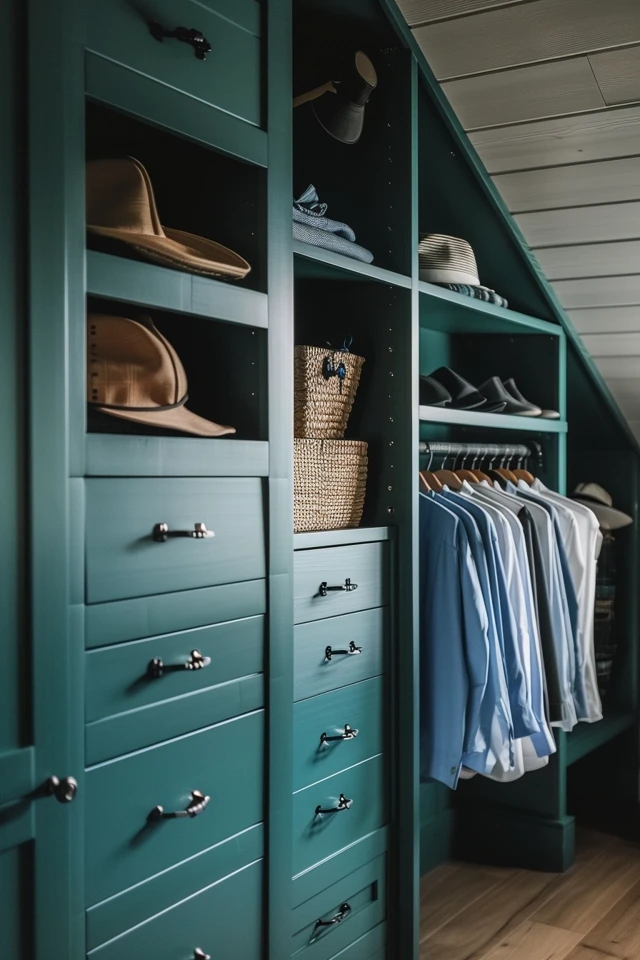
Sloped Ceiling Closet Ideas for Chic Storage Solutions
There is a distinct romance to a room with a sloped ceiling. Whether it is an attic conversion, a finished room over a garage, or a charming A-frame, these angular spaces offer incredible architectural character. However, that charm often evaporates the moment you try to install a standard wardrobe or organize your clothes.
I have designed countless attic bedrooms where the homeowners were ready to give up on having a closet altogether. They assumed the awkward triangles of space were dead zones, destined only for dust bunnies and forgotten boxes. For a visual feast of inspiration, make sure to check out our complete Picture Gallery at the end of this blog post.
The reality is that sloped ceilings offer some of the best opportunities for custom storage if you shift your perspective. By respecting the geometry of the room and utilizing specific measurements, you can turn those frustrating low points into highly functional assets. This guide will walk you through the professional approach to conquering the slant.
1. Mastering the Geometry: Assessing Your Pitch and Knee Wall
Before buying lumber or ordering a system, you must understand the “knee wall.” This is the short vertical wall where the sloped ceiling meets the floor. Its height dictates everything about your closet design.
If your knee wall is under 36 inches, do not attempt to hang clothes there. Standard hangers require a drop of roughly 40 to 42 inches for shirts and jackets to hang freely without bunching at the bottom. Forcing a hanging rod into a low slope results in wrinkled hems and frustration.
For knee walls between 18 and 36 inches, the best solution is built-in drawer units or open shelving for shoes. By pushing these deeper storage elements into the lowest part of the eave, you preserve the full-height areas for standing and dressing.
If you have zero knee wall (where the ceiling hits the floor), you are looking at a “plenum” space. In professional projects, we often build a false wall about 24 inches out from the pinch point. We then install access panels in that false wall to store seldom-used items like holiday suitcases, while the front face becomes usable vertical space for the actual closet.
2. The “Step-Down” Hanging Strategy
One of the most effective layouts for a slanted ceiling is the step-down method. This mimics the roofline with your hanging rods. It optimizes vertical space without requiring complex carpentry.
Place your long-hanging items (dresses, coats, jumpsuits) at the highest point of the closet slope. You need about 60 to 66 inches of vertical clearance for these garments. As the ceiling slopes down, transition to medium-hang items like trousers hung by the cuff (roughly 48 to 50 inches).
Finally, utilize the lowest viable section for short-hang items. This includes shirts, folded pants, and skirts. You can get away with as little as 38 inches here, though 40 is safer.
This cascading effect looks intentional and visually balanced. To make it look like high-end design rather than a quick fix, use matching rod hardware throughout. If you are using brass rods, ensure the brackets and end caps match exactly, even if the rods are at different heights.
3. Custom Millwork vs. Modified Systems
In a luxury project, we always opt for custom millwork. This allows us to “scribe” the cabinetry to the ceiling. Scribing involves cutting a filler piece of wood to match the exact irregularities and angle of the ceiling, creating a seamless, built-in look.
However, you can achieve a similar look with modular systems like IKEA PAX or The Container Store’s Elfa if you are handy. The trick is to buy units that are shorter than your lowest ceiling point and build a “top box” or bulkhead above them.
Do not leave a triangular gap of darkness above a square wardrobe unit; it creates visual clutter. Instead, frame out that triangle with drywall or MDF and paint it to match the walls. This creates the illusion that the closet is embedded in the wall.
For a true built-in look on a budget, use baseboard molding that runs continuously around the room and across the bottom of your wardrobe unit. This grounds the furniture and makes it feel like part of the architecture.
4. Lighting the Triangle
Sloped ceilings cast shadows. If you rely on a single ceiling fixture in the center of the room, your closet under the eaves will be a black hole. You cannot distinguish navy from black in a poorly lit attic closet.
The most effective solution is LED ribbon lighting. Route a channel into the front face of your vertical dividers or the underside of your shelves. Face the light backward toward the clothes, not out toward your eyes. This provides a boutique-style glow that illuminates the garments directly.
If you are retrofitting and cannot hardwire, use rechargeable, motion-sensor LED bars. Look for a color temperature of 3000K to 3500K. This creates a clean, bright white that renders colors accurately but isn’t as harsh as a hospital waiting room (4000K+) or as yellow as a candle (2700K).
Avoid recessed “can” lights on a steep slope. Unless you buy expensive adjustable “gimbal” trims, the light will shine directly into your eyes rather than down onto the floor. Sconces mounted on the flat gable walls are often a better choice for ambient light.
5. Utilizing Deep Eaves: The Deep-Drawer Solution
Sometimes the issue isn’t height; it is depth. Sloped ceilings often create deep, cavernous spaces near the floor that are hard to reach. If you install standard 12-inch shelves, you waste feet of space behind them.
The solution is full-extension deep drawers. In kitchen design, we use 24-inch deep drawers, and you can apply the same logic here. Install heavy-duty drawer slides that allow you to pull a drawer out fully.
This is perfect for seasonal storage. You can store heavy wool sweaters or spare linens in the back half of the drawer and daily items in the front. Because the drawer pulls out into the room, you don’t have to crawl on your hands and knees to reach the back of the closet.
Another option for deep eaves is rolling bins. Build a low facade that matches your cabinetry, attach it to a large wooden box on casters, and roll the entire unit under the slope. It looks like a fixed drawer but functions like a cart.
Designer’s Note: The “Head Bump” Clearance
Here is a lesson I learned the hard way early in my career. I designed a beautiful vanity area tucked into a dormer window. It looked stunning on paper. However, I failed to account for the client’s height relative to the slope.
Every time she leaned forward to apply mascara, she felt the ceiling looming over her head. It created a subconscious claustrophobia. She eventually stopped using the vanity.
When placing functional items like a dresser or a hanging rod, you must account for “lean space.” You need to stand roughly 24 inches back from a dresser to open a drawer. Ensure the ceiling height at that standing point is at least 6 feet 6 inches. If the slope cuts into your headspace where you need to stand, move the storage deeper into the eave or switch to open shelving that doesn’t require stepping back.
6. Doors, Curtains, and Visual Noise
Deciding how to close off a sloped closet is tricky. Standard rectangular doors rarely work unless you build a square frame inside the slope, which eats up valuable space.
Custom angled doors are the premium option. A millworker cuts the top of the door to match the ceiling pitch. This requires precise hinging. The hinges must be placed on the tall side of the door; gravity will eventually sag a door hinged on the short side.
For a softer, more romantic look, use drapery. Mount a ceiling track directly to the slope or the flat ceiling just in front of it. Use a heavy weight linen or velvet. The fabric hides the awkward angles and absorbs sound, making the room feel quieter and cozier.
If the space is small, consider leaving the closet open. This requires discipline. If you go this route, use uniform hangers (wood or velvet) and organize by color. Wallpapering the back wall of the open closet adds a surprising pop of design depth that turns the storage into a feature wall.
Common Mistakes + Fixes
Mistake: Ignoring ventilation.
Fix: Attics and eaves can get hot and humid. Clothes packed tight against an uninsulated roofline can develop mildew. Always leave a 1-2 inch air gap between the back of your cabinetry and the exterior wall. Consider adding louvered doors for airflow.
Mistake: Placing rods too close to the back wall.
Fix: On a slope, the ceiling comes down and forward. If you place the rod at the standard 12 inches from the back wall, the hanger might hit the slanted ceiling before it fits on the rod. You often need to mount the rod 14 or 16 inches from the back wall to clear the slope.
Mistake: Using wire shelving.
Fix: Wire shelving is functional but notoriously ugly in open sloped closets. It also leaves lines on your clothes. Upgrade to solid wood or melamine shelves. If you must use wire, cover the shelves with a plastic liner or thin wood veneer.
What I’d Do in a Real Project
If I were hired to transform a bedroom with a steep sloped ceiling today, here is the exact checklist I would follow:
- Step 1: Map the heights. I would take masking tape and mark the floor where the ceiling height hits 4 feet, 5 feet, and 6 feet. This visualizes the “zones” for drawers, short hang, and long hang.
- Step 2: Build the knee wall storage. I would install a row of IKEA Nordli or similar modular drawers along the lowest wall. I would top them with a custom butcher block counter to create a unified surface.
- Step 3: Install the hanging rails. I would use a wall-mounted rail system (like Rakks or Vitsoe) that allows me to adjust the height of the rods infinitely. I would position them to follow the roofline.
- Step 4: Add the “Jewelry.” I would install unlacquered brass hardware on the drawers and a large, oddly shaped mirror on the tallest flat wall to bounce light around.
- Step 5: Light it up. I would run a continuous LED strip along the top of the knee wall baseboard to wash the floor with light, making the room feel wider.
Final Checklist for Your Sloped Closet
Use this summary to ensure you haven’t missed a critical detail:
- Measured the pitch and identified the “knee wall” height.
- Checked that the hanging rod placement clears the slope for standard hangers (17-18 inches wide).
- Ensured there is standing room (headspace) in front of the drawers.
- Selected a lighting solution that faces the clothes, not the eyes.
- Accounted for ventilation to prevent mildew in roof spaces.
- Chose a door or curtain solution that doesn’t fight the angle.
FAQs
Can I use standard closet doors on a sloped ceiling?
Generally, no. You would need to frame a standard rectangular opening, which usually means sacrificing space on the sides. It is better to use custom angled doors, curtains, or leave the storage open.
How deep should shelves be in an attic closet?
Standard shelves are 12 to 14 inches deep. However, in an attic, deeper is often better (16 to 20 inches) because it pushes the storage out from the low ceiling, making it more accessible.
Is it expensive to build a custom sloped closet?
Custom millwork is expensive, costing thousands of dollars. However, using “hacks” like modifying stock cabinets and using trim to hide the gaps can achieve a similar look for a fraction of the price. The labor is the biggest cost factor.
Conclusion
Sloped ceilings should not be viewed as a storage limitation. They are an invitation to be more creative and deliberate with your design. By moving away from the “one size fits all” mentality of standard wardrobes and embracing the unique angles of your home, you gain a space that feels bespoke and intimate.
Whether you choose high-end joinery or a clever DIY rail system, the key is respecting the measurements. Give your clothes room to breathe, light them well, and use the low points for the items you don’t need to access while standing up. With the right plan, your attic closet can become the most stylish feature of your home.
Picture Gallery


