
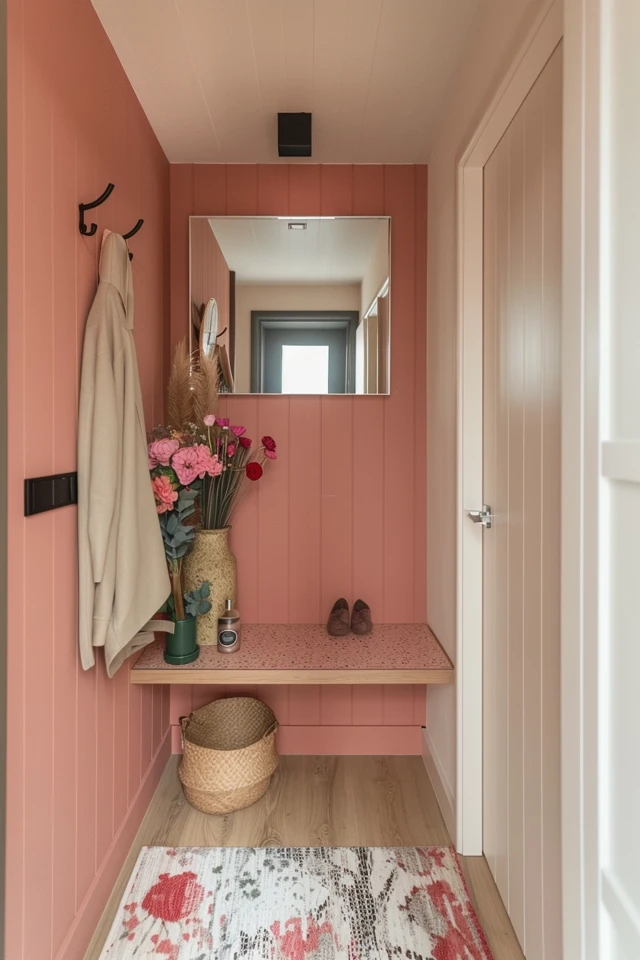
Small Entryway Ideas for Split Level Homes
The split-level home is a hallmark of mid-century architectural efficiency, but it often comes with a glaring flaw: the entryway. This space, usually referred to as the “landing,” is notoriously cramped. You walk in the front door and are immediately faced with a choice to go up half a flight of stairs or down half a flight, leaving very little room to actually stand, take off a coat, or greet guests.
For many of my clients, this 4-by-6-foot square of real estate causes more daily frustration than any other room in the house. It is a high-traffic bottleneck that requires precise planning to function well. The challenge is balancing the need for heavy-duty storage with the desire for an open, airy aesthetic that doesn’t feel like a closet.
The good news is that with the right scale of furniture and some visual trickery, you can turn this awkward transition space into a functional foyer. If you are looking for visual inspiration, we have curated a comprehensive Picture Gallery at the end of the blog post. Let’s dive into the practical mechanics of designing a split-level entry that actually works.
1. Mastering the Scale of the Landing Strip
The biggest constraint in a split-level foyer is floor space. Most landings are roughly 4 to 5 feet deep and 6 to 8 feet wide. If you put standard-sized furniture here, you will block the flow of traffic to the stairs.
The Rule of 36 Inches
In interior design, we aim for a minimum walkway width of 36 inches. In a split entry, you need to maintain this clearance from the door to both the upper and lower staircases. If your landing is only 48 inches deep, you have very little room for furniture.
The Slim Console Solution
Avoid standard console tables, which are typically 16 to 18 inches deep. Instead, hunt for “ultra-slim” or “narrow” consoles that are 8 to 10 inches deep. These provide a surface for keys and mail without encroaching on your walking path. Secure these to the wall to prevent tipping, as they have a narrow center of gravity.
Floating Furniture
When floor space is non-negotiable, go wall-mounted. A floating shelf mounted at waist height (approx. 32-36 inches off the floor) creates a drop zone without a footprint. This allows you to tuck shoes or baskets underneath, maximizing the vertical utility of that single wall.
2. Vertical Storage: Hooks, Pegs, and Board and Batten
Since you cannot build out into the room, you must build up. Most split-level entries lack a coat closet, or the closet is awkwardly placed halfway down the stairs. The solution is using the wall behind the door or the main landing wall for accessible storage.
The Peg Rail System
I often recommend a continuous peg rail wrapping around the available wall space. Unlike individual hooks, a rail creates a cohesive architectural line that looks intentional rather than cluttered. Position the rail at 60 inches high. This is high enough to keep long coats from dragging on the floor but accessible for most adults.
Kid-Friendly Zones
If you have children, add a secondary row of hooks at 36 to 40 inches high. This allows kids to hang their own backpacks and jackets. To keep this from looking messy, assign specific hooks to specific family members.
Designer’s Note: The “One Coat” Rule
In a space this small, you cannot store your entire winter wardrobe. I advise clients to adopt the “one coat” rule for the entryway. Keep currently used items on the hooks and move everything else to bedroom closets or a basement storage area. If you overload a small entry with 15 coats, it will feel claustrophobic regardless of the design.
3. Lighting the Stairwell
Split-level entries can feel like caves because the front door is often the only source of natural light. Proper lighting fixture placement is critical here because of the unique ceiling height changes.
The Chandelier Opportunity
The one advantage of a split level is that the ceiling above the landing is often quite high, extending to the roofline of the upper level. This is a prime spot for a large-scale pendant or chandelier. A fixture here draws the eye upward, making the space feel grand rather than cramped.
Hanging Height Logic
When hanging a fixture in a split entry, you must ensure the bottom of the light is at least 7 feet above the landing floor. However, you also need to check the sightline from the upper level. You do not want to be looking down onto a bare lightbulb from the living room. Choose a fixture with a diffuser or a lantern style that looks good from above and below.
Sconces for Width
If you have a lower ceiling, avoid recessed can lights alone, which can create harsh shadows. Wall sconces placed at eye level (roughly 60-66 inches from the floor) wash the walls with light. This pushes the walls out visually, making the tight hallway feel wider.
4. Flooring Transitions and Stair Runners
The floor of your entryway takes a beating from mud, grit, and snow. In a split level, this flooring also touches two sets of stairs, making the transition point tricky.
Durability First
I always recommend a hard surface for the landing pad itself. Porcelain tile or slate are excellent choices because they are impervious to water. If you choose wood, ensure it has a high Janka hardness rating (like white oak) and a durable polyurethane finish.
The Stair Runner Strategy
To soften the look and reduce noise, install a runner on the stairs leading up and down. A runner draws the eye vertically, connecting the two levels.
- Material: Use wool or a high-quality nylon. Wool is naturally soil-resistant and bounces back after being stepped on.
- Pattern: Stripes are fantastic in split levels. Vertical stripes elongate the stairs, making the short runs look longer.
- Reveal: Leave about 3 to 4 inches of wood visible on either side of the runner. This “reveal” creates a clean border that frames the carpet.
Common Mistake: The Floating Rug
Avoid placing a small 2×3 scatter rug on the landing. It will slide around and often gets caught under the door sweep. Instead, tile the landing or install a custom-sized walk-off mat that is recessed into the floor so it sits flush with the surrounding surface.
5. Railings: Opening Up the Sightlines
The railing system is the most defining architectural feature of a split level. Original homes often have heavy wooden spindles or solid half-walls (pony walls) that block light and view, making the entry feel like a box.
The Pony Wall Dilemma
If you have a solid half-wall separating the entry from the upper living room, consider removing it and replacing it with an open railing. This is one of the most impactful renovations you can do. It instantly connects the entry to the light from the living room windows.
Modern Spindle Options
For a contemporary look, replace thick turned wood spindles with simple square balusters or horizontal cable railings. Metal spindles take up less visual weight than wood, making the space feel more open.
Glass Railings
For the ultimate open feel, tempered glass panels are an option. They remove all visual barriers. However, I caution parents and pet owners: glass requires constant cleaning to remove nose prints and fingerprints. If you want low maintenance, stick to thin metal vertical railings.
What I’d Do in a Real Project: A Mini-Checklist
If I were hired to renovate a split-level foyer today, this is the exact workflow I would follow to ensure success:
1. Verify the Door Swing
Before buying anything, I open the front door fully. I measure the arc of the door swing. Nothing—absolutely no rug, bench, or shelf—can encroach on this arc.
2. Check the “Header” Height
I look at the wall space above the door. If there is room, I might add a shelf above the door frame for decorative baskets to store off-season items like hats and gloves.
3. Select a Mirror
I locate the largest empty wall and plan for a mirror. It should be at least 30 inches wide. The reflection doubles the perceived space and bounces light from any windows.
4. Paint Strategy
I usually paint the landing, the stairwell walls, and the upstairs hallway the same color. This blurs the lines between the “cramped” entry and the “open” living area, making the whole house feel like one cohesive thought.
5. Switch Assessment
I check where the light switches are. Often in older homes, the switch is behind the door. I would hire an electrician to move it to the latch side of the door for easier access.
Common Mistakes + Fixes
Mistake: Using a Deep Storage Bench
Homeowners often buy a bench that is 18 inches deep for the landing.
The Fix: The bench blocks the flow to the stairs. Instead, use a narrow bench (12 inches deep) tucked completely against the wall, or forego the bench entirely in favor of a wall-mounted folding seat that snaps back up when not in use.
Mistake: Ignoring the “Drop Zone” for Keys
People create beautiful entries but forget a place for keys. Keys end up on the stairs or the floor.
The Fix: If you have no room for a table, install a small floating shelf specifically for a key bowl. It only needs to be 6 inches deep and 10 inches wide.
Mistake: Dark Paint Colors
While moody entries are trendy, a small, windowless split entry can feel oppressive in dark charcoal or navy.
The Fix: Stick to light, light-reflective neutrals (LRV of 60 or higher). If you want drama, use a dark color on the front door itself or on the floor tile, keeping the walls bright.
Frequently Asked Questions
How do I handle shoes in a split-level entry?
Shoe storage is the hardest part of this layout. I recommend slim shoe cabinets (like the IKEA Hemnes or Stall) that tilt out. They are typically only 7 to 9 inches deep but can hold 8 to 12 pairs of shoes. Mount this directly to the wall.
Can I knock down the wall between the entry and the living room?
Usually, the wall running parallel to the front of the house is not load-bearing, but the wall separating the stairs from the living room often is. You can almost always replace the drywall with a railing, but removing the studs entirely requires a structural engineer to look at your header.
What is the best rug size for a 4×6 landing?
It is difficult to find a standard rug that fits without interfering with the door. A 3×5 rug is often the best bet, but ensure you use a heavy-duty rug pad so it doesn’t slip. For a perfect fit, have a carpet store cut a piece of broadloom carpet to your exact dimensions and bind the edges.
How do I decorate the tall wall above the stairs?
This space can feel vast and empty. A large-scale piece of art or a gallery wall works well here. However, anchor the art to the landing visually. Center it on the wall space relative to the light fixture, not necessarily the floor.
Conclusion
Designing a small entryway for a split-level home is a game of inches. It requires you to be ruthless about clutter and clever about vertical space. By choosing slim furniture, prioritizing lighting, and keeping your sightlines open, you can transform that cramped landing into a welcoming introduction to your home.
Remember that this space is a transition zone. It doesn’t need to be a fully furnished room; it just needs to facilitate the movement of people and their things. Focus on durability and flow, and the aesthetics will follow.
Picture Gallery


