
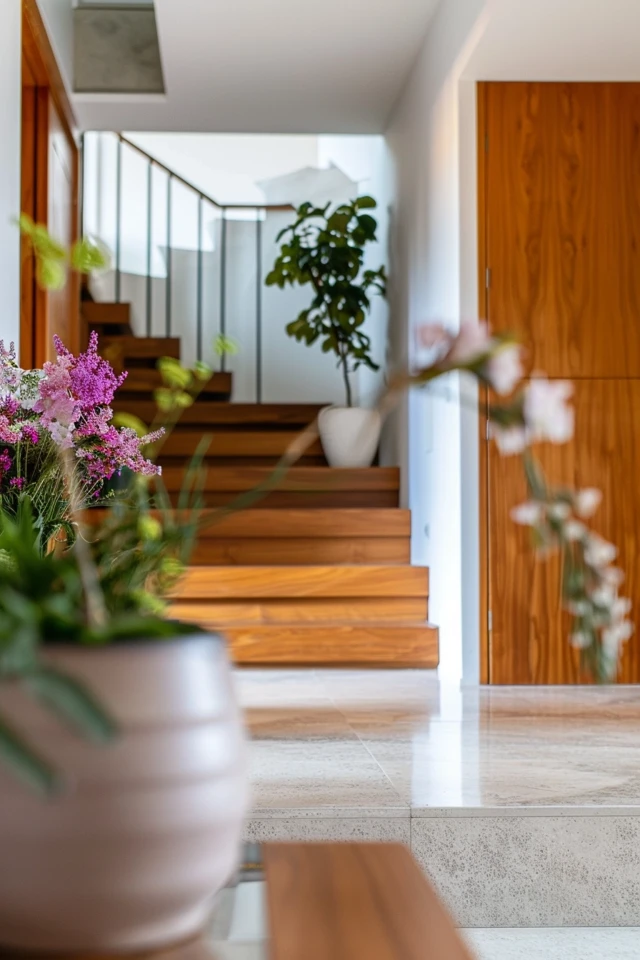
Stylish Split Level Entryway Ideas to Welcome You Home
Split-level homes offer a unique architectural charm, but let’s be honest: the entryway can be a design nightmare. You open the door and are immediately faced with a choice: go up, go down, or stand in a very small square of landing space. This “landing strip” often feels cramped, dark, and difficult to style without cluttering the traffic flow.
However, as an interior designer, I have grown to love these spaces for their specific potential. Because the footprint is small, you can use higher-end materials without breaking the bank, and you can create a stunning first impression that sets the tone for the entire house. It just requires a shift in perspective from horizontal decorating to vertical strategizing.
If you are looking for visual inspiration, check out our Picture Gallery at the end of this blog post.
1. Master the Scale and Traffic Flow
The biggest issue with a split-level entry is the “bottleneck effect.” You usually have a landing that is roughly 4 feet by 6 feet, with stairs immediately cutting off the space.
The first rule of thumb here is maintaining clearance. You need a minimum of 36 inches of clear walking path from the front door to the stairs. If your entry is tight, this dictates exactly what furniture you can use.
Avoid standard console tables, which are typically 15 to 18 inches deep. In a split entry, that depth will make the space feel claustrophobic. Instead, look for “ultra-slim” or “shoe cabinet” styles that are 10 to 12 inches deep.
If you are renovating, consider pushing the door out. Even bumping the entryway out by two feet can transform the functionality of a split level. If that isn’t in the budget, you must rely on visual tricks to expand the space.
Designer’s Note: The “Drop Zone” Dilemma
Here is a lesson I learned the hard way on an early project: do not try to make this small landing your primary mudroom. I once designed a split entry with a bench, hooks, and shoe storage all on the main landing for a family of five. It was a disaster.
Within a week, the pile of shoes blocked the door swing. Now, I advise clients to designate a secondary “drop zone” either at the bottom of the stairs or in the garage. Keep the main landing for guest items and “grab-and-go” essentials only (keys, one pair of shoes, a purse).
2. strategic Lighting for High and Low Ceilings
Lighting a split level is tricky because you often have a double-height ceiling over the stairs, but a standard height over the door. This creates uneven shadows.
You need a layered approach. A single overhead light is rarely enough and often casts unflattering shadows on guests’ faces.
The Chandelier Placement
If you have the vertical space over the stairs, hang a large-scale pendant or chandelier. The bottom of the fixture should be at least 7 feet above the floor of the landing so no one bumps their head. However, visually, it should align with the second-story window if one exists.
Sconces are Your Best Friend
In tight split entries, floor space is premium, so wall-mounted lighting is essential. I love installing sconces flanking the mirror or on the wall opposite the door.
- Mount sconces at approximately 60 to 66 inches from the floor to the center of the fixture.
- Choose fixtures that are “ADA compliant” or low profile, meaning they don’t stick out more than 4 inches from the wall. This prevents snagging coats or bags.
Kelvin Temperature Matters
Because these entries can be dark, use bulbs with a color temperature of 2700K to 3000K. This provides a warm, inviting glow. Anything over 3500K will look like a dentist’s office, and anything under 2700K will look too orange and dim.
3. Vertical Storage Solutions
Since floor space is non-negotiable, your walls have to work twice as hard. You need storage that goes up, not out.
Recessed Niches
If you are doing a remodel involving drywall, ask your contractor to frame out a recessed niche between the wall studs. Standard studs are 16 inches apart on center, giving you about 14 inches of width and 3.5 inches of depth.
This is perfect for a recessed key cabinet or a flush-mounted mirror with hidden storage behind it. It invades zero inches of your walking space.
Board and Batten with Hooks
A common issue in split levels is wall damage. People coming in with groceries or backpacks tend to brush against the walls.
I often recommend installing board and batten paneling up to 60 inches high. Use a semi-gloss or satin paint finish on the woodwork. This acts as armor for your walls. Install sturdy hooks directly into the top rail of the board and batten.
The “Floating” Console
If you need a surface for mail or keys, use a wall-mounted floating shelf or drawer unit.
- Mount it roughly 32 to 36 inches off the ground.
- Keep it shallow (8 to 10 inches deep).
- Because it has no legs, your eye sees the floor extending all the way to the wall, which makes the room feel larger.
4. Flooring and Rugs: Durability Meets Design
The floor of a split entry takes a beating. It sees dirt, mud, and water immediately upon entry.
Hard Material Selection
Avoid hardwood right at the door if you live in a wet climate. It will warp. Porcelain tile or slate are the top choices here.
For a modern look, go with a large format hexagonal tile. The irregular shape distracts the eye from the small, boxy nature of the room. If you use rectangular tile, lay it in a herringbone pattern to point the eye “into” the home, creating a sense of movement.
The Rug Rule
Finding a rug for a split landing is difficult because standard sizes (3×5 or 4×6) rarely fit perfectly.
- The Rule: Leave 4 to 6 inches of bare floor visible around the perimeter of the rug. This “border” is crucial; if the rug touches the walls, the room looks like it is suffocating.
- Pile Height: You must measure the clearance of your front door sweep. If the gap between the bottom of the door and the floor is tight, you need a flat-weave rug or a rug with a pile height under 0.25 inches.
- Material: Use polypropylene or wool. Polypropylene is scrubbable and resists staining. Wool is naturally durable and hides soil well, though it can be pricier.
Stair Runners
The stairs are the first thing you see. A runner is a great way to add texture and dampen noise.
For split levels, I prefer a runner that leaves 3 to 4 inches of wood visible on either side of the tread. This emphasizes the width of the stairs. If you carpet wall-to-wall on the stairs, it can make the tunnel effect feel heavier.
5. Creating Visual Impact with Walls and Mirrors
Because the space is small, you can afford to take risks. This is the place for bold design choices that might be overwhelming in a large living room.
Wallpaper the Stairwell
One of my favorite tricks is to wallpaper the tall wall that spans both the upper and lower levels. This draws the eye upward and unifies the two spaces.
Choose a large-scale pattern. Tiny patterns can look busy and cluttered from a distance. A large botanical or geometric print expands the feeling of volume.
The “Mirror Effect”
A large mirror is non-negotiable in a small entryway. It bounces light around and allows for a final outfit check.
However, be careful what the mirror reflects. Do not place a mirror so that it directly reflects the bathroom door or a pile of shoes. Ideally, it should reflect a light source or a piece of art.
Paint Colors
You have two main paths here:
- Light and Airy: Whites, creams, and soft greys blend the walls with the ceiling, making the boundaries disappear. This is best if your landing is very small.
- The “Jewel Box”: Paint the walls, trim, and even the ceiling in a moody, dark color like navy or charcoal. This embraces the coziness of the space. It sounds counterintuitive, but blurring the edges with dark paint can make a small space feel infinite.
Common Mistakes + Fixes
Mistake: The “Boob Light”
Many split levels come with standard, flush-mount dome lights that look dated and provide poor illumination.
Fix: Swap it for a semi-flush mount fixture. These drop down about 4 to 8 inches from the ceiling, allowing light to bounce off the ceiling and reducing harsh shadows.
Mistake: Ignoring the Risers
The vertical part of the stair steps (the risers) are right in your face when you walk in. Leaving them scuffed or plain is a missed opportunity.
Fix: Paint the risers a crisp white to contrast with wood treads, or use peel-and-stick tile decals on the risers for a pop of pattern.
Mistake: Over-Scaling Furniture
Using a bench that is too deep, causing people to turn sideways to get past it.
Fix: If you need seating, look for a “flip-down” wall-mounted seat. These fold flat against the wall when not in use, saving precious inches.
“What I’d Do in a Real Project” Mini Checklist
If I were hired to redesign a standard suburban split-level entryway today, this is the exact workflow I would follow:
- Step 1: Define the “Clean Zone.” Establish a 4×4 foot area immediately inside the door that must remain clear of furniture.
- Step 2: Install high wainscoting. I would add vertical shiplap or beadboard up to 5 feet high, painted in a durable semi-gloss “Greige” (like Sherwin Williams Agreeable Gray).
- Step 3: Select a feature lighting fixture. I would choose an open-cage lantern style pendant. The “open” structure takes up physical volume but doesn’t block sightlines, keeping the space airy.
- Step 4: Add a mirror. A round mirror (30-inch diameter) creates a nice contrast to the sharp angles of the stairs and door frame.
- Step 5: Address the stairs. I would install a sisal or seagrass runner with a black fabric binding. It adds texture, is incredibly durable for high traffic, and offers excellent grip.
Final Checklist for Your Entryway
Before you start buying decor, run your plan through this checklist to ensure functionality.
- Door Clearance: Does the front door clear the rug and any furniture when fully open?
- Traffic Width: Is there at least 36 inches of walking space between the wall/furniture and the stair railing?
- Lighting Levels: Do you have at least two sources of light (e.g., overhead + sconce, or overhead + table lamp)?
- Storage Reality: Do you have a designated spot for keys and mail that isn’t the floor?
- Durability: Is the rug material capable of handling wet shoes and mud?
- Safety: Is the stair runner or rug secured with a non-slip pad or carpet tape?
FAQs
How do I decorate a split entry if I am renting?
If you are renting, you cannot change the flooring or move walls. Focus on “removable” impact. Use peel-and-stick wallpaper on the main feature wall. Use a large runner rug to cover unattractive tile. Replace the overhead light fixture (keep the old one to reinstall when you move out)—this is usually allowed in most leases and makes the biggest difference.
What if my entryway has no windows?
You have to fake the natural light. Use a large mirror to reflect whatever ambient light exists. Choose a light paint color with a high LRV (Light Reflectance Value)—look for an LRV of 60 or higher on the paint swatch. Keep the light bulbs at 3000K brightness. Add a plant, even if it has to be a high-quality faux one, to bring “life” into the windowless box.
Can I use dark colors in a small split foyer?
Absolutely. As mentioned in the “Jewel Box” strategy, dark colors can actually make the walls recede visually. However, if you go dark, you must have excellent artificial lighting. A dark room with a single dim bulb will just feel like a cave. If you paint the walls Navy, ensure your trim is crisp white and your lighting fixtures are bright and metallic (brass or chrome) to reflect light.
Conclusion
Split-level entryways are often viewed as architectural challenges, but they are actually opportunities to create a concentrated moment of design. Because the space is contained, you have control over every visual element that greets your guests.
By prioritizing traffic flow, layering your lighting, and choosing furniture with the correct scale, you can turn that awkward “landing strip” into a functional and welcoming introduction to your home. Remember, the goal is not just to make it look good, but to make the transition from the outdoors to your living space feel seamless and organized.
Picture Gallery


