
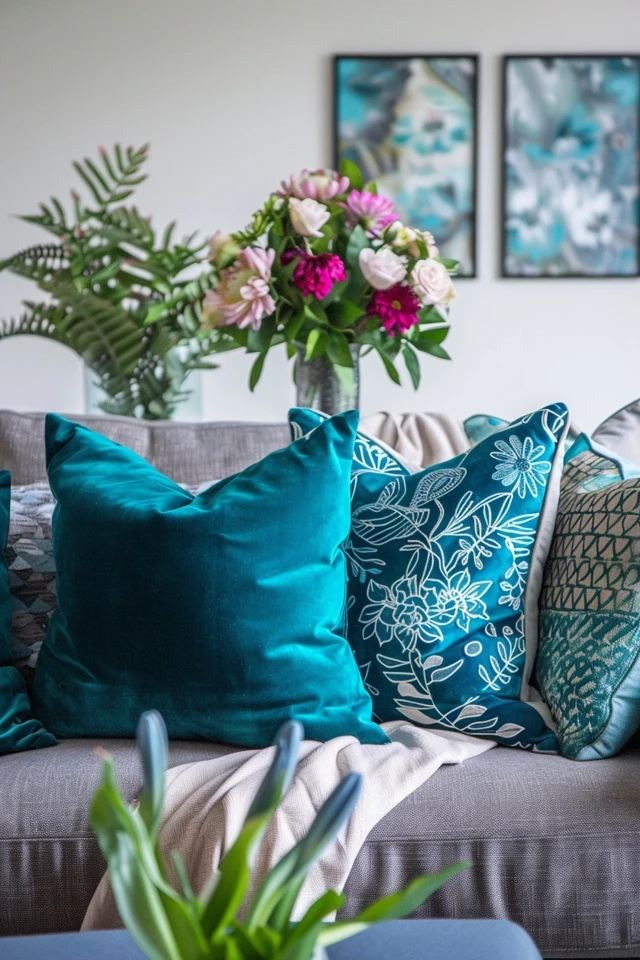
Teal & Grey Living Room Decor Tips & Inspiration
Combining teal and grey in a living room is one of those design choices that feels instantly sophisticated yet surprisingly versatile. I remember walking into a client’s home in Chicago; they had a charcoal grey sectional and felt stuck with a “boring” room. By introducing deep teal velvet drapery and a few strategically placed architectural ceramics, the space went from flat to dynamic in a single afternoon.
The magic of this color pairing lies in its balance. Grey provides the grounding neutral foundation—whether it is a whisper-soft dove grey or a moody slate—while teal brings the emotional depth and energy. However, getting the undertones right is essential, or you risk the room feeling disjointed or uncomfortably cold.
In this guide, I will walk you through the practical steps of building this palette from the ground up, covering everything from paint selection to the final accessory toss. For a huge dose of visual inspiration, don’t miss the curated Picture Gallery at the end of this blog post.
1. The Foundation: Mastering Undertones and Paint Selection
The biggest mistake homeowners make with this palette is assuming all greys are neutral. They aren’t. In the design world, we constantly battle “greige,” blue-greys, and purple-greys. If you pick a cool, blue-based grey paint and pair it with a warm, green-leaning teal sofa, the colors will clash rather than complement.
To get this right, you need to identify the temperature of your teal. Is it a “Peacock Blue” (cool) or a “Lagoon Green” (warm)? If your teal leans blue, stick to cool greys with blue or crisp white undertones. If your teal leans green, a warm stone grey or a “greige” will look significantly better and keep the room from feeling sterile.
Designer’s Note: The “Paint Last” Rule
I never pick the paint color first. Never. There are thousands of paint colors but limited fabric options for sofas and rugs. Always select your main teal or grey upholstery fabric first. Bring that swatch to the paint store. It is infinitely easier to match a paint chip to a sofa than to find a sofa that matches a specific wall color you already painted.
Understanding Light Reflectance Value (LRV)
When choosing your grey paint, look at the LRV number on the back of the swatch. This number runs from 0 (black) to 100 (white).
- For small rooms with low light: Aim for a grey with an LRV of 60 or higher. This reflects light and keeps the teal accents from swallowing the room.
- For moody, dramatic rooms: You can go down to an LRV of 15–25 (charcoal). Just ensure you have adequate artificial lighting.
2. Furniture Selection: Scale, Layout, and Upholstery
In a teal and grey living room, your upholstery is the main event. You generally have two paths: a grey sofa with teal accents, or a bold teal sofa with grey surroundings.
If you choose a teal sofa, treating it as the “hero” piece is vital. Because teal is a visual heavyweight, you need to balance the scale of the room. A large teal sectional needs “breathing room” visually. Keep the surrounding walls lighter (pale grey or off-white) and ensure the rug is light enough to provide contrast between the sofa legs and the floor.
Common Mistake: The “Floating” Furniture
A common issue in DIY design is pushing all furniture against the walls, creating a “dance floor” in the middle.
The Fix: Pull your sofa and armchairs off the walls. Even in a small apartment, giving furniture 3 to 4 inches of breathing room from the wall makes the space look intentional. For conversation areas, the front legs of the sofa and chairs should ideally sit on the rug.
Practical Fabric Choices for Real Life
- Households with Pets: If you have a shedding pet, a dark teal velvet sofa is a magnet for light fur. Conversely, a woven grey tweed hides almost everything. If you love teal but have a Golden Retriever, use teal on vertical surfaces (drapes) or leather ottomans rather than the main seating.
- Durability: Look for “performance velvet” or fabrics with a double-rub count over 30,000. Teal dye can sometimes transfer or fade in direct sunlight, so if your sofa faces a south-facing window, a high-quality UV-resistant fabric is non-negotiable.
3. Warmth and Texture: Avoiding the “Clinical” Look
A danger of the grey/teal combo is that both colors generally read as “cool” on the color wheel. If you stick strictly to these two shades, your living room can end up feeling like a dentist’s waiting room. You must introduce warmth through texture and secondary colors.
Wood tones are your secret weapon here. Walnut is particularly stunning with teal because the orange undertones in the wood sit opposite teal on the color wheel, creating a natural, pleasing vibration. Oak can also work for a “Scandi” look, provided the grey walls are light and airy.
The Rug Strategy
The rug is the anchor. If you have solid grey walls and a solid teal sofa, do not use a solid rug. You need a pattern or a heavy texture to break up the color blocks.
- Size Matters: A common error is buying a 5×8 rug for a standard living room. It’s almost always too small. An 8×10 or 9×12 rug is usually required to anchor a sofa and coffee table properly.
- Placement: Leave 12 to 18 inches of bare floor visible around the perimeter of the room. This “frames” your seating area.
Designer’s Note: Mixing Metals
To warm up a grey and teal room, I almost exclusively use brass or antique gold hardware. Silver or chrome can look slick, but it reinforces the coldness. Gold lighting fixtures, curtain rods, or coffee table legs add a necessary “jewelry” element that creates a high-end feel.
4. Lighting: The Make-or-Break Element
Teal changes drastically depending on lighting conditions. In daylight, it might look Caribbean blue; at night, it might look black. Your lighting plan needs to account for this absorption of light.
The Kelvins Count
Pay attention to the color temperature of your lightbulbs.
- 2700K (Warm White): This casts a yellow glow. It makes grey look muddy or beige and can turn teal slightly green.
- 3000K (Soft White): This is the designer standard. It is crisp enough to keep the grey looking true and the teal looking vibrant, without the harsh blue tint of “Daylight” bulbs.
- 4000K+ (Daylight/Cool): Avoid this in a living room. It will make your space feel like a hospital.
Layering Your Light Sources
Do not rely on a single ceiling fixture. A room with dark colors like teal needs pools of light.
1. Ambient: Your overhead fixture or recessed cans.
2. Task: Floor lamps by reading chairs. Ideally, the bottom of the shade should be at eye level when seated (roughly 40–44 inches from the floor).
3. Accent: Small table lamps or picture lights. If you have dark teal walls, wall sconces are excellent for breaking up the dark expanse.
5. Styling Accessories: The 60-30-10 Rule
Now for the fun part: styling. To keep the room from looking chaotic, adhere to the 60-30-10 rule.
- 60% Main Color: Usually your wall color or largest furniture pieces (e.g., Light Grey).
- 30% Secondary Color: Your main contrast (e.g., Teal upholstery or drapes).
- 10% Accent Color: This is where you inject personality (e.g., Mustard yellow, cognac leather, or brass).
The “Three-Point” Strategy for Teal
Don’t just have one teal thing. The color needs to travel around the room. If you have a teal sofa, add a piece of art with teal in it on the opposite wall, and perhaps a teal vase on a bookshelf. This encourages the eye to move through the space.
Pillow Talk
Please stop buying pillows that come with the sofa. They usually match the sofa fabric exactly, which looks stiff.
What I’d do: On a grey sofa, mix a solid deep teal velvet pillow, a patterned pillow (cream with grey/teal geometric print), and a lumbar pillow in a third texture, like cognac leather or faux fur. This variety creates a curated, “lived-in” luxury.
Final Checklist: Your Project Roadmap
Ready to start? Here is the checklist I would use if I were managing your renovation.
- Step 1: Determine Layout & Measurements. Measure the room. Confirm maximum sofa length (leave 30 inches for walkways).
- Step 2: Select “Hero” Item. Pick the rug or the sofa fabric first. Do not pick paint yet.
- Step 3: Sample Paint. Buy 3 different grey samples. Paint large 12×12 squares on the wall. Watch them change throughout the day.
- Step 4: Check Lighting. Swap out old bulbs for 3000K LEDs to ensure color accuracy.
- Step 5: Order Large Furniture. Allow 8-12 weeks for custom upholstery.
- Step 6: Window Treatments. Mount curtain rods high and wide. A good rule of thumb: mount the rod 4–6 inches above the window frame to make ceilings look taller.
- Step 7: Accessorize. Bring in plants. Greenery is the bridge that connects grey and teal naturally.
FAQs
Is teal and grey just a trend, or is it timeless?
While specific shades of teal trend in and out (like the bright turquoise of the 2010s), deep, muted teal paired with charcoal or dove grey is considered a modern classic. It is historically rooted in mid-century modern design and Art Deco, giving it lasting power.
Can I mix beige into a teal and grey room?
Absolutely. In fact, I encourage it. Bridging grey and beige creates “greige,” which warms up the room. A jute rug (beige) looks fantastic layered under a grey sofa in a room with teal accents. It adds natural texture.
What color curtains work best?
If the walls are grey, I prefer crisp white linen curtains to keep the room fresh. If you want drama, match the curtains to the wall color (grey on grey) to envelope the space. Use teal curtains only if the walls are neutral; otherwise, it can feel too heavy.
How do I make a small living room work with dark teal?
Don’t be afraid of dark colors in small spaces; they blur the corners and can actually make a room feel infinite. However, use mirrors. A large mirror opposite a window reflects light and breaks up the dark wall color.
Conclusion
Designing a teal and grey living room is about more than just picking two colors you like. It is about balancing the visual weight, managing the “temperature” of the room with warm textures, and respecting the lighting conditions of your specific space.
When done correctly, this combination offers the best of both worlds: the calming, clean sanctuary of grey and the creative, spirited energy of teal. Trust your measurements, test your paint, and remember to layer your textures.
Picture Gallery


