
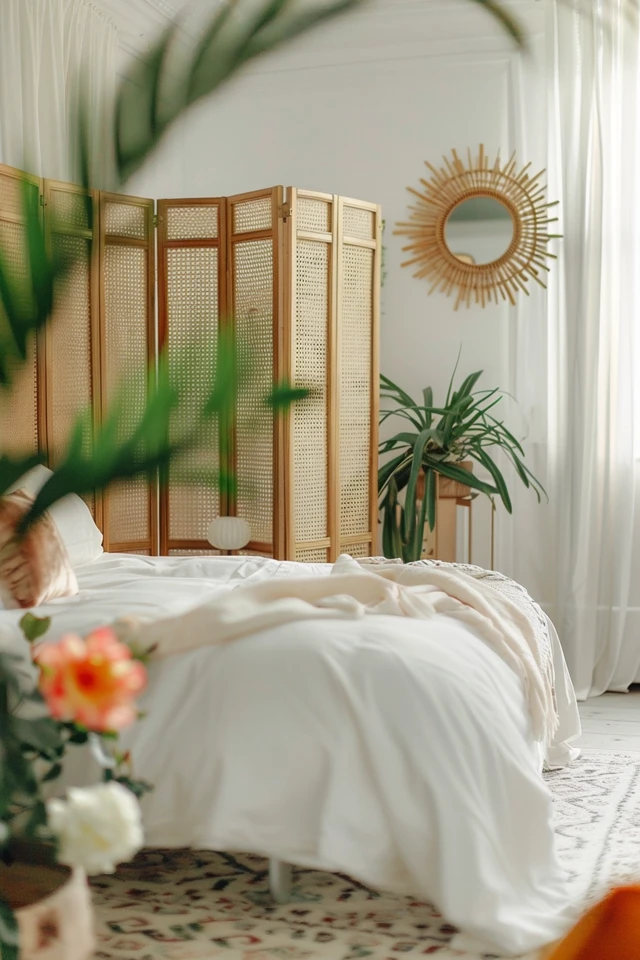
Temporary Door Ideas for Quick Privacy Solutions
Open floor plans and wide archways are visually stunning, but they often fail when you need actual privacy. Whether you are trying to create a quiet home office, separate a nursery, or simply hide a messy laundry room, the lack of a door is a major functional hurdle.
For renters or homeowners not ready for a full renovation, installing a traditional pre-hung door is rarely an option. It requires framing, drywall work, and structural changes that cost thousands of dollars. To help you visualize how these solutions look in real homes, I have curated a comprehensive Picture Gallery at the end of the blog post.
The good news is that temporary door solutions have evolved far beyond flimsy sheets tacked to the wall. With the right hardware and material choices, you can create a barrier that offers visual privacy, sound dampening, and genuine style without permanent construction.
1. Heavyweight Drapery and Portieres
The most accessible and versatile solution for a temporary door is the use of heavyweight textiles. In interior design, we refer to a curtain hung in a doorway as a “portiere.” This is a classic European design element that adds softness while solving the privacy issue.
The success of this method depends entirely on the fabric weight and the fullness of the drape. You cannot simply use a standard window shear. To mimic the feeling of a door, you need a material with high GSM (grams per square meter), such as heavy velvet, wool, or lined linen.
Rules for Curtain Sizing:
- Fullness Ratio: A standard door opening is usually 30 to 36 inches wide. Your curtain panel should be at least 2 times the width of the opening (60 to 72 inches wide). If the fabric is flat when closed, it looks like a sheet; you want deep folds to absorb sound.
- Height: Mount the rod at least 4 to 6 inches above the door frame if possible. This reduces light leaks and makes the ceiling feel higher.
- Floor clearance: For a high-traffic doorway, the fabric should hover exactly 1/2 inch off the floor. Do not let it “puddle” (drag on the floor), as this becomes a tripping hazard and collects dust quickly.
Installation Hardware:
For renters, a heavy-duty tension rod is the standard choice. Look for rods rated for at least 20 pounds to support heavy velvet. If you can drill small holes, a ceiling-mounted track is superior. It allows the fabric to glide smoothly without the friction of rings on a rod, mimicking the sliding action of a real door.
2. Accordion and Folding PVC Doors
Accordion doors often get a bad reputation due to cheap, brittle plastic versions from the 1980s. However, modern vinyl and PVC folding doors have improved significantly in both durability and aesthetics. This is a structural solution that physically latches, providing a higher level of psychological privacy than a curtain.
These doors hang from a single top track, meaning there is no floor track to trip over. When open, they collapse neatly against the door jam. This is known as the “stack back.”
Designer Rules for Installation:
- Measure the Stack Back: A 36-inch accordion door will usually take up about 4 to 5 inches of space inside the door frame when fully open. If your doorway is narrow (under 28 inches), this might make passing through difficult.
- Lubrication: The most common failure point is the glider track. Before hanging the door, apply a silicone-based lubricant to the track. Do not use WD-40, as it attracts dust and gums up the mechanism over time.
- Trimming: Most vinyl accordion doors are sold in a standard 80-inch height. If your opening is shorter, you can trim the bottom with a fine-tooth hacksaw. Always trim from the bottom, never the top where the hardware attaches.
3. Surface-Mounted Sliding Barn Doors
While a traditional pocket door requires tearing open the wall, a barn door kit is a surface-mounted alternative that is surprisingly renter-friendly if you are allowed to patch screw holes. This acts as a piece of movable architecture.
This solution requires a bit more planning regarding wall space. Unlike a hinged door that swings out, a sliding door needs empty wall space next to the opening equal to the width of the door.
The Header Board Rule:
In my projects, I never mount a barn door track directly to the drywall unless the studs line up perfectly with the track holes (which they rarely do).
Instead, install a 1×4 or 1×6 wood “header board” into the studs first. Then, mount the metal track to that board. This distributes the weight and ensures the door doesn’t rip out of the drywall. When you move out, you only have to patch the holes from the header board.
Sizing for Privacy:
A common mistake is buying a barn door that is the exact same width as the opening. This results in “privacy gaps” where you can see into the room from the sides.
- Width: The door slab should be at least 4 inches wider than the opening (2 inches of overlap on each side).
- Height: The door should be tall enough to cover the top trim of the casing completely.
4. Tension-Mounted Shoji Screens
If you need to divide a larger opening, such as an open-concept dining room or a wide archway, standard doors won’t work. Shoji screens (Japanese-style sliding panels) offer a solution that lets light through while obscuring visibility.
Modern variations of these screens often come as “room divider kits” that use floor-to-ceiling tension rods. These vertical posts clamp between the floor and ceiling without screws. The panels then float between these posts.
Why this works for mixed-use spaces:
- Light transmission: The rice paper (or synthetic equivalent) diffuses light. This is critical if the room you are closing off does not have its own window. A solid door would make the space feel like a closet; a Shoji screen makes it feel like a lantern.
- No floor damage: Because these systems rely on tension, they are safe for hardwood floors and carpets.
Styling Consideration:
Shoji screens have a very distinct geometric aesthetic. To blend them into a non-Asian inspired interior, choose frames in neutral finishes like white or natural oak. Avoid black lacquer frames unless you want high contrast, as the grid pattern can become visually overwhelming in small spaces.
5. Swinging Saloon or Cafe Doors
Sometimes you don’t need full audio or visual privacy; you just need a physical barrier to keep pets out or to define a zone. Cafe doors (also called saloon doors) are excellent for kitchens, pantries, or laundry areas.
These operate on gravity hinges, meaning they self-return to the center position after you walk through. They usually cover the middle portion of the doorway, leaving the top and bottom open.
Practical Applications:
- Pet Management: If you install these slightly lower than standard, they effectively stop dogs from entering a room while still allowing cats to slip underneath if desired.
- Airflow: In rooms that require ventilation, like a laundry room with a dryer, a full door can cause overheating. Cafe doors maintain airflow while hiding the view of laundry baskets.
Installation Note:
These require a solid door jamb for mounting. The torque of the swinging motion can pull screws out of weak wood. Use 3-inch screws to reach the framing studs behind the door jamb for a secure hold.
Designer’s Note: The “Ghost Door” Phenomenon
In my years of designing, one specific issue comes up constantly with temporary doors: the “Ghost Door” effect. This happens when a lightweight door or curtain never quite stays closed or open; it drifts.
This is usually caused by air pressure differentials between rooms. If one room is warmer than the other, the air exchange will push a light fabric or unlatched accordion door open.
The Fix:
I always add magnets to the closure points of temporary solutions. For curtains, I sew small weighted magnets into the hems where the panels meet. For accordion doors, I ensure the magnetic striker plate is perfectly aligned. It sounds minor, but having a door that “clicks” shut psychologically reinforces the feeling of privacy.
Common Mistakes + Fixes
Mistake 1: Ignoring the “Light Bleed”
Many people mount curtains inside the door frame (tension rod style). While easy, this leaves a gap at the top and sides where light—and sound—pour through.
Fix: Whenever possible, mount the hardware outside the frame and wider than the opening. This creates a seal against the wall.
Mistake 2: Using Standard 84-Inch Panels
Most retail curtains come in 84-inch lengths. However, most curtain rods need to be mounted higher than the door frame.
Fix: Buy 96-inch curtains and hem them. It is better to have too much fabric than a “high-water” curtain that floats 4 inches off the floor.
Mistake 3: Overloading Tension Rods
People often buy cheap, thin tension rods and load them with heavy velvet. The rod inevitably bows or slides down.
Fix: Look for rods with a diameter of at least 1 inch. Use “center support” hooks (adhesive ones work for renters) if the span is wider than 40 inches.
What I’d Do in a Real Project: A Mini Checklist
If I were walking into your home today to solve this problem, this is the decision tree I would use to select the right product:
- Assess the Header: Is there a solid wall above the door opening?
- Yes: I consider a barn door track or wall-mounted curtain rod.
- No (ceiling height opening): I must use a ceiling track or tension solution.
- Check the Floor: Is it carpet or hard surface?
- Carpet: I avoid floor-rolling screens; they get stuck. I stick to hanging solutions.
- Hard Surface: Rolling screens or accordion doors are viable.
- Determine Acoustic Needs: Is this for visual privacy or sound blocking?
- Sound: I specify heavy velvet curtains with a “bump” (a thick interlining).
- Visual only: I look at linen, macrame, or wood beads for airflow.
- Pet Audit: Do you have cats?
- Yes: I avoid expensive fabrics that can be shredded. I opt for wood, PVC, or metal dividers.
Final Checklist for Installation
Before you purchase any materials, run through this final check to ensure a smooth installation:
- Measure the Width at 3 Points: Door frames often bow. Measure the width at the top, middle, and bottom. Use the narrowest measurement if installing an inside-mount tension rod.
- Check for Studs: Use a magnetic stud finder to locate the framing around the door. This determines where your heavy-duty brackets can go.
- Account for Baseboards: If you are using a barn door or sliding screen, measure the thickness of your baseboards. You may need spacers behind the track so the door doesn’t scrape the trim.
- Verify “Swing” Space: If using a swinging cafe door, ensure it doesn’t hit a hallway console table or light switch when it swings open.
Frequently Asked Questions
Do temporary doors actually block sound?
They dampen sound, but they do not “soundproof.” A solid wood door blocks sound because of its mass and the air seal around the edges. A heavy velvet curtain can muffle high-pitched noises (like dishes clanking) and reduce echo, but you will still hear voices. For maximum sound reduction with a temporary solution, you need multiple layers of dense fabric and a tight seal against the wall.
Can I paint a vinyl accordion door?
Generally, no. The paint will crack as the door folds and flexes. However, some newer models come in “paintable” finishes. If you must change the color, look for a vinyl-specific spray paint, but be aware that it requires perfect surface preparation to adhere.
Are barn doors renter-friendly?
They are “renter-friendly” only if you are handy. You will need to drill significant holes into the studs to mount the track. When you move, you must be prepared to fill those holes with spackle, sand them down, and repaint the wall. If you aren’t comfortable with wall repair, stick to tension-rod curtains.
Conclusion
Lack of privacy doesn’t have to be the price you pay for an open-concept home or a rental apartment. By treating a temporary door as a design feature rather than just a quick fix, you can elevate the look of your room while gaining the separation you need.
Whether you choose the softness of a velvet portiere or the architectural interest of a sliding panel, the key is proper scaling and quality hardware. Measure twice, mount your hardware high, and choose materials that have enough weight to hang straight.
Picture Gallery


