
The Best Perennials for a Low-Maintenance Backyard
Most homeowners dream of a lush, vibrant backyard that looks like it stepped off the pages of a magazine. However, the reality of maintaining that beauty often involves endless hours of weeding, pruning, and coaxing finicky plants to survive another season.
As a designer, I approach a backyard the same way I approach a living room. We want high-impact pieces that offer longevity, structure, and minimal “fuss” once the initial installation is complete. By choosing the right perennials, you can create a self-sustaining landscape that gets better with every passing year.
At-a-Glance: Key Takeaways
- Focus on Hardiness: Choose plants rated for your specific USDA zone to ensure they survive the winter without extra protection.
- Prioritize Texture: Mix fine-textured grasses with broad-leafed perennials like Hostas to create visual depth without needing constant blooms.
- Ground Covers are Essential: Use “living mulch” like creeping thyme or stonecrop to suppress weeds naturally.
- The Power of Three: Always plant in odd numbers and repeating groups to create a cohesive, professionally designed look.
- Drought Tolerance: Select “set it and forget it” varieties that can thrive on natural rainfall once established.
What This Style Means (and Who It’s For)
A low-maintenance perennial backyard is built on the philosophy of “right plant, right place.” This isn’t about having a barren yard; it is about choosing species that are evolutionarily designed to thrive in your local environment with minimal human intervention.
This approach is perfect for busy professionals, families with young children, or retirees who want to enjoy their outdoor space rather than work in it. It is also an ideal strategy for renters who want to improve a property’s curb appeal without committing to a high-maintenance gardening schedule.
In the design world, we call this “Sustainable Luxury.” It’s the idea that your environment should serve you, not the other way around. By investing in perennials—plants that come back year after year—you reduce the annual cost and labor of replanting, making your backyard both economically and ecologically smart.
The Signature Look: Ingredients That Make It Work
To achieve a professional, low-maintenance look, you need a mix of “anchor” plants, “filler” plants, and “spiller” plants. Here are the top performers I recommend for almost any backyard project.
1. Purple Coneflower (Echinacea)
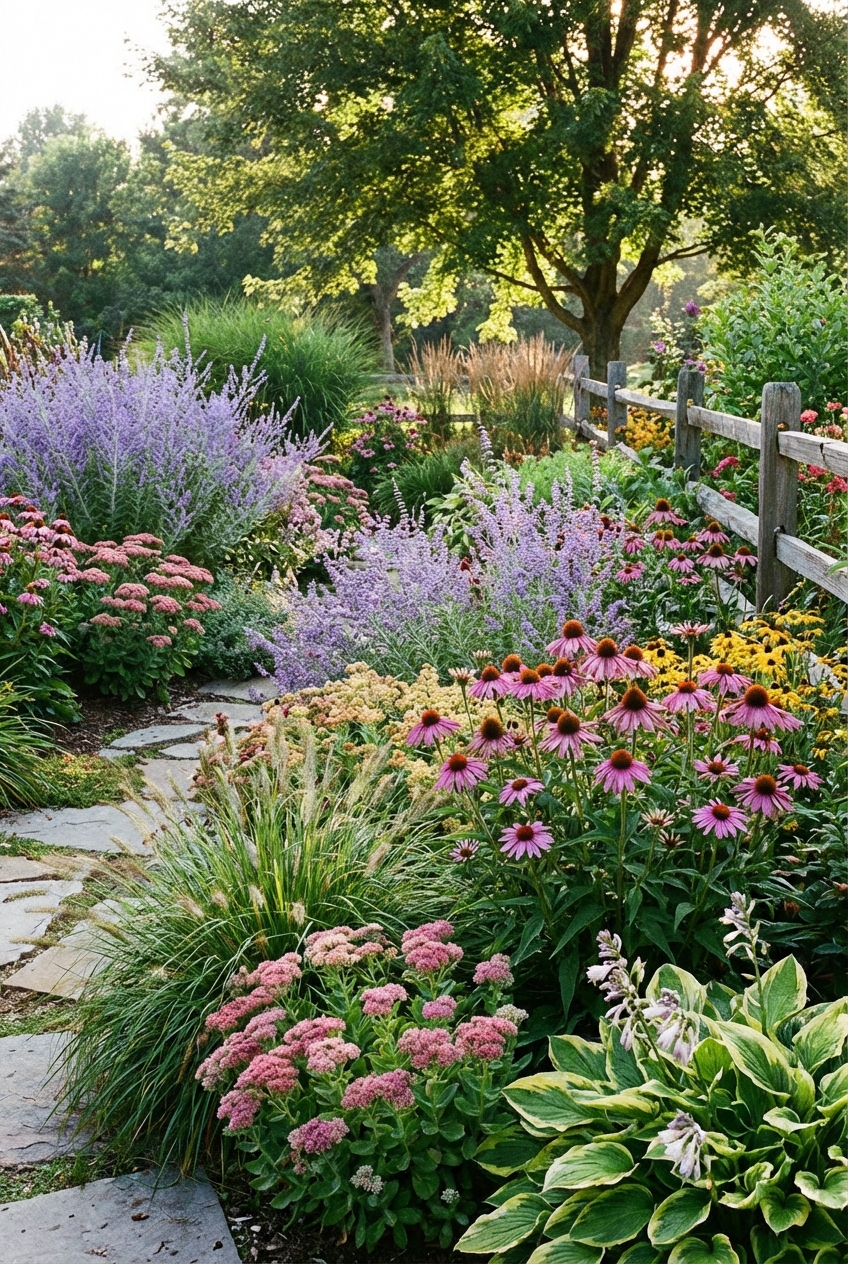
These are the workhorses of the sunny border. They are incredibly drought-tolerant once established and bloom for months. From a design perspective, their architectural cone shape adds a modern, structured element to the garden. They also attract pollinators, bringing life and movement to the space.
2. Hosta (Various Species)
For shaded areas, Hostas are the gold standard. They come in colors ranging from deep blue-green to bright chartreuse. Because they have such large, broad leaves, they act as a natural weed barrier by shading the ground beneath them. I suggest using the “Sum and Substance” variety for a massive, dramatic focal point.
3. Russian Sage (Perovskia atriplicifolia)
If you want the look of lavender but live in an area with tough soil, Russian sage is your best friend. It creates a hazy, silvery-blue cloud of foliage that smells wonderful and requires almost zero water. It reaches about 3 to 4 feet in height, making it an excellent mid-border plant.
4. Stonecrop (Sedum ‘Autumn Joy’)
This is a plant that truly changes with the seasons. In spring and summer, it provides succulent green foliage. In late summer, it produces broccoli-like flower heads that turn from pink to a deep rusty red in the fall. It is virtually indestructible and thrives in poor soil.
5. Ornamental Grasses (Karl Foerster Feather Reed Grass)
Grasses provide the “movement” in a garden. The Karl Foerster variety is particularly useful because it grows vertically and doesn’t flop over. It provides winter interest even when the rest of the garden is dormant, maintaining its golden stalks through the snow.
6. Daylilies (Hemerocallis)
Commonly referred to as “the perfect perennial,” daylilies can survive neglect, poor soil, and varying light conditions. For the lowest maintenance, choose “reblooming” varieties like Stella d’Oro, which will provide color from late spring through the first frost.
Layout & Proportions (Designer Rules of Thumb)
When designing a bed, I follow the “Stadium Seating” rule. This ensures every plant is visible and creates a sense of depth that makes a small backyard feel much larger.
The Layering Heights:
The back layer (against a fence or house) should feature plants that reach 3 to 5 feet. The middle layer should be 1.5 to 2.5 feet, and the front layer (the border) should be 6 to 12 inches tall. This prevents the taller plants from “shading out” the smaller ones.
Spacing Requirements:
One of the biggest mistakes people make is planting too close together. While you want the garden to look full, plants need airflow to prevent disease.
- Small perennials (Heuchera, Sedum): Space 12 inches apart.
- Medium perennials (Coneflower, Salvia): Space 18–24 inches apart.
- Large perennials/Grasses (Russian Sage, Miscanthus): Space 36 inches apart.
The 60/40 Rule:
In a low-maintenance design, aim for 60% foliage plants and 40% flowering plants. Flowering plants often require more cleanup (deadheading). Foliage-heavy plants, like Hostas or Ferns, look beautiful for 100% of the growing season with almost no effort.
Designer’s Note:
In a recent project, a client wanted a “wildflower look” but didn’t want the mess. I solved this by using “mass planting.” Instead of buying 10 different types of plants, we bought 10 of the same plant. Repeating the same texture across a 10-foot span looks intentional and high-end, whereas a mix of single plants often looks like a collection of weeds.
Step-by-Step: How to Recreate This Look
Step 1: Define Your Zones
Map out where the sun hits your yard. “Full Sun” means 6+ hours of direct sunlight. “Part Shade” is 3–6 hours. “Full Shade” is less than 3 hours. Do not try to fight the light; if a spot is shady, don’t try to force a sun-loving rose to grow there.
Step 2: Prepare the Soil Once (and Only Once)
The secret to low maintenance is healthy soil. Before planting, mix 2–3 inches of high-quality compost into your existing dirt. This provides the nutrients the perennials need to establish deep root systems, which eventually makes them drought-resistant.
Step 3: Lay Out the Pots
Before you dig a single hole, place your plants (still in their plastic nursery pots) in the garden bed. Step back and look at them from your patio or through your kitchen window. Adjust the spacing until the arrangement looks balanced.
Step 4: The Proper Planting Technique
Dig a hole twice as wide as the pot but no deeper. When you place the plant in the hole, the top of the root ball should be level with the surrounding soil. If you plant it too deep, the crown will rot; too shallow, and the roots will dry out.
Step 5: The “Two-Inch” Mulch Rule
Immediately after planting and watering, apply 2 inches of hardwood mulch or pine bark. This is the single most important step for a low-maintenance yard. Mulch suppresses 90% of weed seeds and keeps the soil moist so you don’t have to water as often.
Budget Breakdown: Low / Mid / Splurge
Low Budget ($200 – $500)
Focus on “bare root” plants or small 4-inch starter pots. They take a year or two longer to reach full size, but they are significantly cheaper. Focus your money on one or two “statement” plants, like a large Peony or a decorative Grass, and fill the rest with affordable ground covers like Ajuga or Creeping Phlox.
Mid-Range ($1,000 – $2,500)
Purchase 1-gallon sized containers. This gives you an “instant” garden look. You can afford to install a simple drip irrigation system with a timer, which completely removes the task of watering from your schedule. You can also incorporate higher-end mulch, like cedar, which lasts longer and smells better.
Splurge ($5,000+)
At this level, you are buying 3-gallon to 5-gallon specimens for immediate maturity. This budget allows for professional soil grading, the installation of “hardscape” elements like boulders or a flagstone path to complement the perennials, and perhaps a professional lighting system to showcase the textures of the plants at night.
Common Mistakes (and How to Fix Them)
Mistake: Over-watering established plants.
Fix: Once perennials have been in the ground for a full season, they don’t need daily water. Check the soil 2 inches down; if it’s dry, water deeply at the base. Over-watering leads to shallow roots and weak plants.
Mistake: Forgetting about winter interest.
Fix: Many people cut everything down to the ground in October. Instead, leave grasses and seed heads (like Coneflower) standing. They provide food for birds and look beautiful covered in frost. Cut them back in early March before new growth starts.
Mistake: Fighting the local wildlife.
Fix: If you have deer, do not plant Hosta or Lilies. They are basically “deer candy.” Instead, pivot to deer-resistant perennials like Ferns, Bleeding Hearts, or Nepeta (Catmint). A low-maintenance garden shouldn’t require you to spray chemicals or build cages around your plants.
Mistake: Using “weed fabric.”
Fix: Landscape fabric actually makes maintenance harder over time. Soil builds up on top of the fabric, weeds grow into the fabric, and it becomes impossible to pull them. Use a thick layer of organic mulch instead, which improves the soil as it breaks down.
Room-by-Room Variations (Outdoor Zones)
In design, we treat different parts of the backyard like different rooms in a house. Here is how to apply the perennial strategy to each zone.
The “Entryway” (Side Path or Gate)
This is a high-traffic area where you want something fragrant and narrow. Use Lavender or Walker’s Low Catmint. These plants stay compact and release a pleasant scent whenever someone brushes past them. They don’t require pruning to keep their shape.
The “Lounge” (Patio Perimeter)
This area should feel lush but shouldn’t attract stinging insects right next to your seating. Avoid heavy bloomers directly against the patio. Instead, use textural plants like Japanese Forest Grass or Hostas. These provide a cool, calming green backdrop for your outdoor furniture.
The “Privacy Screen” (Fence Line)
Instead of a high-maintenance hedge that requires shearing, use tall perennials. Joe Pye Weed or Hibiscus ‘Lord Baltimore’ can grow 5 to 7 feet tall in a single season. They provide a “living wall” during the summer months and disappear in the winter when you aren’t spending as much time outside.
The “Forgotten Corner” (Far Back Corner)
Every yard has that one spot that is hard to reach with a hose. This is where you plant the “tough as nails” perennials like Yarrow or Blanket Flower (Gaillardia). These plants thrive on neglect and will fill in empty spaces quickly, preventing weeds from taking over the back of your property.
Finish & Styling Checklist
To give your low-maintenance garden that professional “interior designer” finish, follow this mini-checklist once the plants are in the ground.
- Define the Edges: Use a spade to cut a clean, 3-inch deep “V” trench between your lawn and your garden bed. A crisp edge makes even a wild garden look manicured.
- Incorporate Stone: Add three large “character boulders” in varying sizes. Bury them about 1/3 of the way into the ground so they look like they’ve always been there.
- Add Height with Decor: A simple birdbath or a weathered wooden obelisk provides a vertical focal point that doesn’t require watering.
- Check the Sightlines: Sit in your favorite backyard chair. If a plant is blocking your view of the rest of the yard, move it now while it’s still small.
- Lighting: Place small solar or low-voltage uplights beneath your ornamental grasses. The way the light filters through the blades at night is incredibly high-end.
FAQs
Do I need to fertilize my perennials every year?
In a low-maintenance system, you shouldn’t have to. If you add a fresh inch of compost or organic mulch every spring, the natural decomposition process provides all the nutrients most perennials need. Chemical fertilizers often cause “leggy” growth that requires more pruning.
How long do perennials actually live?
It varies. Some, like Peonies, can live for 50 years or more. Others, like Gaillardia or Coreopsis, are “short-lived perennials” that might only last 3 to 5 years. For the lowest maintenance, choose long-lived varieties like Daylilies, Hostas, and Siberian Iris.
When is the best time to plant?
Early spring or early fall are the best times. Planting in the heat of mid-summer is stressful for the plants and requires you to water them twice a day to keep them from wilting, which defeats the purpose of a low-maintenance garden.
What is “deadheading” and do I have to do it?
Deadheading is the process of cutting off faded blooms. It encourages some plants to grow more flowers. However, if you want low maintenance, choose “self-cleaning” plants or varieties like Sedum where the dried flower heads look attractive even after they die.
How do I stop weeds from coming back?
The best way is to leave no bare soil. Plant your perennials close enough that their leaves touch when they are full-grown. A “closed canopy” in your garden bed acts just like a forest floor, making it nearly impossible for weed seeds to get the sunlight they need to germinate.
Conclusion
Creating a low-maintenance backyard isn’t about doing less; it’s about doing the right things at the beginning so you can do less later. By treating your landscape design with the same intentionality as your interior floor plan, you create a space that is functional, beautiful, and sustainable.
Start with a few reliable species like Hostas or Coneflowers, focus on healthy soil, and don’t be afraid to use mulch as your primary defensive tool. Over time, these perennials will weave together into a tapestry that requires little more than a quick spring cleanup and an occasional deep soak. Your backyard should be a sanctuary for relaxation, not a second job. With the right perennials, you can finally reclaim your weekends.


