
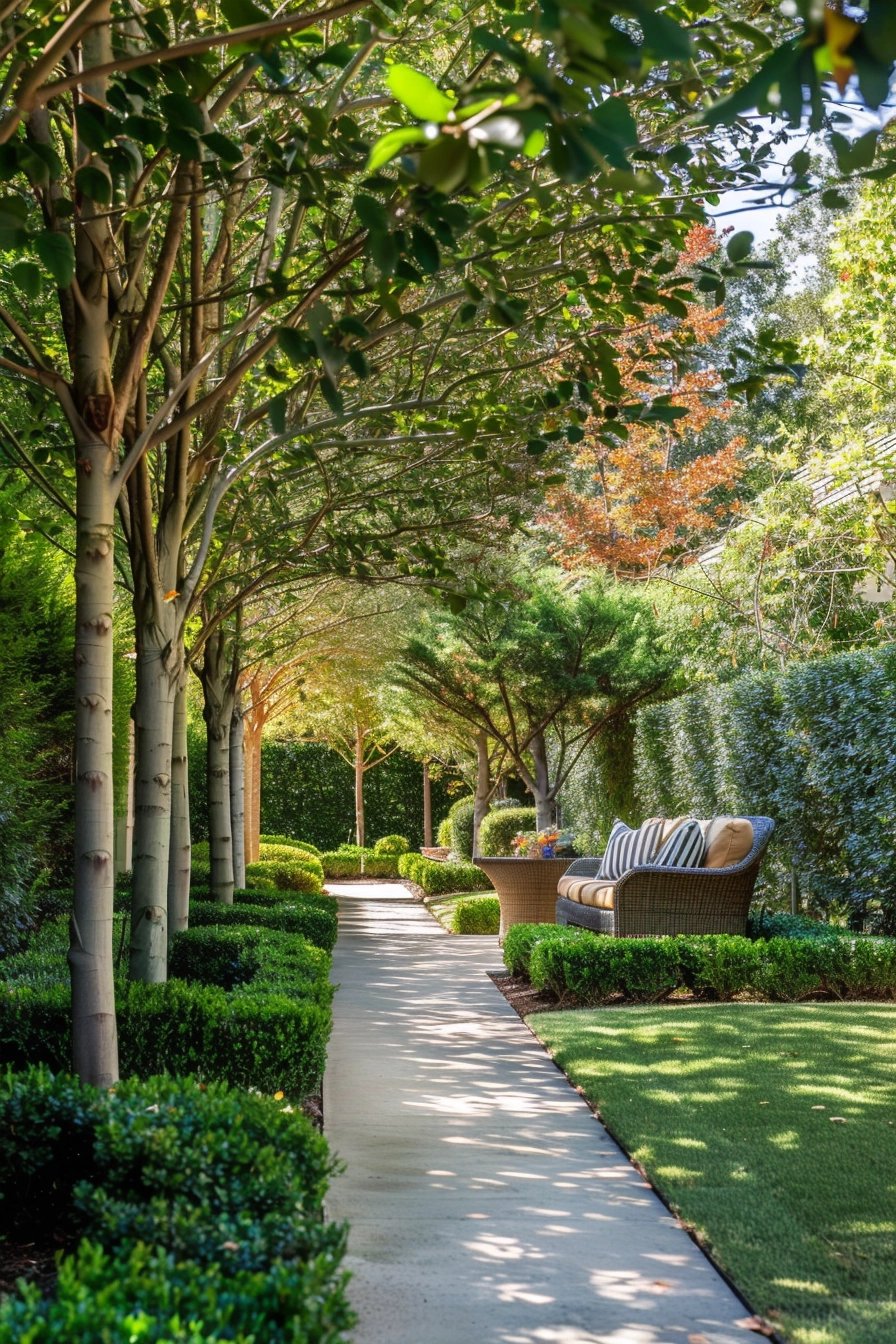
The Best Trees for Adding Privacy and Beauty to Your Backyard
There is nothing quite like the feeling of enjoying a morning coffee on your patio, only to look up and make direct eye contact with a neighbor through a window. While we all love good neighbors, we also love the sanctuary of our own homes. Creating a sense of seclusion in a backyard is one of the most common requests I receive as a designer. It transforms a simple patch of grass into a true outdoor living room.
The solution isn’t always a stark, six-foot wooden fence. In fact, using trees for privacy often provides a much more effective and visually pleasing sound and sight barrier. Trees offer height that fences cannot legally reach, they soften the hard lines of architecture, and they change with the seasons. If you are looking for visual inspiration, scroll down to the bottom of this page to see the Picture Gallery with stunning examples of privacy landscaping.
Selecting the right tree is not just about picking something green and hoping it grows fast. It requires understanding the specific “micro-climate” of your yard, the mature scale of the tree, and how much maintenance you are willing to commit to. In this guide, I will walk you through the specific trees I specify for client projects and the design principles we use to place them.
1. Analyzing Your Space Before You Buy
Before you head to the nursery, you need to conduct a site analysis. In the design world, we call this establishing the “view corridor.” You need to identify exactly what you are trying to block. Is it a second-story window next door, a busy street at ground level, or an unsightly utility pole?
I always recommend the “ladder test” to my clients. Place a ladder or step stool where your patio furniture sits. Sit at the height you normally would, and look around. This tells you exactly how high your screening needs to start and stop. Often, you don’t need a tree that blocks the view from the ground up; you might need a standard tree with a canopy that starts at six feet to block a high window while leaving the ground level open.
You also must know your USDA Hardiness Zone and sunlight availability. “Full sun” generally means at least six hours of direct light. If you have a shady yard, planting a sun-loving Juniper will result in a thin, brown, struggling tree that offers zero privacy. Finally, check for overhead power lines and underground utilities. Call 811 before you dig; it is a non-negotiable step in any landscape project.
Designer’s Note: The “Cone of Vision”
A common mistake is trying to wall off the entire property line. This can make your yard feel like a prison yard. Instead, focus on the “cone of vision.” Block the specific angles that bother you most. This saves money and allows your yard to “borrow scenery” (trees or sky) from the surrounding area, making your space feel larger.
2. The Heavy Lifters: Best Evergreen Trees for Full Screening
When most people think of privacy, they think of evergreens. These are the workhorses of landscape design because they keep their foliage year-round. If you need to block a view 365 days a year, this is your category.
Thuja ‘Green Giant’ (Arborvitae)
This is arguably the most popular privacy tree in the US for a reason. It is incredibly fast-growing, capable of shooting up 3 to 5 feet per year once established. It is disease-resistant and generally deer-resistant (though a hungry deer will eat almost anything).
Spacing: Plant them 5 to 6 feet apart for a dense hedge, or 10 to 12 feet apart for individual specimens.
Mature Size: They can reach 40 to 60 feet tall and 12 to 18 feet wide. Do not plant these in a tiny townhouse backyard; they will swallow the space.
‘Emerald Green’ Arborvitae
For smaller suburban yards where space is tight, the ‘Emerald Green’ is the superior choice. It grows in a narrow pyramidal shape and rarely exceeds 4 feet in width. It grows slower than the Green Giant (about 1 foot per year), but its compact habit means you rarely have to prune it.
Spacing: Plant 2 to 3 feet apart for a tight screen.
Designer Tip: These trees hate dry feet. If you plant them, you must commit to regular watering or a drip irrigation line for the first two years.
Nellie R. Stevens Holly
If you want a tree that doubles as security, this is it. The leaves are prickly, making it an excellent barrier against intruders. It grows rapidly (2 to 3 feet per year) and produces beautiful red berries in the winter. Unlike the Arborvitae, the Holly can handle a bit more shade and is incredibly durable against heat.
Common Mistakes + Fixes:
Mistake: Planting evergreens in a straight soldier row.
Fix: If a disease hits one tree in a straight line, it spreads to the neighbors, and eventually, one dies, leaving a gap like a missing tooth. I prefer to plant in staggered clusters or a zigzag pattern. This looks more natural and provides better sound absorption.
3. Deciduous Options for Seasonal Beauty and Light
Not every privacy concern requires a solid green wall. Sometimes you want “filtered privacy”—a screen that blurs the view without blocking all the light. Deciduous trees (those that lose leaves in winter) often offer better aesthetics, flowers, and fall color.
Crape Myrtle (Multi-Stem Varieties)
In warmer zones (Zone 7 and up), the Crape Myrtle is a structural masterpiece. When you choose a multi-stem variety, the trunks fan out to create a sculptural screen. While they lose leaves in winter, the density of the branches still provides significant visual disruption.
Why I use them: They offer summer flowers for months. They are perfect for blocking second-story windows while leaving the ground level open for planting beds.
Sizing: Look for varieties like ‘Natchez’ (white flowers, tall) or ‘Muskogee’ (lavender flowers). Expect heights of 20+ feet.
Flowering Dogwood or Kousa Dogwood
For a woodland feel, Dogwoods are unbeatable. They offer privacy through their wide, spreading canopy rather than vertical height alone. The Kousa variety is particularly disease-resistant and blooms later in the spring. Their branching structure is horizontal, which is excellent for screening a neighbor’s deck that sits higher than yours.
Ornamental Grasses (The Tree Alternative)
While not technically trees, large ornamental grasses like Giant Miscanthus can reach 10 to 12 feet in a single season. They are perfect for renters or those on a budget because they grow to full size in months, not years. They provide auditory privacy as well; the rustling sound of grass masks traffic noise effectively.
4. Solutions for Small Spaces and Patios
If you are in an urban environment, a townhouse, or have a small lot, planting a massive Oak or a Green Giant is a recipe for disaster. You need verticality without the width. This is where columnar trees shine.
Sky Pencil Holly
As the name suggests, this tree grows straight up like a pencil. It can reach 8 to 10 feet tall but stay under 2 feet wide. It is perfect for flanking a gate or lining a narrow side yard where you need to block a neighbor’s kitchen window just a few feet away.
Clumping Bamboo (Fargesia species)
I must emphasize the word clumping. Never, under any circumstances, plant “running” bamboo in the ground unless you want to be sued by your neighbors. Running bamboo is invasive and destructive. Clumping bamboo, however, expands slowly like a shrub.
Bamboo offers the fastest screening possible. It creates an airy, Zen-like aesthetic and provides lovely movement in the wind. It is evergreen in many climates and works exceptionally well in large planters.
What I’d do in a real project:
For a modern patio with a close neighbor, I often use rectangular corten steel planters (at least 24 inches wide and deep). I plant clumping bamboo or horsetail reed in them. This raises the height of the screen immediately and keeps the roots contained.
5. Strategic Layout and Planting Techniques
Designing for privacy is about geometry. The biggest error homeowners make is placing the tree right up against the fence. This is inefficient and bad for the tree.
The Principle of Triangulation
If you want to block a view, placing the tree closer to the viewer (you) effectively blocks more of the background than placing it near the fence. Think of it like holding your thumb up to your eye; your thumb can block out the moon. If you move your thumb away, it blocks less.
Bring the trees into the yard. Create a planting bed that curves out 10 to 15 feet from the fence line. Plant your larger screening trees in the wide part of the curve. This creates depth and makes the yard feel like a designed landscape rather than a box.
Layering for Sound and Depth
A single row of trees is flat. To create a lush, high-end look, use the “Landscape Triad” rule:
- Back Layer: Your tall screening trees (e.g., Green Giants).
- Middle Layer: Flowering shrubs or hydrangeas planted in the gaps between the trees.
- Front Layer: Perennials, grasses, or ground cover.
This layering absorbs more sound than a flat wall and ensures that if the bottom branches of your big trees thin out over time (which often happens), you have shrubs in front to hide the “bare legs.”
Final Checklist: From Nursery to Backyard
Before you commit to a purchase, run through this designer’s checklist to ensure long-term success:
- Utility Check: Have I called 811 to mark underground gas, electric, and water lines?
- HOA Rules: Have I checked my Homeowner’s Association guidelines regarding tree heights and species?
- Water Access: Can my hose reach the planting site comfortably? New trees need 15-20 gallons of water a week.
- Spacing Math: Have I calculated the mature width of the tree? (Take the mature width, divide by two, and plant that distance away from the fence/house).
- Drainage Test: Dig a hole and fill it with water. If it hasn’t drained in 12 hours, you have drainage issues that will rot tree roots. You may need to build a berm (mound) to plant on.
- Transport: Do I have a way to get a 6-foot tree home? Professional delivery is often worth the cost to protect the tree’s leader branch.
FAQs
How far from a fence should I plant privacy trees?
A general rule of thumb is to plant the tree half of its mature width away from the fence. For a tree that grows 10 feet wide, plant the trunk 5 feet from the fence. For narrow columnar trees, 2.5 to 3 feet is usually sufficient.
What is the fastest-growing tree for privacy?
The Thuja Green Giant and the Hybrid Willow are among the fastest, often growing 3 to 5 feet a year. However, be careful with Willows; they have weak wood and aggressive roots that can damage pipes. Green Giants are the safer “fast” choice.
Can I plant trees in the fall?
Yes, fall is actually the best time to plant trees in many regions. The air is cooler, which reduces stress on the foliage, but the soil is still warm, allowing roots to establish before winter freezes. Spring is the second-best option.
How do I stop deer from eating my new trees?
Physical barriers are the only 100% effective method. Use deer netting or wire cages around young trees. “Deer-resistant” sprays work, but you must reapply them after every rain, and deer will eventually get used to the taste if they are starving.
Conclusion
Adding trees to your backyard is an investment in both your property value and your peace of mind. While a fence is a static structure that degrades over time, a well-chosen tree is a dynamic asset that grows more beautiful and effective with every passing season. It softens the edges of your world, muffles the noise of the street, and turns a standard lot into a private retreat.
Remember that patience is a component of landscape design. The old adage for trees is: “The first year they sleep, the second year they creep, and the third year they leap.” By choosing the right species for your climate and giving them the proper spacing and care, you are setting the stage for decades of privacy and natural beauty.
Picture Gallery


