
Transform Your Split Foyer Entryway Today!
The split foyer is one of the most polarizing architectural features in American housing. If you own one, you know the struggle of the “landing strip” panic when guests arrive. You open the door, and immediately everyone is crowded onto a small platform, forced to decide whether to shuffle upstairs or downstairs.
It presents a unique set of design challenges that standard hallways do not. You are dealing with double-height ceilings, a lack of defined closet space, and stairs that dominate the visual landscape. However, with the right space planning and design tricks, this awkward transition zone can become the most dramatic part of your home.
For plenty of visual inspiration, don’t miss the curated Picture Gallery at the end of this blog post.
1. Conquering the Landing: Space Planning for Tight Zones
The immediate landing area in a split foyer is usually about 4 to 6 feet deep. This creates a bottleneck. The first rule of thumb here is to prioritize flow over furniture volume. You generally need a minimum of 36 inches of clearance for comfortable walking paths.
In a split foyer, I recommend avoiding standard-depth console tables, which are typically 14 to 18 inches deep. Instead, look for “ultra-slim” consoles or shoe cabinets that are 10 to 12 inches deep. These provide a surface for keys and mail without encroaching on your physical movement.
If your landing is truly tiny, skip floor furniture entirely. Use a floating shelf mounted at waist height (roughly 32 to 36 inches off the floor). This gives you the functionality of a table but keeps the floor space visually and physically open, making the landing feel wider.
Designer’s Note: The “Door Swing” Rule
One lesson I learned the hard way involved a beautiful, thick wool rug and a low-clearance front door. Always measure the clearance between the bottom of your door and the floor.
If you have less than an inch, you cannot use a plush rug. The door will get stuck every time you open it. In these cases, use a flat-weave rug or an indoor-outdoor mat that is 0.25 inches thick. Nothing kills the vibe of an entryway faster than wrestling with the door.
Common Mistakes + Fixes
- Mistake: Placing a coat rack on the landing floor.
- Fix: This eats up valuable square footage. Use wall-mounted hooks behind the door or install a peg rail that runs the length of the landing wall.
- Mistake: Ignoring the flooring direction.
- Fix: If you are installing wood or tile, lay the planks or pattern horizontally (side to side) rather than vertically (front to back). This optical illusion makes the narrow landing appear wider.
2. Lighting Strategies for Vertical Drama
One advantage of the split foyer is the vertical space. You often have a ceiling that soars to the height of the second floor. This is your opportunity to hang a statement fixture that would overwhelm a standard room.
However, scale is critical. A small flush mount will look lost in that cavernous space. I use a simple formula: add the length and width of the entry area in feet. The sum, in inches, is the approximate diameter for your chandelier. For example, an 8×6 entry needs a fixture around 14 inches wide, but because of the vertical height, you can afford to go up to 20 or 24 inches for impact.
Layering your light is also essential. The overhead fixture provides ambient light, but it often casts shadows on the stairs. Add sconces along the stairwell walls if you are doing a renovation. If you are renting or not rewiring, use battery-operated picture lights over artwork on the stair walls to introduce a secondary light source.
Proper Hanging Heights
Many homeowners hang their foyer light too high. In a split foyer, the fixture should generally be centered in the window above the door if one exists.
From the floor of the landing, the bottom of the fixture should be no lower than 7 feet to ensure clearance for tall guests. If the fixture hangs over the stairwell void rather than the landing, you can drop it lower to be eye-level with someone standing on the top floor.
What I’d Do in a Real Project
- Bulb Temperature: I always use 2700K or 3000K LED bulbs. Anything higher (4000K+) looks like a hospital waiting room.
- Dimmers: A dimmer switch is non-negotiable here. You want bright light for cleaning, but a soft glow for evening ambiance.
- Window Privacy: If you have that classic semi-circle window above the door, I apply a frosted film rather than trying to find custom drapery. It lets light in but hides the dust.
3. Staircase and Railing Makeovers
The stairs are the elephant in the room. In a split foyer, you see two flights immediately. If they are covered in builder-grade beige carpet, the whole house feels dated.
Upgrading the railing is the highest-ROI change you can make. Replacing heavy, orange-oak spindles with simple iron balusters or squared-off painted wood instantly modernizes the space. For a contemporary look, horizontal cable railings open up the sightlines, making the small entry feel massive.
If replacing the treads isn’t in the budget, install a stair runner. This is practical for two reasons: safety and acoustics. Wood stairs are slippery and loud. A runner creates friction and absorbs the “thundering herd” noise of kids running up and down.
Runner Rules of Thumb
When sizing a runner, the standard reveal (the amount of wood showing on either side) is 3 to 4 inches. If your stairs are 36 inches wide, look for a 28 to 30-inch runner.
For material, I strongly advise against 100% cotton or viscose. They cannot handle the heavy foot traffic of an entryway. Stick to wool, nylon, or a high-quality polypropylene. These materials are durable and easy to clean.
Installation Styles
- Waterfall: The carpet flows over the nose of the tread and straight down to the next tread. It is casual and requires less carpet.
- Hollywood (Upholstered): The carpet is tacked tightly under the nose of the tread. This looks tailored and crisp, but it costs more in labor and material.
4. Wall Treatments to Unify the Space
Because the walls in a split foyer span two floors, they can feel like massive, empty slabs of drywall. You need to break up this visual weight without making the space feel cluttered.
Wainscoting or board and batten is my go-to solution. I like to install this on the lower portion of the walls, following the angle of the stairs. It protects the walls from scuffs—common in narrow entries—and adds architectural interest.
Paint the wainscoting a durable semi-gloss white or a moody dark color, and leave the upper walls a lighter neutral. This grounds the space.
Wallpaper: The “Jewel Box” Effect
Since the entryway is a pass-through space, you can afford to be bold. I love using wallpaper on the upper half of a split foyer. It turns the awkward tall walls into an art feature.
However, consider the sightlines. Whatever pattern you choose will be visible from the living room upstairs and potentially the family room downstairs. Ensure the color palette coordinates with both adjacent rooms.
Mirror Placement
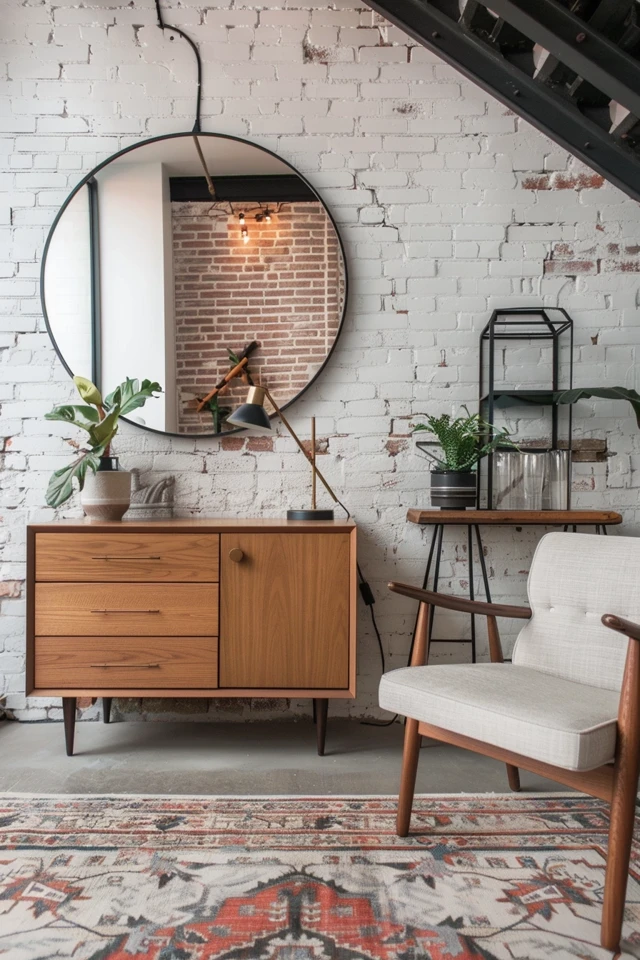
A large mirror is mandatory in a split foyer. It allows you to check your appearance before leaving, but more importantly, it bounces light.
Place a large scale mirror on the wall directly facing the door if possible. If that view is just the stairs, place it on the side wall of the landing. Avoid small mirrors; go for something at least 30 inches wide or tall to act as a “virtual window.”
5. Storage Solutions for the “Closet-Less” Entry
The biggest complaint with split foyers is the lack of a coat closet. You are often left holding your jacket with nowhere to put it. You have to get creative with freestanding or built-in solutions.
If you have a bit of wall space on the landing, use a tip-out shoe cabinet. These are lifesavers. They hide the clutter of shoes that usually pile up on the rug. The top surface serves as your console table.
For coats, look for a “hall tree” bench that fits a narrow depth. However, be careful with visual clutter. Open hooks can look messy very quickly.
The “Downstairs” Drop Zone
Often, the best solution is to accept that the landing is for guests, and the real storage needs to happen at the bottom of the stairs.
I frequently design a “mudroom” area at the foot of the lower stairs. This is where the family drops backpacks, heavy coats, and muddy boots. It keeps the upper landing pristine for guests. You can use the space under the stairs for a custom pull-out drawer or a built-in cubby system.
Designer’s Note: Durability Matters
In these high-traffic zones, paint finish is key. Never use flat or matte paint on split foyer walls. Use an eggshell or satin finish. You need to be able to wipe away fingerprints and suitcase scuffs with a magic eraser without ruining the paint job.
Final Checklist: The Split Foyer Revival Plan
Ready to start? Here is the sequence I follow to keep the project on track and within budget.
- Measure Everything: Get the dimensions of the landing floor, the ceiling height, and the width of the stairs.
- Check Door Clearance: Open the front door and measure the gap between the door bottom and the floor. This dictates your rug choice.
- Select Lighting: Order your chandelier early. Aim for a diameter of 18-24 inches for most split foyers.
- Address the Railing: Decide if you are painting the existing oak (cheapest) or replacing balusters (moderate).
- Plan the Walls: If doing wainscoting, mark the lines with painter’s tape to visualize the height.
- Flooring: If replacing flooring, run planks horizontally to widen the look.
- Shop for “Slim”: Purchase a console table or shoe cabinet that is under 12 inches deep.
Frequently Asked Questions
Should I paint the inside of my front door?
Absolutely. Painting the interior of the door a dark color (like charcoal, navy, or black) frames the view and hides fingerprints around the handle. It creates an instant focal point.
How do I handle the window above the door?
Do not try to hang curtains there; they collect dust and are impossible to operate. Leave it bare if privacy isn’t an issue, or use a static-cling frosted film. This looks like etched glass and costs very little.
Can I mix metal finishes in the entryway?
Yes. In fact, you should. If your door handle is oil-rubbed bronze, your light fixture can be brass or matte black. Just try to repeat each finish at least once (e.g., the mirror frame matches the light fixture).
What is the best rug material for a wet climate?
If you live in a snowy or rainy area, skip the wool rug on the immediate landing. Use a high-quality polypropylene indoor/outdoor rug. They are soft enough for socks but can be scrubbed with bleach and water if needed.
Conclusion
Transforming a split foyer is about embracing the quirks of the architecture rather than fighting them. You have height, drama, and a distinct separation of zones that other homes lack.
By focusing on scale, durable materials, and smart traffic flow, you can turn that awkward “landing strip” into a grand entrance. It does not require moving walls or changing rooflines—just a thoughtful application of lighting, paint, and proportion.
Start with the lighting and the rug. These two elements alone can change the entire atmosphere of the space. Then, tackle the railing and storage as your budget allows. Your split foyer has potential; it just needs a little direction.
Picture Gallery


