Transforming Tiny Spaces: Massage Room Ideas
Discover clever small space massage room ideas that maximize comfort and relaxation in a cozy, efficient setup for your tranquil haven.
Introduction
Creating a sanctuary within your home often feels like a luxury reserved for expansive estates with spare wings. However, some of the most tranquil and effective massage rooms I have designed were carved out of surprisingly small footprints. A converted walk-in closet, a partitioned corner of a home office, or even an enclosed sunporch can become a dedicated retreat if you prioritize function and atmosphere over square footage.
The challenge with small spaces is that every inch counts, and there is nowhere to hide clutter. In a massage room, visual noise equals mental noise. To help you visualize the potential of your own compact space, I have curated a stunning Picture Gallery at the end of this blog post with real-world examples.
My goal today is to walk you through the exact process I use with clients to turn tight quarters into a professional-grade spa experience. We will cover the critical math of table clearance, how to manipulate lighting to blur boundaries, and the storage hacks that keep your equipment accessible but invisible.
1. The Math of Relaxation: Layouts and Clearances
The biggest mistake DIYers make is buying a massage table before measuring the “working zone.” A standard massage table is roughly 30 inches wide and 73 inches long. However, the table itself is only half the equation. The therapist needs room to move, lunge, and apply leverage without hitting a wall or tripping over furniture.
In a professional setting, we aim for 3 feet of clearance on all sides of the table. In a tiny home space, you can cheat this down to 2 feet (24 inches), but anything less compromises the quality of the bodywork. If your room is roughly 9 feet by 11 feet, you can fit a permanent table comfortably. If your space is smaller, say 7 feet by 9 feet, we have to get creative with diagonal placements or alternative equipment.
If you are extremely tight on space, consider the entry point. You do not need clearance on all four sides if the table is solely for personal relaxation or distinct modalities like reflexology. However for a full body massage, the therapist must be able to walk around the entire perimeter.
What I’d Do in a Real Project
- Map it out: I use blue painter’s tape on the floor to outline the table and the “walk zone” around it.
- Check the swing: Ensure the room door can open fully without hitting the table corners.
- Consider diagonals: In a square room, placing the table corner-to-corner often yields more movement space than placing it parallel to a wall.
2. Lighting: Creating Depth and Atmosphere
Lighting is the most powerful tool for expanding a small room visually. In a massage room, overhead lighting is generally the enemy. When you are lying face up on a table, the last thing you want is a direct beam from a recessed can light hitting your retinas. This creates glare and shrinks the room by highlighting the ceiling boundaries.
For tiny spaces, I rely heavily on wall sconces and floor uplighting. By directing light up walls or into corners, you wash the perimeter with a soft glow, which pushes the walls outward visually. This creates a sense of airiness even in a windowless closet.
We also need to talk about color temperature. For a relaxation space, you want to stay in the 2700K to 3000K range. This is a warm, soft white. Anything higher (4000K+) will look clinical, like a dentist’s office, which kills the vibe instantly.
Common Mistakes + Fixes
- Mistake: Using a single central ceiling fixture.
- Fix: Install a dimmer switch immediately. If you are renting, swap the bulb for a “smart bulb” that allows you to dim and change warmth via your phone.
- Mistake: ignoring the corners.
- Fix: Place a small uplight behind a floor plant in the corner. This creates interesting shadows and depth, making the corner disappear.
3. Materiality and Sound: The Invisible Design Elements
In a small room, you are physically closer to the walls and floors. This means the textures you touch and the sounds you hear are amplified. Hard surfaces bounce sound around, creating an “echo chamber” effect that is very distracting during a massage.
To combat this, we need sound-absorbing materials. This is crucial in a small room where the HVAC hum or traffic noise feels louder. I always specify heavy, lined drapery, even if there is no window. Hanging a velvet or thick linen curtain along one entire wall softens the acoustics and adds a layer of luxury.
For flooring, wall-to-wall carpet is quiet, but it can be hard to keep sanitary with massage oils. A better option for small spaces is luxury vinyl plank (LVP) or hardwood with a large, low-pile area rug. The rug anchors the table and provides a soft surface for the therapist to stand on.
Choosing the Right Rug Size
In a tiny room, avoid small “postage stamp” rugs. They chop up the floor plan visually. Get a rug large enough that the entire massage table and the therapist’s standing area fit on it. If the therapist has to step on and off the rug constantly, it is a tripping hazard and an annoyance.
Designer’s Checklist for Acoustics
- Solid Core Doors: If you are remodeling, replace the hollow core door with a solid core door. It blocks significantly more noise from the rest of the house.
- Draft Stoppers: A simple draft stopper at the bottom of the door blocks a surprising amount of sound.
- Fabric Walls: In extreme cases, we have upholstered walls with batting to create a dead-quiet, cocoon-like effect.
4. Vertical Storage and Clutter Control
A small massage room cannot tolerate clutter. Oils, linens, bolsters, and cleaning supplies need a home, but floor space is premium real estate. The solution is almost always vertical storage.
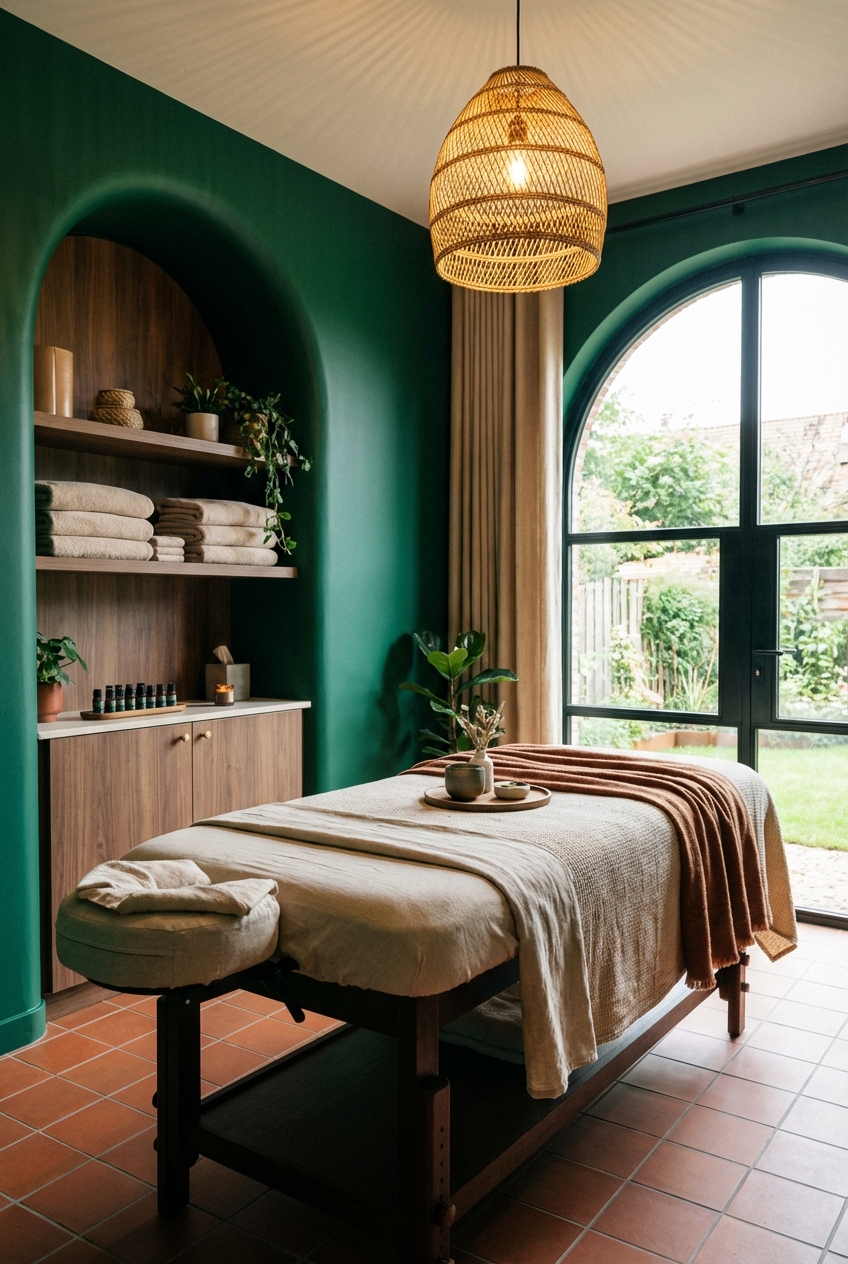
I prefer floating shelves over bulky cabinets. Installing shallow shelves (6 to 8 inches deep) allows you to store oils and candles without encroaching on the walkway. Place them in corners or on the wall behind the head of the table where foot traffic is minimal.
For linens and bolsters, which are bulky, look for “hidden” storage. A storage ottoman that doubles as a seat for the client to remove their shoes is a classic dual-purpose solution. If the room has a closet, remove the door and install a curtain; inside, use wire baskets to organize towels so they breathe.
The “Rolling Cart” Debate
Many therapists use rolling carts. In a large room, they are great. In a tiny room, they are a tripping hazard.
What I recommend instead: A wall-mounted folding shelf. You can pop it up when you need a surface for your oils during the session, and fold it flat against the wall when you are done. This saves valuable inches of floor width.
Storage Rules of Thumb
- Oils: Keep them out of direct sunlight to prevent spoiling.
- Dirty Linens: You need a hamper, but don’t let it eat floor space. A canvas bag hanging on the back of the door is a great space-saver.
- Bolsters: These are awkward to store. I often install large hooks high up on the wall or on the back of a door to hang bolsters out of the way.
5. Decor and Color: The Art of Restraint
When designing for small spaces, the instinct is often to make it “fun” or “cozy” with lots of decor. In a massage room, restraint is your best friend. Your brain processes every object in a room. Less visual input leads to faster relaxation.
I gravitate toward monochromatic color palettes for small spas. Painting the walls, trim, and even the ceiling the same color blurs the hard lines of the room. Warm neutrals—taupe, soft clay, warm greys, or moody greens—work beautifully. Avoid stark bright white, which can feel sterile and devoid of comfort in a small, windowless room.
Mirrors are usually a trick to expand space, but be careful here. Nobody wants to watch themselves getting a massage, and a mirror can be distracting for the therapist. If you use a mirror, position it so it reflects a piece of art or a plant, not the table itself.
Biophilic Design in Small Spaces
Bringing nature inside lowers blood pressure. However, large floor plants take up room.
My fix: Hanging planters or wall-mounted planters. Pothos and ferns thrive in lower light and add a soft, organic texture that contrasts with the geometric lines of the massage table.
Texture Over Pattern
Instead of patterned wallpaper which can close a room in, use textured wall treatments. Limewash paint creates a cloudy, dreamlike movement on the walls that feels expansive and ancient. It adds depth without adding “things.”
Final Checklist: Is Your Room Ready?
Before you book your first session in your new space, run through this practical checklist to ensure the flow works.
FAQs
A: Yes, carpet is actually great for sound dampening. However, ensure the table legs are stable. If the carpet is very plush, the table might wobble during deep tissue work. I recommend using a small, firm board or coaster under each leg to distribute the weight.
A: The absolute minimum for professional ergonomics is roughly 9×10 feet. For casual home use where you might not need 360-degree access, you can squeeze into a 7×9 foot space, provided you are willing to compromise on body mechanics.
A: Focus on textiles and lighting. You can’t change the walls, but you can hang floor-to-ceiling curtains on a tension rod to cover ugly walls. Use high-quality linen sheets on the table. Invest in warm, dimmable lamps. These elements travel with you when you move.
A: If the room is multi-purpose (e.g., a guest room/office), yes. High-quality portable tables are very stable. However, if the room is dedicated solely to massage, a stationary hydraulic or electric lift table is better for the therapist’s back, though they are much heavier and harder to move.
A: Avoid space heaters that blow hot air; they dry out eyes and sinuses. A table warmer (a heated pad that goes under the bottom sheet) is the most efficient way to keep the client warm without overheating the tiny room.
Conclusion
Transforming a tiny space into a functional massage room is less about square footage and more about intentionality. By respecting the clearance requirements, controlling the lighting, and reducing visual clutter, you can create a professional-level sanctuary in a walk-in closet or a spare corner.
Remember that the goal is to engage the senses. Soft textures, warm light, and quiet acoustics can make a 70-square-foot room feel like a high-end destination spa. Start with your layout, measure twice, and don’t be afraid to embrace the coziness of a small footprint.
Picture Gallery
Five photographs · drag or swipe