
Tree Lined Driveway Ideas to Elevate Your Home
Introduction
There is distinct psychology behind the arrival at a home. As an interior designer, I view the driveway not merely as a place to park a car, but as the “foyer before the foyer.” It sets the emotional tone for the entire property. A long, winding approach flanked by mature trees creates a sense of decompression, signaling to guests—and to you after a long day at work—that they have entered a sanctuary.
I recall a project in Connecticut where the interior renovation was impeccable, but the arrival felt abrupt and exposed. The house sat far back from the road, yet the driveway was a straight, barren shot of asphalt. By introducing a rhythm of Columnar Hornbeams and structured lighting, we transformed that simple stretch of pavement into an experience. The house didn’t just look better; it felt more expensive and established before you even touched the front doorknob.
Creating this look requires more than just digging holes and dropping in saplings. It involves understanding scale, calculating canopy spread, and planning for root systems that won’t destroy your hardscape five years down the road. If you are looking for visual inspiration, you can jump right to the Picture Gallery at the end of this blog post. For those ready to plan the logistics, let’s look at how to design a driveway that adds permanent value to your property.
1. Matching Tree Architecture to Home Style
The most successful landscape designs act as an extension of the home’s architecture. When selecting trees for a driveway, the shape of the tree—its habit—must converse with the lines of your house. If you ignore this connection, the landscaping will feel disjointed, like wearing a tuxedo with flip-flops.
For formal homes, such as Georgian, Federal, or Modern styles, symmetry and structure are your best friends. You want trees that grow in a uniform, predictable manner. I often lean toward fastigiate or columnar trees for these applications. These trees grow upward rather than outward, creating a soldier-like row that directs the eye straight to the front door.
Designer’s Note: The “Tunnel” Effect
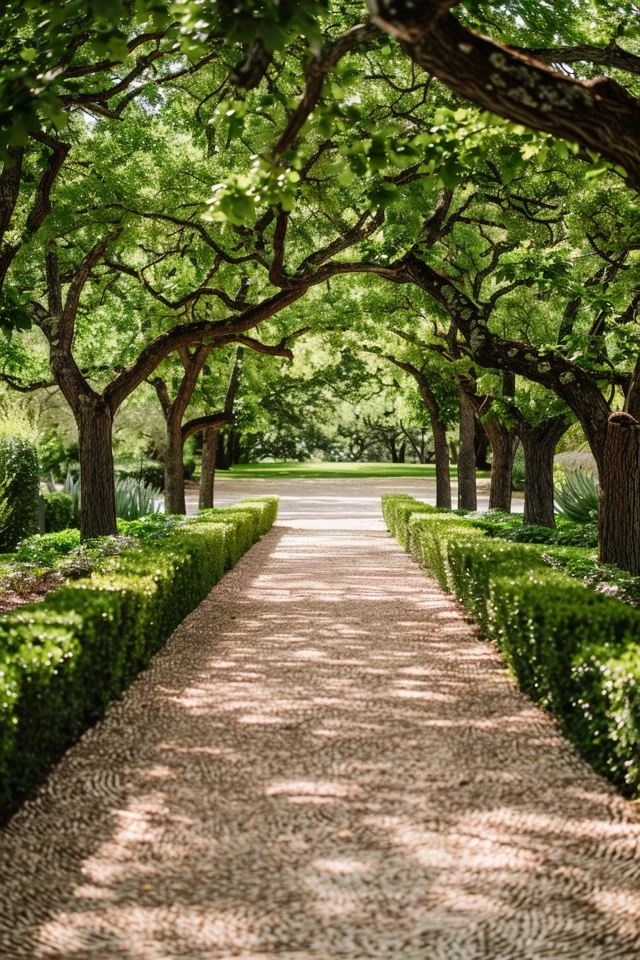
One of the most requested looks is the “tunnel” effect, where tree canopies touch overhead. While romantic, this requires patience and specific species. Don’t try to force this look with narrow, upright trees like Italian Cypress. You need trees with a vase shape, such as American Elms (disease-resistant varieties like ‘Princeton’) or Zelkovas. These branch out high, creating a vaulted ceiling effect without blocking the view of the house at eye level.
For farmhouse, cottage, or ranch-style homes, rigid symmetry can feel too stiff. Here, I prefer a looser, more organic approach. You might plant in irregular clusters rather than a straight line, or choose trees with rounded, open habits like Oaks or Maples. The goal here is a “pastoral” feel, suggesting the road was carved through an existing grove rather than the grove being planted around the road.
2. The Critical Math: Spacing, Setbacks, and Clearance
This is the section where most DIY projects fail. Planting trees too close to the driveway—or too close to each other—is a recipe for cracked asphalt, scratched paint, and heavy pruning bills. In interior design, we talk about flow and circulation; the same rules apply here.
Distance from the Pavement
Never plant a tree directly on the edge of the driveway. You must account for the overhang of vehicle mirrors, delivery trucks, and the eventual spread of the tree trunk.
- Minimum Setback: Plant the center of the trunk at least 4 to 6 feet away from the edge of the pavement.
- Large Canopy Trees: For massive trees like Oaks or Sycamores, push this back to 8 or 10 feet.
- Why? This protects the root zone from soil compaction caused by cars and prevents roots from heaving the driveway surface.
Spacing Between Trees
The spacing depends entirely on the mature width of the species. A common mistake is planting for how the tree looks now, not how it will look in 10 years.
- Formal/Hedge Look: If you want the trees to touch and form a wall, plant them slightly closer than their mature spread. For example, Arborvitae might be spaced 3 to 4 feet apart.
- Allée Look: To distinguish individual trunks while allowing canopies to touch eventually, space them 15 to 25 feet on center.
- Open Grove Look: For a grand, estate feel where trees stand independently, space them 30 to 40 feet apart.
Vertical Clearance
Do not forget the delivery trucks. While your SUV might only be 6 feet tall, a moving truck or UPS van is much taller. You must prune lower branches to maintain a clearance of at least 14 feet over the driving surface. If you don’t, the trucks will do the pruning for you, and it won’t be pretty.
3. Selecting the Species: Deciduous vs. Evergreen
The choice between deciduous (loses leaves) and evergreen (keeps leaves) determines the function of your driveway planting. Are you looking for seasonal drama or year-round privacy?
The Case for Deciduous
Deciduous trees offer the most romance. They mark the passage of time. You get the lush green “tunnel” in summer, the explosion of color in autumn, and the architectural beauty of bare branches in winter.
- Top Picks: Red Maples (fast growth, great color), Ginkgo Biloba (stunning yellow fall color, very tough), and Flowering Pear (though be careful with specific cultivars that are prone to splitting).
- The Trade-off: You lose privacy in winter. If your driveway is exposed to a busy road, the screening effect disappears from November to April. You also have leaf cleanup to manage.
The Case for Evergreen
If your driveway doubles as a privacy screen from neighbors or a noise buffer, evergreens are the practical choice. They provide a constant green wall.
- Top Picks: Green Giant Arborvitae (deer resistant, fast growing), Southern Magnolia (for warmer climates, adds floral interest), and Cryptomeria.
- The Trade-off: They can feel heavy or imposing if planted too thickly. A long wall of dark evergreens can sometimes feel claustrophobic if the driveway is narrow.
Common Mistakes + Fixes
Mistake: Planting messy trees over the asphalt.
The Fix: Avoid trees that drop heavy fruit, nuts, or excessive sap. Black Walnuts, Mulberries, and certain Pines can wreak havoc on car paint. Stick to “clean” trees like Zelkovas or seedless Maples.
4. Layering the Landscape: Underplanting and Borders
A tree-lined driveway looks unfinished if the trees are just shooting out of the grass. In interior design, we use rugs to ground furniture; in landscaping, we use garden beds to ground trees. Creating a continuous bed along the driveway unifies the design and makes maintenance easier (no weaving a lawnmower between trunks).
The Bed Width
If your trees are set back 6 feet from the drive, create a planting bed that is 8 to 10 feet wide. This encompasses the trees and allows room for underplanting.
Planting Combinations
- Classic Boxwood: A low, clipped hedge of boxwood or holly running along the driveway edge creates a crisp, formal border. This keeps the mulch off the driveway and looks good year-round.
- Hydrangeas: Planting Hydrangea ‘Annabelle’ or ‘Limelight’ between the tree trunks creates a fluffy, romantic volume that fills the gaps while the trees mature.
- Ornamental Grasses: For a modern or coastal look, mass plantings of Fountain Grass or Maiden Grass add movement and soften the hard edge of the asphalt.
Lighting the Way
Lighting is non-negotiable for a high-end look. However, avoid the “runway effect” where lights are placed symmetrically every two feet, looking like an airport landing strip.
- Up-lighting: Place a well light or bullet light at the base of each tree, aimed up into the canopy. This highlights the texture of the bark and branches.
- Color Temperature: Stick to 2700K or 3000K warm white LED. Anything cooler (4000K+) looks like a security prison yard.
- Path Lights: Use these sparingly. If you are up-lighting the trees, the reflected glow is often enough to illuminate the pavement.
5. Practical Realities: Root Barriers and Irrigation
Nobody likes to talk about infrastructure, but it protects your investment. Trees are living things that need water, and their roots are powerful enough to lift concrete.
Root Management
If you are planting large trees near a new driveway, install a root barrier. This is a rigid plastic sheet buried vertically along the edge of the pavement (usually 18-24 inches deep). It forces roots to grow downward rather than sideways under the asphalt. It is a small upfront cost that saves thousands in repaving later.
Irrigation Strategy
New trees need significant water to establish—usually for the first 2 to 3 years.
- Drip Lines: Run a drip irrigation line through the planting bed. This is more efficient than spray heads, which lose water to evaporation and wind.
- Gator Bags: If you don’t have an irrigation system, use slow-release watering bags (often green or brown) that zip around the trunk. They look a bit unsightly, so I recommend using them only during the establishment phase or extreme drought.
Renter & Budget Constraints
If you are renting or on a tight budget, you can still achieve this look.
- Buy Small: A 15-gallon tree is significantly cheaper than a balled-and-burlapped mature tree. It might look small now, but younger trees often establish faster and catch up to larger transplants within 5 years.
- Fast Growers: Species like Thuja ‘Green Giant’ or River Birch grow very quickly, giving you a return on investment sooner.
Final Checklist: What I’d Do in a Real Project
If I were managing your driveway project today, here is the exact workflow I would follow to ensure success:
1. Site Analysis
Check for overhead power lines. If lines are present, you must choose small ornamental trees (Dogwood, Redbud) that won’t grow into the wires.
2. The Layout
Mark the tree locations with spray paint or flags.
Drive your car past them. Do the flags feel too close?
Check sightlines at the end of the driveway. Ensure the last tree doesn’t block your view of oncoming traffic when pulling out.
3. The Soil Prep
Don’t just dig individual holes. Rototill the entire strip where the trees will go. Amending the whole bed encourages roots to spread, resulting in faster growth.
4. The Selection
Visit the nursery in person. Tag your trees. Look for straight trunks (leaders) and damage-free bark.
5. The Planting
Plant high. The “flare” where the trunk meets the roots should be visible above the soil line. Planting too deep is the
1 cause of tree death.
Mulch, but do not “volcano” mulch. Keep mulch 3 inches away from the trunk bark to prevent rot.
FAQs
Does a tree-lined driveway increase property value?
Yes, significantly. Mature landscaping contributes to “curb appeal,” which can increase perceived property value by 5-12%. A defined, elegant entry suggests a well-maintained home.
What is the best tree for a driveway entrance?
For a grand entrance, Oaks and Maples are the gold standard due to their longevity and shape. For tighter spaces, Chanticleer Pears or Hornbeams are excellent because they remain narrow.
How far should trees be from the driveway?
A minimum of 4 feet is required for small trees, but 6 to 10 feet is ideal for large shade trees. This prevents root damage to the pavement and keeps branches from scratching vehicles.
Can I plant trees along a gravel driveway?
Absolutely. In fact, trees help define the edge of a gravel drive, which can otherwise migrate into the lawn. The same spacing rules apply.
How do I light a tree-lined driveway?
Focus on up-lighting the trees rather than lighting the asphalt. Use low-voltage LED fixtures placed at the base of the trunk. Avoid solar lights from big-box stores; they rarely provide enough output to look intentional.
Conclusion
Designing a tree-lined driveway is an exercise in patience and vision. Unlike painting a room, where the result is instant, this is a design element that improves with time. The saplings you plant this season will become the grand canopy that welcomes you home ten years from now.
By following the rules of scale, respecting the root zones, and layering with proper lighting and underplanting, you elevate your home from a simple address to a destination. It creates a boundary between the public world and your private sanctuary, offering a daily moment of calm before you even step inside.
Picture Gallery


