
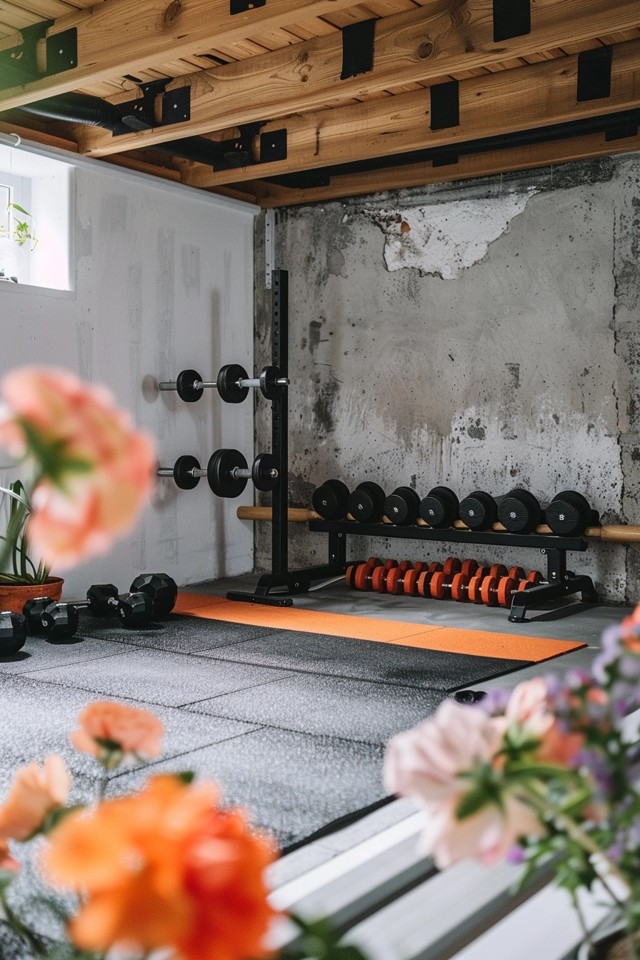
Unfinished Basement Gym Ideas for Your Home Fitness
One of the biggest hurdles to building a home gym is finding the square footage without sacrificing a guest room or a parking spot in the garage. Many of my clients sit on a goldmine of unused space right beneath their feet, but they are terrified of the concrete floors and exposed joists. They assume they need a $40,000 renovation to frame walls and hang drywall before they can even buy a treadmill.
That is simply not true. In fact, the raw, industrial aesthetic is incredibly popular right now, and an unfinished basement is the perfect canvas for a “gritty” training environment. You can create a high-functioning, motivating fitness space by working with the raw elements rather than trying to hide them.
I have transformed countless dark, spider-web-filled basements into bright functional gyms using just paint, proper lighting, and smart flooring choices. If you are looking for visual inspiration, make sure to check out the Picture Gallery at the end of this blog post.
1. Assessing and Prepping the Raw Environment
Before we bring in any dumbbells, we have to address the “basement” factor. Unfinished basements are notorious for being damp, dusty, and dark.
If you skip this step, your expensive equipment will rust, and the room will smell too musty for heavy breathing. Start by sealing any visible cracks in the concrete walls with hydraulic cement to prevent water intrusion.
Next, you must address the air quality. I always recommend installing a commercial-grade dehumidifier if your humidity levels consistently sit above 50%.
Designer’s Note: Moisture Control
In my experience, clients often buy a small, residential dehumidifier that requires emptying twice a day. They eventually get tired of the chore, stop doing it, and mold sets in. I recommend buying a unit with a built-in pump that drains directly into your utility sink or floor drain. It is a set-it-and-forget-it solution that saves the room.
Common Mistakes + Fixes:
- Mistake: Ignoring the dust from the concrete floor.
- Fix: Concrete constantly sheds dust. Apply a clear concrete sealer or a simple masonry paint to the floor before laying down mats. This locks the dust in and keeps your equipment clean.
2. Flooring Solutions for Concrete Slabs
You cannot work out directly on concrete. It is terrible for your joints during cardio and dangerous for your equipment if you drop a weight.
However, you also do not want to install luxury vinyl plank or carpet in an unfinished space that might see moisture. The goal is utility and durability.
I typically use rubber flooring, but the type matters significantly based on your workout style.
Option A: Horse Stall Mats (The Pro Choice)
For heavy lifters, 4-foot by 6-foot rubber stall mats are the gold standard. They are usually 3/4-inch thick. They are indestructible, heavy enough that they don’t slide, and much cheaper than “gym specific” flooring.
Option B: Interlocking Foam Tiles (The Light Duty Choice)
If you only do yoga, pilates, or light cardio, foam tiles are acceptable. They are softer and warmer on the feet. However, do not use these for heavy weightlifting, as the foam compresses and creates an unstable surface for squats.
Measurements and Spacing:
- Thickness: Aim for at least 8mm for general exercise. Go for 3/4-inch (approx 19mm) for deadlifts or Olympic lifting.
- Coverage: You do not need to cover the entire basement floor. Measure a “zone” of 10×12 feet for a standard workout area. This visually defines the gym space within the larger unfinished room.
3. Lighting the Dungeon
Lighting is the single most important design element in an unfinished basement. One single bulb hanging from a pull-chain will make the space feel depressing and small.
You need to flood the space with light to mimic the energy of a commercial gym. Since there is no drywall ceiling to recess lights into, we have to get creative with surface-mounted options.
I prefer using LED linkable shop lights. They are lightweight, plug into standard outlets, and can be hung from the joists with simple S-hooks and chains.
The Rule of Color Temperature
Never use “Warm White” (2700K or 3000K) bulbs in a basement gym. That yellow light promotes relaxation and can make a basement look dingy.
Always choose “Daylight” bulbs, which range from 4000K to 5000K. This crisp, blue-white light mimics natural sunlight, keeps your energy levels high, and makes the space feel cleaner.
What I’d Do in a Real Project:
- Task Lighting: Hang 4-foot LED fixtures directly over the main workout zone.
- Ambient Lighting: Run industrial string lights (bistro lights) around the perimeter for a softer vibe during yoga or cool-downs.
- Mirrors: Lean large, frameless mirrors against the wall. They double the perceived light and break up the monotony of concrete walls.
4. Painting the Ceiling and Walls
If your budget allows for one aesthetic upgrade, let it be paint. Painting an unfinished ceiling is a designer trick that instantly makes the ceiling feel higher and the room more cohesive.
You have two main directions here: the “Blackout” or the “Industrial White.”
The Blackout Ceiling
Spraying the entire ceiling structure (joists, pipes, wires, and ductwork) matte black makes everything disappear. It creates a moody, boutique studio vibe. However, this requires very strong lighting, or the room will feel like a cave.
The Industrial White
Spraying everything white creates a bright, airy loft aesthetic. It reflects light down, making the basement feel larger. The downside is that dust and cobwebs are more visible on white pipes over time.
Wall Treatments
You don’t need to stud and drywall the walls. Painting the concrete block walls with a masonry paint in a bright white or a cool gray transforms the look immediately.
Designer’s Note: The “Half-Wall” Paint Trick
If your basement ceilings are low (under 7 feet), paint the bottom two-thirds of the concrete wall a dark color (like navy or charcoal) and the top third and ceiling bright white. This draws the eye up and creates an illusion of height.
5. Layout and Zoning Logic
In an open, unfinished basement, clutter is the enemy. Without walls to define rooms, equipment can easily look like a pile of junk.
You must create zones based on activity. This helps with flow and safety.
Cardio Zone
Place treadmills and ellipticals near the available outlets. If possible, face them toward the rest of the room or a TV, rather than staring at a blank concrete wall.
Strength Zone
Keep weights on the rubber mats. Never place a weight bench directly under a low-hanging HVAC duct. I have seen clients sit up from a bench press and hit their head on sheet metal.
Clearance Rules of Thumb:
- Treadmills: Leave at least 6 feet of open space behind a treadmill for safety in case you fall.
- Weight Benches: Allow 2 to 3 feet of clearance on all sides for spotting and changing plates.
- Overhead: Before buying a power rack or elliptical, measure your ceiling height at its lowest point (usually the bottom of the HVAC trunk line). Many basements are only 7 feet tall, and some equipment requires 8 feet.
6. Temperature Control and Insulation
Unfinished basements are naturally cooler, which is actually great for high-intensity workouts. However, in the dead of winter, it might be too cold to motivate you.
Since you likely don’t have insulated walls, you need localized heat. A safe, oil-filled radiator heater is a good choice for basements because it doesn’t have an exposed element that could ignite dust.
Dealing with Drafts
The rim joist (where the house frame meets the foundation) is usually the source of cold drafts. Using spray foam or rigid foam board insulation in these gaps is an affordable DIY project that significantly warms up the basement.
Fan Placement
Even in a cool basement, air can become stagnant. Mount an oscillating wall fan in the corner of your workout zone. Avoid ceiling fans if your ceiling is lower than 8 feet, as you risk hitting them during overhead presses or jumping jacks.
7. Storage and Visual Organization
In a finished room, we hide clutter in closets. In an unfinished basement, everything is exposed.
You need robust, industrial storage to match the room’s aesthetic. Flimsy plastic bins will look out of place.
Shelving Recommendations
Use heavy-duty wire shelving units (like the metal racks found in commercial kitchens). They allow airflow, don’t collect dust on the shelves, and can hold heavy equipment like kettlebells and medicine balls.
Pegboards
Mounting a large pegboard to the concrete studs or hanging it from the joists is an excellent way to store resistance bands, jump ropes, and lifting belts. It keeps the floor clear and looks professional.
Common Mistakes + Fixes:
- Mistake: Leaning weight plates against the wall.
- Fix: This damages the drywall or concrete and is a toe-stubbing hazard. Buy a dedicated weight tree. It takes up less than 2 square feet of floor space and organizes hundreds of pounds of plates.
8. Adding “Soft” Elements
An unfinished basement is made of hard materials: concrete, steel, and wood. To make it inviting, you need to layer in softer textures.
This is where the “interior design” aspect comes into play. You don’t want the room to feel sterile.
Textiles and Decor
Add a large area rug in the “transition” area where you put on your shoes or foam roll. A synthetic, low-pile rug is best as it resists moisture and is easy to vacuum.
Curtains
If you have an ugly water heater or furnace that ruins the view, hang a ceiling-mounted curtain track. Use heavy canvas drop cloths as curtains. They are cheap, durable, and match the industrial vibe perfectly while hiding the mechanicals.
Plants
If you have a small egress window that lets in light, add a snake plant or ZZ plant. They thrive in low light and bring life to the concrete box. If you have zero windows, use high-quality artificial greenery to break up the gray tones.
Final Checklist: The “What I’d Do” Project Plan
If I were consulting on your basement gym project tomorrow, this is the exact order of operations I would follow to maximize impact and minimize cost.
- Step 1: clear everything out. You cannot visualize the space with holiday decorations in the way.
- Step 2: Deep clean. Shop-vac every joist and corner. Apply a concrete sealer to the floor to stop dust.
- Step 3: Paint the ceiling. Do this before bringing any gear in. I would spray it matte black for a cozy, focused vibe.
- Step 4: Install lighting. Put up six 4-foot LED shop lights (5000K) on a single switch or smart plug.
- Step 5: Lay the flooring. Install 3/4-inch rubber stall mats in a 10×12 rectangle. Tape the seams on the underside to keep them tight.
- Step 6: Move in equipment. Place the treadmill facing the room, not the wall. Verify overhead clearance for the squat rack.
- Step 7: Add the “vibe.” Hang one large mirror, install a sound system, and add a heavy-duty storage rack.
Frequently Asked Questions
How do I stop my basement gym from smelling musty?
The musty smell is almost always mold or mildew caused by humidity. Run a dehumidifier 24/7 and maintain humidity levels below 50%. Also, ensure you wipe down mats and equipment with disinfectant after every use, as sweat evaporates and settles into the porous concrete, causing odors over time.
Is it safe to mount a TRX or heavy bag to floor joists?
generally yes, but you must mount them correctly. Do not screw into the bottom of the I-beam or joist, as this weakens the wood. You should drill through the center of the joist horizontally and use a blocking method, or buy a mount specifically designed to span across two joists to distribute the weight. If you are unsure, consult a structural engineer or general contractor.
Can I put a mirror on a concrete wall without drilling?
Adhesives are risky on concrete because moisture can cause them to fail, leading to shattered glass. I recommend using “Z-clips” or masonry screws for a secure hold. Alternatively, simply buy a large floor-standing mirror and lean it safely against the wall.
How much does an unfinished basement gym cost compared to a finished one?
Finishing a basement (framing, electrical, drywall, flooring, HVAC) typically costs between $30 and $75 per square foot. Setting up an unfinished gym (paint, mats, lighting, decor) usually costs between $3 and $8 per square foot, excluding the exercise equipment itself. It is a massive savings.
Conclusion
Your home gym does not need to look like a luxury health club to give you a luxury workout. In fact, some of the best athletes in the world train in warehouses that look exactly like your unfinished basement.
The key is shifting your mindset from “this space is incomplete” to “this space is purpose-built.” By addressing the functional basics—lighting, moisture, and flooring—you can create a sanctuary that allows you to drop weights, make noise, and sweat without worrying about damaging a pristine room.
Take advantage of the raw square footage you already have. With a weekend of work and a few strategic purchases, that dark storage area can become the most productive room in your house.
Picture Gallery


