
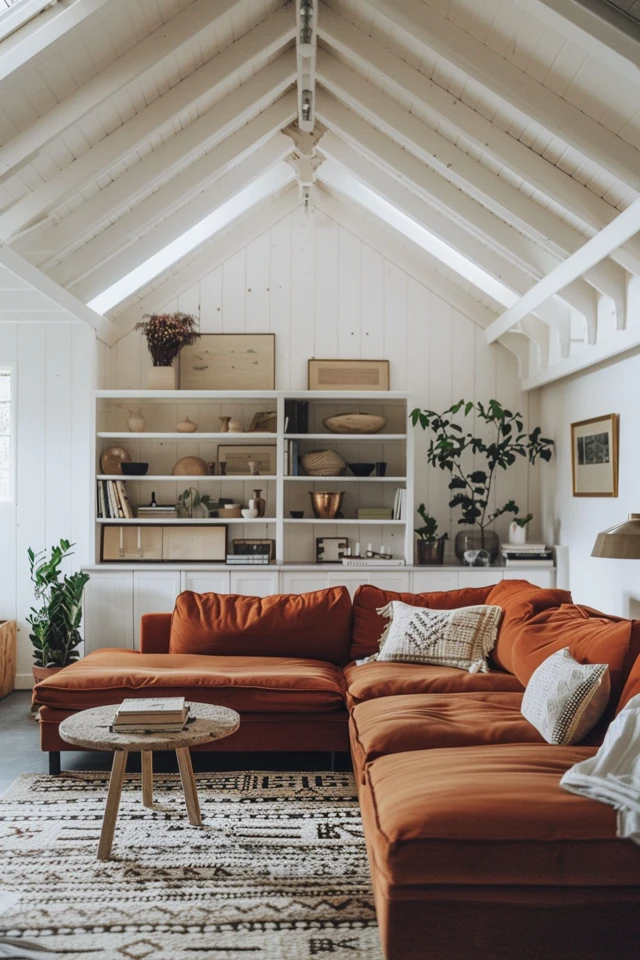
Vaulted Ceiling Ledge Decor Tips & Inspiration
One of the most polarizing architectural features in modern homes is the vaulted ceiling ledge. Often found in homes built during the 1990s and early 2000s, this architectural quirk—sometimes called a plant shelf or a dust ledge—can feel like a riddle. It adds volume to a room, but it also creates a visual void that is incredibly difficult to style and even harder to clean.
Many homeowners feel pressured to fill this space simply because it exists. However, as an interior designer, I often advise that how you handle this ledge can make or break the scale of your room. To help you visualize the potential of this unique architectural feature, I have curated a stunning Picture Gallery at the end of the blog post.
Before you drag a ladder into the living room, take a moment to evaluate the architecture. The goal is to draw the eye up without creating a cluttered, precarious display that distracts from the rest of your design. Let’s break down exactly how to handle high-altitude styling with professional precision.
1. To Decorate or Not to Decorate? (The Golden Rule)
The first decision isn’t what to put on the ledge, but whether to put anything there at all. In contemporary design, negative space is a powerful tool. If your room already has a busy layout, heavy textiles, or a bold rug, leaving the ledge empty allows the eye to rest.
If the ledge is structurally awkward or cuts the room in half visually, decorating it often highlights the flaw rather than fixing it. In these cases, painting the ledge the same color as the upper walls helps it disappear.
However, if the ledge is deep (over 18 inches) and has a dedicated electrical outlet, it was likely intended as a focal point. This is where intentional styling comes into play. The rule of thumb here is simple: if you can’t style it with substantial, large-scale items, leave it empty.
Designer’s Note: The “Dust Collector” Reality
In my years of practice, the biggest regret clients have regarding ledge decor is maintenance. Before committing to a design, ask yourself how you plan to clean it. If you do not own a telescoping duster or an extra-tall ladder, you should opt for a minimalist approach or leave the ledge bare. Nothing ruins a high-end look faster than visible gray dust bunnies hanging off faux greenery.
2. Scale and Proportion: The Math of High Places
The most common mistake homeowners make is using standard-sized decor on a vaulted ledge. Items that look substantial on a coffee table will look like miniature toys when placed 10 feet in the air. Distance compresses visual size, meaning you need to scale up significantly.
When selecting objects, think in terms of “architectural scale.” Pottery and baskets should be oversized. I generally recommend objects be at least 18 to 24 inches tall to register visually from the floor. Anything smaller than 12 inches will simply disappear or look like clutter.
Spacing is just as critical as height. You want to avoid the “soldier row” look, where items are lined up evenly across the entire shelf. Instead, group items in clusters of three or five, leaving significant breathing room between the groups.
Common Mistakes + Fixes
Mistake: Using small picture frames (5×7 or 8×10) to display family photos.
Fix: No one can see the photos from the ground. Instead, lean large, abstract canvas art. The canvas should be at least 24×36 inches to have any impact.
Mistake: Spreading small knick-knacks across the entire length.
Fix: create distinct “zones.” Place a large trio of vessels on the far left, leave the middle empty, and balance the right side with a large woven texture.
3. Styling Options: Greenery, Art, and Objects
Once you have committed to decorating the ledge, you need to select materials that add warmth without creating chaos. The three best categories for this specific application are botanicals, pottery, and art.
Botanicals and Greenery
Historically, these were called “plant shelves” for a reason. However, watering a real plant 12 feet in the air is a logistical nightmare. Unless you have an automated irrigation system installed (which is rare), I highly recommend high-quality faux botanicals. Look for “real touch” varieties.
If you are determined to use real plants, choose varieties that tolerate neglect and low light, such as Pothos or Snake Plants. Trailing plants are particularly effective because they break the horizontal line of the ledge. Ensure the pot has a saucer attached to prevent water damage to the drywall.
Pottery and Baskets
Texture is vital at this height because you cannot see fine details. Woven seagrass baskets, hammered metal vessels, or rough-hewn clay pots read better than smooth glass. Glass often disappears or reflects ceiling lights in an unflattering way.
Leaning Art
You generally want to avoid hammering nails into the wall above a ledge, as it limits future flexibility. Instead, lean large framed art or canvas against the back wall. Layering is key here. Place a smaller (but still large) piece slightly overlapping a larger piece to create depth.
What I’d Do in a Real Project
If I were styling a client’s 15-foot ledge today, here is the exact formula I would use:
- Left side: One massive oversized woven basket (approx. 24″ tall) to anchor the corner.
- Middle-Left: Negative space (about 3 feet of nothing).
- Center/Right: A large abstract canvas (vertical orientation) leaning against the wall, partially obscured by a chunky, matte-black ceramic vase with tall faux branches (olive or eucalyptus).
- Right side: Negative space.
4. Lighting the Ledge
Lighting is the secret weapon of interior designers. A dark ledge feels like a black hole at night, while a properly lit ledge makes the room feel expansive and luxurious. If your home is in the construction phase, I always insist on adding a switched outlet on the ledge.
Uplighting
The best way to light a ledge is with canister uplights. These can be placed behind large pots or baskets to cast a glow up toward the vaulted ceiling. This technique, known as “wall washing,” accentuates the height of the room and highlights the architecture.
LED Strips
For a more modern, linear look, you can install an LED tape light along the back edge of the shelf where it meets the wall. This creates a soft halo effect. Ensure you use a diffuser channel so you don’t see the individual dots of the LED diodes.
Color Temperature
Consistency is key. If your living room lamps are 2700K (warm white), your ledge lighting must match. Mixing cool blue daylight bulbs (5000K) on the ledge with warm lamps below will make the room feel disjointed and clinical.
5. Maintenance and Safety (The Boring but Critical Stuff)
Safety is rarely discussed in decor blogs, but for high ledges, it is paramount. In areas prone to earthquakes or heavy vibrations (like near a busy road or train track), objects can “walk” off the edge over time.
Securing Items
I consider museum putty or “quake wax” a mandatory supply for ledge styling. Place a small ball of wax under every vase, pot, and frame. This invisible anchor ensures that vibrations from doors slamming or minor tremors won’t send a heavy ceramic pot crashing down onto your sofa or flooring.
Weight Distribution
Be mindful of the shelf’s construction. Some drywall-wrapped ledges are merely framed with 2x4s and drywall, while others are structural. Avoid placing excessively heavy items like dense stone sculptures unless you are certain of the load-bearing capacity.
Cleaning Protocol
Dust at that height is inevitable. When selecting decor, choose items that are easy to wipe down. Intricate dried floral arrangements or rough, porous surfaces will trap dust that is nearly impossible to remove without bringing the item down. Smooth ceramics and sealed baskets are much easier to maintain with a long-handled duster.
Final Checklist: Before You Buy
Before you head to the home decor store, run through this quick checklist to ensure your plan is solid.
- Measure twice: Do you know the exact depth of the ledge? Buying a 14-inch base vase for a 12-inch ledge is a common heartbreak.
- Check the height: Measure the distance from the ledge to the ceiling slope. Ensure your items won’t look cramped against the roofline.
- Lighting check: Is there an outlet up there? If not, are you willing to use battery-operated lights, or will you skip lighting?
- Safety gear: Do you have a ladder tall enough to safely place these items, or do you need to hire a handyman?
- The “Squint Test”: Stand back and squint at the space. Does the ledge feel heavy? If so, plan for lighter-colored objects (creams, light woods) rather than black or dark bronze.
FAQs
Should I paint the ledge a different color than the walls?
In 95% of cases, no. Painting the horizontal surface or the back wall of the ledge a different accent color usually chops up the room visually and draws too much attention to the drywall shelf itself. Keep it the same color as the surrounding walls to help it blend in.
Can I put books on a vaulted ceiling ledge?
Technically yes, but practically, no. Unless it is a library with a rolling ladder, books on a high ledge are inaccessible and become purely decorative dust magnets. If you want the “library look,” use large coffee table books stacked horizontally with a decorative object on top, but don’t expect to read them.
How do I decorate a ledge that runs through a bedroom?
Less is more in a bedroom. Psychological comfort is key; you don’t want to sleep feeling like something might fall on you. I usually recommend leaving bedroom ledges entirely empty or using very soft, lightweight items like a single row of empty woven baskets.
What if my ledge is very narrow (under 8 inches)?
If the ledge is shallow, do not force decor onto it. It is likely just an architectural transition rather than a display shelf. Leaving it bare is the correct design choice. If you must add something, lean flat artwork that doesn’t require depth.
Conclusion
Vaulted ceiling ledges are a unique architectural challenge, but they don’t have to be a source of frustration. By respecting scale, prioritizing safety, and embracing the power of negative space, you can turn that awkward dust shelf into a sophisticated design feature.
Remember that you are viewing this space from a distance. You don’t need intricate details; you need shape, texture, and proper proportion. Whether you fill it with oversized pottery or decide to leave it blissfully empty, the goal is to enhance the feeling of height and openness in your home.
Picture Gallery


