
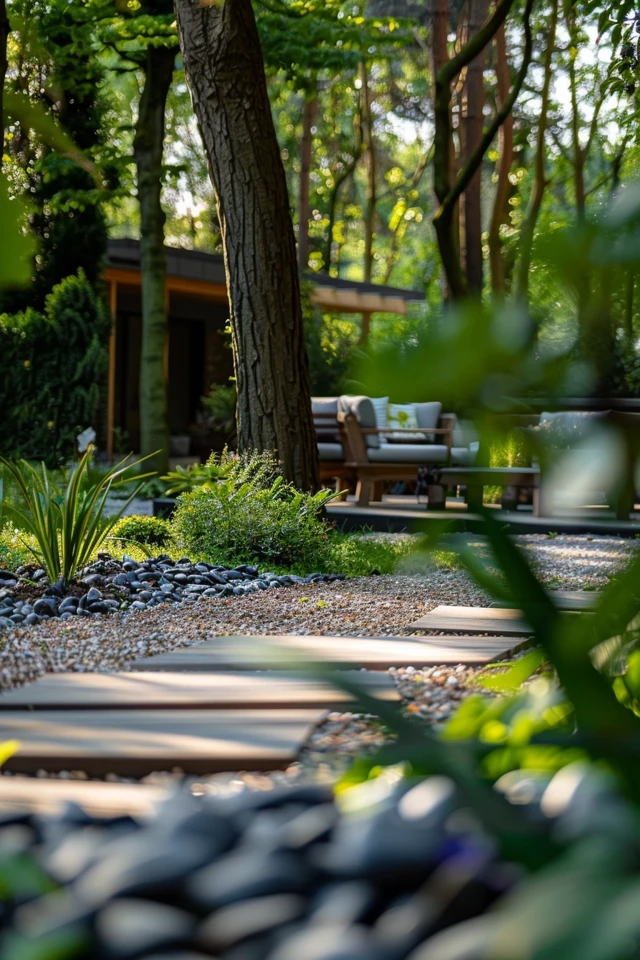
Title: Woodland Landscaping Ideas for a Forest Feel
Introduction
There is a primal sense of peace that comes from walking through a quiet, shaded forest. The dappled sunlight, the scent of damp earth, and the sound of wind rustling through the canopy create an immediate drop in blood pressure. Recreating this atmosphere in a residential yard is one of the most rewarding design challenges because it forces us to work with nature rather than trying to control it.
The goal of woodland landscaping isn’t to let your yard go wild or become overgrown. It is an intentional design strategy that mimics the layers, textures, and lighting of a natural ecosystem while maintaining usability for modern living. If you are looking for visual inspiration, scroll to the bottom of this post to view the Picture Gallery.
Whether you have a sprawling backyard or a small urban patch with a single shade tree, the principles of forest design remain the same. By focusing on vertical layering, organic pathways, and native planting, you can build a sanctuary that feels miles away from the city. Let’s look at how to construct this look from the ground up.
1. Establishing the Canopy and Understory
In interior design, we talk about floor, walls, and ceiling; in woodland landscaping, we talk about groundcover, understory, and canopy. A convincing forest feel requires all three vertical layers working in harmony. If you only plant grass and tall trees, you are creating a park, not a woodland.
The “ceiling” is your canopy trees. If you already have mature oaks, maples, or pines, you are ahead of the game. If you are starting from scratch, you need to plant fast-growing species mixed with slower hardwoods to establish shade. However, the most crucial layer for the “cozy” forest feel is the understory.
The understory consists of smaller flowering trees and large shrubs that sit beneath the tall canopy. This layer bridges the gap between the ground and the sky, providing privacy and enclosure. Dogwoods, Japanese Maples, and Redbuds are classic choices here. They provide structure at eye level, which is essential for making a large space feel intimate.
Designer’s Note: The Rule of Threes
When planting your understory, never plant in even numbers. Two trees look like goalposts; four look like a soldier line. Always group plants in clusters of three, five, or seven. This mimics the random regeneration of nature.
For spacing, I always check the “mature width” of the plant and subtract 20%. If a shrub grows 5 feet wide, I might space them 4 feet apart to ensure they eventually touch and form a continuous mass. This reduces weeding and creates that lush, overgrown look we want.
2. The Ground Floor: Textures Over Flowers
A common mistake homeowners make is trying to force sun-loving, colorful annuals into a shade garden. A true woodland aesthetic relies on texture and varying shades of green, rather than bright pops of color. You want to create a tapestry on the forest floor.
Focus on foliage contrast. Pair the broad, waxy leaves of Hostas with the delicate, lacy fronds of Ferns. Add grassy textures like Japanese Forest Grass (Hakonechloa) or Sedges to introduce movement. When these plants catch the breeze, the whole garden feels alive.
Groundcover is also your primary weapon against maintenance. In a woodland garden, we want to minimize open mulch or bare dirt. Plants like Pachysandra, Vinca Minor, or native Wild Ginger should be encouraged to spread and carpet the floor.
Common Mistakes + Fixes
Mistake: Relying on high-maintenance grass.
Correction: Turf grass struggles in shade and requires constant chemicals to look good under trees. Replace struggling lawns with moss or clover blends. If you must have a lawn, keep it to a small, defined circle of sun-tolerant fescue as a purposeful “clearing” rather than wall-to-wall carpet.
Mistake: ignoring winter interest.
Correction: Hostas die back to the ground in winter, leaving your garden flat. Ensure 30% of your planting is evergreen. Boxwoods, Rhododendrons, and Christmas Ferns provide structure when everything else is dormant.
3. Organic Hardscaping and Pathways
In a formal garden, pathways are straight, geometric, and made of brick or poured concrete. In a woodland garden, hardscaping must feel like it evolved naturally over time. The goal is to minimize rigid lines and sharp 90-degree angles.
Materials matter immensely here. I recommend using crushed stone, pea gravel, or natural flagstone with wide joints. If you use flagstone, leave 2 to 3 inches between stones and plant creeping thyme or moss in the gaps. This softens the transition between the hardscape and the garden beds.
For pathways, think about “meandering.” A curved path invites a slower pace and hides the destination, creating a sense of mystery. You shouldn’t be able to see the entire garden from the back door.
Measurements and Layout Logic
Even in a wild garden, ergonomics apply.
- Main Pathways: Should be at least 48 inches wide. This allows two people to walk side-by-side.
- Secondary Paths: Can narrow down to 30 or 36 inches. This signals to the visitor that this is a private, solo journey.
- Step Spacing: If you are using stepping stones, place them 24 inches on center. This is the average stride for an adult. If you space them too far apart, visitors have to hop; too close, and they have to shuffle.
Real Project Application
In a recent project for a rental property where we couldn’t pour permanent paths, we used high-quality shredded cedar mulch for the walkways. It’s soft underfoot, smells great, and costs a fraction of stone. We lined the edges with medium-sized river rocks to keep the mulch from washing into the beds. It looked intentional and high-end but was totally removable.
4. Managing Light and Shade
Lighting a woodland garden is tricky because you are dealing with deep shadows. During the day, you need to identify your light zones. “Deep shade” (under evergreens) is very different from “dappled shade” (under high-branched oaks).
For dry, deep shade, your plant palette is limited. This is where you rely on hardscaping features, large boulders, or dry river beds, as plants will struggle to compete with tree roots for water. In dappled light, however, you have more freedom for blooms like Astilbe, Bleeding Hearts, and Hydrangeas.
At night, artificial lighting transforms a scary dark yard into a magical setting. The strategy here is “moonlighting.” Instead of placing path lights along the ground (which looks like an airport runway), mount downlights high up in the trees.
Lighting Specs for Designers
- Color Temperature: Always use 2700K to 3000K warm white LEDs. Anything over 3000K looks blue and ghostly in a garden.
- Fixture Placement: Mount lights 20 to 30 feet up in the canopy, aiming down through the leaves. This casts interesting shadows on the ground.
- Uplighting: Use uplights sparingly on the trunks of your most sculptural trees (like a peeling River Birch) to create focal points.
5. Furnishing the Forest
Furniture selection can make or break the immersive feel. You want pieces that blend in, not stand out. Bright white plastic or shiny chrome will shatter the illusion immediately.
Look for materials that patina well. Teak is the gold standard because it weathers to a beautiful silvery grey that matches tree bark. Corten steel is another favorite; it develops a rusted orange surface that looks stunning against green ferns.
If you are on a budget, look for powder-coated aluminum in matte black or dark bronze. Wicker and rattan (or their all-weather synthetic equivalents) add necessary texture.
Placement and Scale
Create “destinations” rather than just placing furniture on the patio. A small bench tucked under a tree at the back of the property gives you a reason to walk through the garden.
Measurements to keep in mind:
- Fire Pit Clearance: If you add a fire pit area, keep it at least 15 feet away from low-hanging branches or flammable shrubs.
- Seating Groups: Keep a 12 to 18-inch clearance between the coffee table and the sofa edge.
- Rug Sizing: Outdoor rugs delineate space. Ensure the front legs of all furniture sit on the rug. If the rug floats in the middle, it looks like a postage stamp.
Final Checklist: What I’d Do in a Real Project
If I were consulting on your yard today, here is the exact mental checklist I would run through to ensure success:
- Soil Test: Woodland plants generally prefer acidic soil (pH 6.0-6.5). I would test the soil immediately. If it’s too alkaline, I’d amend it with pine needles or sulfur.
- Water Access: I would verify where the spigots are. New woodland plantings are thirsty. If a hose can’t reach the back corner, I’d budget for a drip irrigation extension.
- Drainage Check: I’d watch the yard during a rainstorm. Woodland plants hate “wet feet.” If water pools, we need to build a rain garden or dry creek bed in that spot.
- Edit Existing Trees: I would call an arborist to “limb up” existing trees, removing the bottom branches up to 8 or 10 feet. This lets in more light and allows for air circulation.
- Mulch Strategy: I would order triple-shredded hardwood mulch. Avoid the dyed red or black mulch; it looks artificial. Natural brown decomposes and feeds the soil.
FAQs
Q: Will a woodland garden attract too many mosquitoes?
A: Mosquitoes breed in standing water, not in foliage. As long as you don’t have stagnant water in birdbaths or clogged gutters, plants themselves don’t cause mosquitoes. To be safe, incorporate a ceiling fan in your seating area or plant aromatic herbs like lemon balm nearby, which can act as mild deterrents.
Q: Can I do this if I have a dog?
A: Yes, but you must choose durable plants. Delicate ferns will get trampled. Opt for woody shrubs and ornamental grasses that bounce back. Also, verify toxicity. Common woodland plants like Foxglove and Azaleas can be toxic to dogs if ingested. Stick to dog-safe options like Coral Bells (Heuchera) and Spider Plants.
Q: Is this style low maintenance?
A: It is “lower” maintenance than a manicured lawn, but not “no” maintenance. You won’t be mowing weekly, but you will be weeding, especially in the first two years while groundcover establishes. Once the plants fill in and shade the soil, weeding drops significantly. The main task becomes managing fallen leaves in autumn.
Q: How do I handle leaves in the fall?
A: In a woodland garden, you don’t need to rake every single leaf. Leaves provide insulation and nutrients. I recommend raking them off the paths and the crowns of small perennials, but letting them decompose under the shrubs and trees. If the layer is too thick, run a mower over them to chop them up, creating instant compost.
Conclusion
Creating a woodland feel is about restraint and observation. It is about stepping back and letting the texture of a fern or the arch of a branch dictate the design, rather than forcing a rigid grid upon the land.
By layering your planting from canopy to groundcover, choosing natural materials for hardscaping, and respecting the unique light conditions of your space, you can build a retreat that serves as an antidote to the busy world outside.
Start small. Plant one tree, clear a small path, and add a bench. Nature will help you do the rest.
Picture Gallery


