
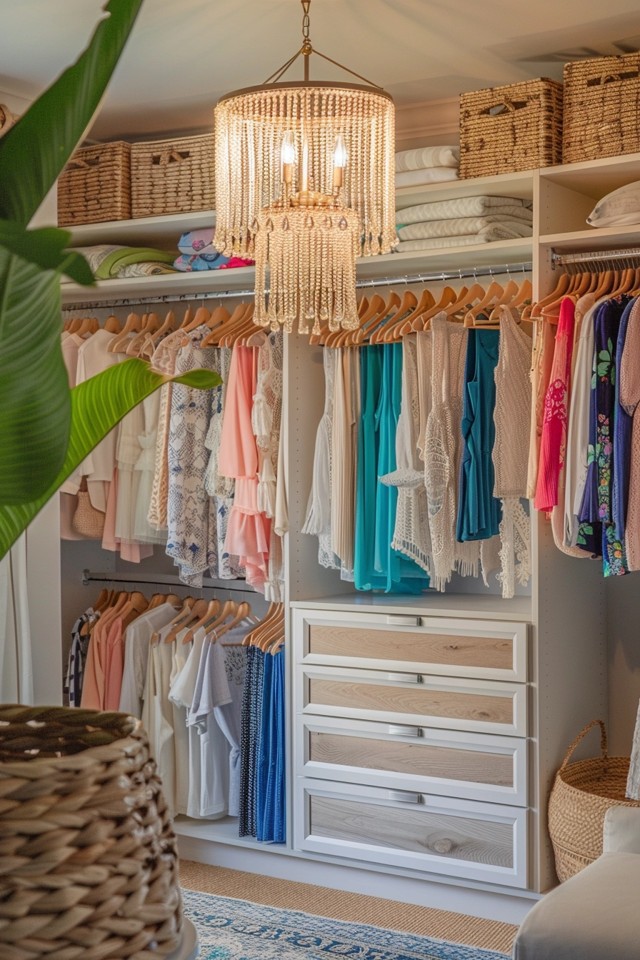
Elevate Your Space with Closet Chandelier Ideas
Every morning begins in your closet. It is the space where you set the tone for the day ahead, yet it is often the most neglected room in the house regarding design. Adding a chandelier to a closet transforms it from a dark storage unit into a luxury boutique.
I recall a project where a client had a spacious walk-in, but she hated getting dressed there because the lighting was harsh and industrial. We swapped the builder-grade flush mount for a small-scale brass chandelier, and the entire energy of her morning routine shifted. I have curated a stunning picture gallery at the end of this post to spark your imagination.
This guide will walk you through everything you need to know, from safety codes to styling tips, ensuring your closet feels like a high-end dressing room.
Defining the Boutique Aesthetic
The primary reason to install a chandelier in a closet is psychological. A closet is strictly utilitarian by definition, but we all crave a moment of glamour. A chandelier signals that this is a room for care and preparation, not just storage.
However, aesthetics must meet function. In a closet, you need to distinguish navy blue from black and spot stains before you leave the house. A chandelier provides ambient light, but the quality of that light matters immensely.
When I design a closet, I view the ceiling fixture as the “crown jewels” of the space. It draws the eye upward, making small closets feel taller and large closets feel grander. It is the easiest renovation you can do that requires no structural changes.
Calculating Scale and Clearance
The most common issue I see in DIY closet makeovers is improper sizing. A fixture that is too small looks cheap, while one that is too large feels oppressive and crowds the space.
The Math of Sizing
To find the right diameter for your chandelier, use this standard interior design formula: add the length and width of the room in feet, and convert that number to inches. For example, if your closet is 8 feet by 10 feet, the sum is 18. Therefore, look for a chandelier approximately 18 inches in diameter.
Vertical Clearance Rules
Height is even more critical than width. You generally need 7 feet of clearance from the bottom of the fixture to the floor to walk underneath it safely. If you have standard 8-foot ceilings, this leaves you only 12 inches for the fixture height. In this case, semi-flush mounts are your best friend.
If you have higher ceilings (9 feet or more), you have the luxury of a pendant or a tiered chandelier. Always measure the drop length before purchasing. You do not want to be dodging crystal droplets while putting on a sweater.
Designer’s Note: The Door Swing Factor
One specific constraint that ruins many installations is the door swing. If your closet door opens inward, you must measure the distance from the door header to the center of the room. Ensure your chandelier does not hang low enough to collide with the door when it is fully open. I usually use a door stop or choose a fixture that sits higher than the top of the door frame to eliminate this risk entirely.
Navigating Safety Codes and Heat
Closets have strict electrical codes because they are filled with flammable materials like fabric and cardboard. Ignorance of these codes can lead to fire hazards or failed home inspections when you eventually sell.
The NEC Clearance Requirements
The National Electrical Code (NEC) dictates how far a light fixture must be from the nearest storage space (shelving or rods).
- Incandescent fixtures: Must be at least 12 inches away from the nearest shelf or rod.
- LED or Recessed fixtures: Can generally be closer, often 6 inches, because they emit less heat.
- Pendants: Surface-mounted or pendant fixtures generally require that 12-inch clearance horizontally from the storage area.
Why LED is Non-Negotiable
Beyond safety codes, incandescent bulbs get hot. In a small, enclosed room, a hot light fixture will raise the temperature, which is bad for leather and delicates. Furthermore, heat can fade the shoulders of garments stored on high shelves.
I only specify LED fixtures for closet projects. They run cool, save energy, and allow for a wider range of placement options closer to your shelving units. If you fall in love with a vintage fixture, have it rewired for LED bulbs before installation.
Selecting the Right Style and Finish
Once you have your measurements and safety parameters, you can have fun with the design. The chandelier should bridge the gap between your bedroom decor and the closet cabinetry.
Crystal and Glass
This is the classic “glam” look. Crystal refracts light, bouncing it into dark corners of the closet. This is excellent for maximizing brightness. However, be aware that glass requires dusting. In a closet, clothes generate a surprising amount of dust (lint). If you hate cleaning, skip the intricate crystals.
Metals and Drums
For a more masculine or modern look, a drum shade with metal detailing works well. A white linen drum shade diffuses light softly, preventing harsh shadows on your face. This is ideal if your closet doubles as a makeup station.
Matching Your Hardware
A simple way to ensure cohesion is to match the chandelier finish to your closet rods or drawer pulls. If you have matte black rods, a black geometric pendant looks sharp. If you have chrome hardware, a polished nickel fixture adds a nice layer of shine without clashing.
Common Mistakes + Fixes
Mistake: Using a fixture with a solid metal shade (like a warehouse pendant).
Fix: These fixtures direct all light downward, leaving the top shelves and corners in total darkness. Choose a fixture with clear glass, exposed bulbs, or a translucent shade to cast light in all directions.
Mistake: Buying a fixture based on how it looks when off.
Fix: Always check the “lit” photos online. Some fixtures cast weird, cage-like shadows on the walls that make it hard to see your clothes clearly.
Understanding Color Temperature (CRI)
You might buy the most expensive chandelier, but if you put the wrong bulbs in it, your clothes will look wrong. Have you ever put on socks that looked black in your closet, only to realize they were navy blue when you got outside? That is a lighting failure.
The Importance of CRI
CRI stands for Color Rendering Index. It measures how accurately a light source reveals colors compared to natural sunlight. For a closet, you want a bulb with a CRI of 90 or higher. This ensures your reds are red and your navies are distinct.
Kelvin Temperature
This measures the “warmth” or “coolness” of the light.
- 2700K: Too yellow. It creates a cozy vibe but distorts colors.
- 3000K to 3500K: The sweet spot. It is crisp and neutral but not sterile.
- 4000K+: Too blue. This looks like a hospital or a commercial garage.
I always recommend 3000K LED bulbs with a high CRI for closets. It provides the most honest reflection in the mirror.
Layering Light for Functionality
A chandelier is primarily for ambient light and decoration. In a large walk-in closet, a single center fixture will not be enough. You will cast a shadow on your clothes as you stand in front of them.
Recessed Lighting
In larger projects, I pair a decorative center chandelier with recessed cans around the perimeter of the room. The cans are positioned about 18 to 24 inches off the wall to shine directly onto the hanging clothes.
LED Strip Lighting
If you cannot add recessed lights, consider running vertical LED channels inside the cabinet frames. This illuminates the clothes from the front. If you are renting or on a budget, battery-operated motion-sensor LED strips are a fantastic alternative that you can stick to the underside of shelves.
The Dimmer Switch
Never install a chandelier without a dimmer. In the morning, you need full brightness to find your shoes. In the evening, you might want soft, low light while you are winding down and putting away laundry. A dimmer gives you control over the mood.
Specific Layout Solutions
Different closet shapes demand different lighting strategies. Here is how I tackle the three most common layouts.
The Galley Closet
This is a long, narrow closet with storage on both sides. A single round chandelier often looks lost here. Instead, consider two smaller, identical semi-flush fixtures spaced evenly apart. This ensures light reaches both ends of the galley. Alternatively, a linear chandelier (rectangular shape) can work if it runs parallel to the walking path.
The L-Shaped Walk-In
These spaces usually have a dead corner. I like to center the chandelier in the main open square of floor space. Do not try to center it based on the room dimensions if one wall is covered in deep shelving; center it visually in the available walking space.
The Reach-In Closet
Yes, you can put a “chandelier” in a standard reach-in closet! You just need a mini-chandelier or a flush mount with hanging crystals. The key here is the header above the door. If you have a deep header, you might be able to tuck a small fixture just behind it. However, usually, you are looking at replacing the external boob light with something more decorative that sits flush against the ceiling.
Installation and Practicality
If you are replacing an existing light, this is a straightforward task for a handyman or a confident DIYer. However, if your closet currently has no light, you will need a licensed electrician to run a junction box.
The “Renter Friendly” Swag
If you rent and cannot hardwire a fixture, look for a swag chandelier. These plug into a standard outlet and hang from a hook in the ceiling. You can run the cord discreetly along the corner of the wall. It adds the drama of a chandelier without losing your security deposit.
Maintenance Reality Check
Closets generate dust. Fabric shades can get dingy over time and are hard to clean. Intricate glass fixtures require hand-polishing. If you are busy, choose a fixture with a simple shape and minimal crevices. A quick wipe with a microfiber cloth should be all it takes to keep it shining.
Final Checklist: What I’d Do in a Real Project
If I were standing in your closet today designing this upgrade, this is the exact mental checklist I would run through to ensure success.
- Measure the Room: Calculate Length + Width in feet to get the fixture diameter in inches.
- Check Ceiling Height: If under 9 feet, filter search for “semi-flush” or “flush mount.” If over 9 feet, look at “pendants.”
- Swing the Door: Physically open the closet door and measure the clearance to the center of the room.
- Inspect Shelving: Locate the highest shelf. Ensure the fixture will be at least 6 to 12 inches away laterally from that shelf edge.
- Select Bulbs: Buy 3000K LED bulbs with a CRI of 90+ before the fixture arrives.
- Plan the Switch: Purchase a compatible dimmer switch to install alongside the fixture.
- Coordinate Finishes: Hold a color swatch of the fixture finish against the closet rods and door handles.
Frequently Asked Questions
Can I put a chandelier in a closet with 8-foot ceilings?
Absolutely. You just need to watch the drop height. Look for fixtures that hang down no more than 12 to 15 inches from the ceiling. This leaves you with roughly 6’9″ of clearance, which is comfortable for most people.
How many lumens do I need for a closet?
For a closet, you want it bright. Aim for about 30 to 50 lumens per square foot. If your closet is 50 square feet, you need a fixture (or combination of lights) that outputs 1,500 to 2,500 lumens.
Do I need a damp-rated fixture?
Generally, no. Closets are dry environments. Unless your closet is directly connected to a bathroom without a door and experiences high humidity, a standard dry-rated fixture is perfectly fine.
Is a clear shade or frosted shade better?
Frosted is usually better for closets because it diffuses the light and reduces glare. Clear glass can create harsh shadows and requires prettier “Edison” style bulbs, which often have poor color rendering.
Conclusion
Lighting is the unsung hero of interior design, and nowhere is this more true than in a closet. A well-chosen chandelier does more than just light up your wardrobe; it elevates the experience of getting dressed. It turns a mundane daily task into a ritual.
By following the rules of scale, prioritizing high-quality LED light, and respecting safety codes, you can add a touch of luxury to your home that you will enjoy every single day. It is a small investment that offers a massive return on daily happiness.
Picture Gallery


