
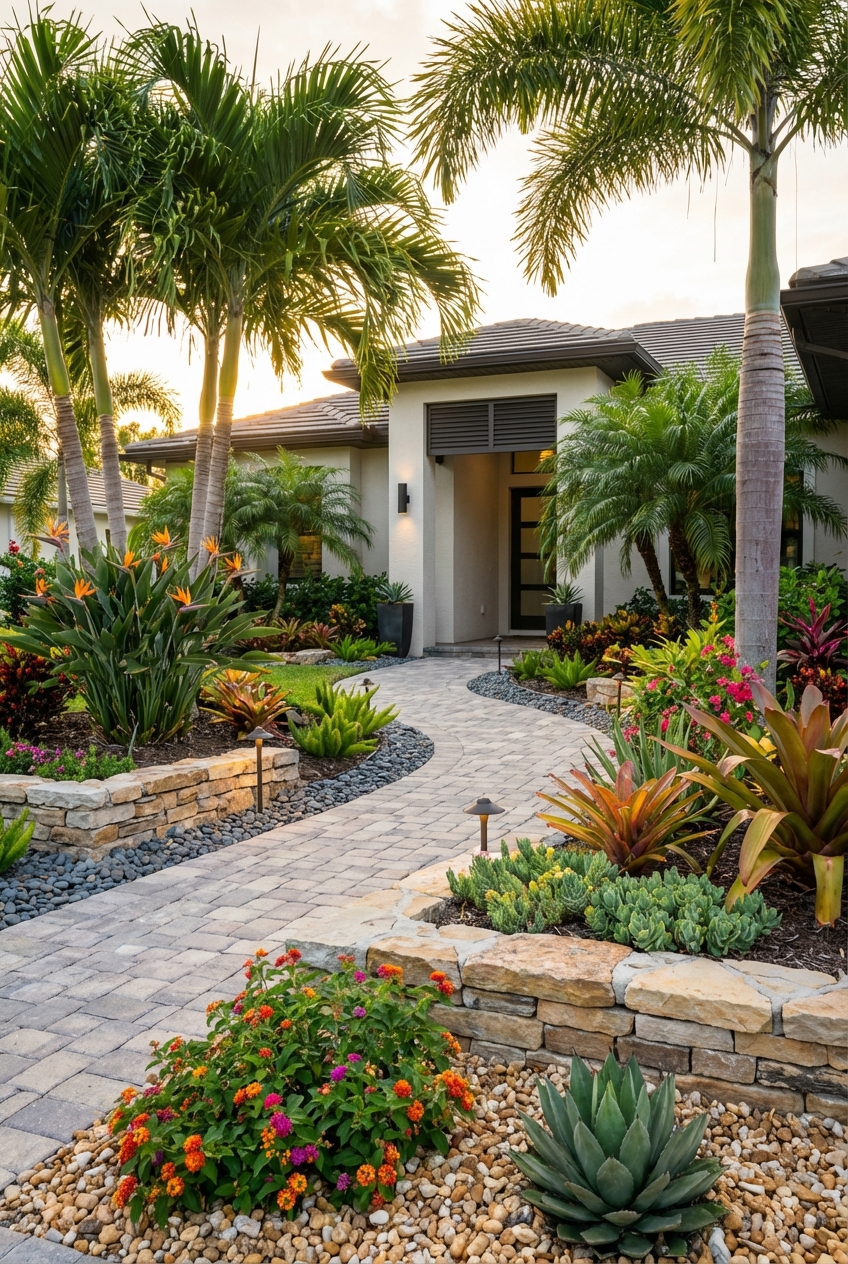
Florida Front Yard Landscaping Tips & Tricks
Florida landscaping is unlike gardening anywhere else in the United States. Between the punishing heat, the sandy soil, and the sudden tropical downpours, your front yard faces unique challenges that require a specific set of rules.
When you approach your front yard through the lens of a designer, you aren’t just planting bushes; you are creating a transition from the street to your sanctuary. Done correctly, a well-designed Florida yard increases property value and creates a cooling microclimate around your home.
At-a-Glance: Key Takeaways
- Native plants are king: Choose species like Saw Palmetto, Muhly Grass, and Coontie for high survival rates and low maintenance.
- Layer for depth: Use the three-tier rule—tall background trees, mid-level shrubs, and low-growing groundcover.
- Manage the moisture: Ensure your grading directs water away from the foundation while using mulch to retain moisture in the sandy soil.
- Scale is everything: Large Florida homes require large-scale foliage; small plants often get lost against expansive stucco walls.
- Lighting matters: Low-voltage LED lighting should highlight architectural features and path safety, not just flood the yard with light.
What This Style Means (and Who It’s For)
Florida front yard landscaping isn’t a single “look,” but rather a commitment to resilience and vibrant texture. It ranges from the structured, formal appearance of a Palm Beach estate to the “Old Florida” look of lush, wild tropicals.
This approach is for homeowners who want to maximize curb appeal without becoming a slave to their lawnmower. It is for people who understand that in Florida, the outdoor space is an extension of the indoor living area, serving as the first “room” guests experience.
Whether you are dealing with a small beach cottage or a sprawling suburban lot, the goal is to create a landscape that survives the “dog days” of August while remaining lush during the drier winter months. This style favors architectural plants with strong silhouettes over delicate flowers that might wilt in 95-degree humidity.
The Signature Look: Ingredients That Make It Work
To achieve a professional-grade Florida landscape, you need a specific palette of materials and plants that can handle the environment. Here are the core ingredients I use in every high-end Florida project.
1. Structural Palms and Trees
Instead of a single lonely palm in the center of the yard, think in clusters. Use a mix of heights, such as a multi-trunk Christmas Palm or a stately Sylvester Palm. For shade and structure, Live Oaks or Magnolia trees are the classic Florida “bones.”
2. Texture-Rich Groundcover
Move beyond just grass. Incorporate “soft” elements like Jasmine Minima or Perennial Peanut. These create a carpet effect that requires no mowing and stays green year-round.
3. Hardscape Contrast
Florida soil is often beige or gray sand. You need contrast. Use dark Mexican beach pebbles, shell-stone pavers, or local Florida fieldstone to create clean lines and defined borders. This “frames” the greenery and makes the yard look intentional.
4. Salt-Tolerant Accents
If you live within five miles of the coast, salt spray is a reality. Ingredients like Sea Grapes, Oleander, and Silver Buttonwood are non-negotiable for longevity. They have waxy leaves that resist the “burning” effect of salty air.
Layout & Proportions (Designer Rules of Thumb)
In interior design, we talk about the “Golden Ratio,” and the same applies to your front yard. If your beds are too narrow, the house looks top-heavy. If they are too deep, the yard looks messy.
The 2/3 Rule for Planting Beds
For a balanced look, your planting beds should generally extend out from the house at least 2/3 the height of the home’s first story. If your eaves are 10 feet high, your foundation beds should be about 6 to 7 feet deep. This provides enough room to layer plants without them crowding against the walls.
The Rule of Three (and Odds)
Never plant things in even numbers. Two shrubs look like ears; four looks like a crowded line. Groups of three, five, or seven create a natural, flowing rhythm that is easier for the eye to process. For a professional look, group three different heights of the same species together to create a “thickout.”
Spacing for Maturity
This is where most DIYers fail. A 3-gallon Silver Saw Palmetto looks small today, but it will eventually be 5 feet wide. Space your plants based on their 5-year growth size, not their size at the nursery. Generally, keep shrubs at least 3 feet away from the house siding to allow for airflow and to prevent pests.
Pathways and Clearances
The main walkway to your front door should be a minimum of 48 inches wide. This allows two people to walk side-by-side. If you have a secondary path (like one leading to the side yard), 30 to 36 inches is acceptable. Use “over-scale” stepping stones to make a small yard feel larger.
Designer’s Note:
In Florida, the sun is so bright that colors appear washed out. If you choose pale pastel flowers, they will vanish from the street view. I always recommend “saturated” colors for Florida front yards—think deep reds, vibrant oranges, and dark purples. These hold their own against the high-contrast Florida light.
Step-by-Step: How to Recreate This Look
Follow this sequence to ensure your landscaping project doesn’t just look good on day one, but thrives for years to come.
- Conduct a “Sun Audit”: Spend one Saturday tracking the sun. Which parts of the yard get 8+ hours of direct light? Which parts are in the shadow of the house? Florida “Full Sun” is much more intense than northern sun; some “sun-loving” plants will actually scorch here.
- Test Your Drainage: Dig a hole 12 inches deep and fill it with water. If it hasn’t drained in an hour, you have a compaction issue or a high water table. You may need to build raised beds or install a French drain before planting.
- Kill the “Bad” Grass: Most Florida yards are full of Crabgrass or invasive weeds. Use a sod cutter to remove the top layer rather than just tilling it in, which often just replants the weed seeds.
- Amend the Soil: Florida “soil” is mostly sand with zero nutrients. Mix in organic compost and peat moss to a depth of 6 inches in your new planting beds. This gives the roots a fighting chance to hold onto water.
- Map Your Hardscape: Install your edging, pavers, or decorative rock first. It is much easier to plant around a stone path than it is to lay stone around delicate new plants.
- Set the “Anchors”: Plant your largest trees and palms first. These are the focal points that everything else will rotate around.
- Layer the Mid-Story: Add your hedges and medium-sized shrubs (like Hibiscus or Boxwood). These should hide the “foundation line” of the house.
- Fill the Gaps: Add your groundcovers and “jewelry” plants (small flowers or colorful bromeliads).
- Irrigation Check: Adjust your sprinkler heads. Ensure they are hitting the root balls of the plants, not the leaves or the side of your house.
- Mulch Heavily: Apply 3 inches of mulch. In Florida, I prefer Pine Bark Nuggets or Eucalyptus mulch over cypress, as they stay in place during heavy rain and don’t mat down as easily.
Budget Breakdown: Low / Mid / Splurge
Landscaping costs can vary wildly based on the maturity of the plants you buy. Here is how to allocate your funds effectively.
Low Budget ($500 – $1,500): The “Refresh”
Focus on high-impact, low-cost changes. Re-edge your existing beds with a crisp, deep line. Replace old, faded mulch with fresh dark brown or black nuggets. Buy “starter” sizes (1-gallon) of native grasses and let them grow in over two seasons. A fresh coat of paint on the front door and new house numbers will finish the look.
Mid-Range ($2,000 – $7,000): The “Renovation”
This budget allows for professional soil amendment and the installation of a few mature focal points. You can afford one or two 10-foot palms and a complete overhaul of the foundation plantings. You can also upgrade to a professional-grade low-voltage lighting system with 6-8 fixtures.
Splurge ($10,000+): The “Estate Look”
Now you are looking at specimen trees—think massive Canary Island Date Palms or ancient Olive trees. This budget includes masonry work, such as stacked stone retaining walls or a custom paver driveway. You can also install an automated “smart” irrigation system that adjusts based on local rainfall data.
Common Mistakes (and How to Fix Them)
Mistake: The “Lollipop” Pruning
Many Florida homeowners trim their shrubs into perfect spheres. This kills the interior of the plant because light can’t reach the center.
The Fix: Use hand pruners to thin out the branches naturally. This keeps the plant healthy and creates a much more modern, designer aesthetic.
Mistake: Planting Too Close to the Foundation
People want to hide the bottom of their house immediately, so they jam plants against the stucco. This leads to mold, wood rot, and termite paths.
The Fix: Pull everything out at least 3 feet. Fill that gap with decorative river rock for drainage and airflow.
Mistake: Over-Irrigating
Watering every day encourages shallow roots that can’t survive a drought.
The Fix: Water deeply but less frequently (2-3 times a week for longer durations). This “teaches” the roots to grow deep into the soil to find moisture.
Mistake: Using Only One Species
A monoculture of “Viburnum” hedges is boring and susceptible to pests. If one gets sick, they all die.
The Fix: Mix textures. Pair a broad-leafed plant (like a Bird of Paradise) with a fine-textured grass (like Fakahatchee Grass).
Room-by-Room Variations
Treat your front yard like a series of “outdoor rooms” to make the design feel cohesive yet interesting.
The “Foyer” (Front Entryway)
This is the area directly surrounding your front door. Use high-end materials here because people see them up close. I recommend large, architectural planters with “spiller, filler, and thriller” combinations. Focus on scent here—plant Gardenias or Jasmine near the door so the fragrance greets guests as they enter.
The “Hallway” (Driveway and Paths)
The edges of your driveway are often forgotten. Avoid planting delicate flowers here that will be stepped on or run over by a car tire. Instead, use tough, “foot-traffic-friendly” plants like Mondo Grass or Flax Lily. Ensure any lighting is recessed so it doesn’t get clipped by the lawnmower.
The “Curb Gallery” (The Street View)
This is about big-picture impact. Use bold, repeating patterns. If you have a long street frontage, repeating a group of three Silver Saw Palmettos every 15 feet creates a professional “rhythm” that guides the eye toward the house.
The “Privacy Screen” (Side Yards)
Side yards in Florida are often narrow “wind tunnels.” Use vertical, columnar plants like Italian Cypress or ‘Skyrocket’ Juniper to provide privacy from neighbors without taking up 6 feet of width. This keeps the side yard functional as a walkway while still looking lush.
Finish & Styling Checklist
Before you call the project finished, go through this “What I’d do in a real project” checklist to ensure those professional finishing touches are present.
- Check all “sightlines” from the street. Is there a stray garden hose or an AC unit visible? If so, screen it with a small section of lattice or a dense “Sweet Viburnum” hedge.
- Install a “hidden” border. Use 4-inch deep metal or heavy-duty plastic edging to keep your grass from creeping into your mulch beds.
- Layer your mulch. Don’t just throw it down; pack it in around the base of the plants to prevent “volcano mulching” (where mulch touches the bark of the tree, which causes rot).
- Check the lighting at night. Walk to the street and look back. Are the lights blinding you? If so, tilt the fixtures down or add “shrouds” to the bulbs.
- Add one “Conversation Piece.” This could be a large blue ceramic urn, a piece of driftwood, or a designer bench. Every yard needs one non-plant focal point.
- Hide the utilities. Paint your electrical boxes and pipes the same color as your house (or a dark “camo” green) so they disappear into the shadows.
FAQs
What is the best grass for a Florida front yard?
It depends on your shade. St. Augustine is the Florida standard—it’s thick and lush but requires a lot of water. If you want something tougher and more drought-tolerant, look into Zoysia (specifically ‘Empire’ Zoysia). If you have zero irrigation and a “wilder” look, Bahia is the sturdiest option, though it is less soft to walk on.
How do I handle “The Big Wet” season?
From June to September, Florida gets massive amounts of rain. Your yard must be graded so water moves away from the house. If you have “puddling” issues, consider a Rain Garden—a depressed area planted with water-loving plants like Pickerelweed or Canna Lilies that naturally filter and absorb excess runoff.
Can I have a “No-Mow” front yard in Florida?
Yes, and it is becoming very popular. You can replace the lawn with a combination of “Florida Snow” (large areas of Jasmine Minima), decorative gravel paths, and expanded planting beds. Not only does this look high-end, but it also reduces your water bill and fertilizer runoff.
What should I do if my yard is mostly shade?
Many Florida yards are dominated by old Oak trees. Standard turf will die there. Instead, lean into the shade with Bromeliads, Ferns (like the Macho Fern), and Gingers. These thrive in the “dappled light” found under tree canopies and give off a very high-end tropical resort vibe.
Conclusion
Landscaping in Florida is a marathon, not a sprint. The most important thing to remember is that you are working with nature, not against it. By selecting plants that are adapted to the heat and salt, and by following designer rules of scale and proportion, you can create a front yard that stands out in the neighborhood.
Start with a clear plan, invest in your soil, and don’t be afraid to pull out plants that are struggling. A designer-level yard is one that looks intentional, well-maintained, and perfectly suited to the unique, beautiful climate of the Sunshine State. With these tips, your front yard will transition from a simple patch of grass into a stunning introduction to your home.


