
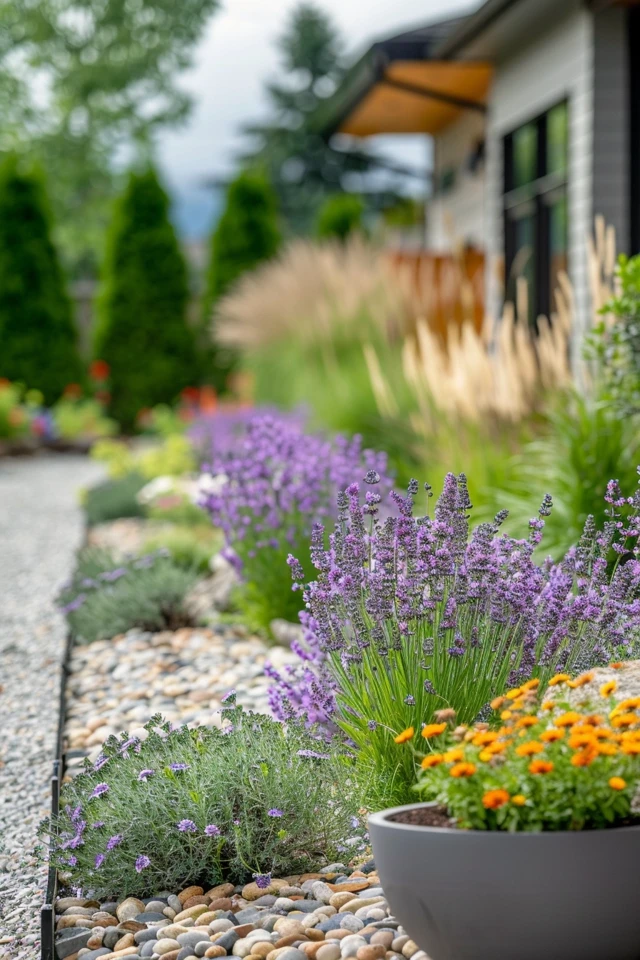
Front Yard Corner Lot Landscaping: Creative Tips
Living on a corner lot is a double-edged sword in the world of residential design. You have twice the curb appeal and openness, but you also deal with the “fishbowl effect” where two sides of your home are exposed to the street. If you are looking for visual inspiration, keep in mind that a curated Picture Gallery is at the end of the blog post.
When I work with clients on corner lots, the biggest complaint is a lack of privacy and confusion over where the “front” actually is. Guests often wander to the side door, or delivery drivers leave packages at the garage entrance. The goal is to anchor the house visually so it commands the corner rather than floating aimlessly on it.
This guide will walk you through how to manage that exposure while creating a stunning landscape. We will cover privacy layering, directing foot traffic, and using the unique geometry of a corner lot to your advantage.
1. Establishing a Clear Hierarchy of Entrance
The most critical design flaw I see with corner lots is the “dual front” confusion. When a house faces two streets, the architecture sometimes sends mixed signals about where the main entrance is. Your landscape design must solve this problem, not add to it.
You need to create a visual hierarchy using hardscaping and lighting. The path to your front door should be significantly wider and more ornamental than any secondary paths leading to a side yard or back gate.
If your main walkway is 48 inches wide (which is my standard recommendation for a comfortable two-person entry), the side path should be no more than 30 or 36 inches. This subtle difference tells the brain which path is for the public and which is service-oriented.
Use materials to reinforce this. If you use high-end bluestone or pavers for the front walk, transition to gravel or simple stepping stones for the side. This material change acts as a subconscious “do not enter” sign for casual visitors.
Designer’s Note: The 90-Degree Rule
In my projects, I always verify how the house sits relative to the intersection. If the front door faces the intersection directly, you have a clear focal point.
However, if the door faces one street, do not plant a large tree directly in front of it to block the view from the cross street. You want the door to be visible from the corner apex to help with wayfinding.
Common Mistakes + Fixes
Mistake: Using the same lighting intensity on both street-facing sides.
Fix: Your front door and main walkway should be the brightest points. Use softer, ambient uplighting on the side street facade. This creates a focal point through illumination.
2. Managing Privacy: The Layered Buffer Zone
Privacy is the number one request I get for corner lots. The instinct is often to put up a 6-foot fence right at the sidewalk edge. Unfortunately, most municipal zoning codes prohibit tall fences in the front setback, usually capping them at 3 or 4 feet.
Instead of a fortress, I use a technique called “green layering.” We start with a hardscape element, like a low masonry wall or a picket fence, set back about 3 to 5 feet from the public sidewalk.
In that 3-to-5-foot gap between the sidewalk and the fence, we plant tough, low-maintenance ground cover or perennials. This is the “public” face. Inside the fence or wall, on the house side, is where the real privacy happens.
I install taller evergreen shrubs or ornamental grasses inside the fence line. This allows you to visually extend the height of the barrier without violating code. A 3-foot fence plus a 3-foot hedge behind it gives you 6 feet of visual screening from the street, but it feels lush rather than defensive.
Specific Measurements for Buffers
For the interior hedge layer, you want plants that are dense but don’t eat up your yard space. I often specify ‘Green Mountain’ Boxwoods or ‘Sky Pencil’ Hollies.
Spacing: Plant upright growers 30 inches apart (center-to-center) for a solid wall within three years.
Setback: Ensure the center of the plant is at least 24 inches from the fence to prevent it from growing through the slats.
What I’d Do in a Real Project
1. Check local zoning for “corner visibility triangles” (areas where you cannot plant anything tall for traffic safety).
2. Install a 42-inch high horizontal slat fence in cedar or composite.
3. Plant a row of Hydrangea paniculata ‘Limelight’ behind the fence for seasonal privacy that starts at 4 feet and grows to 6+ feet.
3. Addressing the “Desire Line” (The Corner Cut-Through)
There is a phenomenon in landscape architecture called the “desire line.” This is the path humans naturally want to take, regardless of where the paved sidewalk is. On corner lots, this manifests as pedestrians cutting across the corner of your lawn to save three steps.
You can fight this with aggressive thorny bushes, but that looks hostile. A better design approach is to surrender the corner or fortify it elegantly.
One successful strategy is to hardscape that specific corner tip. I often replace the grass on the immediate corner radius with cobblestones, gravel, or a low masonry planter. This removes the grass that gets trampled to mud.
If you prefer to keep pedestrians out, use “sculptural obstruction.” Place a grouping of three large boulders or a heavy iron lantern post right at the corner apex. It looks like an intentional design feature, but it physically blocks the shortcut.
Planting for the Corner Apex
This area takes a beating from road salt, dog walkers, and radiant heat from the asphalt. Do not plant delicate specimens here.
Rugged Choices: Daylilies, Rugosa Roses, or ornamental grasses like Switchgrass (Panicum virgatum).
Mulch: Use gravel or river rock instead of wood mulch at the very corner; rain and foot traffic tend to wash wood mulch onto the sidewalk.
Designer’s Note: Visibility Triangles
Most towns require that vegetation at a street corner be kept under 30 inches in height. This ensures cars at the stop sign can see oncoming traffic.
I once had a client who planted massive Arborvitae right at the corner. The city issued a citation and forced us to rip them out two months later. Always measure 20 feet back from the corner intersection before planting anything taller than your knee.
4. Connecting Two Facades with Cohesive Planting
A corner house usually has a “front” facade and a “side” facade that faces the secondary street. The side facade often has fewer windows and less architectural detail, making it look like a large, blank wall.
The landscape needs to bridge this gap. You want the side street to feel like a continuation of the front, not a forgotten alley. We achieve this through repetition of plant material.
Identify the “anchor plants” you used in the front foundation plantings. If you used Boxwoods and Hydrangeas in the front, you must wrap them around the corner to the side.
You do not need to maintain the same density. If the front has a triple layer of plants, the side might only drop to a single layer. However, the species must remain consistent to tie the two views together.
Scale is vital here. A long, blank side wall needs height to break up the horizontal expanse. I like to use columnar trees that grow tall but narrow.
Recommended Columnar Trees for Tight Sides
Armstrong Gold Red Maple: Great for narrow side yards, offers fall color.
Columnar Norwegian Spruce: Provides year-round green against a light-colored siding.
Measurements: Plant these at least 6 to 8 feet away from the foundation to avoid root issues, even if they look small when you buy them.
Common Mistakes + Fixes
Mistake: Stopping the landscaping abruptly at the corner of the house.
Fix: Curve the planting bed around the corner. Instead of a 90-degree angle in the garden bed, use a sweeping radius that guides the eye from the front street to the side street.
5. Creating Distinct Zones in the Yard
Because corner lots often have more square footage in the front and side than in the back, you have a unique opportunity to reclaim the front yard for living space. This is a huge trend in modern landscape design.
We call this creating a “semi-private” zone. This might be a small patio or a bench area situated in the side yard. By using the screening techniques mentioned earlier, this space becomes usable.
I often design a secondary destination point on the side street aspect of the property. This could be a fire pit area or a small reading garden. It utilizes land that is otherwise just “mow-and-blow” maintenance space.
To make this work, the ground surface needs to change. If your driveway is on the side street, consider widening a portion of the walkway connecting the driveway to the house to create a small landing pad for two chairs.
Lighting the Zones
Lighting is what separates the public view from the private feel. On a corner lot, you are responsible for lighting two street frontages.
Security Lighting: Use motion sensors on the side facade, but aim them downward. You don’t want to blind drivers or annoy neighbors across the street.Aesthetic Lighting: Use uplights on the trees that wrap the corner. This creates a boundary of light that defines your territory.
Spacing: Place path lights every 6 to 8 feet. Avoid the “runway effect” of placing them too close together.
Final Checklist: The Corner Lot Strategy
Before you buy a single plant or pour concrete, run through this checklist. I use a version of this for every corner lot consultation.
1. Site Analysis & Constraints
Check the deed for easements (utility boxes are common on corners).
Measure the “visibility triangle” required by your municipality.
Identify the sun path; corner lots often have harsh afternoon sun on the exposed side.
2. Hardscape Planning
Define the primary path (min. 48 inches wide).
Plan the corner “cut-through” defense (boulders or paving).
Check setback requirements for fencing.
3. Plant Selection
Select rugged plants for the “hell strip” (between sidewalk and street).
Choose vertical/columnar trees for the long side wall.
Ensure winter interest (evergreens) to prevent the fishbowl effect in January.
4. Privacy & Zoning
Plan the buffer layer (Fence + Hedge).
Locate the “private” pocket in the side yard.
5. Lighting Plan
Highlight the front door as the primary focal point.
* Wrap uplighting around the corner to connect both streets.
FAQs
How do I handle the sidewalk snow removal on a corner lot?
This is the tax of corner living. You are usually responsible for clearing both sides. Design your planting beds so that you have a place to pile the snow. Do not plant brittle shrubs (like Boxwood) right next to the sidewalk where heavy snow loads from a shovel will crush them. Leave a 2-foot strip of turf or gravel buffer.
Can I move my driveway to the other street?
Usually, this is difficult. Municipalities hate adding new curb cuts because it removes street parking and complicates traffic flow. However, if your current driveway is dangerous due to the intersection, you might have a case. Consult a civil engineer before a landscape designer for this specific issue.
What is the best fence style for a corner lot?
A picket fence or horizontal slat fence with gaps is best. Solid walls can feel oppressive on a corner and may block necessary sightlines. Open fencing allows air and light through while still defining the boundary.
Conclusion
Designing for a corner lot requires a shift in perspective. You aren’t just decorating a front yard; you are managing a three-dimensional transition between two public spaces. It is about claiming your space without walling yourself off completely.
Focus on establishing a clear entrance, layering your privacy, and using the extra frontage to display cohesive, beautiful planting. When done correctly, the “fishbowl” turns into a grand stage, and your home becomes the anchor of the neighborhood.
Picture Gallery


