
Low Ceiling Finished Basement Ideas to Transform Space
I remember the first time I walked into the basement of my current home. It felt less like a potential family room and more like a medieval dungeon, complete with a seven-foot clearance that made me instinctively duck every time I passed under a duct.
Low ceilings are the most common challenge homeowners face when renovating a basement. They can make a space feel dark, cramped, and uninviting, regardless of how much square footage you actually have. To help you visualize how these concepts come together, I have curated a comprehensive Picture Gallery at the end of the blog post with real-world examples.
The good news is that you do not need to physically raise the roof to fix this. Through specific visual tricks, lighting adjustments, and furniture scaling, we can fool the eye into seeing more height than is actually there.
1. Architectural Strategies to Blur the Ceiling Line
The first step in dealing with a low basement ceiling is changing how the physical structure is perceived. In a standard room, we usually define the ceiling with heavy crown molding or a stark contrast in paint color. In a basement, this acts like a lid on a box.
If your ceiling is drywall, avoid wide crown molding. It visually lowers the ceiling height by several inches. Instead, consider taking the wall paint color up onto the ceiling about four to six inches. This technique, often called a “tray effect” without the actual tray, tricks the eye into thinking the walls are taller than they are.
If you are dealing with an unfinished ceiling or exposed joists, you have a massive opportunity. Spray painting the exposed ceiling, joists, ductwork, and pipes a single, matte color creates an “infinity effect.”
Common Mistakes + Fixes
Mistake: Drywalling around every individual pipe and duct, creating a jagged, multi-level ceiling landscape.
Fix: Group your mechanicals. If you must use soffits (bulkheads), try to widen them to create a deliberate architectural zone rather than a small, boxing-in strip. Alternatively, leave the mechanicals exposed and paint them to match the ceiling.
Designer’s Note: The “Black Ceiling” Debate
Clients often ask if painting an exposed basement ceiling black will make it feel like a cave. Surprisingly, the answer is usually no. A matte black spray finish on exposed joists makes the ceiling “disappear.” The eye cannot track the depth of the joists, so the boundary of the room feels infinite rather than capped at seven feet. However, this requires significant lighting to offset the dark color.
2. The Lighting Equation: Recessed vs. Flush Mounts
Lighting is the single most critical factor in a low-ceiling basement. Hanging fixtures are generally out of the question because they intrude into the headspace and create visual clutter.
Your best friend in a low basement is the recessed LED wafer light. Unlike old-school can lights that require deep housing, wafer lights are less than half an inch thick. They can be installed directly under joists or ductwork where traditional cans simply wouldn’t fit.
Aim for a grid pattern that provides even coverage. In a standard 8-foot room, we might space lights 4 to 5 feet apart. In a low-ceiling basement, you may need to tighten that spacing to 3 or 4 feet to ensure there are no dark pockets.
Lighting Temperature Rules
- Avoid 5000K: This is “daylight” blue and will make your basement look like a hospital or a pharmacy.
- Avoid 2700K: This is often too yellow and can make a dim basement feel dingy.
- The Sweet Spot: Aim for 3000K to 3500K. This provides a crisp, clean white light that mimics bright afternoon sun without the harsh blue tint.
Layering is Key
Never rely solely on overhead lights. They cast shadows downward, which can shorten the room. You must include floor lamps and table lamps. Specifically, look for floor lamps that cast light upward toward the ceiling. This washes the ceiling in light, physically brightening the surface and making it appear higher.
3. Furniture Selection: Low Profiles and Horizontal Lines
When the vertical space is limited, you must adjust the scale of your furnishings. Putting a high-back sectional or a tall armoire in a low basement highlights the lack of height. It makes the ceiling feel like it is crushing the furniture.
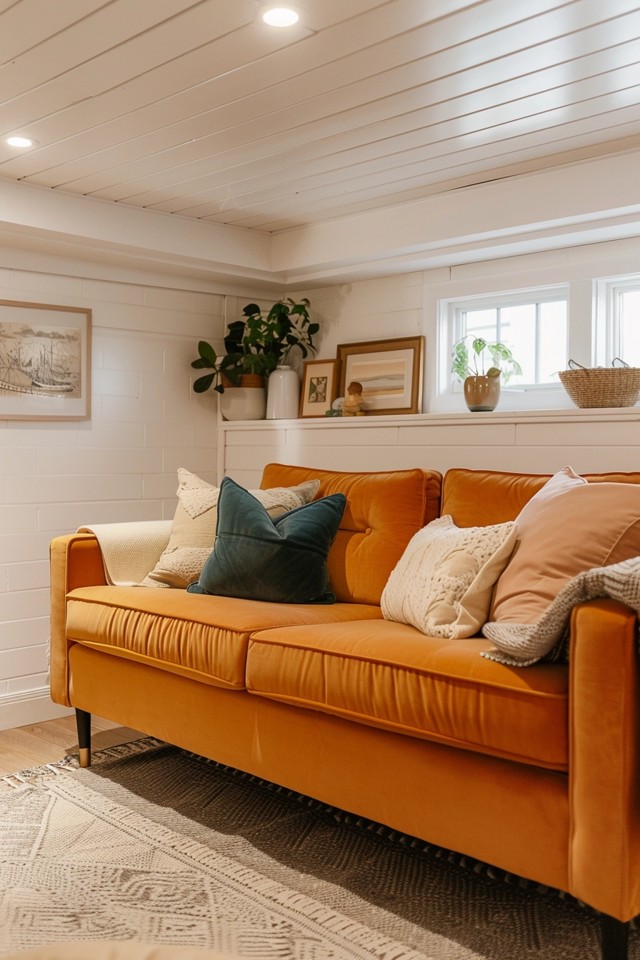
I always specify “low profile” furniture for these spaces. Look for sofas and armchairs with a back height of 32 inches or lower. This leaves more “white space” between the top of the furniture and the ceiling. That empty space is what your brain interprets as height.
Additionally, choose furniture with visible legs. A sofa with a skirt that goes all the way to the floor looks heavy and blocky. A sofa raised on 6-inch legs allows you to see the floor continuing underneath it. This increases the sense of total floor area and makes the room feel airier.
Measurements That Matter
- Sofa Back Height: Keep it under 32 inches.
- Seat Height: Standard is 17-18 inches; don’t go lower than this or it becomes hard to stand up, but avoid “throne” style seating.
- Walkways: In tight basements, aim for a minimum of 30 inches of clearance for walking paths, though 36 inches is ideal for comfort.
What I’d Do in a Real Project
If I am designing a media room in a basement with 7-foot ceilings, I rarely use a standard entertainment center. They are too bulky. Instead, I design a long, low floating console mounted to the wall. Keeping the floor visible beneath the media unit makes the wall look taller.
4. Verticality in Wall Treatments and Decor
Since we lack actual vertical height, we have to manufacture it. Vertical lines draw the eye upward, creating an optical illusion of lift.
One of the most effective ways to do this is with wall paneling. Beadboard, V-groove paneling, or vertical shiplap are excellent choices. The repetitive vertical lines act like arrows pointing toward the ceiling.
Drapery Placement
This is a non-negotiable rule for low ceilings: Mount your curtain rods as close to the ceiling as possible. Do not mount them right above the window frame.
Basement windows are often small, high up on the wall, and horizontal. If you mount the rod right on the window, you emphasize how small and squat the window is. By mounting the rod at the ceiling and letting the fabric hang all the way to the floor, you create a long vertical column of fabric.
Designer’s Note: The “Column” Problem
Basements usually have structural lally columns that hold up the house. You cannot move them. Instead of trying to hide them with bulky drywall boxes, try wrapping them in wood or rope for a tactile feature. If they are in a terrible spot, incorporate them into a built-in bar or a half-wall divider to make them feel intentional.
5. Flooring Choices to Maximize Light
The floor is the largest surface in the room, second only to the walls. In a low-ceiling environment, the floor needs to work hard to reflect light.
Dark floors can be moody and sophisticated, but in a low basement, they can suck the energy out of the room. I generally recommend light to mid-tone wood finishes. Luxury Vinyl Plank (LVP) is the industry standard for basements because it is waterproof and thin.
Thickness matters here. Solid hardwood requires a subfloor and the wood itself is thick, which might rob you of nearly two inches of headroom. LVP can be installed directly over concrete (with a moisture barrier) and is often only a few millimeters thick.
Rug Sizing and Placement
A rug that is too small creates a “postage stamp” effect, making the room look choppy and smaller.
- The Rule: Use the largest rug the room can handle while leaving 12-18 inches of bare floor around the perimeter.
- Legs On: Ensure at least the front legs of all furniture pieces are sitting on the rug. This unifies the seating zone.
- Texture: Since basements can feel cold, wool or high-quality synthetic blends add necessary warmth. Avoid flat-weave cotton rugs as they can feel flimsy on top of concrete.
Final Checklist: The “High-End” Basement Look
Before you finalize your design, run through this checklist. These are the steps I take to ensure a basement feels like a main floor, not a secondary storage space.
- Check the finishes: Did you use matte paint on the ceiling? (Gloss highlights imperfections and lowers the ceiling visually).
- Review the doors: Are you using standard 80-inch doors? If your ceiling is really low, you might need to trim doors down. Ensure this is done cleanly at the bottom.
- Layer the light: Do you have at least three sources of light (overhead, table, floor/sconce)?
- Control the humidity: A damp basement smells like a basement. Integrate a dehumidifier into your HVAC system or buy a high-capacity standalone unit.
- Color Drenching: Consider painting the walls, trim, and baseboards the exact same color. This blurs the boundaries and makes the walls feel taller.
FAQs
Q: Can I use a ceiling fan in a low-ceiling basement?
A: Generally, no. A standard fan on a downrod is a safety hazard in a 7-foot room. If you must have air circulation, look for “flush mount” or “hugger” fans specifically designed for low clearance. Even better, use wall-mounted oscillating fans or floor fans to keep the ceiling plane clean.
Q: Is it better to use drywall or a drop ceiling (suspended ceiling)?
A: Drywall always looks more residential and high-end. It mimics the upper floors of your home. However, drop ceilings provide access to pipes and wires. If you choose a drop ceiling, avoid the cheap 2×4 textured tiles. Look for 2×2 tegular tiles (which drop slightly below the grid) or smooth-finish tiles that look like plaster.
Q: My basement has ductwork that drops down to 6 feet. What can I do?
A: You cannot move main trunk lines easily. The best approach is to turn the area under the ductwork into a “seated zone.” Place your sofa or desk under the low soffit. You don’t need 8 feet of headroom when you are sitting down. Save the highest ceiling areas for walkways and standing zones.
Q: Should I paint my low basement white to make it look bigger?
A: Not necessarily. White needs natural light to bounce around; otherwise, it turns gray and shadowy in a basement. Warm neutrals, greiges, or even bold colors often work better because they hold their own in lower light conditions.
Conclusion
Transforming a basement with low ceilings is less about fighting the architecture and more about manipulating perspective. By choosing the right lighting fixtures, keeping furniture profiles low, and using vertical design elements on your walls, you can turn a cramped storage area into the most popular room in the house.
Remember that comfort is just as important as aesthetics. Address the temperature, the lighting quality, and the acoustics. When a space feels warm and sounds dampened (thanks to rugs and curtains), you stop noticing the ceiling height and start enjoying the room.
Picture Gallery


