
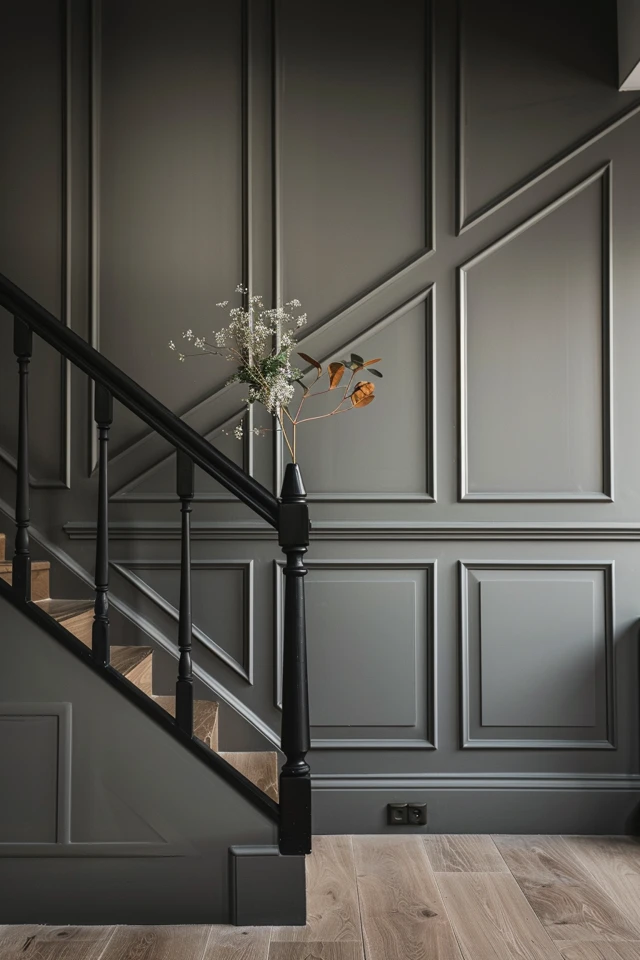
Staircase Wall Molding Ideas for Chic Interiors
1) Introduction
Staircases are notoriously difficult areas to design. They often feel like dark, narrow tunnels that serve a purely functional purpose, lacking the warmth found in the rest of the home. I remember one specific project in a colonial revival home where the entryway was stunning, but the moment you turned to the stairs, the energy completely flattened against a massive, blank sheet of drywall.
Adding wall molding is the single most effective way to bridge the gap between architectural interest and visual durability in these high-traffic zones. It provides a sense of history and intention that paint or wallpaper alone simply cannot achieve. Whether you are dealing with a tight, enclosed stairwell or a grand foyer with a curved banister, the right trim work guides the eye upward and creates a cohesive design narrative.
For those of you looking to visualize how these concepts come together in real homes, be sure to scroll all the way down to see the curated Picture Gallery at the end of this blog post. Until then, let’s dive into the technical details, material choices, and layout rules that will keep your project from looking like a DIY disaster.
2)
Decoding the Styles: Which Molding Suits Your Space?
Before buying materials, you must identify the architectural language of your home. A common error I see is forcing a Victorian level of detail into a mid-century modern split level. The molding should feel like it was always there, not slapped on as an afterthought.
Picture Frame (Box) Molding
This is the most versatile option for staircases. It consists of rectangles or squares created with thin trim pieces applied directly to the wall.
Best for: Adding perceived height to a space. Vertical rectangles draw the eye up.
The Vibe: Ranging from Parisian Chic to Transitional, depending on the thickness of the trim.
Pro Tip: For modern homes, use a simple flat stock trim. For traditional homes, use a trim with an Ogee or cove profile.
Board and Batten
This style features wide vertical boards spaced evenly apart, often capped with a horizontal rail. It is heavier and more substantial than picture framing.
The Vibe: Craftsman, Farmhouse, or Coastal.
The Scale: I usually recommend the battens (vertical pieces) be at least 2.5 inches wide for staircases to prevent them from looking spindly.
Shiplap and Tongue-and-Groove
Installing horizontal or vertical planks adds significant texture. On a staircase, running these vertically can help manage the awkward angles of the stair pitch.
Best for: Casual, approachable interiors.
The Vibe: Modern Rustic or Scandi.
Designer’s Note: Vertical V-groove paneling is currently trending because it elongates the wall and handles the angled cuts at the skirt board much more cleanly than horizontal shiplap.
3)
The Math of the Diagonal: Planning Your Layout
Designing molding for a flat wall is easy; designing it for a staircase requires geometry. The most challenging aspect is ensuring your molding follows the “pitch line” of the stairs. If your boxes or chair rails run parallel to the floor while the stairs climb at a 37-degree angle, the visual disconnect will be jarring.
Finding the Pitch Line
You cannot simply measure up from each tread, because treads have depth and height. You need to establish a continuous diagonal line.
Mark a specific height (e.g., 32 inches for a chair rail).
Snap a chalk line between these two points. This is your guide.
Spacing the Boxes
If you are doing picture frame molding, the bottom of the boxes must run parallel to that diagonal pitch line.
The Gap Rule: I generally leave 2 to 3 inches of space between the molding box and the chair rail or skirt board.
Consistency is Key: Whatever spacing you choose (e.g., 3 inches), it must remain constant between the boxes as well.
The Triangle Trap: On a staircase, your boxes will likely become parallelograms or trapezoids to follow the slope. This requires precise miter cuts that are rarely a standard 45 degrees. You will need a digital angle finder.
Designer’s Note: The Landing Pivot
The trickiest part of the installation is where the angled stair wall meets the flat landing wall.
Don’t: Try to force the angled molding to crash directly into the straight molding.
Do: Use a vertical stile (a vertical piece of wood) as a buffer point in the corner. This allows the angled molding to terminate gracefully before the flat wall begins.
4)
Material Selection: Durability Meets Aesthetics
Staircases are high-impact zones. We haul laundry baskets, suitcases, and furniture up and down them. The walls get kicked, scuffed, and bumped. Therefore, the material you choose matters just as much as the style.
Solid Wood vs. Finger-Jointed Pine
For stain-grade projects where you want to see the wood grain, you must use solid wood (oak, maple, etc.). However, for paint-grade projects, finger-jointed pine is superior to solid wood because it warps less.
Pros: distinct, sharp edges and very durable.
Cons: More expensive and requires more prep work (sanding).
MDF (Medium Density Fiberboard)
This is my go-to for most painted interior molding projects.
Pros: It is stable, doesn’t have knots, and paints beautifully smooth.
Cons: It hates water. If you mop your stairs heavily, ensure the bottom edge is well-sealed with oil-based primer.
Warning: MDF dust is fine and toxic. Always cut outside with a mask.
Polystyrene and PVC
I rarely recommend these for main living areas, but they have a place.
Use Case: Curved walls. If you have a curved staircase, flexible polyurethane molding is a lifesaver. It bends without snapping.
The Feel: It creates a “plastic” sound when tapped. I avoid using it for chair rails or elements that people naturally touch.
Common Mistakes + Fixes
Mistake: Using molding that is too thin (small scale).
Fix: In a two-story foyer or a high stairwell, 1-inch trim disappears. Bump up to 1.5-inch or 2-inch wide profiles.
Mistake: Ignoring the skirt board.
Fix: The skirt board is the trim running along the steps themselves. Your wall molding must sit above this. If you don’t have a skirt board, install one first. Molding floating above bare drywall steps looks unfinished.
5)
Lighting and Paint: The Finishing Touches
Once the carpentry is done, the way you finish the wall determines the final mood. Molding is essentially a tool for catching light and casting shadows; without proper lighting and paint sheen, the effort is wasted.
The “Color Drenching” Technique
A modern and sophisticated approach is to paint the wall, the molding, the baseboards, and even the ceiling in the exact same color.
Why it works: It calms the visual noise. The texture of the molding becomes the star, rather than the contrast of the colors.
My Recommendation: Try a moody slate blue or a warm “greige.” This technique creates a cocooning effect that works well in transitional spaces.
Traditional Contrast
If you prefer a classic look, paint the molding a crisp white and the walls a contrasting color.
The Ratio: Ensure there is enough contrast. White molding on off-white walls often looks like a mistake. Go for a distinct difference in Light Reflectance Value (LRV).
Sheen Matters: I typically specify a Satin or Eggshell finish for the walls and a Semi-Gloss for the molding. The slight difference in shine highlights the architectural lines even if the colors are similar.
Sconce Placement
Staircase walls are the perfect location for sconces, but they must be integrated with the molding layout.
The Rule: Plan your molding boxes around your electrical boxes.
Placement: A sconce should ideally sit centered inside a picture frame box.
Height: Sconces on staircases should be roughly 60 to 66 inches above the step directly below them. This prevents glare in the eyes of someone walking up the stairs.
6)
Renter-Friendly and Budget Constraints
Not everyone can afford a full carpentry overhaul, and renters are often forbidden from using nails. However, you can still achieve the “look” of molding with some strategic compromises.
Peel-and-Stick Molding
Yes, this exists. Companies now make EVA foam or lightweight PVC trim with adhesive backing.
The Reality: It looks good in photos but feels cheap to the touch.
Best For: High areas where no one can reach, or temporary staging.
Application: You must use a laser level. Adhesive is unforgiving; if you stick it crooked, you peel paint when removing it.
Paint Blocking
Instead of physical trim, use painter’s tape to create a “molding” effect.
The Method: Paint the bottom third of the stair wall a darker color and the top two-thirds a lighter color. Use a 1-inch stripe of a third color (like black or gold) to mimic a chair rail.
Cost: Price of a gallon of paint and a roll of tape.
Budget-Conscious Carpentry
If you are handy but on a budget, use lattice strips.
The Hack: Plain pine lattice strips (1.5 inches wide) cost pennies compared to routed molding profiles.
The Look: Creates a clean, Shaker-style box molding that looks very high-end when painted.
7)
Final Checklist: What I’d Do in a Real Project
If I were consulting on your staircase renovation tomorrow, this is the exact workflow I would follow to ensure success.
1. Assess the Scale
Look at the ceiling height at the top of the stairs. If it’s over 9 feet, the molding needs to be substantial (wider styles).
Check the width of the stairs. If the stairs are narrow (under 36 inches), avoid heavy wainscoting that projects out, as it will make the path feel tighter.
2. locate the Studs
Stairwells often have odd framing. Mark every stud with blue tape before you design the layout. You want your nails to hit wood, not just drywall, especially for chair rails.
3. Draw the “Digital” Layout
Take a photo of the wall.
Use a simple markup tool on your phone or iPad to draw the boxes.
Count how many boxes fit comfortably. Adjust the size so you don’t end up with a tiny, 4-inch sliver of a box at the top or bottom.
4. The Mock-Up (Crucial Step)
Buy one stick of trim. Cut it into small pieces.
Tape them to the wall with painter’s tape.
Stand back. Does the spacing look too wide? Too cramped? This saves you from ripping glued wood off the wall later.
5. Installation Order
Install the chair rail first (if using one).
Install the baseboard/skirt board cap second.
Install the inner boxes last.
6. The Caulk and Fill
Caulk is your best friend. Caulk every seam where wood meets wall.
Fill nail holes with wood filler, not caulk (wood filler sands smooth; caulk does not).
8)
FAQs
How high should wainscoting be on a staircase?
Standard wainscoting height is usually between 32 and 36 inches from the nose of the stair tread. However, visual proportions matter more than rules. I often suggest aiming for roughly one-third of the total wall height. If you have a two-story foyer, you might push this higher to 42 inches to balance the massive vertical space.
Can I install molding over textured walls?
It depends on the texture. Light orange peel is fine; the molding will hide it somewhat, and high-quality paint helps. If you have heavy knock-down or popcorn texture on the walls, board and batten is the best choice because the wide boards cover more surface area. For picture frame molding on heavy texture, you may need to skim coat the wall smooth inside the boxes first, or the result will look messy.
What if my stairs change direction (U-shape)?
This is common. Treat each section of the wall as an individual composition. The horizontal chair rail should meet at the corner at the same height. When the stairs turn, the angle of your molding boxes will change. Don’t try to make the boxes wrap around the corner continuously; let the corner be a natural “break” in the pattern.
Should the molding match the baseboards?
In terms of color, yes. If you are painting the molding white, the baseboards should be the exact same white. In terms of style, they should coordinate but don’t need to match perfectly. For example, a simple square-edge molding pairs well with a simple flat-stock baseboard. Avoid mixing a very ornate, curvy French molding with a super modern, minimalist baseboard.
9)
Conclusion
Transforming a staircase with wall molding is an investment that pays off every single day. It turns a transitional passage into a destination in its own right. Whether you opt for the clean, geometric lines of a modern grid or the timeless elegance of traditional box molding, the key is precision in planning.
Remember to respect the angle of the stairs, choose a material that can withstand the inevitable traffic, and don’t be afraid to embrace color. The difference between a builder-grade stairwell and a custom design feature is rarely the budget—it is the attention to detail in the layout and the finish.
Take your time with the math, buy a quality level, and enjoy the process of elevating your home’s interior architecture.
10)
Picture Gallery


