
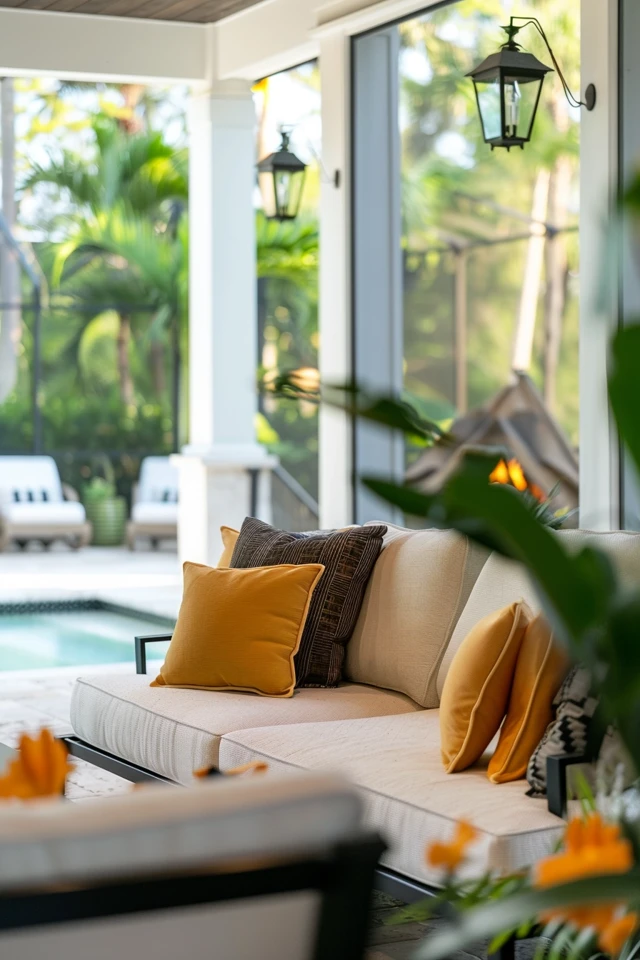
Transform Your Patio with Florida Lanai Ideas
Living in Florida—or just loving that coastal lifestyle—means understanding that the boundary between “indoors” and “outdoors” is meant to be blurred. A true Florida lanai is not just a concrete slab with a couple of folding chairs; it is an architectural extension of your living room. It is a space where you drink your morning coffee, host sweaty summer dinners, and watch the afternoon thunderstorms roll in without getting wet.
I have designed countless lanais, from compact condo balconies in Miami to sprawling screened enclosures in Sarasota. The goal is always the same: create a durable, beautiful room that handles high humidity while looking as polished as your interior. If you are looking for visual inspiration to spark your creativity, make sure to scroll down to the Picture Gallery at the end of the blog post.
Whether you are dealing with a rental unit or planning a full renovation, transforming this space requires a mix of aesthetic vision and practical weatherproofing. Let’s dive into the layouts, materials, and design tricks that turn a basic patio into a luxurious retreat.
1. Layout and Zoning: Treating the Outside Like the Inside
The biggest mistake I see homeowners make is throwing furniture against the walls of the lanai, leaving a vast, empty “dance floor” in the middle. Just like a living room, a lanai needs defined zones. You need to anchor your furniture to create conversation areas rather than a waiting room vibe.
Start by identifying the primary function. If you have a standard 10×12 lanai, you likely have room for one primary zone: either dining or lounging. Don’t try to cram a full dining table and a sectional into a small space; it will feel cluttered and ruin the traffic flow.
If you have a larger space, use the “rug rule” to define zones. I typically place an 8×10 outdoor rug under a seating arrangement and a separate round rug under a bistro set. This visually separates the activities.
Designer Rules of Thumb for Layouts:
- Traffic flow: Keep main walkways at least 30 to 36 inches wide. You never want to turn sideways to shimmy past a chair.
- Door clearance: Ensure your sliding glass doors or French doors can open fully without hitting a piece of furniture. Leave a 3-foot radius clear around the entry.
- Rug sizing: For a seating area, the front legs of the sofa and chairs should sit on the rug. If the rug is floating in the middle with no furniture touching it, it is too small.
2. Flooring Foundations: Comfort Underfoot
Most builder-grade lanais in Florida come with basic concrete slabs. While functional, concrete is prone to cracking and can feel cold and industrial. Covering this surface is the single most impactful change you can make.
For a permanent fix, I often recommend travertine pavers or porcelain tile. Travertine is a natural stone that stays surprisingly cool to the touch, even in the midday Florida sun. Porcelain tile is incredibly durable and non-porous, making it resistant to mold and mildew, which is essential in humid climates.
If you are renting or on a tight budget, interlocking deck tiles are a fantastic solution. These usually come in teak or acacia wood finishes and snap together over existing concrete. They allow water to drain underneath, preventing puddles.
Key Considerations for Flooring:
- Slip resistance: If you choose tile, check the slip rating. You want an R10 or R11 rating for outdoor use. Glossy indoor tile becomes a skating rink when wet.
- Drainage: Ensure your new flooring does not block the weep holes in your screen enclosure. Blocking these causes water to back up toward the house foundation.
- Heat retention: Avoid dark slate or black tiles if the area gets direct afternoon sun. They will become too hot to walk on barefoot.
3. Selecting Furniture That Survives the Humidity
Florida styling is not just about the look; it is about survival. The humidity, salt air (if you are near the coast), and intense UV rays will destroy inferior furniture in a single season.
When I shop for clients, I avoid steel frames unless they are powder-coated and galvanized, as steel rusts quickly. Instead, look for cast aluminum, high-density polyethylene (HDPE) wicker, or teak.
Teak is the gold standard for wood furniture because of its high oil content, which naturally repels water. However, it requires maintenance. You must oil it every 6–12 months to keep the golden color, or let it weather to a silvery gray patina.
The Fabric Factor
The cushion fabric is just as important as the frame. You need solution-dyed acrylic fabrics. In these fabrics, the color goes all the way through the fiber, like a carrot, rather than being printed on top like a radish.
- Foam matters: Ask for “reticulated foam” or “quick-dry foam.” This porous foam allows water to run straight through it, preventing mold growth inside the cushion.
- Cleaning codes: Look for fabrics that are bleach-cleanable. In a lanai environment, you will eventually need to clean off pollen or mildew spots.
- Storage: Even the best furniture lasts longer if covered. I always advise clients to buy custom covers or a deck box for cushions during hurricane season or heavy pollen weeks.
4. Lighting and Airflow: Extending the Usability
A lanai without a fan is practically unusable in August. Air movement is the best natural mosquito repellent and keeps the humidity from feeling oppressive.
When selecting a ceiling fan, size matters. For a standard 12×12 room, look for a fan with a blade span of 52 to 60 inches. You want a “wet-rated” fan if it is exposed to driving rain, or a “damp-rated” fan if it is fully covered by a roof.
Lighting creates the mood. Overhead lighting is often too harsh for evening relaxation. I prefer to layer lighting using portable, rechargeable LED lamps and durable string lights.
Lighting Layers for Atmosphere:
- Ambient: Bistro string lights hung in a zigzag or perimeter pattern. Use “warm white” bulbs (2700K) to avoid a clinical look.
- Task: A rechargeable LED table lamp for reading or dining. These are great because you don’t need to worry about cords tripping people.
- Accent: Solar uplights placed in the corners of the lanai or inside large planters to illuminate foliage at night.
5. Bringing Life with “Softscapes” and Decor
This is the fun part where the room gains personality. Because the architectural elements of a lanai are often hard (concrete, metal, glass), you need “softscapes” to absorb sound and add texture.
Outdoor curtains are a favorite trick of mine. They soften the vertical lines of the screen columns and provide necessary shade when the sun is low in the sky. Make sure to use weighted hems or tie-backs so they don’t flap violently in the wind.
Plants are non-negotiable in a Florida design. They bridge the gap between the structure and the garden. However, screened lanais actually cut out about 30% to 40% of UV light. A plant that loves “full sun” might actually struggle inside a screen if it’s not near the edge.
Top Plants for Screened Lanais:
- Snake Plant (Sansevieria): Indestructible and architectural. Great for modern looks.
- Areca Palm: Adds instant height and tropical volume.
- Bromeliads: Perfect for adding pops of color without needing flowers that require constant deadheading.
- Bird of Paradise: Classic Florida look, but ensure it gets enough light to bloom.
Designer’s Note: The “Threshold” Lesson
Real-world lesson: Early in my career, I designed a beautiful lanai with a thick, plush rug right in front of the sliding door. It looked great, but every time the homeowners went in and out, the rug got caught in the door track or soaked up water from wet shoes.
The Fix: Now, I always leave a “landing pad” of bare floor for the first 3 feet inside the door. If we need a rug there, I use a very flat-weave, washable rug that allows the door to clear it easily. Always measure the clearance between your door bottom and the floor before buying a rug!
Common Mistakes + Fixes
Mistake: Buying indoor throw pillows for outside.
Fix: Indoor pillows will harbor mold spores within weeks because they use cotton fill. Buy outdoor-rated pillow inserts made of polyester fiberfill or hydrophobic material.
Mistake: Ignoring the “Screen Effect.”
Fix: Screens can make a space feel darker than you expect. Paint the back wall of your house (the wall inside the lanai) a lighter color than the rest of the exterior to bounce light around.
Mistake: Undersizing the furniture.
Fix: Outdoor spaces are usually larger in scale than indoor rooms. A dainty bistro set can look lost on a large paver patio. Go for chunky, substantial frames that hold their own visually.
What I’d Do: The Project Mini-Checklist
If I were renovating your lanai tomorrow, this is the order of operations I would follow:
- Measure everything: Sketch the room dimensions, including the location of the door and any fixed columns.
- Power wash: Clean the screens, the floor, and the house wall. A clean slate is essential.
- Define the use: Decide if this is for dining, lounging, or both.
- Select the anchor pieces: Order the sofa or dining table first.
- Plan the lighting: Install the fan and string lights while waiting for furniture delivery.
- Layer the ground: Place the rug once the floor is dry.
- Accessorize: Bring in the plants, pillows, and side tables last.
Frequently Asked Questions
Does adding a lanai increase home value?
Yes, specifically in warm climates. An enclosed, usable outdoor living space is highly desirable. It effectively adds square footage to the home’s “livable” area, even if it isn’t counted in the air-conditioned square footage appraisal.
How do I keep my lanai screens clean?
You don’t need harsh chemicals. I recommend a mixture of warm water and mild dish soap. Use a soft-bristle brush to gently scrub the screens, then rinse with a garden hose on a low setting. Never use a high-pressure washer on screens; it will tear them.
Can I put a TV on my lanai?
Yes, but you have two options. Option one is to buy a specific outdoor-rated TV, which is expensive but durable. Option two is to use a cheaper indoor TV, mount it in a protected corner away from rain, and use a weatherproof cover whenever you aren’t watching it. Just know that humidity will shorten the life of an indoor TV significantly.
Conclusion
Transforming your patio into a functional Florida lanai is about respecting the elements while refusing to sacrifice style. It creates a sanctuary where you can enjoy the sound of the rain or the warmth of the breeze without the annoyance of bugs.
By focusing on durable materials like teak and solution-dyed acrylics, optimizing your layout for flow, and layering in soft lighting, you can build a space that lasts for years. Start with the flooring and the fan, and build your oasis from there.
Picture Gallery


